
BAR-241 · Lesson 10 of 12 · 19 min
Real estate closings, the unauthorized practice of law and South Carolina professional conduct
▶ Video coming soon A video version of this lesson is on the way.
Kinard & Bethea closes about fifteen residential sales and refinances a month, and on Thursdays the conference room fills with buyers, sellers, lenders' packages and a paralegal named Garnett who has been preparing closing documents for nineteen years. On her first Thursday, Lainey asked Ozias Bethea why a lawyer had to be in the room at all. 'In most states, a title company closes the deal,' she said. 'Here it is us.' Bethea smiled. 'In South Carolina, closing a residential real estate loan is the practice of law,' he said. 'And Garnett is very good, but Garnett is not a lawyer. Everything he does, I am responsible for.'
This lesson explains South Carolina's distinctive rule that lawyers must handle key steps in residential real estate transactions, how the Supreme Court has enforced it through the unauthorized practice and discipline rules, and the features of the South Carolina Rules of Professional Conduct and the lawyer's oath that a new lawyer should know from the first day.
Closings as the practice of law
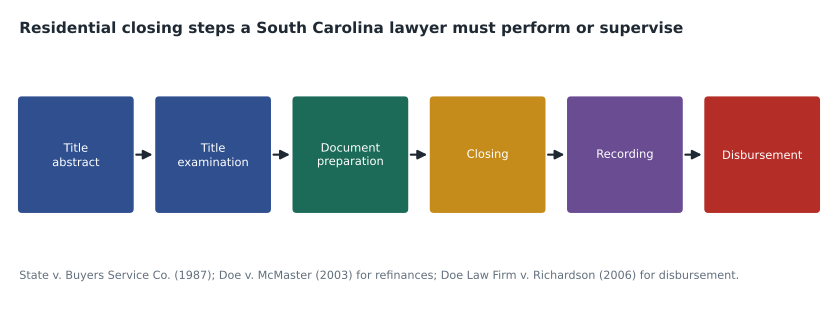
The Supreme Court of South Carolina defines and regulates the practice of law, and it has held that several steps in a residential real estate transaction are the practice of law. The leading case is State v. Buyers Service Co., decided in 1987, in which the Court identified the steps of a residential sale that must be performed or supervised by a lawyer. The steps are commonly listed as abstracting title, preparing the documents, conducting the closing, recording the documents and disbursing the funds.
Later cases extended and refined the rule. In Doe v. McMaster, decided in 2003, the Court held that the same principles apply to refinancing transactions, not just sales. In Doe Law Firm v. Richardson, decided in 2006, the Court held that disbursement of the loan proceeds is an integral part of the transaction and must be performed or supervised by a lawyer, although it did not prescribe a particular form of supervision or require that the funds pass through the lawyer's trust account.
| Step | Lawyer's role | Leading authority |
|---|---|---|
| Title abstract and examination | Perform or supervise | State v. Buyers Service Co. (1987) |
| Preparation of deed, mortgage and loan documents | Perform or supervise | State v. Buyers Service Co. (1987) |
| Closing | Conduct or supervise | State v. Buyers Service Co. (1987); Doe v. McMaster (2003) for refinances |
| Recording | Perform or supervise | State v. Buyers Service Co. (1987) |
| Disbursement of funds | Perform or supervise | Doe Law Firm v. Richardson (2006) |
Supervision means real supervision
The rule is enforced through the discipline system, and the Supreme Court has sanctioned many lawyers who lent their names to closings without supervising them. The South Carolina Bar's Ethics Advisory Committee summarized the cases in an opinion in 2009. Lawyers were sanctioned under Rule 5.5, which forbids assisting the unauthorized practice of law, for failing to review or correct documents, failing to supervise recording and failing to supervise disbursement. In other cases, lawyers were sanctioned for relying on the assurances of nonlawyers that another lawyer was supervising steps the lawyer did not handle.
The lesson drawn from the cases is that supervision means the lawyer actually reviews the work, such as the recorded documents and the disbursement ledger, and corrects errors. A nonlawyer's blanket assurance that everything was done properly is not enough. Rule 5.3 makes a lawyer responsible for a nonlawyer assistant's misconduct when the lawyer orders or ratifies it or, having supervisory authority, fails to take reasonable steps to prevent or correct it.
A lawyer may limit the scope of a representation under Rule 1.2, for example by agreeing only to examine title or only to conduct the closing. That may reduce the lawyer's civil exposure, but the ethics opinion noted that it is not clear a limited engagement avoids responsibility under Rule 5.5 if the lawyer knows other steps are being handled without a lawyer. A lawyer who agrees to do one step should know who is doing the others.
Worked problem
Garnett's closing
On a Thursday in October 2026, Ozias Bethea is in court, and Garnett proposes to conduct a refinance closing himself, with Bethea signing the settlement statement when he returns. The title was examined by Bethea, and Garnett prepared the documents from the firm's templates. Can Garnett close the loan?
Show solution
- A refinance is covered by the same rule as a sale under Doe v. McMaster (2003).
- Conducting the closing is one of the steps that must be performed or supervised by a lawyer.
- Bethea cannot supervise a closing he does not attend or oversee; signing afterward is not supervision.
- Garnett may prepare documents under Bethea's review, but the closing should be rescheduled or handled by another lawyer in the firm.
Answer: Garnett cannot close the loan alone. Lainey, not yet admitted, cannot either. The closing should wait for a lawyer.
The South Carolina Rules of Professional Conduct
The South Carolina Rules of Professional Conduct are found in Rule 407 of the South Carolina Appellate Court Rules. They follow the structure and numbering of the ABA Model Rules, so most of what a candidate learns for the MPRE applies, but South Carolina has its own text in places, and the South Carolina Bar publishes an annotated edition. Lawyer discipline is handled through the Supreme Court's Rules for Lawyer Disciplinary Enforcement, with an Office of Disciplinary Counsel that investigates and prosecutes and a Commission on Lawyer Conduct whose panels hear cases, subject to final decision by the Supreme Court.
Lawyer advertising is one area where South Carolina's text is detailed. South Carolina's Rule 7.2 requires a lawyer to keep a copy or recording of every advertisement or communication for two years after its last dissemination, with a record of when and where it was used, and requires each advertisement to include the name and office address of at least one lawyer responsible for its content. Required disclaimers must be clearly legible and conspicuous: on television they must stay on screen long enough to be read, spoken disclaimers must be plainly audible and website disclaimers must appear on the same page as the statement they qualify.
South Carolina also expects lawyers to know the ethics opinions of the South Carolina Bar's Ethics Advisory Committee, which answer questions about prospective conduct. The opinions are advisory rather than binding, but the closing opinion discussed above shows how useful they can be in summarizing the Court's decisions.
| Topic | Where to find it | What a new lawyer needs to know |
|---|---|---|
| Professional conduct | Rule 407, SCACR | Model Rules structure with South Carolina text |
| Discipline | Rules for Lawyer Disciplinary Enforcement | Office of Disciplinary Counsel investigates; Commission on Lawyer Conduct panels hear; Supreme Court decides |
| Advertising | Rule 7.2 of Rule 407 | Keep copies for two years; name a responsible lawyer; conspicuous disclaimers |
| Residential closings | Buyers Service, McMaster, Richardson; Rules 5.3 and 5.5 | Lawyer must perform or supervise five steps |
| Oath | Rule 402(k) | Includes a civility pledge since 2003 |
The lawyer's oath and civility
Every new South Carolina lawyer takes the oath in Rule 402(k) at the admission ceremony. On October 22, 2003, the Supreme Court amended the oath to add a civility pledge. The amended oath commits the lawyer to opposing parties and their counsel with fairness, integrity and civility, not only in court but also in all written and oral communications. The Court expected all lawyers to take the amended oath, and the pledge has since been cited in discipline cases involving abusive letters and emails. A lawyer's sharp email to opposing counsel is not just bad manners in South Carolina; it can be a breach of the oath.
Trust accounts
Closing practice makes trust accounting central. A lawyer who receives closing funds holds them in trust and must keep them separate from the lawyer's own money, keep detailed records and disburse only as the closing documents provide. South Carolina has detailed financial recordkeeping rules for lawyers in addition to Rule 1.15, and misuse of trust funds is among the most common reasons for serious discipline. Lainey's first assignment on Thursdays was to reconcile the closing ledger with the disbursement checks, under Bethea's eye.
Common mistakes
MistakeA title company can close a South Carolina residential loan without a lawyer.
InsteadUnder Buyers Service and later cases, a lawyer must perform or supervise the key steps.
MistakeRefinances are different from sales.
InsteadDoe v. McMaster (2003) applied the rule to refinances.
MistakeSigning off on a paralegal's closing afterward is supervision.
InsteadSupervision requires actual review and oversight; sanctioned lawyers relied on assurances.
MistakeCivility is aspirational in South Carolina.
InsteadSince October 22, 2003, civility in all communications is part of the lawyer's oath.
Why South Carolina takes this approach
South Carolina's closing rule reflects a judgment by the Supreme Court that residential real estate transactions are among the largest financial decisions most people make and that buyers and borrowers benefit from the involvement of a lawyer who owes them professional duties. In many states, title companies and escrow agents handle closings without lawyers. South Carolina's approach places responsibility on lawyers, which is why the discipline cases focus on lawyers who failed to supervise rather than on the nonlawyers who did the work.
The rule also shapes the state's legal market. Small and medium firms across South Carolina, like Kinard & Bethea, have real estate practices built around residential closings, and many new lawyers' first regular work involves title examinations and closings under supervision. Lenders and title insurers work with closing lawyers rather than around them.
A closing checklist
Ozias Bethea's closing checklist, which Lainey copied into her binder, had a line for each of the five steps and a box for the lawyer's initials. Title: who abstracted it, who examined it, what exceptions remained and how they were cleared. Documents: who prepared them, who reviewed them and what changes were made. Closing: who conducted it, which documents were signed and whether the parties had their questions answered. Recording: when the documents were sent, when they were recorded and whether the recorded copies were reviewed for errors. Disbursement: when funds were received, how they were disbursed, whether the disbursement matched the settlement statement and whether the trust account was reconciled.
The checklist reflected the discipline cases. Each step had a lawyer's name next to it, so no one could later say that someone else was responsible. And each step required the lawyer to look at the work, not just to receive an assurance that it was done.
Unauthorized practice beyond closings
Unauthorized practice issues arise outside real estate too. Nonlawyers may not give legal advice, prepare legal documents for others or represent others in court, with limited exceptions set by the Supreme Court. A lawyer who supervises paralegals and other staff must make sure their work stays within proper bounds and is reviewed. Lainey's own position illustrates the point: until admission, she may research, draft and observe under supervision, but she may not give legal advice to clients or sign pleadings, and after admission, Rule 403 limits her courtroom work until her trial experiences are approved.
Civility in practice
Earline Kinard had a rule for the firm's email: no message to opposing counsel goes out in anger, and any message written after six in the evening is read again in the morning before it is sent. She told Lainey that the oath's civility pledge was the best professional advice she had ever been given in writing. 'Every lawyer in this county will be across from you again,' she said. 'And every judge reads the exhibits.'
Trust accounting and closings together
The connection between closing practice and trust accounting is direct. In a typical closing, the lender wires loan proceeds to the closing lawyer's trust account, the buyer deposits the balance, and the lawyer disburses to the seller, the seller's lender, the real estate agents, the title insurer and the recording office. Every dollar must be traced from receipt to disbursement. A disbursement that does not match the settlement statement, a check written before the funds have cleared or a shortfall covered with another client's money can lead to discipline even if no one loses money in the end.
Bethea's rule for the firm was that the trust account was reconciled every month, that every closing had its own ledger and that no disbursement was made until the incoming wire had been confirmed with the bank. Lainey learned to read a three-way reconciliation, comparing the bank statement, the trust account journal and the client ledgers, before she learned to read a title commitment.
Summary and key terms
- State v. Buyers Service Co. (1987): title abstracting, document preparation, closing, recording and disbursement must be performed or supervised by a lawyer.
- Doe v. McMaster (2003) extended the rule to refinances; Doe Law Firm v. Richardson (2006) confirmed that disbursement is included.
- Lawyers who lend their names without real supervision have been disciplined under Rules 5.3 and 5.5.
- The South Carolina Rules of Professional Conduct are in Rule 407, SCACR, following the Model Rules structure with South Carolina text, including detailed advertising rules.
- The lawyer's oath has included a civility pledge since October 22, 2003.
- 0
- practice of law
- 1
- unauthorized practice of law
- 2
- residential closing
- 3
- disbursement
- 4
- supervision
- 5
- Rule 407
- 6
- civility pledge
- 7
- trust account
Practice problems
Work each problem on paper first, then reveal the answer to check.
Which 1987 case held that key steps in a residential real estate transaction are the practice of law?
Show answer
State v. Buyers Service Co.
Which case extended the rule to refinances?
Show answer
Doe v. McMaster (2003).
How long must a South Carolina lawyer keep a copy of an advertisement?
Show answer
Two years after its last dissemination, with a record of when and where it was used.
What did the October 22, 2003 order add to the lawyer's oath?
Show answer
A pledge of fairness, integrity and civility, not only in court but in all written and oral communications.
Lesson quiz · 5 questions
Score 60% or more to complete this lesson.
Create a free account to save your progress, take quizzes and earn a certificate.