
BAR-241 · Lesson 6 of 12 · 19 min
The Course of Study on South Carolina Law and how South Carolina law appears
▶ Video coming soon A video version of this lesson is on the way.
Lainey's roommate from law school had sat for the bar in a state with its own essay section and spent three weeks memorizing state rules. Lainey expected to do the same. Marchetti told her she would not need to, at least not for the exam. 'South Carolina does not test its own law on the bar exam,' she said. 'It makes you learn it a different way, after you file, through the Course of Study. And on the exam itself, South Carolina law can hurt you if you use it in the wrong place.'
This lesson explains the Course of Study on South Carolina Law, how it fits into the admission timeline, what it covers, and how to keep South Carolina rules out of UBE answers that call for general principles.
The requirement
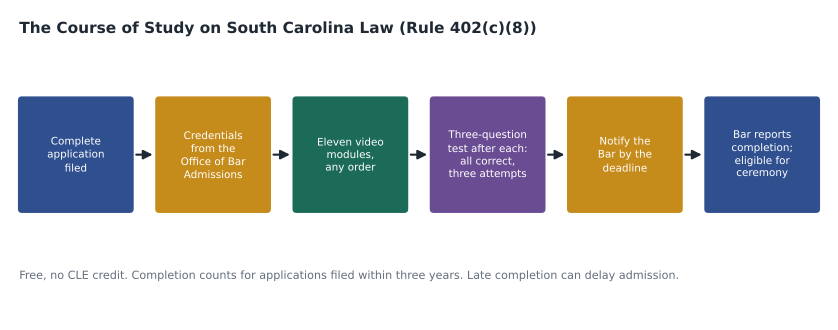
Rule 402(c)(8) requires every applicant for admission under the rule to complete a course of study on South Carolina law. The Board of Law Examiners sets the course's content and method of delivery under Rule 402(k)(3), and the South Carolina Bar administers it. The rule contains three timing provisions. The course cannot be taken before a complete application is filed. Completion counts for any later application filed within three years of completion, so an applicant who completes it and then has to retake the exam does not need to repeat it if the next application comes soon enough. And late completion can delay admission to a later ceremony under Rule 402(h)(2).
NCBE's summary of South Carolina records that South Carolina has a jurisdiction-specific component. Some states satisfy that kind of requirement with a state law exam or an essay on the bar exam itself. South Carolina uses this course instead, which is why there is no South Carolina essay on the UBE.
How the course works
The South Carolina Bar describes the Course of Study as an on-demand online series of eleven video modules designed for candidates for admission. Each module is self-contained, so modules can be watched in any order. The series focuses on how South Carolina law and practice differ from regional, national or federal practice.
After each module, the candidate takes a three-question test of multiple-choice or true-false questions drawn at random from a larger pool. All three must be answered correctly to advance. A candidate gets three attempts per module; after three failures, the candidate must contact the Bar for a new test. There is no charge for the course, and it carries no continuing legal education credit. Candidates access it through the Bar's website using the credentials issued by the Office of Bar Admissions.
When all eleven modules are complete, the candidate must notify the Bar by the deadline the Office of Bar Admissions sets, and the Bar reports completion to the Office. Completion is mandatory before a candidate can be sworn in, and the deadline is tied to the next ceremony.
| Feature | Course of Study on South Carolina Law |
|---|---|
| Rule | Rule 402(c)(8); content set by the Board of Law Examiners under Rule 402(k)(3) |
| Administered by | South Carolina Bar |
| Format | Eleven on-demand video modules, any order |
| Testing | Three random questions after each module; all correct to advance; three attempts |
| Cost and credit | No charge; no CLE credit |
| Earliest start | After a complete application is filed |
| Deadline | Set by the Office of Bar Admissions for each ceremony |
| Validity | Counts for applications filed within three years of completion |
When to take it
The rules allow the course any time after filing, and a candidate who files in August for a February exam could in principle take it in the fall. Marchetti advised against that. 'Your fall belongs to the UBE,' she told Lainey. 'The course is South Carolina law, and you will not be tested on South Carolina law in February. Take it after the exam, while you wait for results, and finish well before the deadline.' Lainey put the course on her calendar for the first two weeks of March 2027.
There is a counterargument, and some candidates choose the other way. A candidate who works in a South Carolina firm during study, as Lainey does, may find the course useful early, because it explains rules she sees at work. The modules are short, and spreading them over a few weekends in the fall costs little. The key point is the deadline: whichever choice a candidate makes, the course must be finished before the ceremony deadline.
How South Carolina law appears on the UBE
The UBE is uniform. The MBE tests generally accepted principles of law and, for procedure and evidence, the Federal Rules of Civil Procedure and the Federal Rules of Evidence. MEE questions are written to be answered under generally applicable principles of law, and where a question needs a particular rule, it usually states which one applies. The MPT supplies its own law. South Carolina law is not tested anywhere on the exam.
That creates a risk for a candidate who works in a South Carolina practice. Lainey sees South Carolina rules at work every day. If an MEE question asks about a matter on which South Carolina differs from the majority rule, writing the South Carolina rule will cost points. The task on the exam is to identify the general rule, apply it and, where a question is ambiguous, note the main alternative.
| Topic | What the UBE tests | South Carolina's rule (for practice, not the exam) |
|---|---|---|
| Civil procedure | Federal Rules of Civil Procedure and federal jurisdiction | South Carolina Rules of Civil Procedure, modeled on the federal rules with state-specific differences |
| Evidence | Federal Rules of Evidence | South Carolina Rules of Evidence, also modeled on the federal rules with differences |
| Comparative fault | General principles; the question usually says which system applies | Modified comparative negligence: plaintiff's fault must not be greater than the defendants' (Nelson v. Concrete Supply Co., 1991) |
| Marriage | Not tested on the MEE since July 2026 | Common-law marriage abolished prospectively in Stone v. Thompson (2019) |
| Residential closings | Not tested | Lawyer must perform or supervise key steps (State v. Buyers Service Co., 1987) |
Worked problem
A comparative fault essay
An MEE torts question describes a pedestrian struck by a car in a jurisdiction that "follows modified comparative negligence." The pedestrian was 40 percent at fault and the driver 60 percent. Lainey knows the South Carolina rule. How should she answer?
Show solution
- Identify the issue: the effect of the plaintiff's fault on recovery.
- State the general rule the question gives: under modified comparative negligence, a plaintiff whose fault does not exceed the defendant's (or, in some versions, is less than the defendant's) recovers damages reduced by the plaintiff's share.
- Apply it: 40 percent is less than 60 percent under either version, so the pedestrian recovers 60 percent of the damages.
- Do not cite South Carolina cases or statutes; the exam does not ask for them.
Answer: The pedestrian recovers 60 percent of the damages. The answer happens to match South Carolina law, but it rests on the rule the question gives.
Where the course and the exam meet
The exam and the course test different things on purpose. The exam asks whether the candidate has the general knowledge and skills of a new lawyer anywhere. The course asks whether the candidate knows the places where South Carolina practice is different. Lessons 7 through 10 of this course follow that idea: they explain South Carolina's courts and procedure, torts, family law and real estate and professional conduct rules, which matter for practice and for the Course of Study, while Lessons 4 and 12 keep the focus on the UBE.
Common mistakes
MistakeThere is a South Carolina essay on the bar exam.
InsteadSouth Carolina has no state essay; it requires the Course of Study instead.
MistakeI can do the Course of Study during law school.
InsteadIt cannot be taken until a complete application is filed.
MistakeThe Course of Study earns CLE credit.
InsteadIt carries no CLE credit; the Essentials course after admission is a separate requirement.
MistakeI should write South Carolina rules on the MEE because I will practice there.
InsteadThe MEE asks for generally applicable principles; South Carolina rules can cost points.
Why South Carolina uses a course
States that adopt the UBE face a choice about local law. Some add a state law exam or an online test to the UBE; some require a course; a few require nothing. A course has advantages. It does not add a graded component that could cause a candidate who passed the UBE to fail admission, it can be taken at the candidate's pace, and it can focus on the practical differences a new lawyer needs rather than the doctrinal detail a written exam tends to test. Its short tests make sure the candidate watched and understood each module without turning the course into a second bar exam.
For South Carolina, a course also fits the way new lawyers learn local practice. The rules that most often trip up new lawyers are not exotic doctrines but practical differences: who handles a real estate closing, what a new lawyer may do in court before completing the trial experiences, how the state's courts are organized and where its procedure differs from the federal rules. Those are the kinds of topics a short video can explain well.
Making the course useful
Marchetti suggested that Lainey treat the course as more than a box to check. She would keep a notebook while watching, writing down each South Carolina rule that differed from what she had learned for the UBE, with a note about where it would matter in practice. Lainey's firm work gave her a head start: by November she already had entries for residential closings, the Family Court's jurisdiction, the Tort Claims Act and the civility pledge in the lawyer's oath. The Course of Study would fill in others.
She also planned to pair the course with the Essentials course that she would take after admission under Rule 408. The Course of Study introduces South Carolina differences before admission; the Essentials course builds on them in the first required reporting year. Together they are South Carolina's way of teaching new lawyers the state's practice, since the bar exam itself does not.
The danger of mixing systems
The bigger risk for a candidate who works in South Carolina practice during bar study is mixing the general rules with the local ones. Lainey noticed it on her first practice MEE torts essay, when she started to write that a defendant less than 50 percent at fault was liable only for its own share. That is South Carolina's statute. The essay question had not mentioned joint and several liability rules at all, and the general approach in many jurisdictions differs. Marchetti's fix was simple: when an MEE question does not give a rule, write the majority or general rule and, if there is a well-known alternative, mention it in one sentence. Never write a rule because it is the one used in your office.
The reverse risk matters after admission. A new lawyer who learned the general rule for the UBE may apply it in a South Carolina case where state law differs. The Course of Study and the Essentials course are designed to prevent that, and so is the habit Marchetti recommends to every new lawyer: before advising a client on any issue, look up the South Carolina authority, even if you are sure you know the answer.
When to take the course: Lainey's decision
In the end Lainey chose to watch two modules in December, during a week when the firm was closed for the holidays and she needed a break from MBE questions. She found them useful and short. She left the remaining nine for March, after the exam, as Marchetti had suggested, and put the Office of Bar Admissions' deadline in her calendar with a reminder two weeks earlier.
A short list of South Carolina differences
By the end of the course, Lainey's notebook had a page titled 'Not on the UBE, but on my desk.' It listed the modified comparative negligence rule from Nelson, the 50 percent threshold for joint and several liability, the Tort Claims Act limits, the one-year separation ground for divorce, the end of common-law marriage in 2019, the lawyer-supervised closing rule, the civility pledge and the Rule 403 trial experiences. Each line had a citation and a note about the file where she had first seen it.
Summary and key terms
- Rule 402(c)(8) requires the Course of Study on South Carolina Law before admission.
- The course is eleven online video modules with three-question tests, free and without CLE credit, administered by the South Carolina Bar.
- It may be taken only after a complete application is filed and counts for applications filed within three years.
- The UBE tests general principles and federal rules; South Carolina law is not on the exam.
- Keep South Carolina rules out of MEE answers unless the question asks for them.
- 0
- Course of Study
- 1
- jurisdiction-specific component
- 2
- module
- 3
- generally applicable principles
- 4
- majority rule
- 5
- South Carolina Rules of Civil Procedure
- 6
- South Carolina Rules of Evidence
- 7
- completion deadline
Practice problems
Work each problem on paper first, then reveal the answer to check.
How many video modules are in the Course of Study?
Show answer
Eleven.
What must a candidate do to advance past a module?
Show answer
Answer all three test questions correctly, with up to three attempts.
Does the Course of Study carry CLE credit?
Show answer
No.
On the MEE, should a candidate apply the South Carolina Rules of Civil Procedure?
Show answer
No. The UBE tests the Federal Rules of Civil Procedure and general principles.
Lesson quiz · 5 questions
Score 60% or more to complete this lesson.
Create a free account to save your progress, take quizzes and earn a certificate.