
BAR-241 · Lesson 2 of 12 · 19 min
Eligibility, education, deadlines and fees
▶ Video coming soon A video version of this lesson is on the way.
Lainey's classmate Lamarr had planned to file for the February 2027 exam over Labor Day weekend. On September 2 he texted Lainey a screenshot of the fee page with three exclamation points. He had missed the end of the lower-fee period by two days. His application would still be accepted, but it would cost him 500 dollars more. Lainey had filed on August 20, but the screenshot sent her back to Rule 402 to make sure there was nothing else she had missed.
Marchetti used Lamarr's text to open the session. 'South Carolina's windows are short and its fees are tied to dates,' she said. 'This lesson is the boring one, and it is the one that costs people money and months.'
This lesson covers the age and education requirements, the rules for sitting before graduation, the application windows and fees, the duty to keep an application current, the limit on repeated attempts and what happens when an applicant is not admitted promptly after qualifying.
Age and education
Rule 402(c) requires an applicant to be at least twenty-one years old and to hold a J.D. or LL.B. from a law school approved by the American Bar Association. NCBE's summary of South Carolina confirms that an ABA-approved J.D. is required and that foreign law graduates are not eligible, even with an American LL.M. South Carolina does not offer a separate attorneys' examination for experienced lawyers from other states; they take the same UBE or transfer a score.
The ABA approval requirement is strict. A degree from a state-accredited school that is not ABA-approved does not qualify, and neither does a degree from a school outside the United States, however long the applicant has practiced there. For the transferred-score route, the Office of Bar Admissions states that the law school must have been ABA-approved at the time the degree was conferred.
Sitting before graduation
Most applicants graduate in May and sit in July, and most of the rest graduate in December and sit in February. Rule 402(c)(3) addresses the timing. An applicant who cannot show proof of graduation by July 10 for the July exam or February 10 for the February exam may not sit. There is one exception: if the law school certifies in writing that the applicant has completed all requirements for graduation, the applicant may sit, but proof of graduation must then be provided by April 1 after a February exam or October 1 after a July exam.
The certification exception helps students whose schools confer degrees on a fixed schedule after coursework ends. It does not help a student who still has a course to finish when the exam is given. Lainey had graduated in May 2026, so the rule did not affect her, but two people in her Tuesday group had December graduation dates and needed their schools' certifications.
The application windows
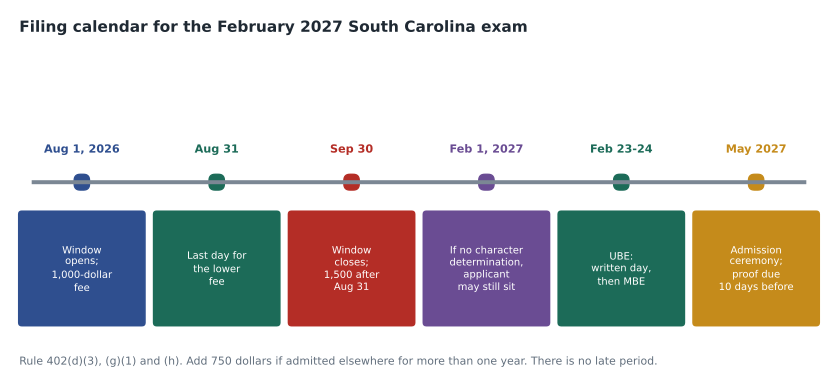
Rule 402(d)(3) sets fixed windows for applicants who will take the UBE in South Carolina. For the February exam, applications are accepted from August 1 through September 30. For the July exam, they are accepted from December 1 through January 31. Within each window there is a lower-fee period: August 1 through August 31 for February and December 1 through January 10 for July.
| Exam | Window opens | Lower fee through | Window closes |
|---|---|---|---|
| February | August 1 | August 31 | September 30 |
| July | December 1 | January 10 | January 31 |
There is no late period after the window closes. An applicant who misses September 30 cannot take the February exam in South Carolina and must wait for the July window. That is why Marchetti told Lainey to treat the lower-fee date as the real deadline: it builds in a month of margin for problems with transcripts, payment or the online system.
Applications based on an existing UBE score, discussed in Lesson 11, have no filing window. They may be filed at any time, because the applicant is not seeking a seat at an exam.
Fees
The application fee for the UBE in South Carolina is 1,000 dollars if the application is filed in the lower-fee period and 1,500 dollars if filed later in the window. An applicant who has been admitted in another jurisdiction for more than one year pays an additional 750 dollars, which reflects the extra work of reviewing a practicing lawyer's record. The fee is non-refundable. NCBE's summary also lists a separate laptop fee of 125.50 dollars for applicants who use a laptop for the written portions.
| Item | Amount (dollars) |
|---|---|
| UBE application, lower-fee period | 1,000 |
| UBE application, rest of the window | 1,500 |
| Additional fee if admitted elsewhere more than one year | 750 |
| Laptop fee, if used (NCBE summary) | 125.50 |
| Provisional application for a law student with a possible character issue | 100 |
| Supplemental application if not admitted within one year | 250 |
| Admission fee at the ceremony | 50 |
Worked problem
Lamarr's fee
Lamarr graduated in May 2026, has never been admitted anywhere and filed for the February 2027 exam on September 2, 2026. He plans to use a laptop. What does he pay, and could he still sit if he had filed on October 2?
Show solution
- September 2 is after the August 31 lower-fee date but before the September 30 close, so the fee is 1,500 dollars.
- He is not a practicing lawyer elsewhere, so the 750-dollar addition does not apply.
- If he uses a laptop, NCBE's summary lists a separate 125.50-dollar fee.
- An October 2 filing would be outside the window, which closes September 30, and there is no late period.
Answer: Lamarr pays 1,500 dollars plus the laptop fee. An October filing would have pushed him to July 2027.
Keeping the application current
Under Rule 402(d)(5), an applicant must keep the application current until admitted, filing updates when information changes. A move, a new job, a traffic charge, a civil suit or a change in a disclosed matter must be reported. Character and fitness panels take a dim view of an applicant who lets the file go stale, because the duty to update is the first professional duty of candor the applicant owes the Court. Lainey moved apartments in October 2026, within Florence, and filed the update the same week.
The limit on repeated attempts
Rule 402(d)(4) addresses repeated failure. After three or more non-qualifying results on the bar examination, an applicant may not sit for the UBE in South Carolina until one year after the most recent non-qualifying exam. It is not a permanent bar, but it forces a pause. An applicant who fails in February, July and the following February would have to skip the next July exam and wait until the February a year after the third failure.
The rule also requires an applicant taking the UBE in South Carolina to sit for all portions in South Carolina at the same administration. Scores from an earlier exam cannot be combined with scores from a later one to reach 266. This differs from some non-UBE jurisdictions that once allowed applicants to carry forward a passing section.
When admission is delayed
Rule 402(i) deals with applicants who qualify but are not promptly admitted. If an applicant is not admitted within one year after notice of a qualifying UBE score, the applicant must file a supplemental application with a 250-dollar fee, and the Committee on Character and Fitness must make a new determination. If the applicant is not admitted within two years, the application is treated as withdrawn. A candidate who passes and then takes a job out of state should therefore plan the South Carolina ceremony rather than leave it for later.
Special cases
Rule 402(g)(2) lets a law student who believes there may be a character problem file a provisional application for a 100-dollar non-refundable fee, to get an early answer. That route is discussed in Lesson 3. Rule 402(j) allows certain deans and tenured professors at the University of South Carolina School of Law and the Charleston School of Law to be admitted without the UBE score, MPRE score or Course of Study, if they meet the conditions in that subsection. It is a narrow route that most candidates will never use, but it appears on lists of South Carolina rules and is worth recognizing.
Common mistakes
MistakeThere is a late filing period after September 30 for the February exam.
InsteadThe window closes September 30; there is no late period. The higher fee applies after August 31.
MistakeA foreign lawyer with an American LL.M. can sit in South Carolina.
InsteadAn ABA-approved J.D. or LL.B. is required; foreign graduates are not eligible.
MistakeI can combine my MBE score from July with my written score from February.
InsteadAll portions must be taken at the same South Carolina administration.
MistakeAfter three failures I am barred for life.
InsteadRule 402(d)(4) requires a one-year wait after the most recent non-qualifying exam.
Building a filing checklist
After Lamarr's text, Marchetti and Lainey built a checklist that every member of the Tuesday group could use, whatever the jurisdiction. The first column listed the document, the second the source, the third the deadline and the fourth the date the item was done. For South Carolina, the list began with the application itself, filed through the Office of Bar Admissions' online system during the window. Next came the fee, paid at the same time, at the amount that matched the filing date. Then the law school's proof of graduation or certification, the MPRE score report, and any court or employment records needed to support the character and fitness disclosures.
The checklist also listed the items that come later. After filing, the applicant receives credentials for the Course of Study. Before the exam, the applicant receives the Office's instructions about location, check-in and permitted items. After the exam, the applicant receives results and, if successful, the deadline for proof of the remaining requirements before the ceremony. Lainey kept a copy of every confirmation email in a folder named for the rule that required it.
Payment and records
Marchetti's other advice was about money and records. The application fee is non-refundable, so an applicant who is unsure whether to sit in February or July should decide before paying. Applicants should keep receipts for every payment, because a disputed payment can delay a file at the worst possible time. And applicants should keep a copy of the complete application as filed, because Rule 402(d)(5) requires updates when information changes, and an applicant cannot update accurately without knowing exactly what was said the first time.
When something goes wrong
Problems happen. A transcript is sent to the wrong office, a payment fails, a school's certification arrives late, or the online system rejects an upload. The lesson Marchetti drew from years of watching candidates is that problems should be raised early and in writing. An applicant who emails the Office of Bar Admissions in August about a transcript problem has time to fix it. An applicant who discovers the problem in February may not. Every call should be followed by a short email confirming what was said.
Lamarr took the advice. He paid the higher fee, set up his checklist and asked his law school to send its certification of his December graduation as soon as the registrar could. By the end of September his file was complete. 'Five hundred dollars for a lesson,' he told the group. 'At least I only paid it once.'
Planning for the possibility of a retake
Marchetti also asked each member to think about the July window before February. No one wants to plan for failing, but the July window opens on December 1 and closes on January 31, before February results are released. A candidate who fails in February therefore cannot file for July after seeing the results; the window will already have closed. That is a real cost of South Carolina's calendar. A February candidate who fails waits for the August window and the following February exam, unless the candidate sits in another UBE jurisdiction whose deadlines are later and transfers the score.
The point, Marchetti said, was not to frighten anyone but to show that each attempt is expensive in time. Preparation for February should be complete enough that there is no retake to plan.
Lainey added one more line to her own checklist: the date the Office of Bar Admissions confirmed her application was complete. Until that confirmation arrived, she treated the file as open.
Summary and key terms
- Applicants must be twenty-one and hold an ABA-approved J.D. or LL.B.; foreign graduates are not eligible.
- Graduation proof is due July 10 or February 10, with a law school certification exception and later proof deadlines.
- The February window runs August 1 to September 30 and the July window December 1 to January 31, with lower fees through August 31 and January 10.
- Fees are 1,000 or 1,500 dollars, plus 750 for lawyers admitted elsewhere more than a year.
- Applications must be kept current; three non-qualifying results trigger a one-year wait; admission must follow within one year or a supplemental application is needed.
- 0
- application window
- 1
- lower-fee period
- 2
- ABA-approved law school
- 3
- certification of completion
- 4
- duty to update
- 5
- non-qualifying result
- 6
- supplemental application
- 7
- provisional application
Practice problems
Work each problem on paper first, then reveal the answer to check.
What is the last day to file for the February exam in South Carolina?
Show answer
September 30, with the higher fee after August 31.
What is the fee for a first-time applicant who files on August 15 and has never been admitted elsewhere?
Show answer
1,000 dollars.
When must a February examinee who sat on a law school certification provide proof of graduation?
Show answer
By April 1 after the exam.
What happens if a qualified applicant is not admitted within two years?
Show answer
The application is treated as withdrawn.
Lesson quiz · 5 questions
Score 60% or more to complete this lesson.
Create a free account to save your progress, take quizzes and earn a certificate.