
BAR-241 · Lesson 12 of 12 · 17 min
Capstone: South Carolina practice questions and an exam-day plan
▶ Video coming soon A video version of this lesson is on the way.
In mid-November 2026, Marchetti asked Lainey to spend a Saturday morning on a long session. The first half would be problems: one in the style of the UBE, testing general law, and three on South Carolina law of the kind she would meet in practice and in the Course of Study. The second half would be planning: the weeks before the exam, the two exam days and the weeks after. 'By the end of today,' Marchetti said, 'I want you to know how you will spend every day between now and your swearing-in.'
This lesson works through those problems in a structured way, then sets out the plan. The problems are original hypotheticals written for this course; none is a released bar exam question.
How to answer a problem
Every answer in this lesson follows the same structure, which works on the MEE and in an office memo. Identify the issue. State the rule. Apply the rule to the facts, using the facts rather than restating them. Conclude. Where the facts are ambiguous, say so and explain how the answer changes. On the MEE, the rule is the generally applicable rule. In the South Carolina problems, the rule is South Carolina's.
Problem 1: a UBE-style torts and procedure question
Facts: Hollin, a citizen of Georgia, was injured when a ladder manufactured by Brightrung Corp., incorporated and headquartered in Ohio, collapsed while he was painting a house in Georgia. He sues Brightrung in federal court in Georgia for 140,000 dollars, alleging negligence and strict products liability. Brightrung answers that Hollin was standing on the top step, which a warning label told users not to do, and moves to dismiss for lack of subject matter jurisdiction, arguing that the case belongs in state court. The jurisdiction follows modified comparative negligence of the 'not greater than' type. The jury finds Hollin's damages are 140,000 dollars, Hollin 30 percent at fault and Brightrung 70 percent at fault.
Issue one: does the federal court have subject matter jurisdiction? Rule: federal diversity jurisdiction requires complete diversity of citizenship and an amount in controversy exceeding 75,000 dollars. A corporation is a citizen of its state of incorporation and the state of its principal place of business. Application: Hollin is a citizen of Georgia; Brightrung is a citizen of Ohio only. The amount claimed is 140,000 dollars. Conclusion: the court has diversity jurisdiction, and the motion should be denied.
Issue two: what is the effect of Hollin's fault? Rule: under the modified comparative negligence rule the question supplies, a plaintiff whose fault is not greater than the defendant's recovers damages reduced by the plaintiff's share. Application: Hollin's 30 percent is not greater than Brightrung's 70 percent. Conclusion: Hollin recovers 70 percent of 140,000 dollars, or 98,000 dollars. A good answer notes that in a strict products liability claim some jurisdictions treat the plaintiff's misuse or assumption of risk differently, and that the answer could change if the warning made the misuse unforeseeable.
Observe what the answer does not do: it does not cite Nelson v. Concrete Supply Co. or South Carolina's statutes. The question gave the rule, and the UBE tests general principles.
Problem 2: South Carolina torts
Facts: On March 6, 2026, Annalee Ravenel was driving on a county road in Darlington County when a county road maintenance truck pulled out of a gravel lot without stopping and struck her car. A few seconds later, a sedan driven by Clint Hutto, who had been drinking for two hours at a licensed bar in Hartsville, struck her from behind. Hutto was charged with driving under the influence. Annalee's damages are 1,000,000 dollars. Assume a jury finds the county 40 percent at fault, Hutto 50 percent and Annalee 10 percent, and finds the bar liable to her as well.
Issue one: does Act 42 apply? Rule: Act No. 42 applies to causes of action or claims arising or accruing after January 1, 2026. Application: the crash was on March 6, 2026. Conclusion: Act 42 applies, including its nonparty and licensee provisions.
Issue two: what can Annalee recover against the county? Rule: under Nelson, Annalee recovers if her negligence is not greater than the combined negligence of the defendants, reduced by her share; under Section 15-38-15, a defendant less than 50 percent at fault is liable only for its own share; under Section 15-78-120, no person may recover more than 300,000 dollars from a governmental entity for a single occurrence, and punitive damages and prejudgment interest are barred. Application: Annalee's 10 percent is not greater than 90 percent, so her total recovery is 900,000 dollars. The county's 40 percent share is 400,000 dollars, but its liability is several only, and the Tort Claims Act limits her recovery from it to 300,000 dollars. Conclusion: Annalee can recover 300,000 dollars from the county.
Issue three: what about Hutto and the bar? Rule: a defendant at 50 percent or more is jointly and severally liable; under Section 61-2-147, when verdicts are rendered against both a licensee and a defendant charged under the listed traffic statutes, the licensee is jointly and severally liable for 50 percent of the plaintiff's actual damages. Application: Hutto, at 50 percent, is jointly and severally liable for the full 900,000 dollars. The bar is liable for 50 percent of her actual damages. Conclusion: Annalee can pursue Hutto for the balance and the bar for its statutory share; the precise interaction of the licensee rule with the comparative fault reduction is a question a careful memo should flag for research in the enacted text.
Issue four: procedure. Annalee may file a verified claim with the county within one year after the loss was or should have been discovered and then sue within three years, or sue within two years without filing the claim. Either way, the suit is brought in circuit court in Darlington County, and the jury must return a special verdict allocating liability among the county and the other defendants.
Problem 3: South Carolina family law
Facts: Rhetta and Thad Lyles married in 2005 and separated on October 1, 2025. Thad inherited a lake cabin from his grandmother in 2016 and spent many weekends with Rhetta renovating it, using money from their joint account. In 2020 Rhetta gave Thad a bass boat for his birthday. Rhetta wants a divorce as soon as possible. Separately, Rhetta's sister Pearline has lived with a man since 2014; they call each other husband and wife, file taxes separately and never married. He has just died.
Issue one: when can Rhetta divorce, and on what ground? Rule: Section 20-3-10 allows divorce after living separate and apart without cohabitation for one year, or on a fault ground; residency is one year, or three months if both are residents. Application: if Rhetta and Thad have not cohabited since October 1, 2025, she can file on the no-fault ground after October 1, 2026, and both are residents. Conclusion: Rhetta may file now on the one-year separation ground; absent evidence of a fault ground, that is her route.
Issue two: are the cabin and the boat marital? Rule: property inherited from a third party is nonmarital, but its increase in value is marital to the extent the other spouse's efforts during the marriage contributed to it; gifts between spouses are marital. Application: the cabin is Thad's nonmarital property, but Rhetta's work and the use of joint funds may make some of its increase in value marital; the boat was a gift from Rhetta to Thad and is marital. Conclusion: the boat is marital; the cabin is nonmarital except for any increase in value attributable to Rhetta's efforts and marital funds, which the court can apportion under the fifteen factors.
Issue three: was Pearline married? Rule: under Stone v. Thompson (2019), no common-law marriage may be formed after July 24, 2019, but one formed before then remains valid if proved by clear and convincing evidence of mutual assent; there is no presumption from cohabitation and reputation. Application: Pearline and her partner began living together in 2014, so a marriage could have formed before 2019. Calling each other husband and wife helps; filing separately cuts the other way. Conclusion: Pearline has a claim but a difficult one, and the outcome will turn on documents and witnesses showing what both intended.
Problem 4: a closing
Facts: A lender asks Kinard & Bethea to close a refinance on a Friday afternoon. Ozias Bethea examined title and reviewed the documents, but he will be at a deposition all afternoon. The lender suggests that its notary conduct the closing and that Bethea review the disbursement on Monday. Rule: under State v. Buyers Service Co. (1987) and Doe v. McMaster (2003), conducting the closing of a residential refinance is the practice of law that a lawyer must perform or supervise; under Doe Law Firm v. Richardson (2006), disbursement is included. Application: the notary is not a lawyer, Bethea will not be supervising the closing and reviewing disbursement after the fact is not supervision. Conclusion: the firm should decline or reschedule, or have another lawyer conduct the closing.
The plan: the last weeks
Marchetti's plan for the final twelve weeks before February 23 has three phases. Through the end of December, Lainey finishes her first pass through all MBE subjects and writes two MEE essays and one MPT a week. In January, she shifts to mixed practice: timed sets of MBE questions across all subjects every day, three essays a week and a full simulated exam every other Saturday. In the final two weeks, she does lighter review, focusing on her miss log, rules outlines and two last timed MPTs. She takes leave from the firm for the last ten days, as Earline Kinard had promised.
The plan: the two days
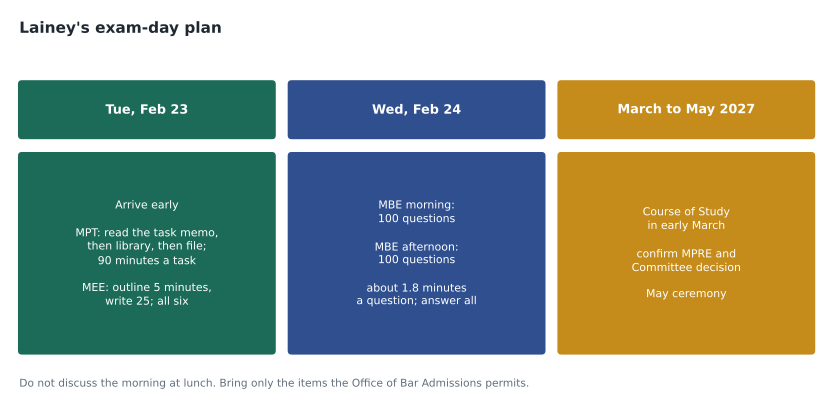
On Tuesday, February 23, 2027, the written day, Lainey will arrive early with her admission ticket, identification and permitted items in the format the Office of Bar Admissions specifies, and her laptop with the exam software installed and tested. In the MPT she will read the task memo first, then the library, then the file, and outline before writing, giving each task ninety minutes. In the MEE she will spend about five minutes outlining each thirty-minute answer and never skip a question. At lunch she will not discuss the morning. On Wednesday, February 24, the MBE day, she will pace herself at about 1.8 minutes per question, mark questions to revisit and fill in an answer for every question before time runs out.
The plan: after the exam
The weeks after the exam belong to the admission requirements that remain. In the first half of March 2027, Lainey will complete the Course of Study on South Carolina Law and notify the Bar. She will check that her MPRE score of 91 is on file, update her application for any changes and watch for the Office of Bar Admissions' letter with the deadline for the May ceremony. After admission she will file her Rule 403 certificate once the experiences are complete and put the Essentials course on her calendar for her first required CLE year, which begins March 1, 2028.
| When | Task | Rule |
|---|---|---|
| February 23 and 24, 2027 | Sit the UBE; 266 needed | Rule 402(c)(5) |
| March 2027 | Complete the Course of Study and notify the Bar | Rule 402(c)(8) |
| Before the May ceremony deadline | Confirm MPRE score and Committee determination; file updates | Rule 402(c)(6), (d)(5), (g) |
| May 2027 | Take the oath; pay the 50-dollar admission fee; join the South Carolina Bar | Rule 402(h)(3) |
| Spring and summer 2027 | Complete and file the Rule 403 experiences | Rule 403 |
| March 1, 2028 to February 28, 2029 | First required CLE year, including the Essentials course | Rule 408 |
Common mistakes
MistakeCiting South Carolina law on the MEE shows extra knowledge.
InsteadThe MEE tests general principles; use the rule the question gives.
MistakeA governmental defendant 40 percent at fault pays its full share no matter how large.
InsteadThe Tort Claims Act limits recovery to 300,000 dollars per person for a single occurrence.
MistakeAn inherited cabin becomes marital if the spouses use it.
InsteadIt stays nonmarital, but increases in value from the other spouse's efforts or marital funds can be apportioned.
MistakeThe Course of Study can wait until after the ceremony.
InsteadIt must be finished before the ceremony deadline.
The night before
Marchetti's last piece of advice was about the night before each exam day. Lay out the admission materials, identification and permitted items. Charge and test the laptop. Plan the route and parking, and leave time for traffic. Eat a normal dinner. Do not study new material; a light review of a one-page outline is enough. Go to bed at a normal time. 'Nothing you learn on Monday night will be worth the sleep it costs,' she said.
Summary and key terms
- Answer every problem with issue, rule, application and conclusion, using the general rule on the MEE and South Carolina law in practice.
- Problem 2 combined Nelson, Section 15-38-15, Act 42 and the Tort Claims Act limits.
- Problem 3 combined the one-year separation ground, nonmarital property rules and Stone v. Thompson.
- Problem 4 applied Buyers Service, McMaster and Richardson to a refinance closing.
- The plan covers twelve weeks of study, the two exam days on February 23 and 24, 2027 and the admission tasks that follow.
- 0
- IRAC
- 1
- diversity jurisdiction
- 2
- several liability
- 3
- special verdict
- 4
- nonmarital property
- 5
- mutual assent
- 6
- miss log
- 7
- exam-day plan
Practice problems
Work each problem on paper first, then reveal the answer to check.
In Problem 2, how much can Annalee recover from the county?
Show answer
300,000 dollars, the Tort Claims Act limit per person for a single occurrence.
In Problem 3, is the bass boat marital property?
Show answer
Yes. It was a gift from one spouse to the other.
In Problem 1, what does Hollin recover?
Show answer
98,000 dollars: 70 percent of 140,000 dollars.
When will Lainey complete the Course of Study?
Show answer
In the first half of March 2027, after the exam and before the May ceremony deadline.
Lesson quiz · 5 questions
Score 60% or more to complete this lesson.
Create a free account to save your progress, take quizzes and earn a certificate.