
BAR-241 · Lesson 4 of 12 · 19 min
The South Carolina UBE: format, scoring and the 266 passing score
▶ Video coming soon A video version of this lesson is on the way.
Lainey's diagnostic MBE in early October came back with a raw score of 58 percent. She texted Marchetti a photo of the report with one word: 'Doomed?' Marchetti called her instead of texting back. 'No,' she said. 'You are in October. You have no idea yet how that turns into a scaled score, and you do not know how your writing will help you. Before we talk about studying harder, let us talk about how the exam is scored. It will change how you study.'
This lesson explains what South Carolina gives on its bar exam, how the three components are weighted and scaled, what 266 means and what it does not mean, and how the two days in February work.
South Carolina and the UBE
South Carolina adopted the Uniform Bar Examination and first gave it in February 2017. NCBE's summary of South Carolina lists the UBE as its exam, with the MBE, MEE and MPT making up the UBE and the MPRE required separately. South Carolina has no separate state law essay on the exam. Instead, applicants must complete the Course of Study on South Carolina Law, covered in Lesson 6. Rule 402(c)(5) requires a UBE score of 266 or higher.
Because the exam is uniform, an applicant who sits in South Carolina takes the same MBE, MEE and MPT as applicants in other UBE jurisdictions on the same days. The MBE is graded by NCBE. The MEE and MPT answers are graded in South Carolina, using NCBE's grading materials and grader training, and the written scores are then scaled to the MBE, so a South Carolina score means the same thing as the same score anywhere else.
The three components
The Multistate Bar Examination is a 200-question multiple-choice exam given in two three-hour sessions. Of the 200 questions, 175 are scored and 25 are unscored pretest questions that look like the others. The scored questions cover seven subjects: civil procedure, constitutional law, contracts, criminal law and procedure, evidence, real property and torts.
The Multistate Essay Examination has six thirty-minute essay questions, written in a single three-hour session. Since July 2026, the MEE covers business associations (agency and partnership, corporations and limited liability companies), civil procedure, constitutional law, contracts including Article 2 of the Uniform Commercial Code, criminal law and procedure, evidence, real property and torts. Starting with that exam, NCBE removed conflict of laws, family law, trusts and estates and secured transactions from the MEE.
The Multistate Performance Test has two ninety-minute tasks. Each gives the applicant a file of facts and a library of legal authorities and asks for a lawyering product such as a memo, a brief, a letter to a client or a set of interrogatories. The MPT tests skills rather than memorized law: the applicant is expected to use only the law in the library.
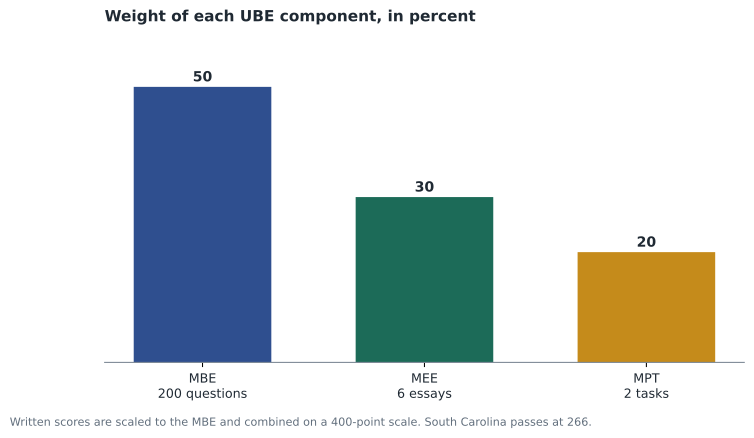
| Component | Format | Time | Weight |
|---|---|---|---|
| MPT | Two performance tasks | Two 90-minute tasks (3 hours) | 20 percent |
| MEE | Six essay questions | Six 30-minute questions (3 hours) | 30 percent |
| MBE | 200 multiple-choice questions (175 scored) | Two 3-hour sessions | 50 percent |
How the score is built
The UBE score is reported on a 400-point scale. The MBE score is converted to a scaled score through a process called equating, which adjusts for differences in difficulty between exams given at different times. The MEE and MPT answers are graded on a raw scale, combined according to their weights and then scaled to the MBE. Scaling means that the written scores are placed on the same distribution as the MBE scores of the same group of applicants, so that a strong writer's position in the group is reflected in points comparable to MBE points.
Two consequences follow. First, the written portion counts for half the score, so an applicant who writes well can make up for a weaker MBE, and the reverse. Second, raw percentages do not translate directly into scaled scores. A 58 percent raw score on a practice MBE may produce a scaled score near the passing range or well below it, depending on the difficulty of the questions and the scale. Marchetti tells candidates to track trends in practice scores rather than fixate on single numbers.
What 266 means
South Carolina's passing score is 266 on the 400-point scale. That is roughly the same as an average of 133 on each half of the score: the MBE half and the written half. It is a total, not a set of minimums. An applicant does not need to pass each component separately.
Each UBE jurisdiction chooses its own passing score, and the choices vary. Among the jurisdictions in Lainey's study group, Missouri uses 260 and Montana 266, while New Hampshire and Nebraska use 270. Because South Carolina's score is at the middle of the range, a score that passes in South Carolina may not transfer to a jurisdiction with a higher requirement, and a score that misses in South Carolina may still be enough elsewhere.
Worked problem
Will Lainey pass?
In late January 2027, Lainey's practice results suggest a scaled MBE of about 138 and a scaled written score of about 130. Estimate her UBE score and compare it with 266.
Show solution
- The UBE total is roughly the scaled MBE plus the scaled written score: about 138 plus 130.
- That is about 268.
- South Carolina's passing score is 266, so the estimate is just above it.
- Practice scores are estimates, so she should keep working on the weaker written side.
Answer: An estimate of about 268 is close to passing but leaves little margin. Improving the written score is the most efficient way to add points.
The two days
The UBE is given over two consecutive days, on the last Tuesday and Wednesday of February and July. For the February 2027 exam, those are February 23 and 24. The first day is the written day: the MPT in the morning and the MEE in the afternoon, or in an order set by the jurisdiction. The second day is the MBE, with a morning session of 100 questions and an afternoon session of 100. The Office of Bar Admissions sends admitted applicants the location, check-in procedures and rules on permitted items.
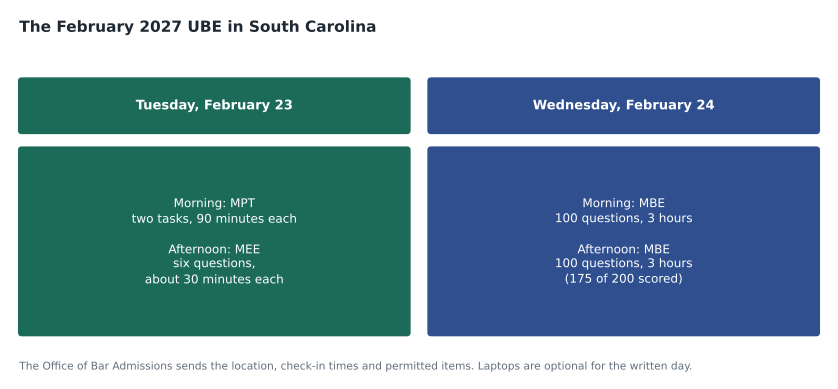
Applicants may type the written portions on a laptop using approved exam software, or write by hand. NCBE's summary lists a laptop fee of 125.50 dollars for South Carolina. Lainey planned to type: her handwriting was slow and her practice essays were longer and better organized on a keyboard.
Study implications
The scoring structure shapes how a candidate should spend time. Because the written portion counts for half the score, an applicant who spends nearly all of the study period on MBE questions is ignoring half the exam. Because the MPT is a skills test with its own library, it rewards practice under time pressure more than memorization. And because the MEE subjects largely overlap with the MBE subjects, studying the law for one helps the other.
Marchetti's plan for Lainey divided the week accordingly: MBE questions every day, two timed MEE essays and one MPT each week, and a full-length practice exam every three weeks. 'Your diagnostic told us where you are,' she said. 'It did not tell us where you will be in February.'
Common mistakes
MistakeI need a passing score on each component.
InsteadSouth Carolina looks at the combined UBE score of 266.
MistakeThe MEE still includes family law and trusts and estates.
InsteadSince July 2026, those subjects and conflict of laws and secured transactions are no longer tested on the MEE.
MistakeA 58 percent raw MBE means I will fail.
InsteadRaw practice percentages do not translate directly into scaled scores.
MistakeThere is a South Carolina essay on the exam.
InsteadThere is no state essay; South Carolina requires the Course of Study instead.
Inside the MBE
The MBE rewards a particular kind of reading. Each question has a fact pattern, a call and four answer choices, and the call tells the candidate what to look for. Marchetti taught Lainey to read the call first, then the facts, then the answers, and to predict the answer before looking at the choices. Wrong answers on the MBE are usually plausible statements of law that do not fit the facts, correct statements of law that answer a different question, or answers that reach the right result for the wrong reason.
The seven MBE subjects are not equally weighted in practice, but each appears substantially on every exam. Civil procedure includes jurisdiction, venue, pleading, joinder, discovery, pretrial motions and the effect of judgments. Constitutional law includes the powers of the branches, federalism, individual rights and state action. Contracts includes formation, defenses, performance, breach, remedies and the sale of goods under Article 2. Criminal law and procedure includes the elements of crimes, defenses and the constitutional rules on searches, confessions and trials. Evidence includes relevance, hearsay, witnesses, privileges and the forms of evidence. Real property includes estates, conveyancing, mortgages, landlord and tenant and land use. Torts includes intentional torts, negligence, strict liability, products liability and defamation.
Inside the MEE
An MEE answer is graded relative to the other answers to the same question, on a scale set by the jurisdiction, using NCBE's analysis of the issues. A grader looks for the issues the question raises, an accurate statement of the governing rules, a clear application to the facts and a conclusion. Graders read quickly. Short paragraphs, headings that track the call and a sentence that states each conclusion help them find the points. Long recitations of rules that the question does not raise do not.
Because the MEE now tests business associations alongside the seven MBE subjects, a candidate's MBE study does double duty. The one subject that needs separate attention is business associations: agency and partnership, and corporations and limited liability companies. Lainey had taken business associations in her second year and found it the hardest subject to revive. She scheduled it early in her plan so that she would see it several times before February.
Inside the MPT
The MPT is the most predictable part of the exam, which makes it the best place to gain points with practice. Every MPT gives the candidate a task memo, a file of facts and a library of law. The task memo says exactly what to write, for whom and in what format. The library contains the only law the candidate may use, even if it differs from the law the candidate knows. Candidates lose points by ignoring instructions in the task memo, by relying on outside law and by running out of time on the second task.
Marchetti's MPT routine was the same for every task. Read the task memo twice. Read the library and outline the rules it gives, with the elements and the key cases. Read the file and match facts to elements. Organize the answer according to the format the task memo requires. Write. She told Lainey to spend about forty minutes reading and organizing and fifty writing, and to stop the first task at ninety minutes even if it was unfinished.
Using practice scores well
Marchetti tracked three numbers for each candidate: the percentage of MBE practice questions answered correctly each week, the average self-graded score on practice essays compared with model answers, and the time each MPT took. The trends mattered more than any single number. A candidate whose MBE percentage rose from 58 to 68 between October and January was on a good path even if a particular week dipped. A candidate whose essays were consistently short of time needed a different fix from one whose essays missed issues.
Lainey's trend was steady. Her MBE percentage climbed through the fall, and her essays improved once she learned to outline before writing. Her MPT timing was the stubborn problem. By December she was finishing the second task with five minutes to spare, and by January with fifteen.
Common scoring myths
Several myths about UBE scoring circulate every year. One is that a candidate must reach a certain raw percentage on the MBE to pass; in fact, the scale changes with each exam's difficulty, and no raw percentage guarantees a result. Another is that the written portion barely matters because the MBE is scaled; in fact, the written score is half the total. A third is that a very strong performance on one MEE question can rescue a weak day; each essay is one of six, and consistency across all of them matters more than brilliance on one. Marchetti asked Lainey to stop repeating anything she heard about scoring unless she could find it in NCBE's published materials.
The most useful fact about scoring, Marchetti said, is also the simplest: every point counts the same, wherever it comes from. A point gained by finishing the second MPT is worth exactly as much as a point gained by learning the rule against perpetuities, and it is often much cheaper to earn.
Summary and key terms
- South Carolina has given the UBE since February 2017 and requires a score of 266.
- The MBE is 50 percent, the MEE 30 percent and the MPT 20 percent of the score.
- Written scores are scaled to the MBE; the score is a combined total out of 400.
- Since July 2026 the MEE tests business associations and the seven MBE subjects.
- The February 2027 exam is on February 23 and 24, with the written portions on the first day and the MBE on the second.
- 0
- UBE
- 1
- MBE
- 2
- MEE
- 3
- MPT
- 4
- scaled score
- 5
- equating
- 6
- passing score
- 7
- pretest questions
Practice problems
Work each problem on paper first, then reveal the answer to check.
What is South Carolina's passing UBE score?
Show answer
266 on the 400-point scale.
What share of the UBE score comes from the written components?
Show answer
Half: 30 percent from the MEE and 20 percent from the MPT.
When did South Carolina first give the UBE?
Show answer
February 2017.
Which subjects left the MEE in July 2026?
Show answer
Conflict of laws, family law, trusts and estates and secured transactions.
Lesson quiz · 5 questions
Score 60% or more to complete this lesson.
Create a free account to save your progress, take quizzes and earn a certificate.