
BAR-251 · Lesson 11 of 12 · 20 min
Score transfer, admission on motion and practice after admission
▶ Video coming soon A video version of this lesson is on the way.
Two messages reached Hollis before the session. Marcus Bell wrote that a Cheyenne firm had asked whether he could join them in a year, and he wanted to know whether his Missouri NextGen score of 648 would get him into Wyoming. And Kenna wrote that her partner Ardith had a law school friend, a lawyer in Montana for twelve years, who wanted to open a Sheridan office. 'Same question, two different routes,' Hollis said. 'And for Kenna, the more practical question: what does a new Wyoming lawyer have to do once she is in?'
This lesson covers admission by transferred UBE or NextGen score, admission on motion, admission for military spouses, temporary and limited practice, and the obligations of a new Wyoming lawyer: bar membership, CLE and staying in good standing.
Admission by transferred score
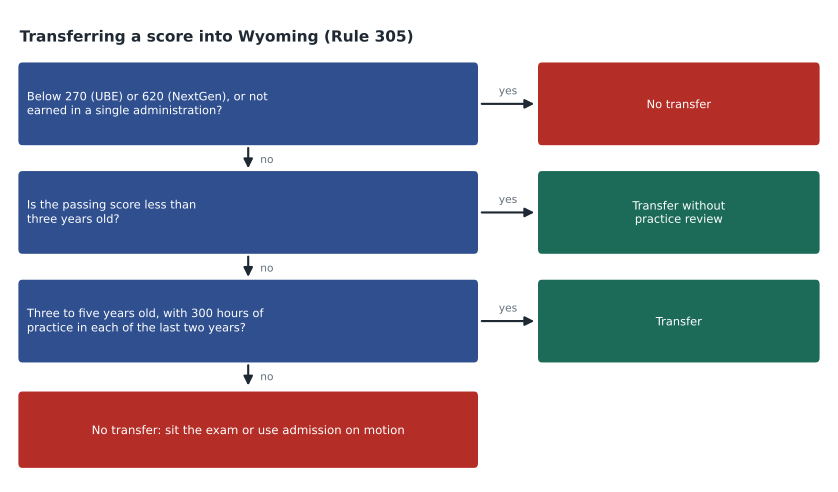
Rule 305 of the Wyoming admission rules allows an applicant who earned a passing UBE score in another jurisdiction to be admitted without sitting the Wyoming exam. The score must meet Wyoming's passing score of 270, and it must have been earned in a single administration of the entire UBE. Since July 2026, Wyoming also accepts transferred NextGen scores of 620 or more.
Wyoming's transfer rule turns on the age of the score. A passing score earned less than three years before the application may qualify without further review of the applicant's practice. A score earned three to five years before the application may qualify only if the applicant has been actively practicing at least 300 hours a year in each of the two years before applying. A score more than five years old does not qualify for transfer; the applicant must sit the exam or use another route such as admission on motion.
A transfer applicant must also meet the other requirements of admission: a JD from an ABA-accredited law school, an MPRE scaled score of at least 85 transferred from NCBE, a certificate of good standing from the highest court of each jurisdiction where the applicant is admitted and currently practices, issued within 90 days, and clearance on character and fitness through the NCBE investigation. The application form asks the applicant to state the UBE or NextGen exam date and the MPRE date and to give an NCBE number.
Marcus's question
Hollis walked through Marcus's file. His score is a NextGen 648 from the July 2026 Missouri exam, above Wyoming's 620. If he applies within three years, by July 2029, the score qualifies without any practice review. He has a JD from an ABA-accredited school. He is admitted in Missouri and in good standing, so he needs a certificate from the Supreme Court of Missouri issued within 90 days of filing. The open question is the MPRE: he took it in 2025 and passed for Missouri, but Wyoming requires 85. 'If my score is below 85, I retake the MPRE,' he said. 'That is easier than a bar exam.'
Admission on motion
Rules 302 to 304 allow experienced lawyers to be admitted without examination. An applicant must hold a JD from an ABA-accredited law school, must have been admitted by written examination in another United States jurisdiction, and must have been actively engaged in the authorized practice of law for at least five of the seven years before the application, with at least 300 hours of practice in each counted year. The applicant must be an active member in good standing of the bar of a UBE jurisdiction or a jurisdiction that would admit Wyoming lawyers on a comparable basis, and must be in good standing everywhere admitted.
The rules also exclude some applicants: a person previously denied admission on motion in Wyoming, a person who has engaged in the unauthorized practice of law in Wyoming, and, under the rule's terms, a person already admitted in Wyoming. Rule 303 defines active, authorized practice to include private practice for compensation, qualifying work for government or as in-house counsel, full-time law teaching at an ABA-accredited school and judicial service, where the applicant's primary duties involve legal counsel, drafting, advising or advocacy.
Wyoming's filing instructions make two practical points. First, Wyoming has no formal reciprocity agreement with any state: a lawyer qualifies by meeting the rule, not by coming from a favored state. Second, there is no filing deadline for motion applications, and complete applications are filed on receipt, but processing typically takes six to twelve months before the Board makes its recommendation to the Court. The fee is 600 dollars, and the applicant also pays NCBE's investigation fee. An MPRE score of 85 is required, or 75 for MPRE exams taken between January 1, 1999 and October 1, 2014, and a lawyer first admitted anywhere before 1999 may instead certify that the MPRE was passed for that admission.
The Wyoming Supreme Court amended several of these rules effective August 12, 2026, as part of the NextGen amendments. A motion applicant should read the current text of Rules 302 to 305 and the August 2026 filing instructions before applying.
| Route | Key requirements | Notes |
|---|---|---|
| Transferred UBE score | 270 from one administration; under three years old, or three to five years with 300 hours a year for two years | MPRE 85; ABA JD; character and fitness |
| Transferred NextGen score | 620 or more; accepted since July 2026 | Same age rules and requirements |
| Admission on motion | Admitted elsewhere by written exam; five of the last seven years of active practice at 300 hours a year; good standing | No reciprocity agreements; no deadline; six to twelve months; 600 dollars |
| Military spouse | Lawyer admitted elsewhere, in good standing, in Wyoming as a service member's spouse | No application fee; ends after qualifying events |
Ardith's friend from Montana
Ardith's friend has practiced full time in Montana for twelve years after passing the Montana exam, which is a UBE jurisdiction. He meets the five-of-seven-years requirement easily, his practice far exceeds 300 hours a year, and he is in good standing. Kenna noted the documents he would need: the motion petition and application, the notarized authorization and release, a color copy of his identification, the 600-dollar fee, a certificate of good standing from the Montana Supreme Court issued within 90 days and a copy of his NCBE character and fitness application. He should file well before he wants to open the Sheridan office, given the six-to-twelve-month processing time, and he must not practice Wyoming law in the meantime except as the rules on temporary practice allow.
Military spouses
Rule 306 provides a route for a lawyer who is the spouse or registered domestic partner of a member of the uniformed services stationed in Wyoming. The applicant must hold a JD, be admitted and in good standing in another jurisdiction, have no pending or past discipline that would bar admission and pass character and fitness review. There is no application fee. The admission ends 60 days after a qualifying event, such as the service member's permanent transfer out of Wyoming or the end of the marriage, and the lawyer must notify the Court within 30 days of the event, or 60 days if the service member died or became disabled. A lawyer who wants to keep practicing in Wyoming after that must qualify by another route.
Temporary and limited practice
A lawyer admitted elsewhere may appear in a particular Wyoming case through pro hac vice admission, which generally requires association with a Wyoming lawyer and approval by the court where the case is pending. Pro hac vice is case-by-case; it is not a substitute for admission for a lawyer who wants a regular Wyoming practice. A lawyer considering it should check the current Wyoming court rules and the Wyoming State Bar's requirements, including any fee and limits on the number of appearances.
Joining the Wyoming State Bar
Every lawyer admitted in Wyoming becomes a member of the Wyoming State Bar, which is an integrated bar. Members pay annual dues, keep their contact information current and comply with the Bar's rules on CLE and trust accounts. Members may hold active, inactive, emeritus and other statuses, each with different practice rights and obligations. A new lawyer starts as an active member.
CLE
Wyoming's continuing legal education rules, adopted by the Supreme Court and administered by the Wyoming State Board of Continuing Legal Education, require active members to complete 15 hours of approved CLE each calendar year, including 2 hours of legal ethics. Emeritus members complete 7 hours, including 1 hour of ethics. The reporting period is the calendar year.
New admittees are exempt for the calendar year in which they are admitted. A lawyer admitted in May 2027 therefore has no CLE requirement for 2027 and begins earning credit for 2028. Hours beyond the minimum, including ethics hours, may be carried forward for two years, but self-study and pro bono hours cannot be carried forward. No more than 8 hours a year may come from self-study programs, and up to 5 hours a year may be earned through pro bono service, at one credit hour for every two hours of service.
Deadlines matter. Applications for credit for a year must be received by March 1 of the following year. The Bar notifies lawyers of their credited hours in November. A lawyer who has not met the requirement by January 15 of the following year is delinquent and owes a 300-dollar delinquency fee, though the delinquency can be cured by March 1. A lawyer who still has not complied faces a recommendation for suspension, an order to show cause from the Court and possible administrative suspension.
Staying in good standing
Beyond CLE, a new Wyoming lawyer must pay dues on time, keep trust accounts in order, report changes of address and comply with the Rules of Professional Conduct. Many Wyoming lawyers also seek admission to the United States District Court for the District of Wyoming, which requires a separate application. And because Wyoming is small, a reputation for reliability spreads quickly: the same judges, clerks and opposing lawyers will see a new lawyer's work for years.
Worked problem
Choosing a route
Three hypothetical lawyers ask about Wyoming. Tessaro passed the UBE in Colorado in February 2023 with a 274 and has worked as an associate since. Brisbin passed the UBE in Utah in July 2020 with a 271 and has practiced there since. Pellham passed a non-UBE state's own exam in 2015 and has practiced full time for eleven years, but she graduated from a law school that was not ABA-accredited.
Show solution
- Tessaro's score is three to five years old by early 2026 and later, so she can transfer it if she shows at least 300 hours of practice in each of the two years before applying, plus MPRE 85 and the other requirements.
- Brisbin's score is more than five years old, so it cannot be transferred; but with more than five of the last seven years of practice after admission by written exam in a UBE jurisdiction, he can apply on motion.
- Pellham cannot be admitted by any route because Wyoming requires a JD from an ABA-accredited law school.
Answer: Tessaro transfers; Brisbin applies on motion; Pellham is not eligible in Wyoming.
Common mistakes
MistakeAny passing UBE score transfers to Wyoming.
InsteadThe score must be at least 270 from one administration, and its age matters.
MistakeA five-year-old UBE score transfers automatically.
InsteadA score three to five years old requires 300 hours of practice in each of the two years before applying; older scores do not transfer.
MistakeWyoming admits Montana lawyers on motion because of reciprocity.
InsteadWyoming has no formal reciprocity agreements; applicants must meet the motion rules.
MistakeNew admittees must complete 15 CLE hours in their first year.
InsteadNew admittees are exempt in the calendar year of admission.
MistakeSelf-study hours can be carried forward.
InsteadSelf-study and pro bono hours cannot be carried forward; other excess hours can be for two years.
Practice problems
Work each problem on paper first, then reveal the answer to check.
What NextGen score transfers into Wyoming?
Show answer
620 or more, accepted since July 2026.
How old may a UBE score be for transfer without practice review?
Show answer
Less than three years old.
How many years of practice does admission on motion require?
Show answer
Five of the last seven years, at least 300 hours a year.
How many CLE hours does an active Wyoming member need each year?
Show answer
Fifteen, including two hours of ethics.
What happens if CLE is not completed by January 15?
Show answer
The lawyer is delinquent and owes a 300-dollar fee, curable by March 1.
Moving between statuses
Life changes, and so does bar status. A Wyoming lawyer who takes a job outside law, moves out of state or steps away from practice for family reasons may change to inactive status, which reduces dues and suspends the CLE requirement but also ends the right to practice. Returning to active status later usually requires catching up on CLE and filing the Bar's reinstatement paperwork. A lawyer near retirement may consider emeritus status, which keeps a reduced CLE requirement. Before changing status, a lawyer should read the current Bar rules and consider how the change affects malpractice coverage, admission to federal court and admission in other states, some of which count only active practice toward their own motion rules.
Marcus asked whether Wyoming's motion rule would count his Missouri years if he moved later instead of transferring his score. Hollis said it would, if he practiced actively and met the hour requirement, but that the transfer route was faster while his score was less than three years old.
Summary and key terms
- Rule 305 allows transfer of a 270 UBE score (or, since July 2026, a 620 NextGen score) from a single administration.
- Scores under three years old transfer without practice review; scores three to five years old need 300 hours of practice a year for two years.
- Admission on motion requires admission elsewhere by written exam and five of the last seven years of active practice at 300 hours a year.
- Wyoming has no reciprocity agreements; motion applications have no deadline and take six to twelve months.
- Military spouse attorneys may be admitted under Rule 306 without a fee.
- Active members complete 15 CLE hours a year including 2 ethics; new admittees are exempt in their first calendar year.
- Transferred score
- A UBE or NextGen score earned elsewhere and used for admission in Wyoming.
- Admission on motion
- Admission without examination for experienced lawyers who meet Rules 302 to 304.
- Active, authorized practice
- Practice that counts toward motion eligibility under Rule 303.
- Military spouse admission
- Admission under Rule 306 for lawyers who are spouses of service members stationed in Wyoming.
- Pro hac vice
- Permission for a lawyer admitted elsewhere to appear in a particular case.
Lesson quiz · 5 questions
Score 60% or more to complete this lesson.
Create a free account to save your progress, take quizzes and earn a certificate.