
BAR-251 · Lesson 8 of 12 · 20 min
Wyoming torts: comparative fault and the Governmental Claims Act
▶ Video coming soon A video version of this lesson is on the way.
Two new files landed on Kenna's desk in the same week. In the first, a pickup driven by a ranch hand collided with a delivery van at a rural intersection near Douglas; the van driver, the firm's client, was hurt, and a county snowplow had left a ridge of packed snow that blocked the view of the stop sign. In the second, a guest at a dude ranch broke her wrist when a horse shied on a trail ride. 'Two files,' Ardith Duvall said, 'and between them you will need most of Wyoming tort law. Start with who is at fault and whether anyone is a government.'
This lesson covers Wyoming's comparative fault statute, several liability and apportionment, the Governmental Claims Act and its notice and caps, the constitutional rule against damages caps, recreation and livestock rules that matter in rural practice, and punitive damages. The bar exam tests general tort principles; this lesson is for Wyoming practice.
Comparative fault under W.S. 1-1-109
Wyoming abandoned contributory negligence in favor of comparative fault by statute in the 1970s, and the current version of the statute, W.S. 1-1-109, governs most actions to recover damages for injury, death or property damage based on fault. The statute uses the word fault broadly to cover negligence, strict liability and other conduct that the law treats as a basis for liability, and it calls each person whose fault contributed to the harm an actor.
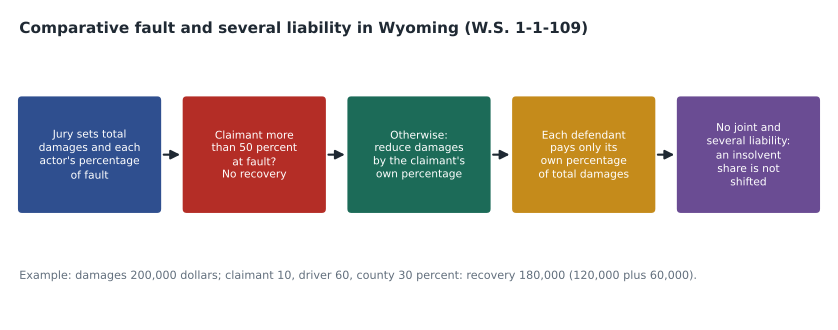
Three rules do most of the work. First, a claimant may recover only if the claimant's fault is not more than the total fault of all the actors, which in practice means a claimant who is more than 50 percent at fault recovers nothing. Second, a claimant who can recover has the damages reduced in proportion to the claimant's own percentage of fault. Third, each defendant is liable only for the portion of the total damages that matches that defendant's own percentage of fault. That last rule is several liability. Wyoming does not use joint and several liability in comparative fault cases, so a plaintiff cannot collect one defendant's share from another.
The jury, or the judge in a bench trial, determines the total damages and assigns percentages of fault to the actors. Wyoming's statute and cases allow fault to be assessed against actors who are not parties in some situations, such as a person who settled before trial, which can reduce the share of damages the remaining defendants must pay. A lawyer should read the current text of the statute and recent Wyoming Supreme Court decisions before advising on apportionment to a nonparty, because the details have been litigated and amended over time.
Working the numbers
Kenna's intersection case shows the arithmetic. Suppose a jury finds total damages of 200,000 dollars and assigns fault as follows: the client van driver 10 percent, the ranch hand 60 percent and the county 30 percent. The client's fault is far below 50 percent, so she recovers. Her damages are reduced by her 10 percent, leaving 180,000 dollars recoverable in total. Under several liability, the ranch hand's employer or insurer owes 60 percent of 200,000, or 120,000 dollars, and the county owes 30 percent, or 60,000 dollars, subject to the Governmental Claims Act limits discussed below. If the ranch hand had no insurance and no assets, the client would not be able to collect his share from the county.
Several liability changes litigation strategy. A plaintiff's lawyer in Wyoming must identify and pursue every solvent actor, because no single defendant can be made to pay for others. A defense lawyer has a strong incentive to show that other actors, including nonparties where the law allows, share the fault.
| Actor | Fault | Share of 200,000 dollars |
|---|---|---|
| Client (van driver) | 10 percent | Recovery reduced by 20,000 dollars |
| Ranch hand | 60 percent | 120,000 dollars |
| County | 30 percent | 60,000 dollars, subject to the Act's caps |
| Total recovered | 180,000 dollars, collected separately from each defendant |
The Governmental Claims Act
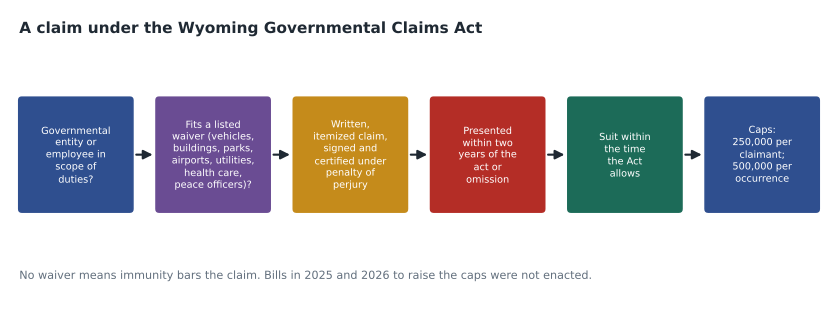
Wyoming's Governmental Claims Act, W.S. 1-39-101 and following, sets the rules for tort claims against the state, counties, cities, school districts and other governmental entities and their employees acting within the scope of their duties. The Act starts from immunity: a governmental entity and its public employees are granted immunity from tort liability except as the Act provides. It then waives immunity for listed categories, including negligence in the operation of motor vehicles and other equipment, negligence in the operation or maintenance of public buildings, recreation areas and public parks, airports and public utilities, and certain negligence by health care providers at public facilities and by peace officers in the performance of their duties. A claim that does not fit a listed waiver is barred.
The snowplow ridge raises the threshold question. Kenna had to decide whether the county's conduct fell within the waiver for operation of a motor vehicle or equipment, or within another waiver, or within none. That analysis comes first, before any question of fault or damages.
The notice of claim
The Act has a strict claim requirement. Under W.S. 1-39-113, no action may be brought against a governmental entity unless the claimant first presents a written claim to the entity within two years of the act, error or omission, with limited extensions for injuries not reasonably discoverable. The claim must state the time, place and circumstances of the loss, the names of the public employees involved if known and the amount of compensation demanded. The claim must also meet the requirements of the Wyoming Constitution, article 16, section 7, which the Wyoming Supreme Court has read to require that a claim against a governmental entity be itemized and signed and certified under penalty of perjury.
The Wyoming Supreme Court has treated these requirements seriously, and claims that were not properly signed and certified, or that were presented to the wrong entity or late, have been dismissed. After presenting a proper claim, the claimant must also file suit within the time the Act allows. Kenna's checklist for the county claim read: identify the correct entity, find the applicable waiver, prepare an itemized claim with a specific dollar demand, have the client sign it with the certification under penalty of perjury, deliver it to the entity well within two years and calendar the deadline to sue.
The caps
Under W.S. 1-39-118, the liability of a governmental entity and its employees under the Act is capped at 250,000 dollars for any one claimant and 500,000 dollars for all claimants arising from a single transaction or occurrence. Those limits have been in place for many years. Bills to raise them have been introduced repeatedly: a 2025 Senate file would have doubled the limits, and a 2026 House bill, the Christian Smith Safety Act, would have raised them to 1,000,000 and 2,000,000 dollars with annual inflation adjustments. Neither bill was enacted; each stalled before a vote of the full chamber. As of November 2026 the caps remain 250,000 and 500,000 dollars, and a lawyer should check for new legislation in each session.
In Kenna's example, the county's 60,000-dollar share is within the cap. In a catastrophic case the cap can control the outcome: a claimant with 2,000,000 dollars in damages caused 50 percent by a county recovers at most 250,000 dollars from it.
No caps on damages in ordinary cases
Wyoming's constitution limits the legislature's power to cap tort damages. Article 10, section 4 provides that no law shall be enacted limiting the amount of damages to be recovered for causing the injury or death of any person. For that reason Wyoming has no general cap on noneconomic damages and no cap on medical malpractice damages for private defendants, unlike many states. The Governmental Claims Act caps are different because they define the extent to which the state has waived its own immunity rather than limiting damages against private parties.
Recreation and inherent risk
Kenna's dude ranch case brings in a statute that matters in a state built on outdoor recreation. The Wyoming Recreation Safety Act provides that a provider of a sport or recreational opportunity is not liable for injuries resulting from risks that are inherent in the activity, meaning risks that are characteristic of, intrinsic to or an integral part of it. Horseback riding is a common example: a horse may shy, buck or bolt, and those are risks a rider accepts. The provider remains liable for negligence that creates risks beyond the inherent ones, such as giving a novice a horse it knows to be dangerous or using frayed equipment.
The Wyoming Supreme Court and the federal courts applying Wyoming law have decided many cases about where inherent risk ends and provider negligence begins. Kenna's job was to find out whether the horse had a known history, whether the wrangler matched horse and rider sensibly and whether the saddle and tack were in good condition. A shy on a trail, without more, is likely an inherent risk.
Livestock and fences
Wyoming is an open range state for many purposes. The traditional rule, reflected in Wyoming's fencing statutes, is that a landowner who wants to keep wandering livestock out must fence the land with a lawful fence, rather than requiring livestock owners to fence their animals in. Collisions between vehicles and livestock on highways and disputes over livestock damage to unfenced land are common in Wyoming practice, and the result often depends on whether the area was within a fence district or a herd district and whether a lawful fence existed. A lawyer should check the specific statutes and local district rules for the location.
Punitive damages
Wyoming allows punitive damages in limited cases. They are not awarded for ordinary negligence. The Wyoming Supreme Court has required conduct that is willful and wanton, such as conduct undertaken with a reckless disregard of the consequences, or malicious, before punitive damages may be considered. Governmental entities are not subject to punitive damages under the Act. Because punitive damages are not available for simple negligence, a plaintiff's lawyer should plead and prove the specific conduct that supports them.
Worked problem
The intersection claim against the county
Assume Kenna's client was injured on January 12, 2026. The county snowplow left a ridge of packed snow that hid a stop sign. The ranch hand ran the sign and hit the client's van. The client's damages are 200,000 dollars.
Show solution
- Identify the entity and the waiver: the county is a governmental entity; Kenna must show the claim falls within a listed waiver, such as negligent operation of equipment or maintenance covered by the Act.
- Present the claim: a written, itemized claim stating the time, place and circumstances, the employees involved and the amount demanded, signed and certified under penalty of perjury, delivered to the county by January 12, 2028 at the latest.
- Apportion fault: with the client at 10 percent, the ranch hand at 60 percent and the county at 30 percent, the client recovers 180,000 dollars in total, with each defendant liable only for its own share.
- Apply the caps: the county's 60,000-dollar share is below the 250,000-dollar per-claimant limit.
Answer: File the claim promptly, sue within the time the Act allows after presenting it, and pursue the ranch hand's insurer separately for its 120,000-dollar share.
Common mistakes
MistakeIn Wyoming a plaintiff can collect all damages from any defendant.
InsteadWyoming uses several liability; each defendant pays only its own percentage.
MistakeA plaintiff who is 50 percent at fault recovers nothing.
InsteadRecovery is barred only when the plaintiff's fault is more than 50 percent.
MistakeA notice of claim can be a simple letter describing the accident.
InsteadIt must be itemized, state a specific amount and be signed and certified under penalty of perjury, within two years.
MistakeWyoming caps medical malpractice damages.
InsteadArticle 10, section 4 of the Wyoming Constitution bars laws limiting damages for injury or death.
MistakeThe Governmental Claims Act caps were raised in 2026.
InsteadThe 2025 and 2026 bills to raise them were not enacted; the limits remain 250,000 and 500,000 dollars.
Practice problems
Work each problem on paper first, then reveal the answer to check.
When is a Wyoming plaintiff barred from recovering?
Show answer
When the plaintiff's fault is more than 50 percent.
What is Wyoming's rule on joint and several liability?
Show answer
Each defendant is liable only for its own percentage of fault.
Within what period must a claim be presented to a governmental entity?
Show answer
Two years from the act, error or omission, subject to limited discovery extensions.
What are the Governmental Claims Act caps?
Show answer
250,000 dollars per claimant and 500,000 dollars per occurrence.
What does the Recreation Safety Act protect providers from?
Show answer
Liability for risks inherent in the sport or recreational activity.
Summary and key terms
- W.S. 1-1-109 bars a claimant more than 50 percent at fault and reduces recovery by the claimant's percentage.
- Each defendant is severally liable only for its own share; there is no joint and several liability.
- The Governmental Claims Act grants immunity except for listed waivers.
- A claim against a governmental entity must be itemized, signed and certified under penalty of perjury and presented within two years.
- The Act caps liability at 250,000 dollars per claimant and 500,000 per occurrence; 2025 and 2026 bills to raise the caps failed.
- The Wyoming Constitution bars general damages caps; the Recreation Safety Act limits liability for inherent risks.
- Actor
- Under W.S. 1-1-109, a person whose fault contributed to the harm.
- Several liability
- Liability limited to a defendant's own share of the damages.
- Governmental Claims Act
- Wyoming's statute granting governmental immunity with listed waivers, claim requirements and caps.
- Written notice of claim
- The written, itemized, certified claim that must be presented to a governmental entity before suit.
- Inherent risk
- A risk characteristic of a recreational activity, for which a provider is not liable under the Recreation Safety Act.
Lesson quiz · 5 questions
Score 60% or more to complete this lesson.
Create a free account to save your progress, take quizzes and earn a certificate.