
BAR-251 · Lesson 6 of 12 · 20 min
What the exam tests and how Wyoming law appears
▶ Video coming soon A video version of this lesson is on the way.
Kenna arrived at the session with a list headed 'Wyoming traps'. At work that week she had drafted a memo on a car accident in which the client was found 40 percent at fault, and she had written, out of habit from the firm's files, that the defendants were only severally liable. The same afternoon she answered an MBE practice question about joint and several liability and got it wrong because she applied the Wyoming rule. 'Which law am I supposed to know?' she asked.
Hollis's answer framed this lesson. Wyoming has no state-specific component on its bar exam: NCBE's chart lists no jurisdiction-specific requirement for either the legacy UBE or NextGen, and Wyoming does not require a separate state law course or test before admission. The exam tests general principles. Wyoming law matters for practice, for the MPT when the Library supplies it, and for avoiding confusion between what the exam rewards and what a Wyoming court would actually do.
No Wyoming component
Some UBE jurisdictions add their own requirement. New York requires an online course and test on New York law. Several states require a short course or seminar on state law and professionalism before admission. Wyoming does none of this. Once an applicant passes the UBE with a 270 (or NextGen with a 620), clears the MPRE and character and fitness, and takes the oath, the applicant is admitted. Wyoming's old rule requiring new admittees to complete mandatory CLE was repealed effective July 1, 2015.
That makes Wyoming's exam portable in both directions. A Wyoming score carries no Wyoming-only element that another jurisdiction would need to replace, and a score earned elsewhere can be transferred into Wyoming without any Wyoming law test. It also means that a new Wyoming lawyer learns Wyoming law on the job and through CLE, not through the admission process. This course covers Wyoming's distinctive law in lessons 7 to 10 for that reason.
What the exam rewards
The MBE and MEE test what NCBE calls generally accepted principles. NCBE's instructions tell examinees to answer according to fundamental legal principles rather than local case law or statutes, unless a question says otherwise. On the MBE, questions that turn on a rule that varies among states usually state the rule to apply, such as 'the jurisdiction follows pure comparative negligence' or 'the jurisdiction has adopted the Uniform Probate Code'. When a question gives no such instruction, the answer follows the majority or the model rule.
The MPT works differently. It supplies its own law in a Library, often drawn from a fictional jurisdiction, and the examinee must use only that law. A Wyoming examinee who brings Wyoming law into an MPT answer is making a mistake, even if the Library's rule is different from Wyoming's.
NextGen follows the same approach. Its content scope lists the concepts and skills tested, and its performance tasks and integrated question sets supply the materials needed to answer. Family law and trusts and estates, which may appear in skills questions, come with the governing law provided.
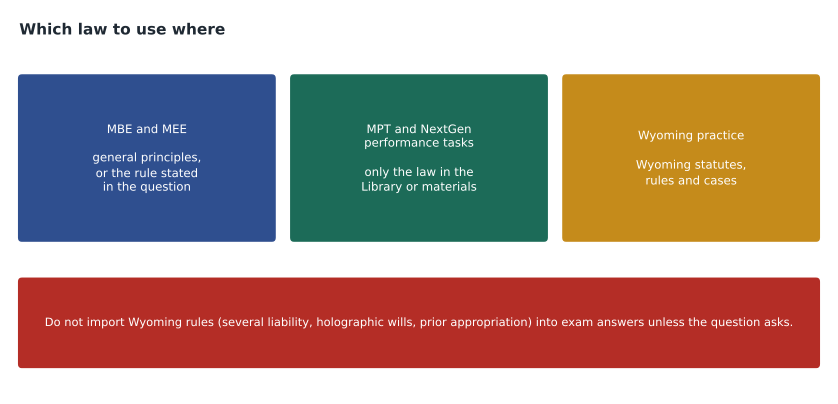
Where Wyoming law differs from what the exam expects
Kenna's list was a good start. Hollis helped her organize it into the places where a Wyoming lawyer's instincts might lead to a wrong exam answer, or where an exam habit might lead to a wrong Wyoming answer. The table below collects the main ones; later lessons explain each.
| Topic | Typical exam assumption | Wyoming rule |
|---|---|---|
| Comparative fault | Pure comparative negligence unless stated; joint and several liability as the traditional default | Modified comparative fault: recovery barred if the plaintiff's fault exceeds 50 percent; each defendant liable only for its own share (W.S. 1-1-109) |
| Claims against government | Sovereign immunity concepts in general terms | Governmental Claims Act: immunity with listed exceptions, a written claim within two years and caps of 250,000 dollars per claimant and 500,000 per occurrence |
| Water rights | Riparian and prior appropriation may both be tested | Prior appropriation under the Wyoming Constitution, administered by the State Engineer |
| Wills | Attested wills; holographic wills only if the question says so | Holographic wills are valid if entirely in the testator's handwriting and signed (W.S. 2-6-113) |
| Elective share | Uniform Probate Code style rules if stated | One-half, or one-fourth if the spouse is not a parent of any surviving issue (W.S. 2-5-101) |
| Civil procedure | Federal Rules of Civil Procedure | Wyoming Rules of Civil Procedure, closely modeled on the federal rules, with state-specific differences |
| Professional conduct | ABA Model Rules (the MPRE) | Wyoming Rules of Professional Conduct plus separate rules governing contingent fees |
Torts: the clearest example
Kenna's mistake is the classic one. On the MBE, unless the question states otherwise, an examinee should apply the rule the question gives or the general rule, and many MBE questions assume pure comparative negligence and joint and several liability among tortfeasors who cause an indivisible injury. In Wyoming, the comparative fault statute bars a claimant whose fault is more than 50 percent, reduces the recovery of a claimant whose fault is 50 percent or less, and makes each defendant liable only for the share of damages matching its own percentage of fault. A Wyoming plaintiff who is 40 percent at fault and sues two defendants each 30 percent at fault recovers 60 percent of the damages, collected 30 percent from each, and bears the risk that one of them cannot pay.
The correct exam technique is simple. Read the call and the facts for a stated rule. If none is stated, use the general rule. Save the Wyoming rule for practice and for questions that say the jurisdiction follows modified comparative fault with several liability.
Property and water
MBE real property questions occasionally test water rights, and when they do they may test either the riparian doctrine of the eastern states or the prior appropriation doctrine of the arid west. Wyoming follows prior appropriation, and the Wyoming Constitution declares water to be the property of the state. A Wyoming lawyer who answers a riparian question with Wyoming rules will get it wrong. The fix is to identify which doctrine the question uses and apply it. Lesson 9 covers Wyoming water law in detail.
Estates and family law
Trusts and estates and family law left the MEE in July 2026 but may still appear in MPT materials, and they will appear in Wyoming practice from the first week. Wyoming recognizes holographic wills, sets its own elective share fractions and divides property at divorce under an equitable distribution statute. Wyoming is not a community property state. Because the exam no longer tests these subjects directly, Kenna can study them for practice without worrying about exam traps, except on an MPT where the Library may state a different rule.
Procedure and evidence
The Wyoming Rules of Civil Procedure and the Wyoming Rules of Evidence are closely modeled on their federal counterparts, so most MBE and MEE learning carries straight over. The differences are in details: state-specific disclosure and timing rules, venue and the structure of the courts, which lesson 7 describes. On the exam, civil procedure means federal procedure, including federal jurisdiction, Erie and the Federal Rules of Civil Procedure.
Professional responsibility
The MPRE tests the ABA Model Rules of Professional Conduct and related law. The Wyoming Rules of Professional Conduct for Attorneys at Law follow the Model Rules' numbering and much of their text, but Wyoming adds a separate set of rules governing contingent fee agreements, with required written forms and presumptively reasonable percentages. On the MPRE, apply the Model Rules. In Wyoming practice, apply the Wyoming rules and the contingent fee rules. Lesson 10 covers the differences.
Building a two-track study plan
Hollis suggested that Kenna keep two notebooks. The exam notebook holds the general rules the MBE and MEE reward, with a list of the places where the question may state a different rule. The Wyoming notebook holds the Wyoming rules she meets at work and in this course: the comparative fault statute, the Governmental Claims Act notice and caps, prior appropriation basics, holographic wills, the elective share, the contingent fee rules and the Wyoming court structure. Before the exam she studies only from the first. After the exam she turns to the second.
The two-track approach also helps on the MPT. An examinee who knows Wyoming law well must be disciplined about using only the Library. Hollis had Kenna practice by reading an MPT Library aloud and stating, for each rule, whether Wyoming law was the same or different. 'You are not looking for differences to use,' Hollis said. 'You are looking for differences to ignore.'
How NextGen changes the picture
From July 2027, Wyoming candidates sit NextGen. Its content scope is narrower than the legacy MBE and MEE combined, its integrated question sets mix doctrine and skills, and its performance tasks supply their own law. Nothing about NextGen adds Wyoming-specific content. The two-track plan still applies: learn the exam's general rules for the exam and Wyoming's rules for practice.
Worked problem
Answering in the right voice
A practice MBE question describes a plaintiff who is 30 percent at fault in a two-car crash and a defendant who is 70 percent at fault, in a jurisdiction that has adopted modified comparative negligence. It asks how much of 100,000 dollars in damages the plaintiff recovers. A second question, with no rule stated, involves two defendants who together cause an indivisible injury, one of whom is insolvent.
Show solution
- The first question states a modified comparative negligence rule. Because the plaintiff's 30 percent is not greater than the defendant's, the plaintiff recovers 70,000 dollars.
- The second question states no rule. Under the traditional general rule for an indivisible injury, each defendant may be jointly and severally liable, so the solvent defendant may be liable for the whole.
- Under Wyoming law the second plaintiff would recover only the solvent defendant's share, but the question does not ask about Wyoming.
Answer: Apply the stated rule where given and the general rule where not; keep the Wyoming several-liability rule for Wyoming practice.
Common mistakes
MistakeWyoming has a state law component on its bar exam.
InsteadWyoming has no jurisdiction-specific component for either the UBE or NextGen.
MistakeWyoming examinees should answer MBE questions using Wyoming law.
InsteadApply the rule stated in the question or the general rule, not Wyoming law.
MistakeAn MPT answer can supplement the Library with Wyoming cases.
InsteadUse only the law in the Library.
MistakeSince family law left the MEE, a new Wyoming lawyer can ignore it.
InsteadFamily law and estates are everyday Wyoming practice; study them for practice.
MistakeNew Wyoming admittees must complete a special CLE program before practicing.
InsteadThat requirement was repealed in 2015; ordinary annual CLE applies after admission.
Practice problems
Work each problem on paper first, then reveal the answer to check.
Does Wyoming require a state-specific test or course for admission?
Show answer
No.
On the MBE, which rule applies when a question states none?
Show answer
The general or majority rule.
Which law governs an MPT answer?
Show answer
Only the law in the Library.
Name two Wyoming rules that differ from common exam assumptions.
Show answer
Several liability under modified comparative fault, and holographic wills (also prior appropriation and the elective share fractions).
Which rules does the MPRE test?
Show answer
The ABA Model Rules of Professional Conduct.
A short drill
Hollis closed the session with a quick drill. She read a short statement and Kenna answered whether it was an exam answer, a Wyoming answer or both.
First: a claimant who is 60 percent at fault recovers nothing in a modified comparative fault jurisdiction. Both, if the question states modified comparative fault; and it is the Wyoming rule too, because Wyoming bars a claimant more than 50 percent at fault.
Second: a will must be signed by two witnesses to be valid. An exam answer in many settings, but not a complete Wyoming answer, because Wyoming also recognizes holographic wills without witnesses.
Third: a senior appropriator's right is filled before a junior's in a shortage. Both, when the exam question uses prior appropriation; it is always the Wyoming rule.
Fourth: two tortfeasors who cause an indivisible injury are each liable for the whole. An exam answer under the general rule; not a Wyoming answer, because Wyoming uses several liability.
Fifth: a lawyer may charge a contingent fee in a personal injury case if the agreement is in writing. Both in general, but the Wyoming answer adds that the agreement must follow the state's form and is subject to presumptive percentages.
Kenna answered all five correctly, and Hollis added one more piece of advice. 'When you are unsure on the exam, ask yourself whether the question told you the rule. If it did, use it. If it did not, use the rule you learned for the exam, not the rule you used at work this week.'
Why the difference matters after the exam
The same skill works in reverse after admission. A new Wyoming lawyer who answers a client's question from memory of bar study will sometimes give the general rule when Wyoming law is different. The cure is the same discipline: check the Wyoming statute or rule before advising, and treat bar exam knowledge as a starting point rather than an answer.
Summary and key terms
- Wyoming has no state-specific exam component or course for either the UBE or NextGen.
- The MBE and MEE test general principles and any rule stated in a question; the MPT uses only its Library.
- Wyoming's comparative fault statute, Governmental Claims Act, water law, wills rules and contingent fee rules all differ from typical exam assumptions.
- Keep two notebooks: exam rules before the exam, Wyoming rules for practice.
- The MPRE tests the Model Rules; Wyoming practice uses the Wyoming rules plus the contingent fee rules.
- NextGen adds no Wyoming content; the two-track approach still applies.
- Jurisdiction-specific component
- A state law test or course some jurisdictions add to the UBE; Wyoming has none.
- General principles
- The widely accepted rules the MBE and MEE expect unless a question states otherwise.
- Library
- The packet of law provided with an MPT or NextGen performance task.
- Several liability
- Liability limited to a defendant's own share of fault, as under Wyoming's comparative fault statute.
- Prior appropriation
- The western water doctrine of first in time, first in right, followed in Wyoming.
Lesson quiz · 5 questions
Score 60% or more to complete this lesson.
Create a free account to save your progress, take quizzes and earn a certificate.