
BAR-251 · Lesson 3 of 12 · 21 min
Character and fitness and the MPRE
▶ Video coming soon A video version of this lesson is on the way.
Two items in Kenna's NCBE application had worried her for weeks. As a college sophomore she received a citation for a noisy party in her apartment, which she paid. Two years later a medical bill from a ski injury went to a collection agency while she was arguing with her insurer; she paid it in full and the account was closed. 'Neither one is a crime,' she told Hollis, 'but I spent an hour deciding whether to mention them.' Hollis's answer was immediate: 'Mention everything the question asks about. In Wyoming, as everywhere, the problem is almost never the old ticket. The problem is the applicant who left it out.'
This lesson explains how Wyoming reviews character and fitness, what the Committee looks at, how hearings and review by the Supreme Court work, when conditional admission is available, and what the MPRE requirement means in practice.
The standard and the burden
Rule 401 of the Wyoming admission rules places the burden on the applicant. An applicant must prove good moral character and fitness to practice law, and at a hearing must do so by clear and convincing evidence. The rule describes the essential eligibility requirements for practice in terms of conduct a client and a court must be able to rely on: the ability to exercise good judgment in conducting one's own and clients' business, honesty and candor with clients, lawyers, courts and others, compliance with the Wyoming Rules of Professional Conduct, timely and careful performance of obligations, competent legal skills and the ability to communicate.
The rule then lists factors that may indicate a problem. They include unlawful conduct, academic misconduct, false statements or omissions in the application itself, misconduct in employment, acts of dishonesty, fraud or deceit, abuse of legal process, neglect of financial responsibilities, neglect of professional obligations, violation of court orders, evidence of a mental or emotional condition or substance use that currently impairs the ability to practice, denial of admission elsewhere on character grounds, discipline in another profession and similar matters. A listed factor is not an automatic bar. It is a reason to look more closely.
The rule also tells the Committee how to weigh past conduct. It considers the applicant's age at the time, how recent the conduct was, how reliable the information is, how serious the conduct was, the factors that led to it, the cumulative effect of several incidents, evidence of rehabilitation, positive social contributions since then, the applicant's candor in the admission process and the materiality of any omissions. The rule expressly prohibits discrimination on protected grounds.
Candor is the central issue
Hollis kept returning to one point. The application asks broad questions about arrests, citations, civil suits, debts, employment terminations, academic discipline and treatment that affects current fitness, among others. The applicant must answer each question as asked, fully and honestly. An applicant who discloses a twelve-year-old shoplifting citation and explains it is in a strong position. An applicant who omits it and is found out through the NCBE investigation now has two problems: the old conduct and a false statement on a sworn application, which goes directly to honesty.
Kenna disclosed both items, attached the receipt for the paid citation and the closing letter from the collection agency, and wrote a short, factual explanation for each. Hollis read the drafts. 'No excuses, no essays,' she said. 'What happened, what you did, what you learned. Two paragraphs each.'
The duty to disclose continues after filing. The application is a continuing application, and an applicant must update it if anything changes, through the Amendment to Application form. A new citation in December or a lawsuit filed in January must be reported promptly, not saved for an interview.
How a file moves
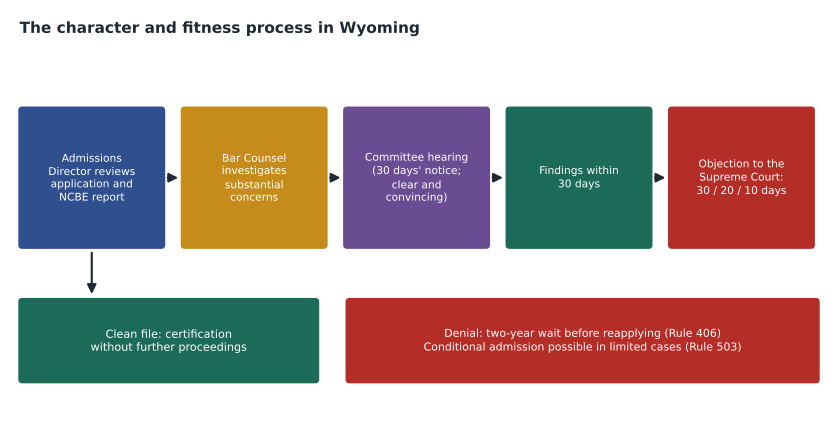
Rule 402 describes the path. The Admissions Director reviews each application and the NCBE report. Most files are clean and move toward certification without further proceedings. When the Director sees a substantial concern, the file goes to Bar Counsel, who may investigate further, interview the applicant and issue subpoenas. If Bar Counsel finds a substantial question about the applicant's character or fitness, the matter is referred to the Character and Fitness Committee for a hearing.
Under Rule 403, the applicant receives at least 30 days' notice of the hearing. The applicant appears in person, may be represented by counsel, may present witnesses and documents and must prove good moral character and fitness by clear and convincing evidence. The rules address subpoenas and the use of evidence, and they allow the Committee to require an independent medical examination at the Bar's cost where current fitness is genuinely in question. An applicant may withdraw before the Committee issues its final recommendation.
Under Rule 404, the Committee files written findings of fact, conclusions and a recommendation within 30 days after the proceedings conclude or the transcript is received, and members may dissent. Under Rule 405, an applicant may object to an adverse recommendation by filing a brief with the Supreme Court within 30 days; Bar Counsel responds within 20 days, and the applicant may reply within 10 days. The Court reviews the record and decides, and it may set the matter for oral argument. Under Rule 406, an applicant denied on character and fitness grounds must wait two years before reapplying.
| Step | Rule | Time limit or standard |
|---|---|---|
| Review of application and NCBE report | 402 | Admissions Director; substantial concerns to Bar Counsel |
| Hearing | 403 | At least 30 days' notice; applicant proves fitness by clear and convincing evidence |
| Findings and recommendation | 404 | Within 30 days after proceedings or transcript |
| Objection to the Supreme Court | 405 | Applicant 30 days; Bar Counsel 20 days; reply 10 days |
| Reapplication after denial | 406 | Two-year wait |
Conditional admission
Wyoming allows conditional admission in limited situations. Under Rule 503, an applicant who is otherwise qualified but who has a history of substance abuse, a recurring mental or physical impairment or financial neglect, and who is in sustained treatment or remediation, may be admitted subject to a monitoring agreement. The agreement sets conditions such as treatment, reporting and financial plans. The initial period may not exceed 60 months. A violation can lead to an extension, modification, suspension or termination of the conditional admission.
Conditional admission is a tool for applicants who can show real, ongoing rehabilitation but whose history makes the Committee want a period of confirmation. It is not a way around nondisclosure. An applicant who hides the history that would justify monitoring is in a far worse position than one who discloses it and proposes a plan.
Common issues in Wyoming files
Hollis listed the issues she sees most often in files from rural states. Driving offenses, including DUI, are common and are usually manageable if disclosed and followed by evidence of sobriety and compliance with any sentence. Debts and collections, especially medical and student debt, are reviewed for responsibility rather than amount: has the applicant communicated with creditors, made a plan and kept to it. Hunting and fishing violations, which applicants sometimes forget count as citations, must be disclosed if the question asks about them. And employment problems, such as a firing from a summer job, should be explained plainly.
She also stressed timing. A file that needs a hearing takes months. An applicant who expects a question should file early, gather documents before being asked and respond to every request from the Admissions Director or Bar Counsel promptly.
The MPRE requirement
Wyoming requires a scaled score of at least 85 on the Multistate Professional Responsibility Examination. Under Rule 211, evidence of the passing MPRE score must be provided within one year of the UBE sitting. The MPRE is written and scored by NCBE and is offered several times a year at testing centers, with sittings in March, August and November. The test has 60 multiple-choice questions, 50 of them scored, over two hours, and scaled scores run from 50 to 150.
Timing matters for two reasons. First, the Board will not recommend an applicant for admission until a passing MPRE score is on file, so a candidate who passes the bar exam but has not taken the MPRE waits for the next MPRE sitting and its score release. The filing instructions warn against delaying the MPRE for exactly that reason. Second, the one-year window means a candidate cannot treat the MPRE as something to do years later. Kenna's August 2026 score of 97 was well clear, and she had NCBE send it to Wyoming at once.
The 85 requirement is at the high end of the national range. A candidate who earned an 80 for another state needs to retake the MPRE for Wyoming. For admission on motion, Wyoming accepts a 75 for exams taken between January 1, 1999 and October 1, 2014, reflecting its earlier standard; lesson 11 covers that rule.
Worked problem
Disclose or not?
A hypothetical applicant, Rasmussen, received a game and fish citation in 2019 for fishing without a license, paid a fine and forgot about it. In 2022 he was fired from a ranch job after a dispute over hours. His NCBE application asks about all citations other than minor parking violations and about any termination from employment.
Show solution
- The game and fish citation is a citation the question asks about, so it must be disclosed even though it is minor.
- The termination must be disclosed with a short factual explanation; whether the firing was fair is less important than candor.
- Omitting either item would create a false statement on the application, a listed factor under Rule 401 and a matter of honesty.
- Both items, if disclosed, are likely to be weighed in light of age, recency, seriousness and candor.
Answer: Rasmussen should disclose both, attach the citation record and a brief explanation of the termination, and update the application if anything new arises.
Common mistakes
MistakeThe Committee must prove the applicant is unfit.
InsteadThe applicant bears the burden and must prove fitness by clear and convincing evidence at a hearing.
MistakeMinor citations do not need to be disclosed.
InsteadDisclose everything the question covers, including game and fish citations if the question asks.
MistakeAn adverse recommendation is final.
InsteadThe applicant may object to the Supreme Court within 30 days, and the Court decides on the record.
MistakeAn MPRE score of 80 is enough for Wyoming.
InsteadWyoming requires 85 for exam applicants, with the score due within one year of the UBE sitting.
MistakeConditional admission is available to anyone with a problem in the file.
InsteadIt is limited to substance abuse, recurring impairment or financial neglect with sustained treatment or remediation, under a monitoring agreement of up to 60 months.
Practice problems
Work each problem on paper first, then reveal the answer to check.
Who bears the burden in character and fitness review?
Show answer
The applicant.
What standard applies at a Committee hearing?
Show answer
Clear and convincing evidence of good moral character and fitness.
How long after denial must an applicant wait to reapply?
Show answer
Two years.
What MPRE score does Wyoming require, and by when?
Show answer
A scaled score of 85, with evidence within one year of the UBE sitting.
What is the maximum initial period of conditional admission?
Show answer
Sixty months.
Writing a disclosure statement
Many applicants struggle with the explanations the application asks for. Hollis gave Kenna a template for each disclosure: the date, the place, what happened in one or two plain sentences, the result, and what the applicant has done since. She warned against three habits. The first is minimizing, such as calling a DUI a misunderstanding. The second is blaming others, such as saying a roommate caused the noise complaint. The third is over-explaining, such as writing two pages about a parking dispute. A committee reads hundreds of these statements; a clear, honest paragraph stands out.
Documents help. A court record showing a citation was paid, a letter from a creditor confirming an account is closed, a certificate of completion for an alcohol education class or a letter from an employer describing reliable work since an incident all support the statement. An applicant who expects questions should gather these before filing rather than waiting for a request.
Debts and financial responsibility
Financial issues are among the most common reasons a Wyoming file receives a closer look. The concern is not that an applicant owes money; most new lawyers carry student loans. The concern is neglect: ignoring creditors, defaulting without explanation or using the bankruptcy process in a way that suggests dishonesty. An applicant with financial trouble should show a plan and a record of keeping to it, such as an income-driven repayment plan for student loans, payment arrangements on old medical debt and an up-to-date credit report with an explanation of any old problems.
Kenna's closed collection account fit this pattern well. She had disputed the bill with her insurer, paid it when the dispute was resolved and kept the paperwork. Hollis told her that a committee looking at that history would see responsibility, not neglect, as long as the explanation was short and the documents were attached.
When to get help
An applicant with a serious matter in the file, such as a felony conviction, a pending lawsuit alleging fraud or a history of discipline in another profession, should consider consulting a lawyer who represents bar applicants before filing. The decision is the applicant's, and many applicants with minor issues do not need counsel. But a hearing under Rule 403 is an adversarial proceeding at which the applicant bears a heavy burden, and preparation matters.
Summary and key terms
- The applicant must prove good moral character and fitness; at a hearing, by clear and convincing evidence.
- Rule 401 lists warning factors and the factors used to weigh past conduct, including candor in the process.
- Files move from the Admissions Director to Bar Counsel and, for substantial questions, to a Committee hearing.
- Adverse recommendations may be challenged in the Supreme Court; denial means a two-year wait.
- Conditional admission under a monitoring agreement is available in limited cases for up to 60 months initially.
- The MPRE score must be at least 85 and filed within one year of the UBE sitting.
- Clear and convincing evidence
- The heightened standard an applicant must meet at a character and fitness hearing.
- Bar Counsel
- The Wyoming State Bar lawyer who investigates character concerns and lawyer discipline.
- Conditional admission
- Admission subject to a monitoring agreement for applicants in sustained treatment or remediation.
- Monitoring agreement
- The written conditions governing a conditional admission.
- MPRE
- The Multistate Professional Responsibility Examination, written and scored by NCBE.
Lesson quiz · 5 questions
Score 60% or more to complete this lesson.
Create a free account to save your progress, take quizzes and earn a certificate.