
BAR-251 · Lesson 9 of 12 · 20 min
Wyoming water, family and estates law
▶ Video coming soon A video version of this lesson is on the way.
Kenna's Thursday at Duvall and Ostlund had three appointments, and Ardith said afterwards that they could stand for half the firm's practice. A rancher near Buffalo, Dale Overbeck, wanted to know whether he could move part of an old ditch right to a new field. A young couple from Casper wanted to divorce without a fight over their house and two trucks. And a widow brought in her late husband's will, written by hand on two sheets of yellow paper, and asked whether it was any good.
This lesson covers the three areas behind those appointments: Wyoming water law, Wyoming family law and Wyoming wills and estates. None is tested on the February 2027 MEE, because family law and trusts and estates left the MEE in July 2026 and water law appears only occasionally on the MBE. All three are everyday Wyoming practice.
Water: the property of the state
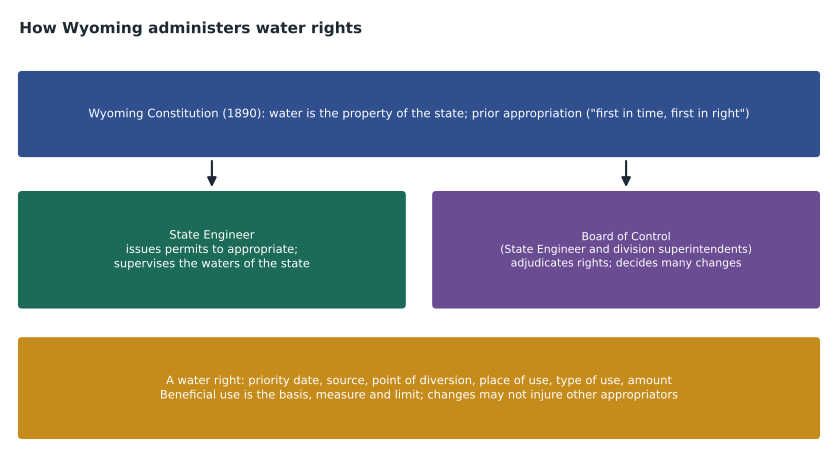
Wyoming's constitution, adopted at statehood in 1890, declares that the water of all natural streams, springs, lakes and other collections of still water within the state is the property of the state. Private parties do not own water as such; they hold rights to use it. The constitution adopts the doctrine of prior appropriation, under which priority of appropriation for beneficial uses gives the better right. In simple terms, first in time is first in right.
Wyoming was a pioneer of state administration of water. Its constitution created the office of State Engineer, who supervises the waters of the state, and a Board of Control, made up of the State Engineer and the superintendents of the state's water divisions, which adjudicates water rights and decides many changes to them. Wyoming's system of permits issued by the State Engineer and adjudication by the Board of Control was influential across the West.
Under prior appropriation, a water right has a few essential features. It is defined by a priority date, a source, a point of diversion, a place of use, a type of use such as irrigation, stock watering, municipal or industrial use, and an amount. Beneficial use is the basis, the measure and the limit of the right: a user may not take more than the use requires. In a shortage, the senior right on a stream is filled first, and junior users may be curtailed entirely. A right that is not used can be lost through abandonment under the procedures in Wyoming statute.
Changing a water right
Overbeck's question is a classic one. In Wyoming, an irrigation water right is generally attached to the land described in the permit or adjudication. Moving it to a different field, or changing its type of use, usually requires approval from the state, in many cases a petition to the Board of Control. The governing principle is that a change may not injure other appropriators. To protect them, the state typically limits a changed right to the amount of water historically consumed under the original use, not the full amount diverted, because some of what was diverted returned to the stream and is now relied upon by downstream users.
Kenna's checklist for Overbeck had five items: obtain the permit and adjudication records for the ditch right, map the original and proposed places of use, estimate historic diversions and consumptive use, identify other appropriators who might claim injury, and prepare the petition with the right supporting data. Ardith added a sixth: check whether the right had gone unused for long enough to raise an abandonment question, because a petition would invite scrutiny of the right's history.
Federal, tribal and interstate water
Wyoming water law also has federal and interstate dimensions. Reserved water rights for federal lands and Indian reservations arise under federal law, with priority dates tied to the creation of the reservation. The Wind River Reservation's water rights were the subject of a long general stream adjudication in the Wyoming courts, the Big Horn adjudication, which recognized reserved rights for the Eastern Shoshone and Northern Arapaho Tribes with a priority date reaching back to the 1868 treaty. Wyoming also shares rivers with neighboring states under interstate compacts and decrees, which limit what Wyoming users may take from interstate streams. A lawyer handling a large water matter must check all three layers.
Family law: divorce
Wyoming is not a community property state. Spouses own property individually or jointly according to title and contract, and the court divides property at divorce under an equitable distribution statute. Wyoming allows no-fault divorce on the ground of irreconcilable differences, and a residency requirement applies before a court will grant a divorce. Divorce cases are filed in district court.
When dividing property, the court makes a disposition that appears just and equitable, considering factors such as the respective merits of the parties, the condition in which they will be left, the party through whom the property was acquired and the burdens imposed on the property for the benefit of either party or the children. Equitable does not necessarily mean equal. The court may also award alimony or other support where appropriate.
The Casper couple had a house with a mortgage and two trucks. Kenna explained that they could settle the division by written agreement, which the court would review and usually incorporate into the decree, or ask the court to divide the property. With no children and similar incomes, a settlement was likely to be simple. Kenna also explained that one lawyer cannot represent both spouses in a divorce, and that the firm could represent only one of them.
Children: custody and support
When a divorcing couple has children, Wyoming courts decide custody, now usually framed as decisions about physical custody and parenting time and legal decision making, under a best interests of the child standard. The Wyoming statute lists factors, including the quality of the relationship between each child and each parent, each parent's ability to provide care, each parent's willingness to accept responsibilities and to allow the child a relationship with the other parent, how the parents and child interact, and the physical, mental and emotional needs of the child. No single factor controls.
Child support is set under Wyoming's statutory child support guidelines, which calculate support from the parents' net incomes and the custody arrangement. A court may deviate from the presumptive amount only with findings explaining why. A new lawyer should run the guideline calculation in every case involving children, even when the parents have agreed on support, because the court must review the agreement against the guidelines.
Wills: execution and holographic wills
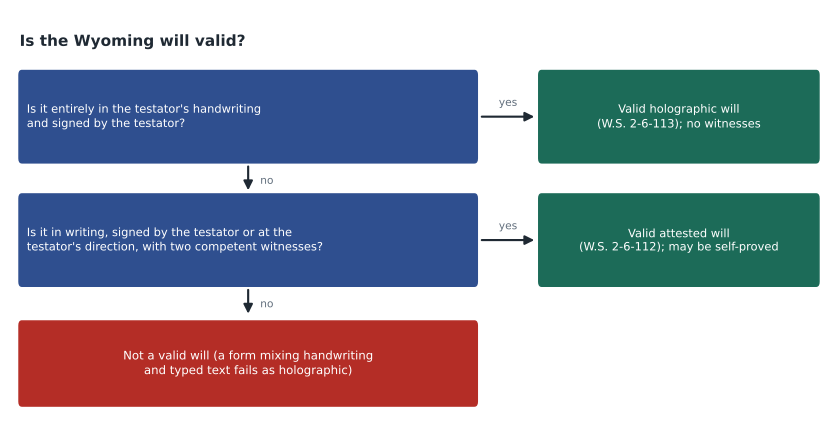
Wyoming's will execution rules are short. Under W.S. 2-6-112, a will other than a holographic will must be in writing, signed by the testator or by someone in the testator's presence and at the testator's direction, and witnessed by two competent witnesses. A will may be made self-proving at the time of execution, or later, by the testator's acknowledgment and the witnesses' affidavits before a notary or other officer authorized to administer oaths, which saves the need to locate witnesses at probate.
Under W.S. 2-6-113, Wyoming also recognizes holographic wills. A holographic will is valid if it is entirely in the handwriting of the testator and signed by the testator. No witnesses are required. The Wyoming Judicial Branch's guidance stresses that a form will mixing handwritten and printed or typed language will not qualify as holographic. A will that fails as holographic must meet the two-witness requirements to be valid.
The widow's yellow sheets were entirely in her husband's handwriting and signed at the end. Kenna explained that the will appeared to meet the holographic requirements, subject to proof of the handwriting at probate, and that the next questions were what the will said and whether any statutory rights of a surviving spouse applied.
Wyoming also limits gifts to witnesses. A subscribing witness to a will generally cannot take a benefit under it unless the will is also witnessed by two disinterested, competent witnesses. A witness who would have inherited without the will may still receive up to the amount the witness would have taken by intestacy. The safe practice is always to use disinterested witnesses.
The surviving spouse: elective share and intestacy
A surviving spouse who is left less than the law allows may elect against the will. Under W.S. 2-5-101, the elective share is one-half of the estate if the surviving spouse is the parent of any surviving issue of the decedent or if there are no surviving issue, and one-fourth if the surviving spouse is not the parent of any surviving issue of the decedent. The election must be made within the time set by W.S. 2-5-105 after the will is admitted to probate, so a lawyer for a surviving spouse should calendar that date immediately.
When a person dies without a will, the intestacy statute governs. Under the Wyoming Judicial Branch's summary of the rule, a surviving spouse takes one-half of the estate when the decedent leaves children or descendants of children, with the rest passing to them, and takes the estate when the decedent leaves no children or descendants of children. A lawyer should read the statute itself for the full order of succession and for special rules such as those for children born after a parent's death.
| Situation | Wyoming rule |
|---|---|
| Attested will | Writing, signed by the testator or at the testator's direction, two competent witnesses (W.S. 2-6-112) |
| Holographic will | Entirely in the testator's handwriting and signed; no witnesses (W.S. 2-6-113) |
| Interested witness | Generally takes nothing unless two disinterested witnesses also signed |
| Elective share | One-half; one-fourth if the spouse is not a parent of any surviving issue (W.S. 2-5-101) |
| Intestate spouse | One-half with children or their descendants; the estate if none |
Probate in practice
Probate cases are filed in district court. Wyoming provides full probate administration with a personal representative under court supervision, and simplified procedures for smaller estates, including a distribution by affidavit procedure for estates below a statutory value and a summary procedure for somewhat larger ones. A lawyer should check the current dollar thresholds in the probate code, which the legislature has raised from time to time. Ranch and mineral estates often involve property in several counties or states, and may need ancillary proceedings elsewhere.
Wyoming also allows several ways to pass property outside probate, including joint tenancy, payable on death and transfer on death designations, and trusts. Lesson 10 covers Wyoming trusts, which play an unusually large role in the state's legal economy.
Worked problem
Three Thursday clients
Overbeck wants to move part of an 1899 ditch right from a hay meadow to a new pivot field a mile away. The Casper couple, married five years with no children, want an agreed divorce. The widow brings a signed will written entirely in her husband's hand that leaves everything to his brother; she is the mother of his two surviving children.
Show solution
- Overbeck: the right is likely attached to the meadow; moving it requires state approval, likely through the Board of Control, and the change may not injure other appropriators, so it may be limited to historic consumptive use.
- The couple: they can divide their property by agreement for the court's review under the equitable distribution statute; the firm can represent only one spouse.
- The widow: the will appears valid as holographic; because she is a parent of the decedent's surviving issue, her elective share is one-half of the estate, and she must elect within the time set by W.S. 2-5-105.
Answer: Kenna prepares a records request and injury analysis for Overbeck, a single-client engagement letter for one spouse, and an elective share memo with the election deadline calendared for the widow.
Common mistakes
MistakeWyoming landowners own the water flowing across their land.
InsteadWater is the property of the state; users hold rights to use it under prior appropriation.
MistakeA water right can be moved to any field the owner chooses.
InsteadA change usually requires state approval and may not injure other appropriators.
MistakeWyoming is a community property state.
InsteadWyoming divides property at divorce under an equitable distribution statute.
MistakeA partly typed, partly handwritten form will is a holographic will.
InsteadA holographic will must be entirely in the testator's handwriting and signed.
MistakeA surviving spouse always takes one-half by election.
InsteadThe share is one-fourth if the spouse is not a parent of any surviving issue of the decedent.
Practice problems
Work each problem on paper first, then reveal the answer to check.
Which doctrine governs Wyoming water rights?
Show answer
Prior appropriation: first in time is first in right, with beneficial use as the measure and limit.
Which body adjudicates water rights and decides many changes?
Show answer
The Board of Control.
What makes a Wyoming holographic will valid?
Show answer
It is entirely in the testator's handwriting and signed by the testator.
What is the elective share when the spouse is not a parent of any surviving issue?
Show answer
One-fourth of the estate.
Under what standard are custody decisions made?
Show answer
The best interests of the child, using the statutory factors.
Summary and key terms
- Wyoming water is the property of the state; rights to use it follow prior appropriation and beneficial use.
- The State Engineer issues permits and the Board of Control adjudicates rights; changes may not injure other appropriators.
- Wyoming divides marital property under an equitable distribution statute; it is not a community property state.
- Custody follows the best interests of the child; support follows the statutory guidelines.
- Attested wills need two witnesses; holographic wills must be entirely handwritten and signed.
- The elective share is one-half, or one-fourth if the spouse is not a parent of any surviving issue.
- Prior appropriation
- The water doctrine under which the earliest beneficial use has the better right.
- Board of Control
- The Wyoming body of the State Engineer and division superintendents that adjudicates water rights.
- Historic consumptive use
- The amount of water actually consumed under a right, often the limit on a changed right.
- Holographic will
- A will entirely in the testator's handwriting and signed, valid in Wyoming without witnesses.
- Elective share
- The portion of an estate a surviving spouse may claim instead of taking under the will.
Lesson quiz · 5 questions
Score 60% or more to complete this lesson.
Create a free account to save your progress, take quizzes and earn a certificate.