
BUS-101 · Lesson 1 of 12 · 32 min
What business is and how organizations create value
A business is an organization that produces goods or services and sells them to customers in the hope of earning a profit. That short definition hides a great deal. A business has to work out what people need, find a way to make or deliver it, persuade customers to buy, collect the money, pay the people and suppliers who helped, follow the law and still have something left over. This course walks through each of those jobs in turn. This first lesson sets out the basic vocabulary: what a business is, what profit means, how organizations create value, who has a stake in them and how the different parts of a business fit together.
Throughout the course, examples are drawn from the US economy and US law, with comparisons to other countries where they help. When a figure or rule is current, the text says so and gives the date, because economic numbers change quickly.
Goods, services and the customer
Goods are physical products you can hold, store and resell: a bicycle, a bag of flour, a laptop. Services are activities performed for a customer: a haircut, a tax return, a streaming subscription, a flight. Most offerings today are bundles of both. A new car comes with a warranty and financing; a restaurant meal is food plus the service of cooking, serving and cleaning up. Thinking of every offering as a bundle helps a business see where customers really find value and where it can compete.
Every business starts with a customer. A customer is anyone who exchanges money, time or attention for what a business offers. Some businesses sell to individual consumers, which is called business-to-consumer or B2C. Others sell to other organizations, which is business-to-business or B2B: a steel mill selling to a car maker, or a software firm selling payroll systems to hospitals. Some sell mainly to governments. The same product can be sold in several of these markets with very different prices, sales methods and contracts.
Revenue, costs and profit
Revenue is the money a business earns from selling its goods and services. Costs are what it spends to produce and sell them: materials, wages, rent, energy, advertising, interest and taxes. Profit is what remains when costs are subtracted from revenue. When costs are larger than revenue, the result is a loss.
Profit matters because it is the reward to the owners for taking risk, and because it funds the future. A profitable business can pay its owners, invest in new equipment, hire more people and survive a bad year. A business that loses money for long enough runs out of cash and fails, however good its intentions. Profit is also a signal: when an activity is profitable, it tells entrepreneurs that customers value it more than it costs to provide, and others are drawn in to compete.
Two simple measures appear in almost every business conversation. The first is the gross margin, the share of each sales dollar left after paying the direct cost of the goods sold. The second is the net profit margin, the share left after all costs, including overhead and tax. A grocery chain might have a gross margin near 25 % and a net margin of only 2 % or 3 %, while a software company might keep 75 % of revenue after direct costs and 20 % or more as net profit. Margins differ so much between industries that they are only meaningful when compared with similar firms.
Worked problem
Profit and margins for a bakery
A neighborhood bakery sells $480,000 of bread and pastries in a year. Flour, butter, packaging and the wages of the bakers who make the products cost $264,000. Rent, utilities, the manager's salary, insurance and marketing cost $168,000, and income tax is $9,600. Calculate gross profit, gross margin, net profit and net margin.
Show solution
- Gross profit = revenue − cost of goods sold = $480,000 − $264,000 = $216,000.
- Gross margin = $216,000 ÷ $480,000 = 0.45, or 45 %.
- Operating profit = gross profit − operating expenses = $216,000 − $168,000 = $48,000.
- Net profit = operating profit − tax = $48,000 − $9,600 = $38,400.
- Net margin = $38,400 ÷ $480,000 = 0.08, or 8 %.
Answer: Gross profit is $216,000 (a 45 % gross margin) and net profit is $38,400 (an 8 % net margin). Each dollar of sales leaves 45 cents after direct costs but only 8 cents after everything.
How businesses create value
A business survives only if it creates value: if what it delivers is worth more to customers than the price they pay, and if the price is higher than what it costs the business to provide. Picture three numbers for a single product. The first is the customer's willingness to pay, the most a customer would pay before walking away. The second is the price. The third is the cost to the business. The gap between willingness to pay and price is the value the customer keeps, sometimes called consumer surplus. The gap between price and cost is the profit the business keeps. The total value created is the whole gap between willingness to pay and cost.
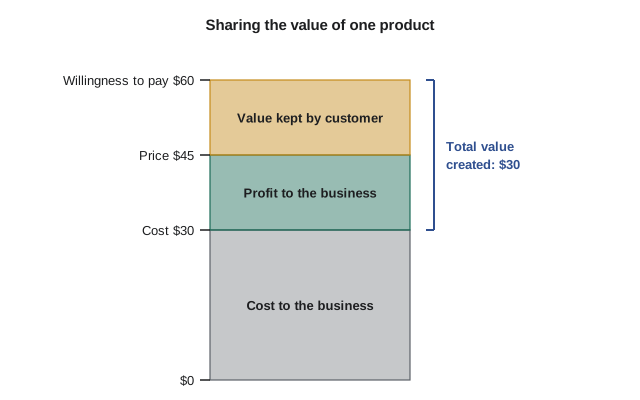
This simple picture explains a great deal of business strategy. A firm can create more value by making the product more useful, which raises willingness to pay, or by finding cheaper ways to make it, which lowers cost. Price then decides how the value is shared. If price is set too high, customers walk away and nothing is created at all. If it is set too low, customers are delighted but the business may not survive. Competition pushes prices toward cost, which is good for customers and forces businesses to keep improving.
Worked problem
Sharing the value of a running shoe
A runner would pay up to $180 for a new pair of shoes. The shoes sell for $140, and the full cost to the company of designing, making, shipping and selling one pair is $95. How much value is created, and how is it shared? What happens if a rival launches a similar shoe at $120?
Show solution
- Total value created = willingness to pay − cost = $180 − $95 = $85.
- Value kept by the customer = $180 − $140 = $40.
- Profit kept by the company = $140 − $95 = $45.
- If the company matches the rival at $120, the customer keeps $180 − $120 = $60 and the company keeps $120 − $95 = $25.
- The total value created is still $85; competition has shifted $20 of it from the company to the customer.
Answer: The shoe creates $85 of value: $40 to the runner and $45 to the company. Matching a $120 rival leaves the total unchanged but shifts $20 to the runner, unless the company can lower cost or raise willingness to pay.
Stakeholders
A stakeholder is anyone affected by what a business does or able to affect it. Owners, or shareholders in a corporation, provide capital and expect a return. Employees provide skills and effort and expect fair pay, safety and respect. Customers expect value and honest dealing. Suppliers want to be paid on time and to keep the relationship. Lenders want interest and repayment. Communities host the business and bear its noise, traffic and pollution, but also benefit from jobs and taxes. Governments write the rules and collect taxes.
Stakeholders' interests overlap but also conflict. Higher wages may please employees and cut profit; a cheaper supplier may raise profit and hurt a long relationship. Older thinking held that a company's only duty was to make money for its owners within the law. Most current thinking, including in corporate law, accepts that directors may and often should consider other stakeholders, because a business that treats them badly tends to lose employees, customers and its license to operate. Lesson 12 returns to this question.
In the US, corporate law is mostly state law, and Delaware law, which governs most large companies, focuses directors on the long-term interests of the corporation and its shareholders. Many states have also created benefit corporations, which must consider a public benefit alongside profit.
Kinds of organizations
Not every organization exists to earn profit for its owners, and the differences shape how each one is run. The table compares the main types.
| Type | Main purpose | Who owns or controls it | Example in the US |
|---|---|---|---|
| For-profit business | Earn profit for owners | Owners or shareholders | A family restaurant; a company listed on the NYSE |
| Co-operative | Serve members who use it | Members, one member one vote | A credit union; REI; agricultural co-ops |
| Nonprofit or charity | Pursue a social mission | A board; no owners take profit | A food bank; a nonprofit hospital |
| Government corporation | Public policy goals run on business lines | Federal or state government | The US Postal Service, Amtrak, the Tennessee Valley Authority |
| Benefit corporation or social enterprise | Earn profit while pursuing a stated public benefit | Owners, with a duty to consider the benefit | A company that has chosen benefit corporation status |
Not-for-profit organizations still need to manage money carefully. A charity that spends more than it raises will close just as surely as a business that loses money. The difference is what happens to any surplus: it is reinvested in the mission rather than paid to owners.
Sectors of the economy
Economists group economic activity into broad sectors. The primary sector extracts natural resources: farming, fishing, forestry, mining, and oil and gas. The secondary sector turns raw materials into goods: manufacturing and construction. The tertiary or service sector provides services: retail, finance, health care, education, transportation, information technology and many more. Some writers add a quaternary sector for knowledge work such as research and software.
In the US, as in other wealthy economies, services make up most of economic output and roughly four out of five jobs. Manufacturing remains large in absolute terms, the US being one of the world's biggest manufacturers, and resource industries such as agriculture, shale oil and gas and mining are important to particular regions.
Worked problem
A sector's share of output
A small economy produces $1,200 billion of goods and services in a year (its gross domestic product, or GDP). Services account for $852 billion, manufacturing and construction for $264 billion, and resource industries for the rest. What share of output does each sector produce?
Show solution
- Resource output = $1,200 billion − $852 billion − $264 billion = $84 billion.
- Services share = $852 ÷ $1,200 = 0.71, or 71 %.
- Manufacturing and construction share = $264 ÷ $1,200 = 0.22, or 22 %.
- Resources share = $84 ÷ $1,200 = 0.07, or 7 %.
- Check: 71 % + 22 % + 7 % = 100 %.
Answer: Services produce 71 % of output, manufacturing and construction 22 % and resources 7 %, a typical pattern for a wealthy economy.
The functional areas of a business
Inside a business, work is usually divided into functions. Even a one-person business performs all of them, while a large company has whole departments for each. Seeing the functions clearly helps you understand how a decision in one area affects the others, and it maps directly onto the rest of this course.
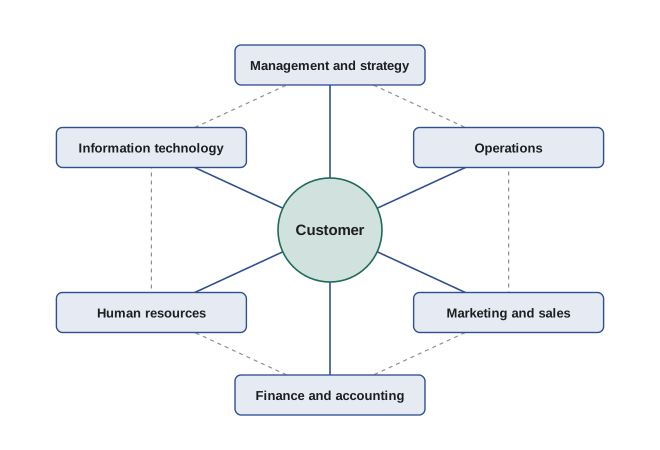
- Management and strategy set direction, organize resources and make major decisions (lesson 5).
- Operations make the product or deliver the service and manage the supply chain (lesson 8).
- Marketing and sales understand customers, set prices and promote and sell the offering (lesson 7).
- Human resources recruit, pay, train and support the people (lesson 6).
- Accounting and finance record transactions, report results and raise and manage money (lessons 9 and 10).
- Information technology supports all of these with systems and data.
A good business model ties the functions together. One common tool, the business model canvas, asks nine questions: who the customers are, what value is offered, how it reaches customers, what relationship is kept with them, where revenue comes from, what key resources, activities and partners are needed, and what the cost structure is. Filling in the canvas forces a founder to check that the pieces fit.
Unit economics
Before a business grows, it should check that each sale makes money. Unit economics means looking at the revenue and cost of a single unit, such as one product, one customer or one order. If each unit loses money, growing faster only loses money faster.
Worked problem
Unit economics of a coffee cart
A coffee cart sells a latte for $5.50. Coffee, milk, cup and lid cost $1.40, the card payment fee is 2.5 % of the price, and the operator estimates $0.60 of the barista's wage is used per drink. The cart's fixed costs, such as the permit, insurance and the cart lease, are $3,000 a month. What does each latte contribute, and how many lattes a month cover the fixed costs?
Show solution
- Payment fee = 2.5 % × $5.50 = $0.14 (rounded).
- Variable cost per latte = $1.40 + $0.14 + $0.60 = $2.14.
- Contribution per latte = $5.50 − $2.14 = $3.36.
- Lattes to cover fixed costs = $3,000 ÷ $3.36 ≈ 893 a month.
- At 30 selling days, that is about 30 lattes a day before the cart makes any profit.
Answer: Each latte contributes $3.36 toward fixed costs and profit, and about 893 lattes a month (about 30 a day) are needed to break even. Lesson 4 builds on this idea of a break-even point.
Common mistakes
MistakeTreating revenue as if it were profit.
InsteadSubtract all costs, including overhead and tax, before talking about profit.
MistakeComparing margins across very different industries.
InsteadCompare a firm's margins with similar firms; grocery and software margins are not comparable.
MistakeAssuming a not-for-profit does not need to manage money.
InsteadEvery organization must keep spending within its revenue to survive.
MistakeGrowing a product that loses money on each sale.
InsteadCheck unit economics first; growth multiplies losses as well as profits.
MistakeIgnoring stakeholders other than owners.
InsteadConsider employees, customers, suppliers and communities, whose support the business needs.
Summary and key terms
- A business produces goods or services and sells them in the hope of profit.
- Profit equals revenue minus costs; gross and net margins measure it as a share of sales.
- Value created is the gap between willingness to pay and cost; price decides how it is shared.
- Stakeholders include owners, employees, customers, suppliers, lenders, communities and governments.
- Organizations include for-profit businesses, co-operatives, nonprofits, government corporations and benefit corporations.
- Services produce most output and jobs in wealthy economies.
- The functional areas are management, operations, marketing, human resources, finance and accounting, and IT; unit economics checks that each sale pays.
- Revenue
- Money earned from selling goods and services.
- Profit
- Revenue minus all costs.
- Gross margin
- Gross profit as a share of revenue.
- Net margin
- Net profit as a share of revenue.
- Willingness to pay
- The most a customer would pay before walking away.
- Consumer surplus
- The gap between willingness to pay and the price paid.
- Stakeholder
- Anyone affected by or able to affect a business.
- Co-operative
- A business owned and controlled by the members who use it.
- Business model
- How a business creates, delivers and captures value.
- Unit economics
- The revenue and cost of a single unit of business.
Practice problems
Work each problem on paper first, then reveal the answer to check.
Revenue is $200,000 and total costs are $176,000. What is profit?
Show answer
$24,000.
Revenue $300,000, cost of goods sold $195,000. What is the gross margin?
Show answer
35 %.
Net profit $18,000 on revenue $360,000. What is the net margin?
Show answer
5 %.
Willingness to pay $50, price $35, cost $20. How much value does the customer keep?
Show answer
$15.
In the same case, how much value is created in total?
Show answer
$30.
Name four stakeholder groups.
Show answer
Any four of owners, employees, customers, suppliers, lenders, communities, governments.
What makes a co-operative different from a corporation?
Show answer
It is owned and controlled by its members, usually one member one vote.
Which sector does a bank belong to?
Show answer
The tertiary or service sector.
A product sells for $12 with variable costs of $7. What is the contribution per unit?
Show answer
$5.
With $4,000 of monthly fixed costs and a $5 contribution, how many units cover fixed costs?
Show answer
800 units.
Lesson quiz · 5 questions
Score 60% or more to complete this lesson.
Create a free account to save your progress, take quizzes and earn a certificate.