
BUS-101 · Lesson 2 of 12 · 28 min
The economic environment: markets, competition and the business cycle
No business operates in a vacuum. Its sales depend on how much customers earn and spend, its costs on wages, energy and materials, its borrowing on interest rates, and its prices on what competitors charge. This lesson introduces the economic forces every manager needs to read: supply and demand, the kinds of competition a firm can face, the measures of how the whole economy is doing, the business cycle, inflation and interest rates, and the role of the central bank and government. The economics courses ECON-101 and ECON-102 treat these ideas in depth; here the aim is to see them from a business owner's chair.
Economic systems
Every society has to decide what to produce, how to produce it and who gets it. In a market economy, those decisions are made mostly by households and businesses trading freely, with prices carrying information about what is scarce and what people want. In a command economy, a central authority decides. Real economies are mixed. Canada and the United States are market economies in which governments also provide public services such as roads and schools, redistribute income through taxes and transfers, regulate safety and competition, and in some cases own businesses.
The US mix leans somewhat more toward private provision than many other wealthy countries: most health insurance is provided through employers or bought privately, alongside public programs such as Medicare and Medicaid.
Supply, demand and price
In a market, demand describes how much buyers want to buy at each price, and supply describes how much sellers want to sell at each price. As price rises, buyers usually want less and sellers want to offer more. The price at which the amount demanded equals the amount supplied is called the equilibrium price. If the price is above it, unsold goods pile up and sellers cut prices. If it is below, shortages appear and prices rise.
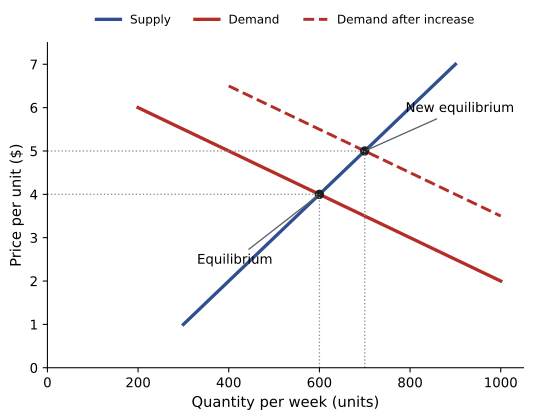
Many things shift demand: income, tastes, the prices of substitutes and complements, population and expectations. Supply shifts when the cost of inputs changes, when technology improves, when new firms enter or when a drought or a strike disrupts production. A business that understands what drives its demand and supply can see price changes coming instead of being surprised by them.
Worked problem
Reading a shift in demand
A city's ice cream shops sell 600 cones a week at $4 each. A heat wave raises demand, and the market settles at 700 cones a week at $5. By how much did revenue for the market change, and what explains the higher price?
Show solution
- Revenue before = 600 × $4 = $2,400 a week.
- Revenue after = 700 × $5 = $3,500 a week.
- Change = $3,500 − $2,400 = $1,100, an increase of about 46 %.
- Demand shifted to the right: at every price, buyers want more cones.
- Shops can only make more by adding staff and freezer time, so the extra cones come at a higher price.
Answer: Market revenue rises by $1,100 a week (about 46 %). The higher price reflects increased demand meeting supply that costs more to expand.
Economists also measure how sensitive demand is to price. If a 10 % price rise cuts the quantity sold by 20 %, demand is called elastic: buyers have alternatives and revenue falls when price rises. If it cuts the quantity by only 3 %, demand is inelastic: buyers have few alternatives, as with gasoline or medicine in the short run, and revenue rises with price. Knowing whether demand for your product is elastic is one of the most useful facts a pricing manager can have.
Kinds of competition
How much freedom a business has to set its price depends on its market structure. Economists describe four broad types.
| Market structure | Number of sellers | Product | Control over price | Example |
|---|---|---|---|---|
| Perfect competition | Very many | Identical | None: firms take the market price | Wheat, canola or corn sold into commodity markets |
| Monopolistic competition | Many | Differentiated | Some, through brand and features | Restaurants, hair salons, clothing brands |
| Oligopoly | A few large firms | Similar or differentiated | Considerable, but each watches rivals | Wireless carriers, airlines, banks |
| Monopoly | One | No close substitutes | Large, often regulated | A local electricity distributor |
Most small businesses operate in monopolistic competition: many rivals, each trying to stand out through location, quality, service or brand. Large firms in oligopolies watch one another closely, and their pricing decisions are often interdependent. Monopolies are rare and are usually either regulated, as with utilities, or watched by competition authorities to stop them abusing their position.
In the US, competition law is called antitrust law. The Sherman Act prohibits agreements that restrain trade and monopolization, the Clayton Act addresses mergers, and the Federal Trade Commission Act prohibits unfair methods of competition. The Department of Justice Antitrust Division and the Federal Trade Commission share enforcement, and both have brought major cases against large technology firms in recent years.
Measuring the economy
The broadest measure of economic activity is gross domestic product, or GDP: the market value of all final goods and services produced in a country in a period. GDP can be measured by adding up spending (consumption, investment, government purchases and net exports), incomes or output. Real GDP adjusts for price changes so that growth reflects more stuff, not just higher prices. GDP per person is a rough measure of living standards.
Other key indicators include the unemployment rate (the share of people in the labor force who want work and cannot find it), the inflation rate (how fast the general price level is rising), retail sales, housing starts and business confidence surveys. Managers watch these because they signal what is coming for their own sales and costs.
In the US, the Bureau of Economic Analysis publishes GDP quarterly, and the Bureau of Labor Statistics publishes the jobs report and the Consumer Price Index monthly.
Worked problem
Real versus nominal growth
An economy's GDP measured in current prices rose from $2,950 billion to $3,100 billion in a year. Over the same year, the general price level rose by 3 %. Estimate nominal growth and real growth.
Show solution
- Nominal growth = ($3,100 − $2,950) ÷ $2,950 = $150 ÷ $2,950 ≈ 5.1 %.
- Real growth is roughly nominal growth minus inflation.
- Real growth ≈ 5.1 % − 3.0 % = 2.1 %.
- More precisely, real GDP = $3,100 ÷ 1.03 ≈ $3,010 billion in last year's prices, so real growth = $60 ÷ $2,950 ≈ 2.0 %.
Answer: Nominal GDP grew about 5.1 %, but about 3 percentage points of that was higher prices; the economy actually produced about 2 % more.
The business cycle
Economies do not grow smoothly. They move through a business cycle of expansion, peak, contraction and trough. During an expansion, output and employment rise, businesses invest and confidence is high. At the peak, the economy may overheat and inflation rises. In a contraction, output falls and unemployment rises; a contraction that is deep and lasting is called a recession, often described informally as two quarters in a row of falling real GDP. At the trough the decline ends and recovery begins.
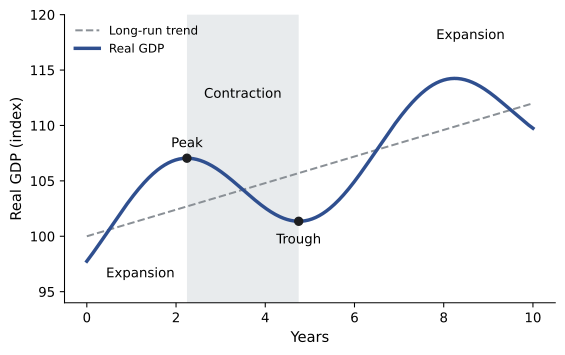
Different industries feel the cycle differently. Cyclical industries such as car sales, construction, furniture and travel swing sharply, because customers can delay big purchases. Defensive industries such as groceries, utilities and basic health care are steadier. A sensible business plans for a downturn even in good times by keeping a cash buffer, avoiding too much debt and knowing which costs it could cut.
Inflation and interest rates
Inflation is a general rise in prices, measured by indexes such as the Consumer Price Index (CPI). Moderate, predictable inflation is normal. High inflation erodes the value of money, makes planning harder and pushes up wages and interest rates. For a business, inflation raises input costs, and the question is whether it can raise its own prices just as fast.
Interest rates are the price of borrowing money. When rates rise, loans, mortgages and lines of credit become more expensive, so households and businesses borrow and spend less, which cools the economy and inflation. When rates fall, borrowing becomes cheaper and spending picks up. Central banks influence interest rates to keep inflation near a target.
The US central bank is the Federal Reserve. Congress gives it a dual mandate of maximum employment and stable prices, and it aims for 2 % inflation as measured by the price index for personal consumption expenditures. Its main tool is the target range for the federal funds rate. At the time of writing (October 2026), the Federal Open Market Committee raised the target range by a quarter point to 3.75 % to 4.00 % on September 16, 2026, its first increase since 2023, citing inflation running well above target.
Worked problem
What a rate change costs a business
A small manufacturer has a $400,000 line of credit, fully drawn, at a variable rate of prime plus 1.5 %. Prime is 4.45 % and then rises by 0.25 percentage points after a central bank increase. What happens to annual interest cost?
Show solution
- Rate before = 4.45 % + 1.5 % = 5.95 %. Annual interest = $400,000 × 0.0595 = $23,800.
- Rate after = 4.70 % + 1.5 % = 6.20 %. Annual interest = $400,000 × 0.062 = $24,800.
- Increase = $24,800 − $23,800 = $1,000 a year.
- Each 0.25-point increase adds 0.0025 × $400,000 = $1,000 a year on this balance.
Answer: Annual interest rises by $1,000, from $23,800 to $24,800. Variable-rate debt passes central bank decisions straight through to a firm's costs.
Fiscal policy and the role of government
Governments also influence the economy through fiscal policy: decisions about taxes and spending. Cutting taxes or raising spending can support demand in a downturn; raising taxes or cutting spending can cool an overheated economy or reduce deficits. Governments also shape business through regulation, through procurement (governments are huge buyers) and through programs that support research, training, exporting and small business.
In the US, fiscal policy is set by Congress and the President at the federal level, while states and cities set their own taxes and budgets, often with balanced-budget rules. Federal programs relevant to business include the research and experimentation tax credit and the loan and contracting programs of the Small Business Administration.
Reading economic news as a manager
Economic statistics arrive every week, and a manager does not need to follow all of them. A useful habit is to track a handful that matter most for your business: the inflation rate and the central bank's policy rate, which drive borrowing costs and wage demands; the unemployment rate, which signals how hard it will be to hire; retail sales or consumer confidence, if you sell to households; housing starts, if you are in construction or home furnishings; and the exchange rate, if you import or export. Look at the trend over several months rather than a single release, because monthly figures are noisy and often revised. Then ask what each change means for your customers' spending, your costs and your financing, and adjust plans before competitors do.
Common mistakes
MistakeAssuming higher prices always mean higher revenue.
InsteadCheck whether demand is elastic; if buyers have alternatives, a price rise can cut revenue.
MistakeReading nominal growth as real growth.
InsteadSubtract inflation to see whether the economy, or your sales volume, really grew.
MistakePlanning as if good times will last.
InsteadKeep a cash buffer and know which costs you could cut in a downturn.
MistakeIgnoring interest rates when borrowing at a variable rate.
InsteadCalculate what a rise of one or two percentage points would cost before borrowing.
MistakeTreating competitors' pricing as unrelated to your own.
InsteadIn concentrated markets, watch rivals closely and expect them to respond.
Summary and key terms
- Canada and the US are mixed market economies.
- Supply and demand set prices; shifts in either move price and quantity.
- Price elasticity measures how sensitive buyers are to price.
- Market structures range from perfect competition to monopoly; competition law polices abuses.
- GDP measures output; real GDP adjusts for inflation.
- The business cycle moves through expansion, peak, contraction and trough.
- The Federal Reserve pursues maximum employment and 2 % inflation through the federal funds rate, 3.75 % to 4.00 % at the time of writing (October 2026).
- Market economy
- An economy in which most decisions are made through voluntary trade.
- Equilibrium price
- The price at which quantity demanded equals quantity supplied.
- Elastic demand
- Demand that changes a lot when price changes.
- Oligopoly
- A market dominated by a few large firms.
- GDP
- The market value of all final goods and services produced in a period.
- Real GDP
- GDP adjusted for changes in the price level.
- Recession
- A significant, lasting decline in economic activity.
- Inflation
- A general rise in the price level.
- Policy interest rate
- The rate a central bank sets to influence borrowing costs.
- Fiscal policy
- Government decisions about taxes and spending.
Practice problems
Work each problem on paper first, then reveal the answer to check.
A 10 % price rise cuts quantity sold by 25 %. Is demand elastic or inelastic?
Show answer
Elastic (elasticity of about 2.5).
Name the four market structures.
Show answer
Perfect competition, monopolistic competition, oligopoly and monopoly.
Nominal GDP grew 6 % and inflation was 2.5 %. Approximate real growth?
Show answer
About 3.5 %.
Write the spending formula for GDP.
Show answer
GDP = C + I + G + (X − M).
Name the four phases of the business cycle.
Show answer
Expansion, peak, contraction and trough.
Give two examples of cyclical industries.
Show answer
For example car sales, construction, travel or furniture.
What happens to borrowing when central banks raise rates?
Show answer
It becomes more expensive, so borrowing and spending tend to fall.
A $250,000 variable loan sees its rate rise by 0.5 points. Extra annual interest?
Show answer
$1,250.
What inflation rate does the Federal Reserve target?
Show answer
2 %.
What is fiscal policy?
Show answer
Government decisions about taxing and spending.
Lesson quiz · 5 questions
Score 60% or more to complete this lesson.
Create a free account to save your progress, take quizzes and earn a certificate.