
BUS-101 · Lesson 12 of 12 · 28 min
Ethics, law and sustainability, and writing a business brief
Businesses operate within a framework of laws and within society's expectations about right and wrong. A firm that breaks the law faces fines, lawsuits and sometimes criminal charges; a firm that acts legally but unethically can still lose customers, employees and investors. This final lesson covers business ethics and how to reason through ethical dilemmas, the legal environment of business, corporate social responsibility, sustainability and ESG reporting, and then brings the whole course together in a capstone: writing a one-page business brief.
Business ethics
Ethics is the study of right and wrong conduct. Business ethics applies ethical principles to business decisions, such as how to treat customers, employees, suppliers and communities, how to compete and how honestly to report results. The law sets a minimum standard; ethics often asks for more. Many practices are legal but widely seen as wrong, such as burying important terms in fine print or exploiting a supplier's dependence.
Ethical problems in business often arise from pressure to meet targets, conflicts of interest (when a personal interest could influence a professional decision), rationalizations such as 'everyone does it' or 'no one will be hurt', and organizational cultures that reward results without asking how they were achieved. Common issues include bribery, fraud and misleading financial reporting, false advertising, privacy breaches, unsafe products, discrimination and harassment, and poor treatment of workers in supply chains.
Reasoning through a dilemma
Several ethical frameworks help analyze a decision. A utilitarian approach asks which option produces the greatest good for the greatest number. A rights-based approach asks whether an option respects the rights of everyone affected, such as rights to privacy, safety and fair treatment. A justice or fairness approach asks whether benefits and burdens are distributed fairly. A virtue approach asks what a person of good character would do. When the frameworks agree, the answer is usually clear; when they conflict, the dilemma is real and requires judgment.
A practical process: get the facts; identify the stakeholders and how each is affected; list the options; test each against the law, the company's code of conduct and the frameworks above; ask whether you would be comfortable if the decision were reported on the front page or explained to someone you respect (the newspaper test); choose and act; and reflect on the result.
Worked problem
An ethical dilemma in sales
A sales representative learns that a batch of the company's water filters performs slightly below the claim on the box (it removes 95 % rather than the advertised 99 % of a contaminant) but still meets the legal health standard. Her manager tells her to keep selling them without comment because quarter-end targets are at stake. Analyze the situation.
Show solution
- Facts: the product is legal and safe but does not meet its advertised claim.
- Stakeholders: customers (who paid for 99 %), the company (reputation and legal risk), the representative (integrity and career), shareholders and regulators.
- Legal test: selling a product that does not match its advertised performance may be deceptive advertising under the FTC Act and state consumer protection laws.
- Ethical tests: utilitarian, short-term sales gains are outweighed by the harm to customers and the risk to the company if discovered; rights, customers have a right to accurate information; newspaper test, the decision would look bad.
- Action: raise the issue in writing with the manager, propose options (relabeling, a discount with disclosure, holding the batch), and if necessary use the company's ethics hotline or compliance office.
Answer: Continuing to sell without disclosure is legally risky and ethically wrong. The representative should escalate through proper channels and propose practical alternatives. Organizations that make escalation safe, through hotlines and anti-retaliation policies, catch such problems early.
Many companies support ethical behavior through a written code of conduct, ethics training, leaders who model integrity, anonymous hotlines and protection for whistle-blowers who report wrongdoing.
In the United States, the Sarbanes-Oxley Act and the Dodd-Frank Act protect employees who report securities fraud, and the SEC's whistle-blower program pays awards of 10 % to 30 % of sanctions over $1 million collected thanks to original information.
The legal environment of business
Businesses deal with many areas of law. Some of the most important for a new manager are:
- Contract law: a contract is a legally enforceable agreement. It generally needs an offer, acceptance, consideration (something of value exchanged), capacity of the parties and a legal purpose. Important contracts should be in writing.
- Tort law: torts are civil wrongs, such as negligence, that cause harm. Businesses can be liable for injuries caused by their products or by employees acting in the course of their work, which is why they carry liability insurance.
- Product liability and consumer protection: laws that require safe products and fair dealing with consumers.
- Intellectual property: patents protect inventions, generally for 20 years from filing; trademarks protect brand names and logos; copyright protects original creative works; trade secrets protect confidential business information.
- Competition law: laws against price-fixing, bid-rigging, abuse of dominance and anticompetitive mergers.
- Employment, privacy, environmental and tax law.
In the United States, most contract, property and tort law is state law. Every state except Louisiana has adopted the Uniform Commercial Code's rules for sales of goods in some form. Federal law covers areas such as antitrust, bankruptcy, patents and copyrights, securities and interstate commerce. The Federal Trade Commission and the Department of Justice enforce antitrust law, and the US Patent and Trademark Office registers patents and trademarks.
Bribery of foreign officials is illegal for Canadian and US businesses anywhere in the world, under Canada's Corruption of Foreign Public Officials Act and the US Foreign Corrupt Practices Act. Both laws can bring large fines and prison sentences.
Corporate social responsibility
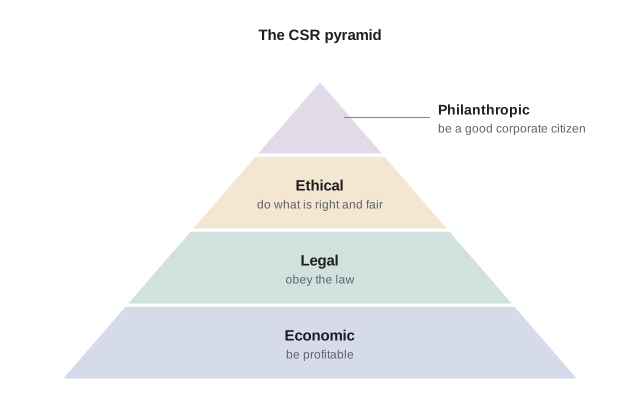
Corporate social responsibility (CSR) is the idea that businesses have obligations to society beyond making a profit and obeying the law. One well-known model describes four layers of responsibility: economic (be profitable), legal (obey the law), ethical (do what is right and fair) and philanthropic (contribute to the community). Supporters argue that responsible firms attract customers, employees and investors and reduce risk. Critics, following Milton Friedman, argue that a company's social responsibility is to increase profits within the rules of the game, and that spending shareholders' money on social causes is for governments and individuals to decide. Many firms now frame the debate in terms of creating shared value: finding business opportunities in solving social and environmental problems.
Sustainability and ESG
Sustainability means meeting present needs without compromising the ability of future generations to meet theirs. For businesses, it includes reducing greenhouse gas emissions, energy and water use and waste, sourcing responsibly and designing products for reuse and recycling. The triple bottom line asks firms to measure performance on people, planet and profit. Investors increasingly assess companies on environmental, social and governance (ESG) factors, such as emissions, labor practices, board independence and executive pay, though ESG investing has also faced political backlash and criticism over inconsistent ratings and greenwashing (making misleading environmental claims).
At the time of writing (October 2026), the SEC's 2024 climate disclosure rule is not in effect: the SEC stopped defending it in court in 2025. California has enacted laws requiring large companies doing business in the state to disclose greenhouse gas emissions and climate-related financial risks, with phased deadlines that have been subject to litigation, and companies with European operations face EU reporting rules. The FTC's Green Guides set out how environmental marketing claims should be substantiated.
Worked problem
A simple payback on an energy upgrade
A small manufacturer can replace its lighting with LED fixtures for $36,000. The upgrade will cut electricity use by 120,000 kWh a year at $0.14 per kWh and reduce maintenance by $1,200 a year, and a utility rebate covers $6,000 of the cost. What are the annual savings, the payback period and the 10-year undiscounted net saving?
Show solution
- Electricity saving = 120,000 × $0.14 = $16,800 a year.
- Total annual saving = $16,800 + $1,200 = $18,000.
- Net cost after rebate = $36,000 − $6,000 = $30,000.
- Payback = $30,000 ÷ $18,000 ≈ 1.7 years.
- 10-year undiscounted net saving = 10 × $18,000 − $30,000 = $150,000.
Answer: The upgrade pays back in under two years and saves about $150,000 over ten years before discounting. Many sustainability investments, especially in energy efficiency, are simply good business.
Capstone: writing a one-page business brief
A business brief is a one-page summary that explains a business or a proposal clearly enough for a busy reader, such as a banker, investor or senior manager, to decide whether to read further. Writing one draws on everything in this course. A strong brief covers:
- The opportunity: the customer problem and evidence that it is real (lesson 1, lesson 7).
- The offer and value proposition: what you sell and why customers will choose you (lesson 1, lesson 7).
- The market and competition: size, trends, competitors and economic conditions (lesson 2, lesson 4).
- Legal form and ownership (lesson 3).
- Operations and people: how you will deliver, key staff and suppliers (lessons 5, 6 and 8).
- Financials: price, unit economics, break-even, start-up costs and funding needed (lessons 4, 9 and 10).
- Risks, including trade, legal, ethical and sustainability risks, and how you will manage them (lessons 11 and 12).
Worked problem
Building the numbers for a brief
Two partners plan a mobile coffee trailer. Each cup sells for an average of $5.50, with variable costs (beans, milk, cups, payment fees) of $1.60. Fixed costs are $7,800 a month (trailer loan, insurance, permits, a part-time employee, commissary kitchen). Start-up costs are $70,000. They expect to sell 3,000 cups a month in their first full year. Calculate the figures the brief needs.
Show solution
- Contribution per cup = $5.50 − $1.60 = $3.90 (a 70.9 % contribution margin).
- Break-even = $7,800 ÷ $3.90 = 2,000 cups a month, about 67 a day over 30 days.
- Monthly profit at 3,000 cups = 3,000 × $3.90 − $7,800 = $11,700 − $7,800 = $3,900.
- Margin of safety = (3,000 − 2,000) ÷ 3,000 = 33 %.
- Annual profit ≈ 12 × $3,900 = $46,800 before owners' pay and tax; simple payback on $70,000 ≈ 1.5 years if all profit is reinvested.
Answer: The brief can state: break-even at 2,000 cups a month (about 67 a day), expected profit of about $3,900 a month at 3,000 cups, a 33 % margin of safety and funding needed of $70,000 plus a working capital buffer. The partners should test the 3,000-cup assumption at markets and events before committing.
| Section | What to include | Example for the coffee trailer |
|---|---|---|
| Opportunity | Customer problem and evidence | No quality coffee at the city's busiest weekend markets; survey of 120 visitors |
| Offer | Product and value proposition | Specialty espresso drinks served in under three minutes |
| Market | Size, competitors, trends | 40,000 market visitors a month; one competing vendor |
| Structure | Legal form and owners | LLC owned equally by two partners |
| Operations | Location, staff, suppliers | Two markets and corporate events; one part-time barista; local roaster |
| Financials | Price, break-even, funding | $5.50 average; break-even 2,000 cups a month; $70,000 start-up |
| Risks | Main risks and responses | Weather (book indoor events), permits (apply early), cost of beans (fixed-price supply contract) |
Keep the brief to one page, lead with the most important point, use numbers instead of adjectives, state assumptions clearly and make sure the figures add up. A reader should finish it knowing what the business does, why it will work, what it needs and what could go wrong.
Common mistakes
MistakeAssuming that anything legal is ethical.
InsteadThe law is the minimum; test decisions against fairness, rights and the newspaper test.
MistakeMaking vague green claims such as "eco-friendly".
InsteadBack environmental claims with specific, substantiated evidence.
MistakeRelying on a handshake for important deals.
InsteadPut key terms in a written contract.
MistakeWriting a business brief full of adjectives.
InsteadUse specific numbers, evidence and stated assumptions.
MistakeTreating CSR as only philanthropy.
InsteadStart with economic, legal and ethical responsibilities, then philanthropy.
Summary and key terms
- Business ethics applies principles of right and wrong to business decisions; the law is only the minimum.
- Utilitarian, rights, justice and virtue frameworks help analyze dilemmas.
- Codes of conduct, hotlines and whistle-blower protection support ethical cultures.
- Key areas of business law include contracts, torts, intellectual property and competition.
- CSR covers economic, legal, ethical and philanthropic responsibilities.
- Sustainability and ESG reporting are growing but contested; green claims must be substantiated.
- A one-page business brief pulls together the opportunity, offer, market, structure, operations, financials and risks.
- Business ethics
- The application of principles of right and wrong to business decisions.
- Conflict of interest
- A situation in which a personal interest could influence a professional decision.
- Whistle-blower
- An employee who reports wrongdoing inside an organization.
- Contract
- A legally enforceable agreement.
- Tort
- A civil wrong, such as negligence, that causes harm.
- Patent
- Legal protection for an invention, generally for 20 years from filing.
- Corporate social responsibility
- A business's obligations to society beyond profit and legal compliance.
- Triple bottom line
- Measuring performance on people, planet and profit.
- Greenwashing
- Making misleading claims about environmental benefits.
- Business brief
- A one-page summary of a business or proposal for decision makers.
Practice problems
Work each problem on paper first, then reveal the answer to check.
Name four ethical frameworks.
Show answer
Utilitarian, rights, justice and virtue.
What is the newspaper test?
Show answer
Asking whether you would be comfortable if the decision were publicly reported.
Name the elements of a valid contract.
Show answer
Offer, acceptance, consideration, capacity and legal purpose.
What protects a brand name?
Show answer
A trademark.
What are the four layers of the CSR pyramid?
Show answer
Economic, legal, ethical and philanthropic.
What is greenwashing?
Show answer
Misleading claims about environmental benefits.
An upgrade costs $20,000 after rebates and saves $8,000 a year. Payback?
Show answer
2.5 years.
Price $6, variable cost $2, fixed costs $6,000 a month. Break-even units?
Show answer
1,500.
List the seven sections of the business brief.
Show answer
Opportunity, offer, market, structure, operations, financials and risks.
Which law bans bribing foreign officials?
Show answer
The Foreign Corrupt Practices Act.
Lesson quiz · 5 questions
Score 60% or more to complete this lesson.
Create a free account to save your progress, take quizzes and earn a certificate.