
BUS-101 · Lesson 5 of 12 · 29 min
Management and organization
Every business, from a two-person food truck to a bank with 90,000 employees, has to decide what it is trying to achieve, how work will be divided, who will make which decisions and how progress will be checked. Those tasks are the work of management. This lesson introduces the four functions of management, the levels and skills of managers, strategic planning and SWOT analysis, goal setting, organizational structures, and the basics of leadership and decision making.
The four functions of management
Management is the process of achieving an organization's goals by working with and through people and other resources. A classic way to describe what managers do divides the work into four functions that repeat in a cycle:
- Planning: setting goals and deciding how to reach them, including strategy, budgets and schedules.
- Organizing: dividing the work, grouping jobs into teams and departments, assigning authority and allocating resources.
- Leading: motivating, guiding and communicating with people so they work toward the goals.
- Controlling: measuring results against the plan, finding gaps and taking corrective action.
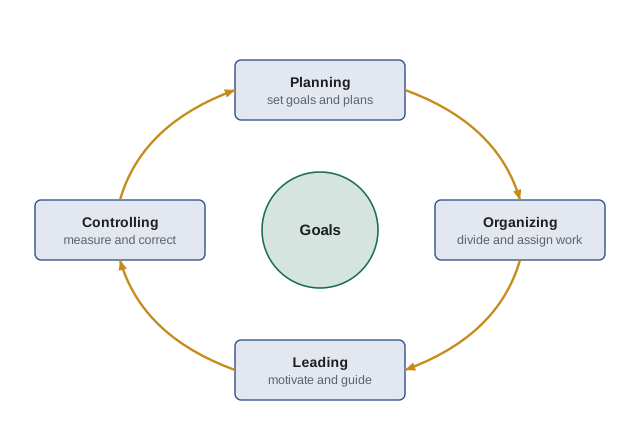
In practice managers move between the functions all day. A restaurant manager might revise next week's staff schedule (planning and organizing), coach a new server through a busy shift (leading) and check food costs against budget at closing (controlling), all on the same day.
Levels of management and the skills they need
Larger organizations have several levels of managers. Top managers, such as the chief executive officer (CEO), chief financial officer (CFO) and other executives, set overall direction and are accountable to the board of directors. Middle managers, such as regional managers, plant managers and department heads, turn strategy into plans for their units and manage other managers. First-line managers, such as supervisors, team leads and shift managers, direct the employees who do the day-to-day work.
Managers need three broad kinds of skill. Technical skills are the knowledge needed to do the work itself, such as knowing how to run a machine or prepare a tax return. Human or interpersonal skills are the ability to communicate with, motivate and work with people. Conceptual skills are the ability to see the organization as a whole, analyze complex situations and think strategically. All managers need human skills; first-line managers rely more on technical skills, while top managers rely more on conceptual skills.
| Level | Typical titles | Main focus | Most important skills |
|---|---|---|---|
| Top | CEO, CFO, vice-president | Strategy and long-term direction | Conceptual and human |
| Middle | Plant manager, regional manager, director | Turning strategy into unit plans | Human and conceptual |
| First-line | Supervisor, team lead, shift manager | Daily operations and people | Technical and human |
Mission, vision and strategic planning
Planning starts with purpose. A mission statement says what the organization does, for whom and why; a vision statement describes what it hopes to become; and a statement of values describes how people are expected to behave. Good statements are short and specific enough to guide decisions. A mission such as 'to be the best' gives no guidance; 'to give rural families fast, affordable internet' does.
Plans come at several levels. Strategic plans set the organization's long-term direction, usually over three to five years, and are made by top managers. Tactical plans translate strategy into specific actions for departments over one to two years. Operational plans set out the day-to-day and week-to-week work, such as production schedules and staffing rotas. Contingency plans describe what to do if something goes wrong, such as a supplier failure or a cyberattack.
SWOT analysis
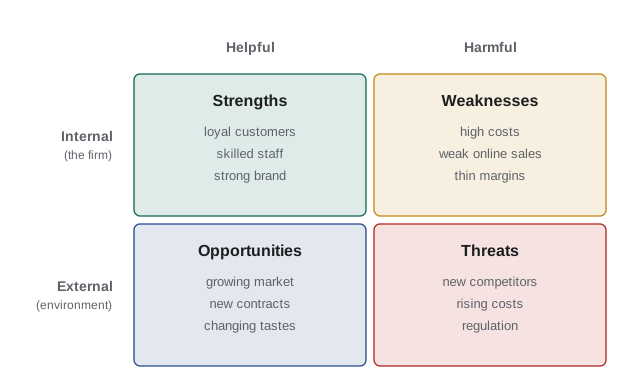
A SWOT analysis is a simple tool for strategic planning. It lists the organization's internal strengths and weaknesses and the external opportunities and threats in its environment. The goal is to build strategies that use strengths to seize opportunities, shore up weaknesses and defend against threats.
Worked problem
SWOT for an independent bookstore
An independent bookstore in a mid-sized city has loyal customers, knowledgeable staff and a café, but high rent, a small online presence and thin margins. Online retailers sell books more cheaply, but the city is growing, the local school board wants a supplier for classroom sets and author events draw crowds. Prepare a SWOT analysis and suggest one strategy.
Show solution
- Strengths (internal, helpful): loyal customers, expert staff, café that brings people in.
- Weaknesses (internal, harmful): high rent, weak online sales, thin margins.
- Opportunities (external, helpful): growing population, school board contract, popularity of author events.
- Threats (external, harmful): lower online prices, rising costs.
- Strength–opportunity strategy: use expert staff and event space to win the school contract and run a ticketed author series, building revenue that online sellers cannot easily copy.
Answer: The analysis points toward strategies built on experience and community, where the store has an advantage, rather than competing on price, where it cannot win.
Setting goals and measuring performance
Goals turn plans into targets people can act on. A widely used guide is that goals should be SMART: specific, measurable, achievable, relevant and time-bound. 'Improve customer service' is not a SMART goal; 'raise our average customer rating from 4.1 to 4.5 stars by June 30 by answering every review within 48 hours' is.
Organizations track progress with key performance indicators (KPIs), the handful of numbers that best show whether goals are being met, such as sales growth, gross margin, customer retention, on-time delivery or employee turnover. Controlling then compares actual KPIs with targets, explains differences and decides what to change.
Worked problem
Controlling with a variance
A call center set a target of answering 80 % of calls within 30 seconds. In March it received 24,000 calls and answered 17,400 within 30 seconds. What was the service level and the variance from target, and what might the manager do?
Show solution
- Service level = 17,400 ÷ 24,000 = 72.5 %.
- Variance = 72.5 % − 80 % = −7.5 percentage points (unfavorable).
- Calls that would have needed to be answered on time to meet the target = 80 % × 24,000 = 19,200, so the shortfall was 1,800 calls.
- Next, the manager investigates causes: higher call volume than forecast, absences, a new product generating questions or longer handling times.
- Corrective actions might include adjusting schedules to peak hours, adding a self-service web page for common questions or cross-training staff.
Answer: The service level was 72.5 %, 7.5 points below target. Controlling means finding the cause before choosing the fix, not simply telling staff to work faster.
Organizing: structure and the organization chart
Organizing creates a structure that divides work and coordinates it. Key ideas include:
- Division of labor (specialization): breaking work into specialized jobs, which raises efficiency but can make jobs dull.
- Departmentalization: grouping jobs, for example by function (marketing, finance), by product, by customer type or by geographic region.
- Chain of command: the line of authority from the top to the bottom of the organization, showing who reports to whom.
- Span of control: the number of people who report directly to one manager. Wide spans create flat organizations; narrow spans create tall ones.
- Centralization and decentralization: whether decisions are made mainly at the top or pushed down to managers closer to customers.
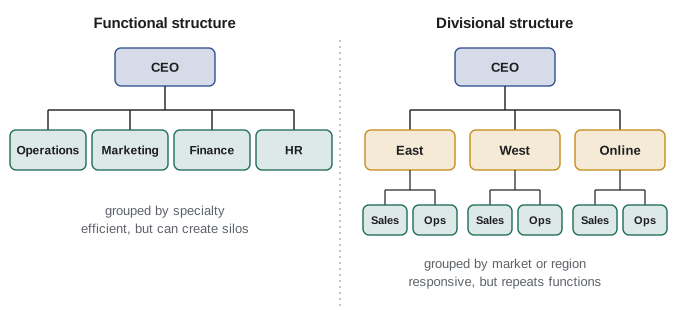
An organization chart is a diagram of the structure. In a functional structure, departments are grouped by specialty such as operations, marketing, finance and human resources; it is efficient but can create silos. A divisional structure groups people by product, market or region, each with its own functions; it responds well to different markets but duplicates resources. A matrix structure gives employees two bosses, such as a functional manager and a project manager, which helps on complex projects but can confuse priorities. Many firms also use cross-functional teams and project teams that cut across the formal structure.
Worked problem
Span of control and layers
A company has 729 front-line employees. If every manager supervises 9 people, how many layers of management are needed above the front line, and how many managers in total? What if each manager supervises 27 people?
Show solution
- With a span of 9: front-line supervisors needed = 729 ÷ 9 = 81.
- Their managers = 81 ÷ 9 = 9; and above them 9 ÷ 9 = 1 top manager.
- Layers = 3; total managers = 81 + 9 + 1 = 91.
- With a span of 27: supervisors = 729 ÷ 27 = 27; above them 27 ÷ 27 = 1.
- Layers = 2; total managers = 27 + 1 = 28.
Answer: Widening the span from 9 to 27 removes a layer and 63 management positions, making the organization flatter and faster but giving each manager far more people to support.
Leadership
Leading is the function most people picture when they think of management. Leadership is the ability to influence people toward goals. Researchers have described several styles. Autocratic leaders make decisions alone and expect them to be carried out; this can work in emergencies or with inexperienced teams. Participative or democratic leaders involve employees in decisions, which builds commitment and draws on more knowledge. Laissez-faire or free-rein leaders set goals and leave employees to decide how to reach them, which suits skilled professionals. Transformational leaders inspire people with a vision and encourage them to grow, while transactional leaders focus on clear expectations and rewards. Most effective leaders adapt their style to the situation and the people involved.
Motivation theories help explain why people work hard. Maslow's hierarchy suggests that people seek to satisfy physical and safety needs before social, esteem and self-actualization needs. Herzberg distinguished hygiene factors such as pay and working conditions, which cause dissatisfaction when inadequate, from motivators such as achievement, recognition and responsibility, which drive satisfaction. Expectancy theory says people work hard when they believe effort leads to performance, performance leads to rewards and the rewards matter to them. Each theory points managers toward fair pay, meaningful work, recognition and clear links between effort and results.
Decision making
Managers make decisions constantly. A rational process has six steps: define the problem, identify alternatives, evaluate them against criteria, choose one, implement it and evaluate the results. In reality, managers rarely have complete information or time, so they often settle for the first option that is good enough, a behavior called satisficing. Common traps include confirmation bias (seeking only evidence that supports a favored option), anchoring (relying too heavily on the first number heard), sunk-cost thinking (continuing a failing project because of money already spent) and groupthink (going along with the group to avoid conflict). Asking someone to argue the opposite case and setting decision criteria in advance help.
Delegation is the practical skill that links organizing and leading. Managers who try to do everything themselves become bottlenecks; managers who delegate well assign a clear task and outcome, give the person the authority and resources to do it, agree how progress will be checked and remain accountable for the result. Delegation also develops people, which is one of a manager's most important long-term jobs.
Common mistakes
MistakeTreating the four functions as separate stages done once a year.
InsteadPlan, organize, lead and control continuously; results feed back into planning.
MistakeWriting vague goals such as "grow sales".
InsteadWrite SMART goals with a number, a deadline and a clear owner.
MistakeListing internal weaknesses as threats in a SWOT.
InsteadStrengths and weaknesses are internal; opportunities and threats are external.
MistakeBelieving one leadership style is always best.
InsteadMatch the style to the situation, the urgency and the team's experience.
MistakeContinuing a project because so much has been spent on it.
InsteadIgnore sunk costs; decide on future costs and benefits only.
Summary and key terms
- Management is achieving goals through people and resources.
- The four functions are planning, organizing, leading and controlling.
- Top, middle and first-line managers need different mixes of technical, human and conceptual skills.
- Strategic, tactical, operational and contingency plans work at different horizons.
- SWOT separates internal strengths and weaknesses from external opportunities and threats.
- Structures may be functional, divisional or matrix; span of control shapes how tall they are.
- Effective leaders adapt their style and decisions guard against common biases.
- Management
- Achieving organizational goals by working with and through people and resources.
- Planning
- Setting goals and deciding how to reach them.
- Controlling
- Measuring results against plans and correcting deviations.
- Mission statement
- A short statement of what the organization does, for whom and why.
- SWOT analysis
- A list of internal strengths and weaknesses and external opportunities and threats.
- SMART goal
- A goal that is specific, measurable, achievable, relevant and time-bound.
- Key performance indicator
- A measure that shows progress toward an important goal.
- Span of control
- The number of people reporting directly to one manager.
- Chain of command
- The line of authority running from the top of an organization to the bottom.
- Matrix structure
- A structure in which employees report to both a functional and a project manager.
Practice problems
Work each problem on paper first, then reveal the answer to check.
Name the four functions of management.
Show answer
Planning, organizing, leading and controlling.
Which skills matter most for top managers?
Show answer
Conceptual skills (with human skills).
Is "a new competitor opening nearby" a weakness or a threat?
Show answer
A threat, because it is external.
Rewrite "improve safety" as a SMART goal.
Show answer
For example: cut lost-time injuries from 6 to 3 this calendar year by completing safety training for all staff by March 31.
A target is 95 % on-time delivery; actual is 91 %. What is the variance?
Show answer
−4 percentage points (unfavorable).
A firm has 512 workers and a span of control of 8. How many first-line supervisors?
Show answer
64.
Give one advantage and one disadvantage of a functional structure.
Show answer
Efficient specialization; can create silos and slow coordination.
Which leadership style suits an emergency?
Show answer
Autocratic, because decisions must be fast.
What is satisficing?
Show answer
Choosing the first option that is good enough rather than searching for the best.
Give an example of a hygiene factor.
Show answer
Pay, job security, working conditions or company policies.
Lesson quiz · 5 questions
Score 60% or more to complete this lesson.
Create a free account to save your progress, take quizzes and earn a certificate.