
CISSP-111 · Lesson 1 of 12 · 30 min
Assets and information as assets
Domain 2 of the CISSP, Asset Security, asks a deceptively simple question: what does the organization have, how valuable is it, and how should it be handled from the day it is created or acquired until the day it is destroyed? Every other domain depends on the answer. You cannot design an architecture, write access rules, monitor a network or recover from an incident well if you do not know which assets matter most. This course works through the whole domain in twelve lessons, and this first lesson sets out what an asset is, why information deserves to be treated as an asset in its own right, how organizations build and maintain inventories, and how they decide what an asset is worth.
CISSP is a registered mark of ISC2. This course is an independent study aid based on the publicly available exam outline. The quiz and exam questions are original practice items written for this course; they are not real exam questions and are not taken from any exam.
Where Domain 2 sits
The CISSP exam outline in force since 15 April 2024 weights Domain 2 at about 10 percent of the exam, tied with software development security as the smallest domain. Small does not mean easy: asset security questions are often written as management scenarios in which the right answer depends on knowing who owns a decision, which law sets a minimum, or which sanitization method fits a piece of media. ISC2 reviews its outlines every few years through a job task analysis, and commentators have been discussing a possible future refresh, so check the ISC2 website before you sit the exam to confirm which outline applies. The 2024 outline divides Domain 2 into six sub-domains, which this course follows in order, spending more than one lesson on the larger ones.
| Sub-domain | Topic | Lessons |
|---|---|---|
| 2.1 | Identify and classify information and assets | 1 and 2 |
| 2.2 | Establish information and asset handling requirements | 4 |
| 2.3 | Provision information and assets securely | 5 |
| 2.4 | Manage the data life cycle (roles, collection, location, maintenance, retention, remanence, destruction) | 3, 6, 8 and 9 |
| 2.5 | Ensure appropriate asset retention (end of life, end of support) | 5 and 9 |
| 2.6 | Determine data security controls and compliance requirements | 7, 10 and 11 |
What counts as an asset
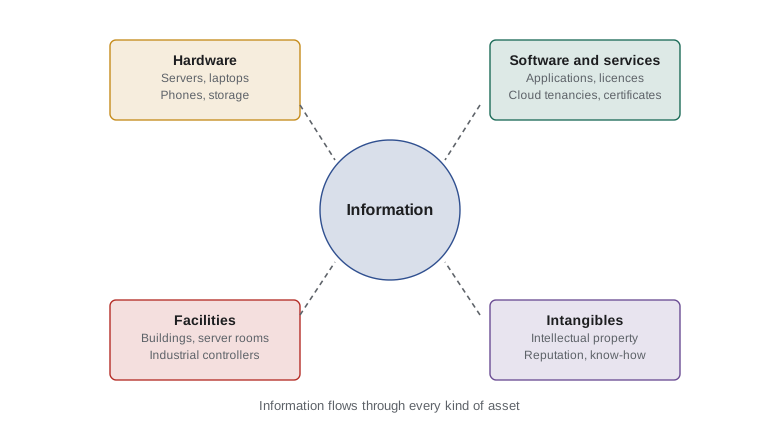
In security, an asset is anything of value to the organization that needs protection. The obvious examples are tangible: servers, laptops, phones, network equipment, storage arrays, removable media, buildings, vehicles and industrial controllers. Less obvious, but often more valuable, are intangible assets: data and information, software and licenses, intellectual property such as designs and source code, customer relationships, brand and reputation, and the knowledge in people's heads. Services count too. A cloud tenancy, a software-as-a-service subscription, a domain name and a code-signing certificate are all assets whose loss or misuse would hurt.
People are sometimes described as assets in security writing, and in one sense they are the most valuable of all. The CISSP, however, treats people mainly through the lens of safety, roles and personnel security rather than as items in an asset register. When a question asks you to rank priorities, remember the rule from Domain 1: human safety always comes first.
Information deserves special attention because it behaves differently from physical assets. It can be copied perfectly at almost no cost, so theft may leave the original untouched and unnoticed. Its value can change quickly: a draft earnings report is extremely sensitive the day before release and public the day after. It moves constantly between systems, people, partners and clouds, so the place where it is stored today may not be where it is tomorrow. And the same piece of information can exist in many forms at once: a database row, a spreadsheet extract, a printed report, a screenshot in a chat, and a backup tape in an offsite vault. Asset security is largely about keeping track of information as it multiplies and moves.
Why inventory comes first
The first practical step in asset security is an inventory: a list of the assets the organization has, where they are, who is responsible for them and how important they are. Security frameworks put inventory at the very start for good reason. The Center for Internet Security's Critical Security Controls begin with inventory and control of enterprise assets, followed by inventory and control of software assets. NIST's Cybersecurity Framework 2.0 places asset management in the Identify function. ISO/IEC 27001:2022, through its Annex A controls, requires an inventory of information and other associated assets, with owners assigned. The logic is the same everywhere: you cannot protect what you do not know you have.
Unknown assets are a recurring theme in breach investigations. A forgotten test server still running an old operating system, a marketing team's cloud storage bucket set to public, an unmanaged laptop belonging to a contractor, or an internet-facing device that nobody remembers buying can each give an attacker a way in. These are often called shadow IT when business units acquire technology without involving IT or security. The cure is not to forbid every new tool, which simply drives the behavior underground, but to make registration easy and to discover assets actively.
A good inventory records, at minimum, a unique identifier, a description, the owner, the custodian or operator, the location, the classification of the information it holds or processes, its business criticality, and its life-cycle status. For hardware it adds the serial number, model and warranty or support dates; for software it adds the version, license terms and support end date; for data sets it adds the systems that hold them, the categories of personal information they contain and the retention rule that applies.
Building and maintaining the inventory
Inventories are built from several sources, because no single source sees everything. Procurement and finance records show what was bought. Network discovery scans and switch tables show what is connected. Endpoint management and mobile device management tools show which devices are enrolled. Cloud provider consoles and their application programming interfaces list virtual machines, storage, databases and identities. Identity systems show which applications people log into. Data discovery tools scan file shares, databases and cloud storage for sensitive content such as payment card numbers or health identifiers. Reconciling these sources is where the value lies: a device that appears on the network but not in the endpoint management console is either unmanaged or unauthorized, and either way needs attention.
Many organizations hold their inventory in a configuration management database (CMDB), part of an IT service management platform. A CMDB records configuration items, which can be hardware, software, services or documents, and the relationships between them, such as which application runs on which server and which business service depends on which application. These relationships matter for security. When a vulnerability is announced in a library, the CMDB can show which applications use it; when a server is compromised, it can show which services and data sets are affected.
Inventories decay quickly. Devices are added, moved, lent and lost; cloud resources are created and deleted in minutes; staff change roles. An inventory is therefore a process rather than a document. Automated discovery should run continuously or at least frequently, discrepancies should create tickets with owners and deadlines, and the inventory should be reviewed formally at set intervals and whenever there is a major change such as a merger, a data center move or a cloud migration.
Worked problem
Reconciling three sources
A company reconciles three lists of laptops. Purchasing records show 420 laptops bought in the last four years. The endpoint management console shows 395 enrolled laptops. A network scan over a week sees 401 distinct laptop-type devices. Of the 401, 391 are also in the console. What should the security team investigate?
Show solution
- Laptops bought but not enrolled: 420 − 395 = 25. These may be retired, lost, stolen, in storage or in use without management.
- Devices seen on the network but not enrolled: 401 − 391 = 10. These are unmanaged or unauthorized devices connecting now.
- Enrolled devices not seen on the network this week: 395 − 391 = 4. These may be off site, switched off or on extended leave.
- Priorities: the 10 unmanaged devices are an active risk; the 25 unaccounted purchases may be a data exposure if any were lost or disposed of without sanitization.
Answer: Investigate the 10 unmanaged devices first, then trace the 25 purchased laptops not in management, and confirm the status of the 4 silent enrolled devices.
Ownership and accountability
Every asset in the inventory needs an owner: a named person, usually a business manager rather than a technician, who is accountable for the asset's protection. The owner decides how sensitive the asset is, who should have access and what level of protection is appropriate, within the organization's policy. Owners rarely do the day-to-day work themselves. Custodians, often IT or operations teams, implement and operate the controls on the owner's behalf. Lesson 3 explores these roles in detail. For now, the key point is that an asset with no owner is an asset nobody will defend: no one approves access, no one notices when it is no longer needed, and no one decides when it should be retired.
Valuing assets
Security spending should be proportionate to the value of what it protects, so organizations need some way to value assets. Value can be measured in several ways, and a mature organization uses more than one. Replacement cost is what it would take to buy or rebuild the asset. Revenue or productivity dependence is how much income or work stops if the asset is unavailable. Liability exposure is the legal and regulatory cost of a breach, including notification, fines, lawsuits and remediation. Competitive value is the harm if a competitor obtained the asset, as with trade secrets. Reputational value is the effect on customer trust and the brand. Finally, there is value to an adversary: what the asset would be worth to a criminal, a competitor or a foreign intelligence service, which can be very different from its value to you.
Quantitative valuation assigns a monetary figure, which feeds directly into the asset value (AV) used in the single loss expectancy calculation from Domain 1: SLE = AV × EF, where EF is the exposure factor. Qualitative valuation assigns a rating such as low, moderate or high, or a score on a scale. Information is notoriously hard to value in money, so qualitative ratings tied to clear criteria are common, with quantitative estimates reserved for the most important assets or for business cases.
Worked problem
Valuing a customer database
A retailer holds 250,000 customer records with names, addresses and purchase histories. Rebuilding the database from backups and logs would cost about $40,000. If the data were stolen, the company estimates notification, call center and credit monitoring costs of $12 per record, plus legal and regulatory costs of $500,000. What value should it use when weighing protections against theft?
Show solution
- Replacement cost: $40,000. This matters for availability and integrity incidents, not theft.
- Breach cost per record: 250,000 × $12 = $3,000,000.
- Add legal and regulatory costs: $3,000,000 + $500,000 = $3,500,000.
- For confidentiality risk, the relevant value is about $3.5 million, plus unquantified harm to reputation.
Answer: About $3.5 million for theft scenarios, far more than the $40,000 replacement cost. The per-record figure is an illustrative assumption; real costs vary widely by industry and jurisdiction.
The example shows why the type of harm matters. The same database has a modest value when the question is whether it can be restored, and a large value when the question is whether it can be kept secret. This is one reason classification, covered in the next lesson, considers confidentiality, integrity and availability separately rather than giving each asset a single number.
Assets across their life cycle
Assets have a life cycle: they are planned, acquired or created, deployed, used and maintained, and eventually retired and disposed of. Information has a parallel life cycle, from creation or collection through storage, use, sharing and archiving to destruction. Security has a job at every stage. At acquisition, it sets requirements and checks suppliers. During use, it applies access control, monitoring and patching. At retirement, it ensures that data is retained where the law requires and destroyed securely where it does not, and that hardware leaves the organization only after sanitization. Lessons 5, 6, 8 and 9 follow these stages in detail, because some of the most expensive asset security failures happen at the end of the life cycle, when attention has moved on.
| Value lens | Question it answers | Typical use |
|---|---|---|
| Replacement cost | What would it cost to rebuild or buy again? | Availability and integrity planning, insurance |
| Business dependence | What stops if it is unavailable, and for how long? | Business impact analysis, recovery objectives |
| Liability exposure | What legal and regulatory costs follow a breach? | Privacy and compliance risk, breach budgets |
| Competitive value | What harm if a competitor obtained it? | Trade secrets, research and pricing data |
| Adversary value | What is it worth to an attacker? | Threat modeling, prioritizing monitoring |
Thinking like a manager
CISSP questions on assets usually reward answers that start with knowledge and accountability before technology. If a scenario describes an incident involving an unknown server, the root cause is often a gap in inventory and ownership, not the missing patch itself. If a question asks what to do first in a new asset security program, building or validating the inventory and assigning owners is usually the right foundation. And if a question asks who decides how sensitive a data set is, the answer is the owner, not the custodian, the security team or the auditor. Keep these patterns in mind as you work through the rest of the domain.
Common mistakes
MistakeTreating only hardware as assets.
InsteadInformation, software, services, intellectual property and reputation are assets too, and information is often the most valuable.
MistakeBuilding an inventory once and filing it.
InsteadMaintain the inventory continuously with automated discovery, reconciliation and periodic review.
MistakeAssigning ownership to the IT team by default.
InsteadOwners are accountable business managers; IT usually acts as custodian.
MistakeUsing replacement cost as the value for every risk.
InsteadChoose the value lens that fits the harm, such as breach liability for confidentiality.
MistakeBanning all unapproved tools to stop shadow IT.
InsteadMake registration easy and discover assets actively; bans drive behavior out of sight.
Summary and key terms
- Domain 2 is about 10 percent of the 2024 CISSP outline and has six sub-domains.
- Assets include hardware, software, services, facilities, information and intangibles such as intellectual property and reputation.
- Information is easy to copy, changes in value over time and moves constantly, so it must be tracked across forms and locations.
- An accurate, continuously maintained inventory is the foundation of asset security.
- Inventories combine procurement, network, endpoint, cloud, identity and data discovery sources; reconciliation reveals gaps.
- Every asset needs an accountable owner; custodians operate controls on the owner's behalf.
- Asset value depends on the type of harm: replacement, dependence, liability, competitive and adversary value can differ greatly.
- Asset
- Anything of value to the organization that needs protection.
- Asset inventory
- A maintained record of assets, their owners, locations, classification and status.
- CMDB
- A configuration management database recording configuration items and their relationships.
- Configuration item
- Any component tracked in a CMDB, such as a server, application or service.
- Shadow IT
- Technology acquired or used without the knowledge of IT or security.
- Asset owner
- The accountable person who decides an asset's classification and protection.
- Custodian
- The person or team that implements and operates controls for the owner.
- Asset value (AV)
- The worth of an asset used in quantitative risk analysis.
- Exposure factor (EF)
- The proportion of an asset's value lost in a given incident.
- Data discovery
- Scanning storage for sensitive content to find where it resides.
Practice problems
Work each problem on paper first, then reveal the answer to check.
Name three intangible assets an organization should protect.
Show answer
Examples include intellectual property, reputation, customer data and know-how.
Why is information harder to protect than a physical asset?
Show answer
It can be copied without loss, changes value over time and moves between systems and forms.
Which CIS Critical Security Control comes first?
Show answer
Inventory and control of enterprise assets.
What does reconciling the network scan with the endpoint console reveal?
Show answer
Devices connected to the network that are not managed.
What relationship information does a CMDB add beyond a simple list?
Show answer
Which services, applications and infrastructure depend on each other.
Who decides how sensitive a data set is?
Show answer
The asset or data owner.
Give the formula for single loss expectancy.
Show answer
SLE = AV × EF.
Why might a database have a low replacement cost but a high value for confidentiality risk?
Show answer
Restoring it is cheap, but a breach brings large notification, legal and reputational costs.
What is the best first step in a new asset security program?
Show answer
Build or validate the inventory and assign owners.
At which life-cycle stage do many expensive asset failures occur?
Show answer
Retirement and disposal, when data may leave on unsanitized media.
Lesson quiz · 5 questions
Score 60% or more to complete this lesson.
Create a free account to save your progress, take quizzes and earn a certificate.