
CISSP-111 · Lesson 6 of 12 · 27 min
The data life cycle: from collection to destruction
Sub-domain 2.4 of the 2024 outline, manage the data life cycle, is the largest in Domain 2. It covers the roles introduced in lesson 3 and then follows data through collection, location, maintenance, retention, remanence and destruction. This lesson gives the overall shape of the life cycle and covers the early and middle stages: collection, storage location, use, sharing and maintenance. Lessons 8 and 9 then go deeper into remanence and destruction, and into retention and records management.
Why a life cycle view
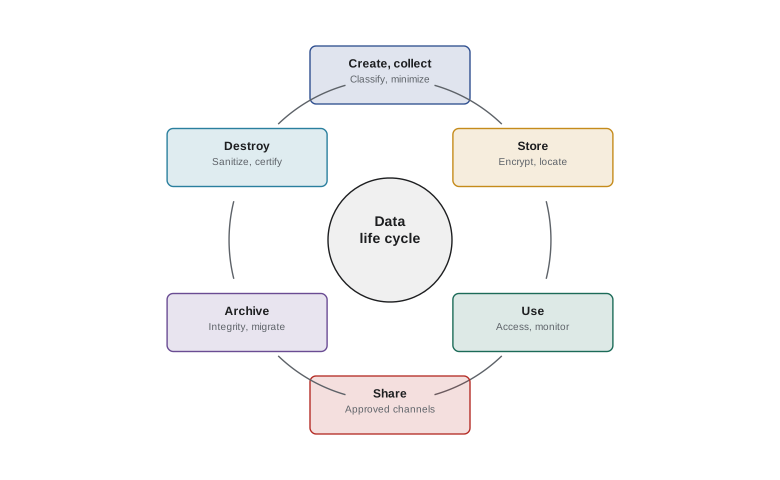
Data is not static. It is created or collected, stored, used, shared, archived and eventually destroyed, and the risks and controls change at each stage. Collection raises questions of necessity, consent and quality. Storage raises questions of location and protection. Use and sharing raise questions of access and purpose. Archiving raises questions of integrity over long periods and readability of old formats. Destruction raises questions of completeness and evidence. A life cycle view makes sure no stage is forgotten, and it aligns security with privacy, records management and data governance, which all use similar models.
Different sources draw the life cycle slightly differently. A common six-stage model is create, store, use, share, archive and destroy, often used for cloud data security. Privacy programs usually start with collect, because data about people is often collected rather than created. Records management emphasizes classification of records, retention schedules and disposition. The details matter less than the habit of asking, for each data set, what happens at each stage and who is responsible.
Creation and collection
Classification should happen as early as possible, ideally at creation. Templates, default labels in collaboration tools, and automatic labeling of content that matches sensitive patterns all help. Information that is labeled at creation can be protected throughout its life; information labeled later has often already been copied and shared.
For personal information, collection is governed by privacy principles common to Canadian, US and international law: collect only what is necessary for an identified purpose (data minimization), tell people why it is being collected, obtain consent where required, and keep it accurate. Minimization is one of the most effective security controls available, because data that was never collected cannot be breached. A form that asks for a full date of birth when only proof of age is needed, or a system that stores full payment card numbers when a token would do, creates risk without benefit. Lesson 10 covers privacy protection in more depth.
Collection also raises questions of quality and integrity. Data collected from untrusted sources, such as web forms, partner feeds or sensors, should be validated before it is trusted. Poor-quality data causes business harm in its own right and can mask or enable fraud.
Data location
The outline names data location explicitly. Where data is stored and processed matters for legal, contractual and operational reasons. Legally, the laws of the country where data is held may give its authorities access, and some laws restrict transfers abroad or require certain data to stay in a particular place, a requirement called data localization or data residency. Contractually, customers, especially governments, often require data to stay in a particular country or region. Operationally, location affects latency, resilience and recovery: data replicated to two regions survives a regional outage, but each copy must be protected and eventually destroyed.
In the United States, there is no general data localization law for private organizations, but sectoral rules and contracts shape location. Federal agencies using cloud services rely on FedRAMP authorizations, and some data, such as certain defense information, must stay within the United States and be handled only by US persons under International Traffic in Arms Regulations and DFARS requirements. Export controls under the Export Administration Regulations can apply to technical data stored abroad. A 2024 Department of Justice rule restricts certain transfers of bulk sensitive personal data to countries of concern. State laws generally focus on how data is protected rather than where it is held.
Cloud services make location a choice that must be made deliberately. Most providers let customers pick regions for primary storage, but backups, logs, support access and disaster recovery may involve other locations. Contracts and configuration should cover all of them. Data sovereignty, a related term, refers to the idea that data is subject to the laws of the country where it is located, and also, for some providers, to the laws of the provider's home country, which is why some governments prefer domestically controlled providers for sensitive data.
Use and access
During use, the main controls are access control, monitoring and purpose limitation. Access should follow need to know and least privilege, as approved by the owner. Monitoring, through logs and user behavior analytics, detects misuse such as an employee looking up records of a celebrity or a neighbor, which is a frequent cause of privacy complaints in health care and government. Purpose limitation, a privacy principle, means data collected for one purpose should not be reused for an unrelated purpose without a legal basis or consent. Using customer service recordings to train a marketing model, for example, may need a fresh look at notice and consent.
Data in use is also hard to protect technically. While data is being processed in memory it is usually unencrypted, so it is exposed to malware, memory-scraping attacks and privileged insiders. Lesson 7 covers newer techniques, such as confidential computing, that protect data in use.
Sharing
Sharing extends the life cycle to other parties. Internal sharing should follow the handling matrix; external sharing needs owner approval, a legal basis for personal information, an agreement defining the recipient's obligations, and secure transfer, as lesson 4 described. Sharing for analytics or research may be possible using de-identified data, with the caveats lesson 10 explains. Every share creates a new copy whose life cycle the organization must still account for, especially if the data must later be deleted at an individual's request or at the end of a contract.
Maintenance
Maintenance covers keeping data accurate, complete and usable during its life. It includes correcting errors, keeping backups current and tested, migrating data when systems change, and protecting integrity with controls such as checksums, database constraints and audit trails. Data quality is a security concern because integrity is one of the core properties: decisions made on inaccurate data can cause harm as serious as a breach. Privacy laws also give individuals a right to access and correct their information, which requires processes to find all copies and update them.
Maintenance also includes managing the systems that hold the data. When applications are upgraded or replaced, data must be migrated securely, with validation that nothing was lost or altered, and the old system's data must then be retained or destroyed according to the schedule. Migration projects are a frequent source of forgotten copies: the old database left running just in case, the export file left on a shared drive, the test environment loaded with production data.
Archiving
Data that is no longer actively used but must be kept, for legal, regulatory or historical reasons, moves to an archive. Archives need integrity protection over long periods, controlled access, and the ability to read the data years later. Formats and media become obsolete: data on an old tape format with no working drive, or in a proprietary file format no current software opens, is effectively lost. Archive plans should include periodic integrity checks, media refresh and format migration. Archived data still counts as held by the organization for privacy and legal purposes, including access requests and discovery in litigation.
Worked problem
Mapping a data set through the life cycle
A university collects applicant data through an online form: names, contact details, transcripts and, optionally, disability accommodation requests. Successful applicants become students; unsuccessful applicants' files are kept for a period and then destroyed. Outline the key controls at each stage.
Show solution
- Collect: ask only for information needed for admission; collect accommodation requests separately with clear notice; validate uploads; label as confidential at creation.
- Store: approved admissions system in an approved region; encrypt at rest; restrict accommodation data to the accessibility office.
- Use: admissions staff access by role; log access; no reuse for unrelated marketing without a legal basis.
- Share: transcripts verified with issuing schools through approved channels; no sharing of accommodation data with admissions committees.
- Archive: successful applicants' files move to the student record under its retention rule.
- Destroy: unsuccessful applicants' files destroyed at the end of the retention period, including copies in exports and backups as they expire, with a disposal record.
Answer: Each stage has its own controls, and accommodation data is handled more strictly throughout. Retention and destruction of unsuccessful applications are as important as protection during use.
Tracking data across systems
The life cycle view is only useful if the organization knows where each data set lives. Data maps or records of processing activities document what personal data is processed, for what purposes, by which systems and vendors, where it is stored and how long it is kept. The GDPR requires records of processing activities from most controllers and processors, and Canadian and US privacy programs use similar inventories to answer access requests, assess breaches and plan retention. Data discovery and classification tools help keep these maps current by scanning repositories for sensitive content, finding the copies that manual mapping misses.
Worked problem
How many copies?
A customer record lives in a production database replicated to a second region, backed up nightly with 35 days of retention, exported weekly to an analytics warehouse, and copied monthly into a test environment. How many locations must be considered if the customer asks for deletion?
Show solution
- Production database and its regional replica: 2 locations.
- Backups: up to 35 nightly copies, which typically expire on schedule rather than being edited.
- Analytics warehouse: 1 location, possibly with its own backups.
- Test environment: 1 location, which should not hold real data at all.
- Logs and caches that may contain identifiers: additional locations to check.
Answer: At least four live locations plus up to 35 backup copies and any logs. A common approach deletes live copies promptly, lets backups expire on schedule while preventing restoration of deleted records, and documents this in the privacy notice.
Thinking like a manager
Life cycle questions on the exam often ask which stage a control belongs to or what the owner should consider at a given point. Classification and minimization belong at creation and collection. Location decisions belong at storage and must cover backups and disaster recovery. Purpose limitation and monitoring belong at use. Agreements belong at sharing. Integrity and format migration belong at archiving. Evidence-based destruction belongs at the end. When in doubt, choose the answer that addresses the problem as early in the life cycle as possible, because early controls are cheaper and more effective.
Common mistakes
MistakeClassifying data only when it is archived or audited.
InsteadClassify at creation so protection follows the data throughout its life.
MistakeCollecting extra personal data in case it is useful later.
InsteadCollect only what is needed for an identified purpose; minimization reduces risk.
MistakeChoosing a cloud region for primary data and ignoring backups and support access.
InsteadCover all locations, including replicas, backups, logs and support, in contracts and configuration.
MistakeLeaving the old system running after a migration just in case.
InsteadValidate the migration, then retain or destroy the old data according to the schedule.
MistakeAssuming archived data is outside privacy and legal obligations.
InsteadArchived data is still held and subject to access requests and discovery.
Summary and key terms
- Data moves through creation or collection, storage, use, sharing, archiving and destruction, with different controls at each stage.
- Classify at creation and collect only what is needed; minimization is a powerful control.
- Data location has legal, contractual and operational consequences, including for backups and support access.
- During use, apply access control, monitoring and purpose limitation.
- Every share creates a copy the organization must still account for.
- Maintenance protects accuracy and integrity; migrations must not leave forgotten copies.
- Archives need integrity checks, media refresh and format migration, and remain subject to legal obligations.
- Data life cycle
- The stages data passes through from creation or collection to destruction.
- Data minimization
- Collecting and keeping only the personal data needed for a purpose.
- Data residency
- A requirement or choice to store data in a particular location.
- Data localization
- A legal requirement that certain data stay within a jurisdiction.
- Data sovereignty
- The principle that data is subject to the laws where it is located or controlled.
- Purpose limitation
- Using personal data only for the purposes for which it was collected, unless another basis applies.
- Data map
- A record of what data is held, where, why, by whom and for how long.
- Record of processing activities
- A documented inventory of personal data processing required by the GDPR.
- Format migration
- Converting archived data to current formats so it stays readable.
- Data discovery
- Scanning repositories to find sensitive data and its copies.
Practice problems
Work each problem on paper first, then reveal the answer to check.
Name the six stages of the common data life cycle model.
Show answer
Create, store, use, share, archive and destroy.
Why is minimization described as a security control?
Show answer
Data that is never collected cannot be breached.
What three kinds of reasons make data location matter?
Show answer
Legal, contractual and operational.
Which 2024 federal rule restricts certain transfers of bulk sensitive personal data?
Show answer
The Department of Justice rule on transfers to countries of concern.
What is purpose limitation?
Show answer
Using personal data only for the purposes it was collected for, unless another legal basis applies.
Why is data in use hard to protect?
Show answer
It is usually unencrypted in memory while being processed.
What can go wrong during a system migration?
Show answer
Old systems, exports and test copies are forgotten and left unprotected.
What threatens the readability of archives over time?
Show answer
Obsolete media and file formats.
What is a record of processing activities?
Show answer
A documented inventory of personal data processing, required by the GDPR.
When in doubt, where in the life cycle should a problem be addressed?
Show answer
As early as possible.
Lesson quiz · 5 questions
Score 60% or more to complete this lesson.
Create a free account to save your progress, take quizzes and earn a certificate.