
CISSP-114 · Lesson 2 of 12 · 29 min
Identification and identity proofing
Before anyone can authenticate, someone must decide who they are. Identification is the claim a subject makes; identity proofing is the process an organization uses, once, at enrollment, to establish that the claimed identity belongs to a real person and that the applicant is that person. Weak proofing undermines everything built on top of it: a fraudster who opens an account in someone else's name will pass every later authentication perfectly, because the credential really is theirs. This lesson covers identifiers and naming, the account types an organization must manage, how identity proofing works and how assurance levels describe its strength, and the digital identity programs emerging in Canada and the United States.
Identifiers and naming conventions
An identifier is the label by which a system knows a subject. Good identifiers are unique within their scope, so that two subjects never share one; persistent, so that they do not change when a person changes name or department; and ideally non-descriptive, revealing as little as possible about the person or their role. Uniqueness is essential for accountability. Persistence matters because logs and permissions reference identifiers for years; if an identifier is reused, a new employee can inherit the history and even the access of a former one. Non-descriptiveness is a defense against reconnaissance: an account called admin-payroll tells an attacker exactly which account to target.
Many organizations use two identifiers: an immutable internal identifier, such as a randomly generated employee number or directory object identifier, which never changes or gets reused, and a friendly login name or email address, which can change when a person marries or transfers. Applications should key permissions on the immutable identifier. Common naming schemes such as first initial plus surname produce collisions in any organization of a few hundred people, so they need a documented rule for duplicates and a ban on reusing names of former staff for a defined period.
import random
random.seed(114)
first = ['Amira','Ben','Chen','Dana','Eli','Fatima','Gabe','Hana','Ivan','Jia','Kofi','Lea','Malik','Nora','Omar','Priya','Raj','Sofia','Tom','Yusuf']
last = ['Singh','Smith','Tremblay','Nguyen','Brown','Wilson','Martin','Lee','Roy','Patel']
staff = [(random.choice(first), random.choice(last)) for _ in range(400)]
logins = [f[0].lower() + l.lower() for f, l in staff]
from collections import Counter
c = Counter(logins)
clashes = sum(n - 1 for n in c.values() if n > 1)
print('Staff:', len(staff), ' distinct first-initial logins:', len(c), ' people needing a suffix:', clashes)
# Chance two of n people receive the same random 6-digit identifier (birthday bound)
import math
for n in (500, 1000, 5000):
    p = 1 - math.exp(-n * (n - 1) / (2 * 10**6))
print(f'{n:5d} random 6-digit IDs: chance of at least one collision {p:.1%}')Staff: 400 distinct first-initial logins: 172 people needing a suffix: 228 500 random 6-digit IDs: chance of at least one collision 11.7% 1000 random 6-digit IDs: chance of at least one collision 39.3% 5000 random 6-digit IDs: chance of at least one collision 100.0%
The output shows two things. Name-based logins collide constantly, so the collision rule is not an edge case. And even random numeric identifiers collide surprisingly often by the birthday effect, which is why the issuing system must check uniqueness rather than trust randomness. Identifiers are not secrets: user names appear in email addresses and logs, so security must never rest on keeping them hidden, although an organization can reasonably avoid publishing administrator account names.
Account types
An IAM program governs several kinds of account, each with different risks. Standard user accounts belong to one person for everyday work. Privileged or administrator accounts can change systems, and should be separate from the same person's everyday account so that reading email or browsing is never done with administrator rights. Service accounts are used by applications and scheduled jobs; they have no human behind them, often hold broad rights, rarely have their passwords changed and are a favorite target. Shared or generic accounts, such as a kiosk login, are used by several people and defeat accountability; they should be eliminated or tightly constrained. Emergency or break-glass accounts give access when normal authentication fails, and must be sealed, monitored and reviewed after every use. Guest and external accounts for contractors, partners and customers need sponsors and expiry dates.
| Account type | Main risk | Key controls |
|---|---|---|
| Standard user | Phishing and credential theft | Strong authentication, least privilege, joiner-mover-leaver automation |
| Privileged or administrator | Full compromise of systems if stolen | Separate account, PAM vaulting, just-in-time elevation, session recording |
| Service or workload | Long-lived secrets with broad rights, no owner | Named owner, managed or keyless identities, rotation, no interactive login |
| Shared or generic | No individual accountability | Eliminate; if unavoidable, check out through PAM with individual sign-in |
| Emergency (break-glass) | Unmonitored backdoor | Sealed credentials, alerts on use, post-use review and rotation |
| Guest, contractor, customer | Access outlives the relationship | Sponsor, expiry date, restricted scope, periodic review |
How identity proofing works
Identity proofing establishes a link between an applicant and a real-world identity. NIST describes three steps. Resolution distinguishes the claimed identity from all others by collecting enough attributes, such as name, date of birth and address, to point to exactly one person. Validation checks that the evidence presented, such as a passport or driver's license, is genuine, current and accurate, for example by inspecting security features or checking with the issuing authority. Verification confirms that the applicant is the person to whom the evidence belongs, for example by comparing a live selfie with the photo on the document, by an agent comparing the face in person, or by sending a code to an address of record.
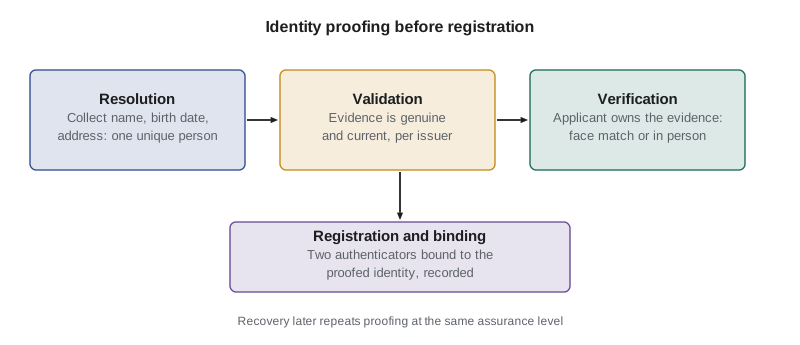
Proofing can be in person, supervised remotely over video or unsupervised remotely through an app that reads a document and captures a selfie. Remote proofing scales and is convenient but faces document forgery, deepfake video and presentation attacks, so better systems use liveness detection and checks with authoritative sources. Organizations also proof employees as part of hiring: checking identity documents for employment eligibility, references and, where lawful, background checks. The identity established at hiring becomes the authoritative identity that drives provisioning, which is why personnel security and IAM are linked.
Knowledge-based verification, asking questions such as previous addresses or loan amounts, was once common for remote proofing. It is now considered weak because the answers are widely available from data breaches and social media, and NIST no longer accepts it for verification at higher assurance levels. Likewise, a phone number or email address shows that someone controls a channel, not who they are.
Assurance levels: IAL, AAL and FAL
NIST SP 800-63, the US Digital Identity Guidelines, separates digital identity into three independent dimensions, each with its own assurance levels. The fourth revision, SP 800-63-4, was finalized in August 2025 (checked October 2026). Identity assurance level, IAL, describes the strength of proofing. Authenticator assurance level, AAL, describes the strength of authentication, covered in lessons 3 and 4. Federation assurance level, FAL, describes the strength of assertions passed between an identity provider and a relying party, covered in lesson 6. Separating the dimensions lets a service choose, for example, strong authentication for an anonymous account (low IAL, high AAL), or strong proofing with moderate authentication.
| Level | Proofing (IAL) | Typical use |
|---|---|---|
| IAL1 | Basic proofing of core attributes with limited evidence; remote, unsupervised | Low-risk services where some confidence in identity is useful |
| IAL2 | Strong evidence validated against the issuer and verified to the applicant, remotely or in person | Benefits, tax and health portals; most employee onboarding |
| IAL3 | In-person or supervised remote proofing by trained staff with biometric collection | High-value or high-risk access where impersonation would cause severe harm |
Selecting the level is a risk decision. The guidelines ask the service owner to assess the impact of a proofing failure, from inconvenience to financial loss to harm to safety, and choose controls that match. Choosing too high a level excludes legitimate users who lack the required documents or cannot attend in person; revision 4 places new emphasis on equity and on offering alternatives, such as trusted referees who vouch for an applicant. Choosing too low a level invites fraud. In Canada, the Treasury Board Standard on Identity and Credential Assurance uses four levels of assurance for federal programs, and the Pan-Canadian Trust Framework maps similar levels across jurisdictions.
Worked problem
Choosing an assurance level
A provincial agency plans an online portal where residents can change the bank account into which their monthly benefit, averaging $1,400, is deposited. Fraudsters have previously redirected payments by impersonating recipients. Recommend proofing and authentication levels and justify them.
Show solution
- Impact of a proofing failure: direct financial loss to vulnerable residents and to the agency, plus harm to trust; this is at least moderate.
- Proofing: IAL2 or equivalent, with document validation against the issuer and verification such as a selfie match or an in-person option at a service center.
- Authentication: AAL2 at minimum, with a phishing-resistant option offered, because changing payment details is a high-risk transaction.
- Add transaction controls: notify the old contact details of any change, hold the first payment to a new account for review and allow residents without documents to use an assisted channel.
Answer: Strong proofing alone does not stop account takeover, and strong authentication alone does not stop a fraudster who enrolled in the victim's name. The portal needs both, plus monitoring of the high-risk transaction.
Digital identity programs
In the United States, there is no national digital identity card. Federal agencies follow NIST SP 800-63-4, finalized in August 2025, and many use Login.gov, operated by the General Services Administration, which offers identity verification to IAL2 including a remote option with facial comparison and an in-person option at participating post offices. Some agencies and states also use commercial identity providers. States issue the foundational credentials, driver's licenses and state ID cards, and REAL ID enforcement began on 7 May 2025, so a REAL ID-compliant card or another accepted document such as a passport is now needed to board domestic flights and enter certain federal facilities. Many states also issue mobile driver's licenses that follow the ISO/IEC 18013-5 standard and are accepted at some airport checkpoints. Checked October 2026; confirm current acceptance lists.
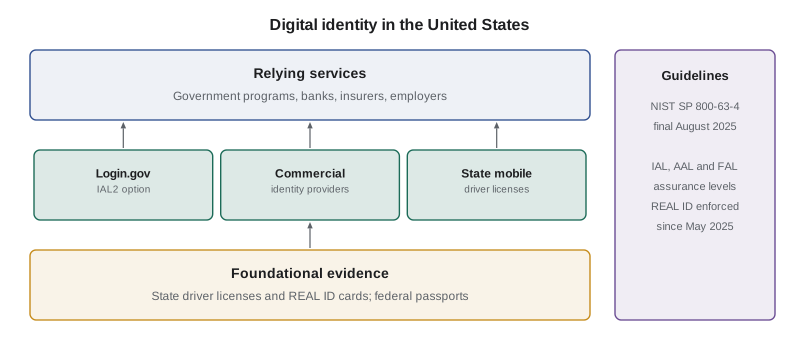
For organizations, these programs matter in two ways. They may become accepted evidence for proofing customers and employees, reducing the need to collect and store copies of documents. And they raise the same privacy questions as any identity system: what data is shared, whether use can be tracked across services and how consent is managed. Verifiable credentials, digital wallets and selective disclosure, which let a person prove they are over 19 without revealing their birth date, are designed to reduce oversharing.
Registration and binding
Once proofed, the applicant is enrolled: an account is created and one or more authenticators are bound to it. Binding must be done securely, because an authenticator bound to the wrong person, or intercepted in transit, gives an attacker a perfectly valid credential. Good practice includes delivering initial credentials through a separate channel from the proofing session, requiring the user to set their own secret immediately, binding at least two authenticators so that losing one does not force weak recovery, and recording which authenticators were bound, when and by whom. Account recovery deserves the same rigor as enrollment, because attackers target the help desk and the forgotten-password page precisely because they are often the weakest path to an account.
Worked problem
Help-desk recovery
A caller claiming to be the finance director phones the help desk at 18:30, says she is traveling, has lost her phone and needs her multifactor reset urgently before a board deadline. What should the procedure require?
Show solution
- Do not reset based on caller knowledge alone; names, titles and travel plans are easy to find.
- Verify through an independent channel: call back on the number in the HR record, or require a video check against the photo on file with her manager present.
- Use a pre-registered backup authenticator if she has one, rather than issuing a new one.
- If an exception is approved, give temporary, limited access, alert the account owner through all known channels and review the event the next day.
Answer: Recovery is a form of re-proofing and needs controls equal to the account's assurance level. Social engineering of help desks has led to major breaches, so urgency should trigger more scrutiny, not less.
Thinking like a manager
Identity proofing and identifier design are early decisions that are hard to change later. A manager should insist on unique, persistent identifiers keyed to an authoritative source, separate privileged accounts, owners and expiry dates for every non-standard account, and proofing and recovery processes whose strength matches the risk of the service. Exam questions often describe an attack that succeeded at enrollment or recovery; the best answer strengthens that process, not the login page.
Common mistakes
MistakeReusing the login names of former employees.
InsteadKeep identifiers unique and persistent, and never reuse them for a defined period or at all.
MistakeUsing knowledge-based questions to verify identity remotely.
InsteadUse document validation with liveness checks, authoritative sources or in-person verification.
MistakeLetting the help desk reset multifactor authentication on a convincing phone call.
InsteadVerify through an independent channel or pre-registered backup authenticator, and alert the owner.
MistakeGiving administrators one account for both daily work and administration.
InsteadUse a separate privileged account, managed through PAM.
MistakeChoosing the highest proofing level everywhere.
InsteadMatch the level to the risk, and provide alternatives so legitimate users are not excluded.
Summary and key terms
- Identifiers should be unique, persistent and non-descriptive; they are not secrets.
- Different account types, from users to service and break-glass accounts, need different controls.
- Identity proofing resolves, validates and verifies an identity before binding authenticators.
- NIST SP 800-63-4, final in August 2025, separates IAL, AAL and FAL.
- Knowledge-based verification is weak because answers are widely exposed.
- Canada relies on provincial digital IDs and the DIACC Pan-Canadian Trust Framework; the US uses NIST guidance, Login.gov and state credentials, with REAL ID enforced since May 2025.
- Account recovery is re-proofing and must be as strong as enrollment.
- Identifier
- A label that uniquely names a subject within a system.
- Identity proofing
- Establishing that an applicant is who they claim to be before enrollment.
- Resolution
- Distinguishing one unique identity from all others using attributes.
- Validation
- Confirming that identity evidence is genuine and current.
- Verification
- Confirming that the applicant is the owner of the evidence.
- IAL
- Identity assurance level, the strength of proofing.
- AAL
- Authenticator assurance level, the strength of authentication.
- FAL
- Federation assurance level, the strength of federated assertions.
- Break-glass account
- An emergency account used when normal access fails, under strict control.
- Pan-Canadian Trust Framework
- DIACC conformance criteria for trusted digital identity in Canada.
Practice problems
Work each problem on paper first, then reveal the answer to check.
Why should identifiers be persistent?
Show answer
Logs and permissions reference them for years; changing or reusing them breaks accountability.
What are the three steps of identity proofing?
Show answer
Resolution, validation and verification.
Why is knowledge-based verification weak?
Show answer
Answers are often available from breaches and social media.
Which assurance dimension describes the strength of proofing?
Show answer
IAL.
When was NIST SP 800-63-4 finalized?
Show answer
August 2025.
Why must administrators have separate privileged accounts?
Show answer
So everyday activity such as email is never done with administrative rights.
What three controls should every guest or contractor account have?
Show answer
A sponsor, an expiry date and restricted scope with review.
Why should a random identifier generator still check uniqueness?
Show answer
Collisions occur surprisingly often by the birthday effect.
What does selective disclosure allow?
Show answer
Proving an attribute, such as age over a threshold, without revealing more data.
Why is account recovery a common attack path?
Show answer
It is often weaker than normal authentication and relies on help desks that can be socially engineered.
Lesson quiz · 5 questions
Score 60% or more to complete this lesson.
Create a free account to save your progress, take quizzes and earn a certificate.