
CISSP-114 · Lesson 9 of 12 · 26 min
The identity and access provisioning life cycle
Access is not granted once and forgotten. People join, change jobs, take leave, return, become contractors and leave; systems are added and retired; roles are redesigned. Each change should change access, and in most organizations many changes do not. The result is privilege creep, where long-serving staff accumulate rights from every job they have held, and orphaned accounts, where access survives the person or project it was created for. Sub-domain 5.5 covers managing this identity and access provisioning life cycle. This lesson walks through joiner, mover and leaver processes, automated provisioning with SCIM, access reviews and recertification, and the audit and legal expectations that make the life cycle a compliance matter as well as a security one.
Joiners, movers and leavers
The identity life cycle is often summarized as joiner, mover, leaver, JML. A joiner event, triggered by a new hire record in the authoritative HR system, creates a directory identity and grants birthright access, the baseline every member of that role, department or location receives, such as email, the intranet and the time-sheet system. Further access beyond birthright is requested and approved through a workflow, ideally by the resource owner, not just the manager. A mover event, such as a promotion, transfer or change of manager, should add access for the new role and remove access the person no longer needs; in practice the removal is often forgotten, which is the main cause of privilege creep. A leaver event, triggered by termination, should disable the identity immediately, revoke sessions and tokens, recover devices and badges, transfer ownership of data and remove access in every connected system.
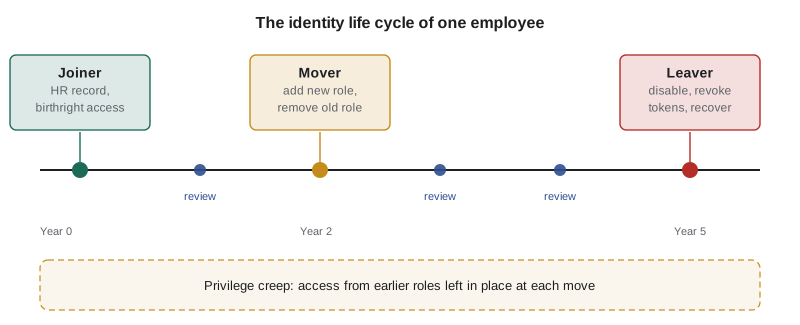
Leavers deserve special attention because the risk is concentrated in the hours around departure. For voluntary departures, access can be removed at the end of the last day; for involuntary terminations, especially of privileged staff, access should be removed before or at the moment the person is told, coordinated between HR, the manager and security. Disabling the directory account is not enough if the person also has local accounts, cloud console access, personal API keys, shared credentials they know or active sessions and refresh tokens that remain valid for hours or days. Shared passwords the leaver knew must be rotated.
| Event | Trigger | Access actions | Common failure |
|---|---|---|---|
| Joiner | New hire record in HR | Create identity; grant birthright access; route requests for more | Copying another user's access ("make her like Sam") |
| Mover | Job, department or manager change in HR | Grant new role access; remove old access after a defined overlap | Old access never removed: privilege creep |
| Leave of absence | HR status change | Suspend access; keep data | Accounts active and unmonitored for months |
| Leaver | Termination in HR | Disable identity; revoke sessions and tokens; rotate shared secrets; recover assets | Accounts in unconnected systems left active |
| Contractor end | Contract end date in vendor system | Automatic expiry; sponsor confirmation to extend | Access outlives the contract |
Copying another user's access, the make-her-like-Sam request, is a quiet but serious problem: Sam may have accumulated years of excess rights, which are now duplicated. Role-based birthright access, documented role definitions and request workflows that ask for specific entitlements with a business reason avoid it.
Automated provisioning and SCIM
Manual provisioning, where help desk staff create accounts from emailed requests, is slow and error-prone, and manual deprovisioning is worse because nobody is waiting impatiently for it. Identity governance and administration, IGA, tools connect the HR system to the directory and to applications, so that life cycle events flow automatically. Connectors for on-premises systems often use LDAP, database or API calls. For cloud applications, the System for Cross-domain Identity Management, SCIM 2.0, defined in RFC 7643 and RFC 7644, is the standard: the identity provider calls each application's SCIM API to create, update, deactivate and delete users and groups using a common JSON schema. When choosing software-as-a-service products, support for SCIM, or at least for automated deprovisioning, should be a requirement in procurement.
import json
# A SCIM 2.0 request body to deactivate a user (PATCH /scim/v2/Users/{id})
patch = {
    'schemas': ['urn:ietf:params:scim:api:messages:2.0:PatchOp'],
    'Operations': [{'op': 'replace', 'path': 'active', 'value': False}],
}
print(json.dumps(patch, indent=2))
# A minimal SCIM user resource as returned by the application
user = {
    'schemas': ['urn:ietf:params:scim:schemas:core:2.0:User'],
    'id': '2819c223-7f76-453a-919d-413861904646',
    'userName': 'priya.singh@example.ca',
    'name': {'givenName': 'Priya', 'familyName': 'Singh'},
    'active': False,
    'groups': [],
}
print('User', user['userName'], 'active =', user['active'], 'groups =', user['groups']){
"schemas": [
"urn:ietf:params:scim:api:messages:2.0:PatchOp"
],
"Operations": [
{
"op": "replace",
"path": "active",
"value": false
}
]
}
User priya.singh@example.ca active = False groups = []Automation does not remove the need for reconciliation. Some systems will never be connected, and connectors fail silently. Regular reconciliation compares the authoritative HR list with the accounts that exist in each system, flagging accounts with no matching person, accounts belonging to people who have left and accounts whose attributes disagree. Each flagged account needs an owner's decision and a deadline.
hr = {  # authoritative source: employee id -> status
    'E1001': 'active', 'E1002': 'active', 'E1003': 'terminated', 'E1004': 'leave', 'E1005': 'active',
}
app_accounts = [  # accounts found in an unconnected finance application
    ('jlee', 'E1001'), ('mroy', 'E1003'), ('temp-audit', None), ('kpatel', 'E1004'), ('svc-report', None), ('aotieno', 'E1005'),
]
service_owners = {'svc-report': 'finance-systems-team'}
for account, emp in app_accounts:
    if emp is None:
        if account in service_owners:
            print(f'{account:11s} service account, owner {service_owners[account]} - confirm still needed')
        else:
            print(f'{account:11s} ORPHAN: no person or owner - disable and investigate')
    elif hr.get(emp) == 'terminated':
        print(f'{account:11s} LEAVER STILL ACTIVE ({emp}) - disable now, review recent activity')
    elif hr.get(emp) == 'leave':
        print(f'{account:11s} on leave ({emp}) - suspend until return')
    else:
        print(f'{account:11s} matched to active employee {emp}')
missing = [e for e, s in hr.items() if s == 'active' and e not in {emp for _, emp in app_accounts}]
print('Active employees with no account (expected for most):', missing)jlee matched to active employee E1001 mroy LEAVER STILL ACTIVE (E1003) - disable now, review recent activity temp-audit ORPHAN: no person or owner - disable and investigate kpatel on leave (E1004) - suspend until return svc-report service account, owner finance-systems-team - confirm still needed aotieno matched to active employee E1005 Active employees with no account (expected for most): ['E1002']
Access reviews and recertification
An access review, also called recertification or attestation, asks a responsible person to confirm that each user's access is still appropriate, and removes what is not. Reviews can be organized by user, with managers reviewing their staff's access, or by resource, with data and application owners reviewing who can reach their systems; resource-owner reviews are usually better for sensitive systems because owners understand what each entitlement does. Privileged access, access to regulated data and access granted by exception should be reviewed more often, typically quarterly, while ordinary access may be reviewed twice a year or annually.
Reviews fail in predictable ways. Reviewers rubber-stamp hundreds of items without reading them, especially when entitlements have cryptic names such as GRP_FIN_AP_RW_03. Reviews arrive as spreadsheets that take weeks to reconcile. Revocations decided in the review are never carried out. Good programs give reviewers business-friendly descriptions, highlight risky or unusual access such as access unused for 90 days or outside the person's peer group, track revocation to completion and measure the results.
reviews = {  # reviewer: (items reviewed, items revoked, median seconds per decision)
    'manager-a': (120, 9, 21),
    'manager-b': (340, 0, 2),
    'app-owner-payroll': (85, 14, 48),
    'manager-c': (60, 0, 3),
}
print('reviewer            items revoked  rate   s/item  flag')
for who, (n, revoked, secs) in reviews.items():
    rate = revoked / n
    flag = 'possible rubber-stamping' if revoked == 0 and secs < 5 else ''
    print(f'{who:20s}{n:5d} {revoked:7d} {rate:6.1%} {secs:6d}  {flag}')
total = sum(r[0] for r in reviews.values()); revoked = sum(r[1] for r in reviews.values())
print(f'Overall revocation rate: {revoked / total:.1%} of {total} items')
print('Revocations completed within 5 business days: 21 of 23 (91.3%) - chase the 2 open items')reviewer items revoked rate s/item flag manager-a 120 9 7.5% 21 manager-b 340 0 0.0% 2 possible rubber-stamping app-owner-payroll 85 14 16.5% 48 manager-c 60 0 0.0% 3 possible rubber-stamping Overall revocation rate: 3.8% of 605 items Revocations completed within 5 business days: 21 of 23 (91.3%) - chase the 2 open items
Worked problem
Diagnosing privilege creep
An internal audit finds that a senior analyst at a utility, with the company for 14 years, holds 212 entitlements, compared with a median of 61 for analysts in the same team, including write access to a billing system she last used in a job she left in 2019. What process failures does this reveal, and what should change?
Show solution
- Mover process: access from previous jobs was never removed when she changed roles.
- Access reviews: past reviews approved the access, probably because the reviewer saw only entitlement codes and trusted a long-serving employee.
- Fix the mover process so old role access is removed automatically after an overlap of, say, 30 days unless re-approved.
- Run a one-time clean-up using peer-group comparison and last-used dates, then improve reviews with descriptions, usage data and outlier flags.
Answer: Privilege creep is a process failure, not an individual one. Automated mover handling and risk-focused reviews prevent recurrence.
Audit and legal expectations
In the United States, the Sarbanes-Oxley Act requires public companies to assess internal control over financial reporting, and external auditors routinely test user access provisioning, timely removal of leavers and periodic access reviews for financial systems; findings such as terminated users with active access are common deficiencies. Other regimes have similar expectations: HIPAA's security rule requires access authorization, establishment and modification procedures; PCI DSS requires reviews of user accounts and removal of inactive accounts within 90 days; NYDFS Part 500 requires at least annual review of user access privileges; and federal agencies follow NIST SP 800-53 access control requirements. State privacy laws limit how long personal data about former employees may be retained. Checked October 2026.
Evidence matters as much as practice. Auditors ask for proof: lists of leavers with the time their access was removed, completed review records with reviewer decisions, approvals for new access and exception registers. A life cycle that works but leaves no trail will still fail an audit.
| Metric | Why it matters | Example target |
|---|---|---|
| Time from termination to access removal | Leaver risk is highest at departure | Within 1 hour for involuntary, end of day for voluntary |
| Orphaned accounts found in reconciliation | Measures provisioning completeness | Zero unexplained after each cycle |
| Review completion on time | Shows the process is followed | 100 % within the review window |
| Revocations completed | Decisions must be carried out | All within 5 business days |
| Entitlements per user versus peer median | Detects privilege creep | Investigate outliers above twice the median |
| Accounts with no sign-in for 90 days | Unused access is unneeded access | Disable or justify |
Thinking like a manager
Life cycle questions usually describe a symptom, such as a former employee logging in, a long-serving employee with excessive access, or an audit finding, and ask for the best response. The best answer fixes the process that caused it: connect provisioning to the authoritative HR source, automate deprovisioning, remove old access on moves, reconcile unconnected systems, and run risk-focused reviews whose revocations are carried out and evidenced. Disabling the single account in the example is necessary but never sufficient.
Common mistakes
MistakeGranting new staff a copy of a colleague's access.
InsteadGrant role-based birthright access and approve additional entitlements individually.
MistakeAdding access on transfer without removing the old role's access.
InsteadRemove previous access automatically after a defined overlap unless re-approved.
MistakeDisabling only the directory account when someone leaves.
InsteadRevoke sessions and tokens, rotate shared secrets and remove access in unconnected systems.
MistakeSending reviewers spreadsheets of cryptic entitlement codes.
InsteadProvide business descriptions, usage data and outlier flags, and track revocations to completion.
MistakeBuying SaaS applications without automated deprovisioning.
InsteadRequire SCIM or equivalent in procurement.
Summary and key terms
- The life cycle covers joiners, movers, leavers, leave and contractor end, driven by authoritative sources.
- Privilege creep comes mainly from mover events that add access without removing it.
- Leaver processes must revoke sessions, tokens and shared secrets, not just disable accounts.
- SCIM 2.0 standardizes provisioning to cloud applications; reconciliation catches what automation misses.
- Access reviews should be risk-focused, understandable and followed by completed revocations.
- Auditors expect evidence of timely removal and reviews; Canadian and US regimes test these controls.
- Track metrics such as time to remove leavers and orphaned accounts found.
- Joiner, mover, leaver
- The life cycle events that should create, change and remove access.
- Birthright access
- Baseline access granted automatically based on role, department or location.
- Privilege creep
- Gradual accumulation of access beyond current needs.
- Orphaned account
- An account with no current owner or matching person.
- SCIM
- System for Cross-domain Identity Management, a standard API for provisioning.
- Reconciliation
- Comparing authoritative identity data with accounts in each system.
- Access review
- Periodic confirmation by a responsible person that access is still appropriate.
- Rubber-stamping
- Approving review items without genuine evaluation.
- Identity governance and administration
- Tools and processes for provisioning, requests and reviews.
- Peer-group analysis
- Comparing a user's entitlements with those of similar users to find outliers.
Practice problems
Work each problem on paper first, then reveal the answer to check.
Which life cycle event most often causes privilege creep?
Show answer
Mover events where old access is not removed.
What is birthright access?
Show answer
Baseline access granted automatically by role, department or location.
Why must sessions and refresh tokens be revoked when someone leaves?
Show answer
They can remain valid after the account is disabled.
Which standard API provisions users to SaaS applications?
Show answer
SCIM 2.0.
What does reconciliation compare?
Show answer
Accounts in each system against the authoritative identity source.
Who is usually better at reviewing access to a sensitive application?
Show answer
The application or data owner.
Give one sign of rubber-stamping in reviews.
Show answer
Very fast decisions with no revocations.
Why is copying a colleague's access risky?
Show answer
It duplicates any excess access the colleague has accumulated.
When should a privileged employee's access be removed on involuntary termination?
Show answer
Before or at the moment they are told.
What do auditors need besides a working process?
Show answer
Evidence such as removal times, review records and approvals.
Lesson quiz · 5 questions
Score 60% or more to complete this lesson.
Create a free account to save your progress, take quizzes and earn a certificate.