
CISSP-117 · Lesson 4 of 12 · 27 min
Securing the development environment and the delivery pipeline
Attackers have learned that it is often easier to compromise software where it is made than where it runs. A malicious change slipped into a build server, a stolen credential for a code repository or a tampered build tool can deliver malicious code to every customer at once, signed and trusted. The SolarWinds compromise discovered in December 2020, in which attackers inserted a backdoor into the build process of a widely used network management product, made this risk impossible to ignore. Lesson 10 examines that case and the wider software supply chain. This lesson looks inward, at the development ecosystem the organization itself controls: developer workstations and tools, source code repositories, build systems, artifact repositories, test environments and the continuous integration and delivery (CI/CD) pipeline that connects them.
The CISSP outline asks you to identify and apply security controls in software development ecosystems, naming programming languages, libraries, tool sets, integrated development environments, runtimes, CI/CD, security orchestration, automation and response, software configuration management, code repositories and application security testing. Testing tools are covered in Lesson 9. Here we concentrate on protecting the ecosystem itself.
The development ecosystem as a high-value target
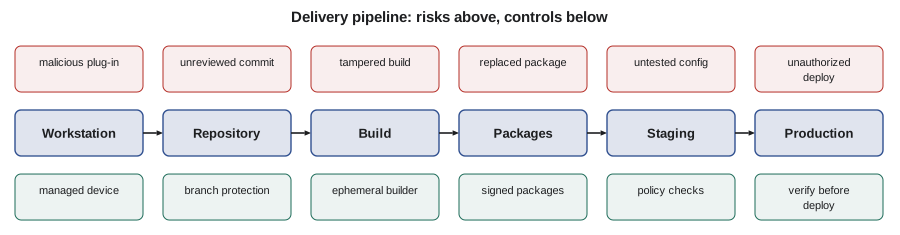
The development ecosystem deserves the same protection as production, and sometimes more. It holds the organization's intellectual property, credentials for production systems and the ability to change what customers run. Yet it is often less protected: developers have broad privileges, test environments are loosely controlled, and build servers are configured once and forgotten. A useful way to think about it is that every component that can change the final software is part of the trusted computing base of that software. If the build server can be altered, the code review that happened before it is irrelevant.
Developer workstations and tools
Developers need flexibility, but their workstations are a common entry point. Controls include managed and encrypted devices with endpoint protection, prompt patching, separate accounts for everyday work and privileged tasks, and phishing-resistant multifactor authentication for code repositories and cloud consoles. Integrated development environments (IDEs) and their plug-ins, browser extensions, command-line tools and package managers all execute code on the workstation, and malicious extensions have been published in public marketplaces. Organizations should maintain a list of approved tools and extensions, obtain them from trusted sources, and review high-risk categories such as tools that request access to source code or credentials. Remote development environments, in which code is edited on centrally managed cloud workspaces rather than laptops, can reduce exposure by keeping code and secrets off endpoint devices.
Source code repositories and configuration management
Software configuration management (SCM) is the discipline of identifying, controlling and tracking every version of every item that makes up the software: source code, build scripts, infrastructure definitions, configuration and documentation. A version control system, today almost always Git hosted on a platform such as GitHub, GitLab or Bitbucket, provides the technical foundation. For security, the repository is where integrity and accountability are established.
| Control | Purpose | Typical implementation |
|---|---|---|
| Strong authentication | Prevent account takeover | Single sign-on with phishing-resistant MFA; short-lived access keys |
| Least privilege | Limit who can change what | Write access only to the team's repositories; few administrators |
| Branch protection | Prevent unreviewed changes to release branches | Pull requests required; direct pushes blocked; force pushes disabled |
| Two-person review | Separation of duties and quality | At least one approving review from someone other than the author; code owners for sensitive paths |
| Required status checks | Enforce automated gates | Build, tests and security scans must pass before merging |
| Signed commits and tags | Attribute changes reliably | Commits or release tags signed with keys tied to verified identities |
| Audit logging | Accountability and detection | Repository and organization audit logs sent to the SIEM |
| Secrets scanning and push protection | Keep credentials out of code | Pushes containing likely secrets blocked; history scanned |
Repositories must also be protected against accidental disclosure. Making a private repository public by mistake, or copying code to a personal account, can expose proprietary logic and embedded secrets. Organizations should monitor public code hosting for their own code and credentials, and should treat repository visibility settings as security-relevant configuration.
Secrets in code
A secret is any value that grants access: passwords, API keys, cloud access keys, database connection strings, signing keys and tokens. Secrets embedded in source code are one of the most common and most damaging development mistakes, because repositories are widely copied and their history keeps every value ever committed. Removing a secret in a later commit does not remove it from history; the only safe response to a committed secret is to revoke and rotate it.
The control is to keep secrets out of code entirely. Applications read secrets at runtime from a secrets manager or a cloud key management service, using an identity granted to the workload rather than a stored password. Pipelines receive short-lived credentials through mechanisms such as workload identity federation instead of long-lived keys stored as pipeline variables. Secrets scanning on every push and periodic scans of history catch the mistakes that still happen.
import re
# Defensive secrets scan over an invented configuration snippet (values are fake)
snippet = '''
db_host = payments-db.internal
db_user = refunds_app
db_password = Ch4ngeMe-Example-Only
api_base = https://api.example.test/v2
partner_api_key = rk_live_EXAMPLE0000000000000000
log_level = info
'''
rules = [
    ('password assignment', re.compile(r'(?i)\b\w*(password|passwd|secret)\w*\s*=\s*\S+')),
    ('live API key pattern', re.compile(r'\brk_live_[A-Za-z0-9]{16,}\b')),
]
for n, line in enumerate(snippet.strip().splitlines(), 1):
    for name, rx in rules:
        if rx.search(line):
            key = line.split('=')[0].strip()
            print(f'line {n}: possible secret ({name}) in "{key}" -> block push, revoke and rotate')
print('Values are never printed: the scanner reports the location, not the secret.')line 3: possible secret (password assignment) in "db_password" -> block push, revoke and rotate line 5: possible secret (live API key pattern) in "partner_api_key" -> block push, revoke and rotate Values are never printed: the scanner reports the location, not the secret.
Two management points follow from the example. First, scanners report locations, not values, because the scan output itself must not become a new place where secrets leak. Second, a detected secret triggers revocation and rotation, not just deletion, and the incident should be logged and reviewed to find out how the secret got into the code.
Build systems and pipeline integrity
The build system turns source code and dependencies into deployable artifacts. Its integrity determines whether what was reviewed is what gets shipped. Good practice is to run builds on isolated, ephemeral workers that are created fresh for each build and destroyed afterwards, so that one compromised build cannot persist into the next; to define the pipeline itself as code, stored in the repository and subject to review; to give each pipeline only the permissions it needs for its stage; and to protect the pipeline's own configuration and secrets as carefully as production credentials. Pipelines that run untrusted code, such as contributions from outside the organization, must not have access to secrets or deployment credentials.
Reproducible builds strengthen integrity further. A build is reproducible if building the same source with the same tools always yields bit-for-bit identical output, which lets independent parties verify that a published binary really came from the published source. Full reproducibility is hard to achieve, but even partial progress, such as pinning dependency versions and tool versions, reduces surprises.
SLSA and build provenance
Supply-chain Levels for Software Artifacts (SLSA, pronounced 'salsa') is an open framework, now hosted by the Open Source Security Foundation, that defines increasing levels of assurance for how software is built. Version 1.0, released in 2023, defines a build track with levels from 0 to 3. The core idea is provenance: a signed, machine-readable statement, generated by the build platform itself, recording what was built, from which source, by which build process and with which inputs. Consumers can verify provenance before deploying an artifact.
| SLSA build level | Requirement in brief | What it protects against |
|---|---|---|
| Build L0 | No guarantees | Nothing; the starting point |
| Build L1 | Provenance exists showing how the package was built | Mistakes and confusion about what was built |
| Build L2 | Provenance is generated and signed by a hosted build platform | Tampering with provenance after the build |
| Build L3 | Hardened build platform isolates builds and protects signing material from the build steps | Tampering during the build by insiders or compromised build steps |
# Evaluate pipelines against simplified SLSA build-track criteria (illustrative)
criteria = [
    ('L1', 'provenance generated'),
    ('L2', 'hosted build platform'),
    ('L2', 'provenance signed by platform'),
    ('L3', 'isolated ephemeral builds'),
    ('L3', 'signing keys inaccessible to build steps'),
]
pipelines = {
    'refunds-service':  {'provenance generated', 'hosted build platform', 'provenance signed by platform',
                         'isolated ephemeral builds'},
    'mobile-app':       {'provenance generated', 'hosted build platform'},
    'legacy-batch':     set(),
}
for name, have in pipelines.items():
    level = 0
    for lvl in ('L1', 'L2', 'L3'):
        need = {c for l, c in criteria if l == lvl}
        if need <= have:
            level = int(lvl[1])
        else:
            missing = sorted(need - have)
            break
    else:
        missing = []
print(f'{name:16s} Build L{level}' + (f' next: {", ".join(missing)}' if missing else ''))refunds-service Build L2 next: signing keys inaccessible to build steps mobile-app Build L1 next: provenance signed by platform legacy-batch Build L0 next: provenance generated
Code signing complements provenance. Signing an artifact with a private key lets anyone holding the public key verify that the artifact has not changed since it was signed and that it came from the holder of the key. Its weakness is key management: if the signing key is stolen, attackers can sign malicious code. Signing keys should live in hardware security modules or managed key services, be usable only by the release pipeline, and be covered by monitoring. The open source Sigstore project offers keyless signing, in which short-lived certificates are tied to a verified identity and every signature is recorded in a public transparency log, making signing easier and misuse more visible.
Artifact repositories and deployment
Built artifacts, such as container images, packages and binaries, are stored in artifact repositories before deployment. Only the release pipeline should be able to publish to the repositories that production pulls from, and production should deploy only artifacts that are signed and whose provenance has been verified, a rule that admission controllers can enforce automatically in container platforms. Internal mirrors or proxies of public package registries let the organization control which external components developers can use and keep builds working if a public package disappears.
Test environments and test data
Test and staging environments should mirror production closely enough to make testing meaningful, but they are often less protected. Two rules are essential. First, separate environments with distinct accounts, networks and credentials, so that a compromise of a test system does not reach production. Second, do not use real personal or payment data in test environments unless there is no alternative and the environment is protected to production standards. Use synthetic data, or production data that has been masked, tokenized or otherwise de-identified. Privacy law in both Canada and the United States treats personal information in a test database exactly like personal information anywhere else.
Worked problem
Fixing an exposed staging database
A Ridgeline engineer copies a full production database to staging to reproduce a bug. The staging environment allows broad developer access and has no audit logging. A security champion notices and escalates.
Show solution
- Treat it as a potential privacy incident: restrict access immediately, preserve access logs that exist, and involve the privacy officer to assess whether a reportable breach occurred.
- Delete the copy or bring the environment up to production controls if the data must remain for a short, approved period.
- Address the root cause: provide a self-service tool that creates masked, production-like datasets so engineers are not tempted to copy real data.
- Update the standard: real personal or payment data in non-production environments requires documented approval and production-equivalent controls.
Answer: Contain and assess the exposure, then remove the incentive by providing safe test data and a clear standard.
Common mistakes
MistakeProtecting production carefully while leaving build servers and repositories loosely controlled.
InsteadTreat everything that can change the shipped software as part of its trusted computing base.
MistakeDeleting a committed secret in the next commit and considering the problem solved.
InsteadRevoke and rotate the secret, because repository history and copies retain it.
MistakeStoring long-lived cloud keys as pipeline variables.
InsteadUse short-lived credentials issued through workload identity and a secrets manager.
MistakeRunning builds on long-lived shared servers.
InsteadUse isolated, ephemeral build workers and define the pipeline as reviewed code.
MistakeKeeping code signing keys on a build server file system.
InsteadProtect signing keys in an HSM or managed key service usable only by the release pipeline.
MistakeCopying production personal data into test environments.
InsteadUse synthetic or masked data, or protect the environment to production standards with approval.
Summary and key terms
- The development ecosystem can change what customers run, so it needs protection at least equal to production.
- Developer workstations, IDEs and plug-ins need management, approved sources and strong authentication.
- Repositories need MFA, least privilege, branch protection, two-person review, required checks, signing and audit logs.
- Secrets belong in secrets managers; committed secrets must be revoked and rotated.
- Builds should run on isolated, ephemeral workers with pipelines defined as reviewed code.
- SLSA defines build levels based on signed provenance; code signing and Sigstore help consumers verify artifacts.
- Test environments must be separated from production and should use synthetic or masked data.
- Software configuration management
- Identifying, controlling and tracking versions of every item that makes up software.
- Branch protection
- Repository rules that prevent unreviewed or unauthorized changes to important branches.
- Secret
- A value such as a password, key or token that grants access.
- Ephemeral build
- A build run on a fresh worker that is destroyed afterwards.
- Reproducible build
- A build that produces bit-for-bit identical output from the same inputs.
- Provenance
- A verifiable record of how, from what and by which process an artifact was built.
- SLSA
- Supply-chain Levels for Software Artifacts, a framework of build integrity levels.
- Code signing
- Applying a digital signature to software so recipients can verify its origin and integrity.
Practice problems
Work each problem on paper first, then reveal the answer to check.
Why can the build system be more important to protect than production?
Show answer
It can alter every release delivered to every environment and customer.
Name three repository controls.
Show answer
MFA, branch protection, two-person review, required status checks, signed commits, audit logs, secrets scanning.
What must happen when a secret is committed to a repository?
Show answer
It must be revoked and rotated, and the cause reviewed.
Why should scanners report locations rather than values?
Show answer
So the scan output does not leak the secrets.
What is an ephemeral build worker?
Show answer
A fresh build environment created for one build and destroyed afterwards.
What does SLSA provenance record?
Show answer
What was built, from which source, by which build process and with which inputs.
What distinguishes SLSA Build L2 from L1?
Show answer
Provenance is generated and signed by a hosted build platform.
What is the main weakness of code signing?
Show answer
Theft or misuse of the signing key.
What does Sigstore add to signing?
Show answer
Short-lived certificates tied to identities and a public transparency log of signatures.
What data should normally be used in test environments?
Show answer
Synthetic or masked data rather than real personal or payment data.
Lesson quiz · 5 questions
Score 60% or more to complete this lesson.
Create a free account to save your progress, take quizzes and earn a certificate.