
CISSP-117 · Lesson 8 of 12 · 25 min
Databases and data security in applications
Almost every application exists to create, read, update and delete data, and most of the data that attackers want sits in databases behind applications. The CISSP body of knowledge has long treated database security as part of software development security because the protections are designed into the application and the database together: the data model, the transactions, the queries, the accounts the application uses and the views it exposes. This lesson covers the database concepts a security manager should know, the classic database-specific threats of aggregation and inference, and the techniques used to protect data inside applications.
CISSP-111 covers data classification, data states and protection methods at the asset level, and CISSP-112 Lesson 6 covers database servers as part of system vulnerability management. CMPUT-291 teaches database design and SQL in depth. Here we focus on where development decisions create or reduce risk.
Database models and terminology
A database management system (DBMS) stores data and controls access to it. Relational databases organize data into tables (relations) of rows (tuples) and columns (attributes). Each table has a primary key that uniquely identifies each row; a foreign key in one table refers to the primary key of another and enforces referential integrity, so that, for example, a refund cannot reference a payment that does not exist. Normalization organizes tables to reduce redundancy and update anomalies. A view is a stored query that presents a subset or transformation of data, and is a powerful security tool because users can be granted access to the view without access to the underlying tables. The data dictionary or catalog holds metadata describing every table, column, view and permission.
Other models appear on the exam and in practice. Hierarchical databases organize records in parent-child trees; network databases allow more general links; object-oriented databases store objects with their methods. NoSQL databases, which became popular for large-scale web applications, include key-value stores, document databases, wide-column stores and graph databases. They often trade some consistency guarantees for scale and flexibility, and many early deployments shipped with authentication disabled by default, leading to large data exposures from databases left open on the internet. The security principles are the same across models: authenticate every connection, grant least privilege, protect data in transit and at rest, validate queries and monitor access.
Transactions and the ACID properties
A transaction is a group of operations that must succeed or fail as a unit. Moving money from one account to another involves a debit and a credit; doing only one of them corrupts the books. Relational databases guarantee four properties for transactions, known by the acronym ACID.
| Property | Meaning | Security relevance |
|---|---|---|
| Atomicity | All operations in a transaction complete, or none do | No partial updates that leave records inconsistent |
| Consistency | A transaction moves the database from one valid state to another, respecting all rules and constraints | Integrity rules such as balances and foreign keys always hold |
| Isolation | Concurrent transactions do not see each other's intermediate states | Prevents race conditions such as double spending |
| Durability | Once committed, a transaction survives failures | Committed records, including audit records, are not lost |
Supporting mechanisms include commit (make the transaction permanent), rollback (undo it), savepoints, two-phase commit for transactions spanning several databases, locking to manage concurrent access, and transaction logs that allow recovery. Lesson 7 described a race condition in which two refund requests together exceed the original payment. A transaction that checks and updates in one atomic step, with constraints enforced by the database, closes that gap.
import sqlite3
# Atomic refund with a database constraint: over-refunding is impossible (defensive pattern)
db = sqlite3.connect(':memory:', isolation_level=None)
db.execute('''CREATE TABLE payments (id TEXT PRIMARY KEY, amount_cents INTEGER,
              refunded_cents INTEGER DEFAULT 0 CHECK (refunded_cents <= amount_cents))''')
db.execute("INSERT INTO payments (id, amount_cents) VALUES ('P-77', 12550)")
def refund(pid, cents):
    try:
        db.execute('BEGIN IMMEDIATE')
        cur = db.execute('UPDATE payments SET refunded_cents = refunded_cents + ? WHERE id = ?', (cents, pid))
        if cur.rowcount != 1:
            raise ValueError('unknown payment')
        db.execute('COMMIT')
        return 'committed'
    except (sqlite3.IntegrityError, ValueError) as e:
        db.execute('ROLLBACK')
        return 'rolled back (' + str(e).split(':')[0] + ')'
for cents in (10000, 2000, 1000):
    print(f'refund {cents / 100:7.2f}:', refund('P-77', cents))
print('refunded total:', db.execute("SELECT refunded_cents FROM payments WHERE id='P-77'").fetchone()[0] / 100)refund 100.00: committed refund 20.00: committed refund 10.00: rolled back (CHECK constraint failed) refunded total: 120.0
Database access from applications
Applications usually connect to databases through a service account. The security of that account is a design decision with large consequences. Each service should have its own account with only the privileges it needs: the reporting service can read selected views, the refunds service can update the refunds and payments tables but not drop them, and only the migration process can change schemas. Database administrators should use separate named accounts with strong authentication and logging, not the application account. Credentials come from a secrets manager or, better, short-lived identity-based authentication rather than a password in a configuration file.
Database interfaces and middleware, such as ODBC, JDBC and the drivers used by ORMs, all support parameterized queries, encrypted connections and certificate validation, but these protections must be configured. Stored procedures can enforce business rules and restrict what an application can do, provided they do not build dynamic SQL from their inputs. Database activity monitoring tools record queries and can alert on unusual access, such as a service account suddenly reading an entire customer table.
Aggregation and inference
Two threats are specific to collections of data. Aggregation occurs when individually non-sensitive items, combined, become sensitive. A list of employees' names is low risk, and so is a list of office locations, but combined with schedules and security clearances they may reveal far more. A single merchant's daily sales total may be harmless, while the full set of totals across all merchants in a city reveals competitive intelligence. Controls for aggregation include classifying the combined data at the higher level, restricting bulk queries and exports, rate limiting, and monitoring for unusually large result sets.
Inference occurs when a user deduces information they are not authorized to see from information they are authorized to see. Classic examples include deducing an individual's salary from department averages when the department has only one or two members, or deducing a confidential project from a sudden change in staff assignments. Controls include suppressing small cells in reports, adding noise or rounding to statistics, restricting queries that isolate small groups, polyinstantiation (described below), and careful design of what summary data is exposed. Differential privacy, a formal technique that adds calibrated random noise to query results, provides mathematical limits on what can be inferred about any individual and is used by statistical agencies and large technology companies.
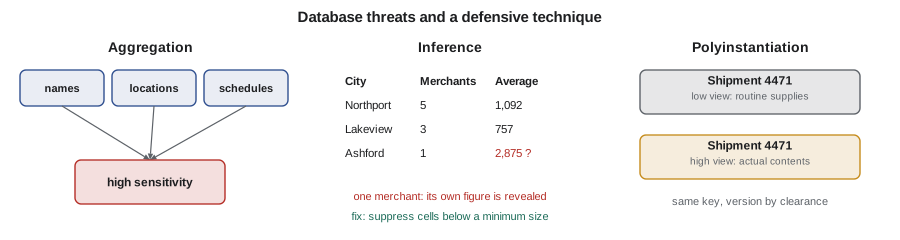
from statistics import mean
# Small-cell suppression in a summary report to limit inference (illustrative data)
refunds = {   # city -> refund amounts per merchant this month
    'Northport': [1200, 950, 1430, 870, 1010],
    'Lakeview':  [640, 720, 910],
    'Ashford':   [2875],
}
MIN_CELL = 3
print(f"{'City':10s} {'merchants':>9s} {'average':>9s}")
for city, vals in refunds.items():
    n = len(vals)
    avg = f'{mean(vals):9.0f}' if n >= MIN_CELL else f"{'suppressed':>9s}"
    print(f'{city:10s} {n:9d} {avg}')
print(f'Rule: averages shown only where at least {MIN_CELL} merchants contribute.')City merchants average Northport 5 1092 Lakeview 3 757 Ashford 1 suppressed Rule: averages shown only where at least 3 merchants contribute.
Polyinstantiation
Polyinstantiation means allowing several rows, or several versions of a data item, with the same primary key but different classification levels. It comes from multilevel secure databases used in defense settings. If a low-clearance user tries to create a record that already exists at a higher classification, refusing the insert would reveal that a secret record exists, which is itself an inference channel. Instead, the database stores a separate low-level version, and each user sees the version appropriate to their clearance. The exam standard example is a shipment recorded as routine supplies for uncleared users and as its real contents for cleared users. In commercial applications the same idea appears in more modest forms, such as presenting different levels of detail to different roles from the same record.
Protecting data within applications
Beyond access control, several techniques reduce the impact if data is exposed. Encryption at rest protects storage media and backups; transparent database encryption protects against theft of files but not against anyone who can query the database. Field-level or column-level encryption protects specific sensitive values, such as bank account numbers, so that only services holding the key can read them. Tokenization replaces a sensitive value with a random token and stores the real value in a separate, tightly controlled vault, which is why payment card environments use it to shrink the systems in scope for card industry assessments. Masking shows only part of a value, such as the last four digits. Hashing with a secret key allows matching without storing the original, for example to check whether an account number has been seen before.
| Technique | Protects against | Does not protect against |
|---|---|---|
| Transparent database encryption | Theft of disks, files or backups | Users or applications with query access |
| Field-level encryption | Database administrators and services without the key; query-level exposure of that field | Compromise of a service that holds the key |
| Tokenization | Exposure of the real value in most systems; reduces compliance scope | Compromise of the token vault |
| Masking | Casual exposure on screens and in reports | Access to the underlying stored value |
| Views and row-level security | Users seeing rows or columns beyond their role | Flaws in the definitions or privileged accounts that bypass them |
APIs deserve particular attention because they are now the main route by which applications expose data. The OWASP API Security Top 10, last updated in 2023, is led by broken object-level authorization, the API equivalent of the insecure direct object reference. Other common API failures include excessive data exposure, in which an endpoint returns entire records and relies on the client to hide fields, and missing limits on resource consumption. A secure API returns only the fields the caller needs, enforces authorization for every object and property, and applies rate and size limits.
Worked problem
Designing data protection for merchant bank details
Ridgeline stores each merchant's payout bank account number. Today it is in plain text in the main database, readable by twelve services and by several engineers with query access.
Show solution
- Minimize: only the payout service needs the real number; other services need to know whether bank details are verified and the last four digits.
- Tokenize: replace the number with a token in the main database and store the real value in a vault service with its own database, keys and audit trail.
- Restrict: grant the payout service a narrow API to the vault; remove engineers' direct query access, replacing it with a break-glass process that is logged and reviewed.
- Protect changes: require re-authentication and notify the merchant whenever bank details change, since account changes are a common fraud pattern.
Answer: Tokenization and minimization reduce exposure from thirteen access paths to one controlled service, and change controls address the fraud risk.
Common mistakes
MistakeLetting every service connect with one powerful database account.
InsteadGive each service its own least-privilege account, with separate administrator accounts.
MistakeEnforcing business rules only in application code.
InsteadAlso use transactions and database constraints so rules hold under concurrency.
MistakeAssuming transparent database encryption stops data theft through the application.
InsteadUse field-level encryption or tokenization for high-value fields, plus access control.
MistakePublishing statistics for very small groups.
InsteadSuppress small cells, round or add noise to limit inference.
MistakeReturning full records from APIs and hiding fields in the client.
InsteadReturn only needed fields and enforce object- and property-level authorization on the server.
MistakeDeploying NoSQL databases with default settings.
InsteadEnable authentication, restrict network exposure and apply the same controls as relational databases.
Summary and key terms
- Relational databases use tables, keys, views and a data dictionary; views are useful for restricting access.
- ACID properties (atomicity, consistency, isolation, durability) keep transactions reliable and help prevent race conditions.
- Each application service should use its own least-privilege database account with credentials from a secrets manager.
- Aggregation combines low-sensitivity items into sensitive information; inference deduces hidden facts from permitted data.
- Small-cell suppression, noise, query restrictions and polyinstantiation limit inference.
- Encryption at rest, field-level encryption, tokenization and masking protect against different exposures.
- APIs need object- and property-level authorization, minimal responses and resource limits.
- Primary key
- A column or set of columns that uniquely identifies each row in a table.
- Foreign key
- A column that refers to the primary key of another table, enforcing referential integrity.
- View
- A stored query that presents a subset or transformation of data.
- ACID
- Atomicity, consistency, isolation and durability, the properties of reliable transactions.
- Aggregation
- Combining individually less sensitive data into more sensitive information.
- Inference
- Deducing unauthorized information from authorized information.
- Polyinstantiation
- Storing several versions of a data item with the same key at different classification levels.
- Tokenization
- Replacing a sensitive value with a random token and storing the real value in a protected vault.
Practice problems
Work each problem on paper first, then reveal the answer to check.
Why are views useful for security?
Show answer
Users can be granted access to a view without access to the underlying tables.
What does atomicity guarantee?
Show answer
All operations in a transaction complete, or none do.
Which ACID property prevents concurrent transactions seeing intermediate states?
Show answer
Isolation.
How should application database accounts be designed?
Show answer
One per service, least privilege, with credentials from a secrets manager or identity-based access.
Give an example of aggregation.
Show answer
Combining names, locations and schedules into sensitive information.
Give a control against inference.
Show answer
Small-cell suppression, noise, rounding, query restrictions or polyinstantiation.
Why does polyinstantiation exist?
Show answer
To avoid revealing the existence of higher-classified records to lower-cleared users.
What does transparent database encryption not protect against?
Show answer
Anyone or anything with query access to the database.
Why does tokenization reduce compliance scope?
Show answer
Most systems hold only tokens, not the real sensitive values.
What leads the OWASP API Security Top 10?
Show answer
Broken object-level authorization.
Lesson quiz · 5 questions
Score 60% or more to complete this lesson.
Create a free account to save your progress, take quizzes and earn a certificate.