
CON-305 · Lesson 12 of 12 · 26 min
Capstone: wellbeing, developing people and a supervision plan
The final lesson brings the course together in three parts. The first looks at wellbeing and mental health, of crews and of supervisors themselves, because construction has some of the highest rates of suicide and substance-related harm of any industry and supervisors are often the first to notice when someone is struggling. The second looks at developing people: training apprentices and new workers, mentoring future supervisors and building a more diverse and inclusive workforce. The third is the capstone: a supervision plan for the wood-frame phase of Larkspur Commons, which applies the ideas of every lesson to one real piece of work.
Mental health in construction
Construction work is physically demanding, often seasonal or project-based, involves long hours and travel, carries a high risk of injury and chronic pain, and has a culture that has long discouraged people, especially men, from talking about stress, depression or substance use. The consequences show up in the data.
In the United States, a December 2023 report from the Centers for Disease Control and Prevention, using 2021 data, found a suicide rate of 56.0 per 100,000 among men working in the construction industry and 65.6 per 100,000 among men in construction and extraction occupations, compared with 17.8 per 100,000 for the working-age population as a whole. Construction has had one of the highest suicide rates of any industry in each of the CDC's recent reports.
Canada has no national suicide data broken down by industry, a gap that Canadian construction safety associations have pointed out, but there is little reason to think the pattern is very different. Ontario research on opioid deaths found that construction workers made up a disproportionate share of people who died of opioid toxicity while employed; one widely reported finding was that about one in thirteen opioid-related deaths in Ontario from 2018 to 2020 occurred among people working in construction. Chronic pain from injuries, prescribed opioids and a culture of working through pain are thought to contribute.
Risk factors commonly cited for construction workers include a tough-it-out culture, long hours and fatigue, time away from family, job insecurity and seasonal unemployment, chronic pain and injury, access to means, substance use and isolation on remote or camp-based projects. Protective factors include supportive supervisors and co-workers, steady work, a culture where it is normal to ask for help, access to an employee assistance program or other confidential help, and peer support.
What supervisors can do
Supervisors are not counselors and should not try to diagnose anyone. But they see their crews every day and are often the first to notice changes: a reliable worker who starts arriving late, becomes withdrawn or irritable, has more near misses, talks about being a burden or seems impaired. The supervisor's role is to spot, ask, listen and connect the person with help.
| Step | What it looks like |
|---|---|
| Spot | Changes in mood, behavior, attendance, performance, appearance or safety; comments about hopelessness or being a burden |
| Ask | Privately and directly: "You haven’t seemed yourself lately. How are you doing?" If you are worried about suicide, it is appropriate to ask directly; asking does not put the idea in someone’s head |
| Listen | Without judgment, without rushing to fix; let them talk |
| Connect | Help them reach the employee assistance program, a doctor, a crisis line or emergency services; stay with them if they are in immediate danger |
| Follow up | Check in over the following days; adjust work if needed and possible; keep the conversation confidential except where safety requires otherwise |
Both countries now have a three-digit suicide crisis line: in the United States, the 988 Suicide & Crisis Lifeline has operated since July 2022, and in Canada, 9-8-8: Suicide Crisis Helpline launched in November 2023. Both can be reached by call or text at 988. In an emergency where someone's life is at immediate risk, call 911.
Industry programs have grown. In the United States, the Construction Industry Alliance for Suicide Prevention promotes a stand-down during Construction Suicide Prevention Week each September, and OSHA, unions, contractor associations and major general contractors provide toolbox talks, peer support programs and mental health first aid training. HSE-109 covers psychological health and safety in depth.
On Larkspur Commons, Dana includes mental health in toolbox talks a few times a year, makes sure every crew knows how to reach Thornbury's employee assistance program, and has completed mental health first aid training. She also watches for the link between workload and wellbeing: a crew that has worked six ten-hour days for a month is at higher risk of fatigue, injury and stress (lesson 8).
This is a sensitive topic. If you are struggling yourself, talking to someone you trust, your doctor, your employee assistance program or a crisis line such as 988 is a sign of strength, not weakness.
The supervisor's own wellbeing
Superintendents are not immune. They work long hours, carry responsibility for other people's safety, absorb pressure from owners, managers and subcontractors and often take the job home in their heads and on their phones. The World Health Organization describes burnout as an occupational phenomenon resulting from chronic workplace stress that has not been successfully managed, characterized by exhaustion, mental distance or cynicism about the job, and reduced effectiveness. Supervisors who burn out make poorer decisions, become short-tempered and eventually leave, taking their experience with them.
The habits that protect supervisors are the same ones this course has recommended for doing the job well: delegating to capable people (lesson 2), planning so that every day is not a crisis (lesson 8), setting expectations about after-hours messages, keeping meetings efficient (lesson 7), handling conflict early before it festers (lesson 10) and asking for help. Physical basics, sleep, food, activity, time with family and friends, are not luxuries. A superintendent who models a sustainable pace gives the crew permission to do the same.
Developing people
Good supervisors leave behind more than a finished building; they leave behind people who are more skilled, more confident and more ready to lead than when the project started. With skilled trades shortages expected in both countries for years to come (lesson 1), developing people is a business necessity as well as a responsibility.
Much of construction training happens on the job. A simple and proven structure for teaching a task comes from the Training Within Industry Job Instruction method, developed in the United States during the Second World War to train new workers quickly: prepare the learner (put them at ease, find out what they already know), present the task (tell, show and explain one step at a time, stressing key points and the reasons for them), try out performance (have the learner do it and explain it back, correcting errors), and follow up (check frequently, encourage questions, then taper off). The method fits the situational leadership idea from lesson 3: start directive and move toward delegation as competence grows.
Apprentices deserve particular attention. They are learning a trade under a regulated system, with ratios of journeypersons to apprentices, logged hours and technical training set by provincial and territorial apprenticeship authorities in Canada and by registered apprenticeship programs in the United States (CON-365). Supervisors make the difference between an apprenticeship that teaches a trade and one that teaches sweeping. Rotating apprentices through a range of tasks, explaining the why, giving feedback and protecting them from hazing all matter.
Developing future supervisors means delegating real responsibility at the right level (lesson 2), involving promising foremen in planning and coordination meetings, giving feedback on leadership as well as technical work, and having explicit conversations about career goals. Dana's development of Omar, from field engineer to assistant superintendent with a 90-day plan, is an example. Many companies pair new supervisors with experienced mentors and offer leadership courses; the best superintendents treat mentoring as part of their job, not an extra.
Diversity and inclusion
Construction remains less diverse than the workforce as a whole. Women are a small minority of tradespeople in both countries, and Indigenous people, racialized workers and newcomers face barriers to entry and advancement. Public owners increasingly set goals for apprentices and workers from underrepresented groups on their projects, and community benefits agreements on large projects often include local and equity hiring targets (CON-330). Whatever the policy, the practical question for a supervisor is whether people from every background can join a crew, learn, be respected and advance.
Supervisors influence that directly. Inclusive sites have properly fitting protective equipment for all body sizes, clean and private washroom facilities including for women, zero tolerance for harassment (lesson 11), fair distribution of good assignments and training opportunities, and supervisors who call out exclusion when they see it. Research on workforce retention in construction finds that negative site culture is a major reason women and other underrepresented workers leave the trades. Every worker who leaves because of how they were treated is a skilled worker the industry cannot afford to lose.
Capstone: a supervision plan for the wood-frame phase
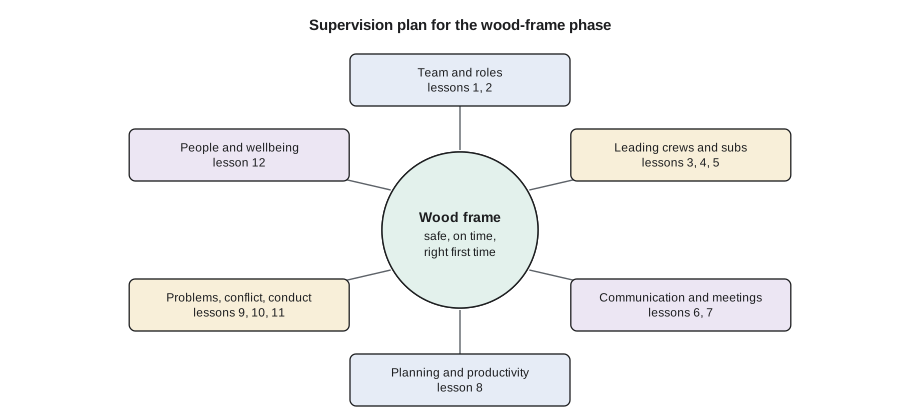
Larkspur Commons' four stories of wood frame above the podium will take about six months. Framing, mechanical, electrical and plumbing rough-in, windows, roofing, insulation and drywall will overlap floor by floor, and site headcount will rise from about 40 to more than 120. Before the phase begins, Priya asks Dana to prepare a supervision plan: a short document that sets out how the phase will be led, not just scheduled. The figure shows its structure, and the table summarizes the key decisions, with the lesson that each draws on.
| Plan element | Decisions for the wood-frame phase | Lessons |
|---|---|---|
| Team and roles | Dana overall; Omar leads levels 3 and 4, a second assistant superintendent joins for levels 5 and 6 and the roof; Mei handles layout, RFIs and drawings; agreed split with Priya; written delegation levels | 1, 2 |
| Leadership approach | Lead through foremen; situational styles for new foremen; recognition of good work and safe behavior; psychological safety for reporting | 3, 4 |
| Subcontractor leadership | Start-up meeting and walk for every trade; weekly commitments; manpower tracked daily; escalation ladder agreed with Priya | 5 |
| Communication | Daily 6:45 huddle at the hoist; crew huddles; radio channels for hoist, crane and general; plain-language rules; read-backs for lifts and pours | 6 |
| Meetings | Weekly coordination at 10:00 Wednesdays, 75 minutes, standing agenda; biweekly owner meeting; pre-installation meetings for windows, roofing and fire stopping | 7 |
| Planning and productivity | Three-week look-ahead by floor; tomorrow planned by 2 p.m. with readiness checklist; earned hours for self-performed work; overtime only in short bursts | 8 |
| Problems and decisions | Containment-first rule for safety and quality; escalation list for design and temporary works; decisions recorded in daily reports | 9 |
| Conflict | Mediation process for trade conflicts; back charges through the PM only | 10 |
| Conduct and legal duties | Daily supervisor inspections by floor; honest records; gift policy reminder; harassment and fitness-for-duty policies briefed at start-up | 11 |
| People and wellbeing | Mental health toolbox talks; EAP posted; apprentices rotated through tasks; mentoring for the new assistant superintendent; sustainable hours | 12 |
The plan also sets the supervision staffing for the phase. A common rule of thumb is that a foreman can effectively lead a crew of roughly six to twelve workers and that each assistant superintendent can coordinate a limited number of foremen and areas; the right numbers depend on the complexity of the work and the experience of the people. The worked example uses Thornbury's illustrative company guidelines, at most 10 trades workers per foreman on site and at most 8 foremen per site supervisor, to check whether the planned supervision covers the forecast headcount.
# Check supervision coverage against forecast headcount for the wood-frame phase (illustrative)
import math
weeks = list(range(1, 27))
# forecast trades workers on site by week (all employers), rising then falling
forecast = [40, 46, 52, 60, 68, 76, 84, 92, 100, 106, 112, 118, 122, 124, 124, 122,
            118, 112, 106, 98, 90, 82, 74, 66, 58, 50]
max_per_foreman, max_foremen_per_super = 10, 8
site_supervisors = {w: (2 if w <= 8 else 3) for w in weeks}   # Dana + Omar, then a 2nd assistant
peak = max(forecast)
print(f"Peak headcount {peak} in week {forecast.index(peak) + 1}")
short_weeks = []
for w, n in zip(weeks, forecast):
    foremen = math.ceil(n / max_per_foreman)
    supers_needed = math.ceil(foremen / max_foremen_per_super)
    if supers_needed > site_supervisors[w]:
        short_weeks.append(w)
    if w in (1, 8, 9, 14, 26):
        print(f"week {w:2d}: {n:3d} workers -> at least {foremen:2d} foremen, "
              f"{supers_needed} site supervisor(s) needed, {site_supervisors[w]} planned")
print("Weeks short of site supervision:", short_weeks or "none")Peak headcount 124 in week 14 week 1: 40 workers -> at least 4 foremen, 1 site supervisor(s) needed, 2 planned week 8: 92 workers -> at least 10 foremen, 2 site supervisor(s) needed, 2 planned week 9: 100 workers -> at least 10 foremen, 2 site supervisor(s) needed, 3 planned week 14: 124 workers -> at least 13 foremen, 2 site supervisor(s) needed, 3 planned week 26: 50 workers -> at least 5 foremen, 1 site supervisor(s) needed, 3 planned Weeks short of site supervision: none
On these guidelines, peak headcount of 124 needs at least 13 foremen across all trades and two site supervisors to coordinate them, so the planned team of Dana, Omar and a second assistant from week 9 covers the phase with some margin. The margin matters: Dana herself spends much of her time on owner meetings, planning and problems, and the second assistant gives cover for holidays, sickness and the roof and stair towers, which are higher-risk work areas. The check also tells subcontractors something: Thornbury expects each of them to provide a working foreman for every crew of ten or so, a requirement Priya will confirm in the start-up meetings.
Measuring the plan
A plan without measures is a wish. Dana chooses a short list of indicators, reviewed weekly with Priya and the foremen. They mix leading indicators, which predict future performance, with lagging indicators, which record results.
| Indicator | Target | Why it matters | Lesson |
|---|---|---|---|
| Percent of weekly commitments completed | At least 80 % | Reliability of planning and subcontractor commitments | 5, 7, 8 |
| Manpower on site against commitments | At least 95 % | Early warning of subcontractor drift | 5 |
| Productivity factor, self-performed work | At least 1.0 | Cost of the work Thornbury controls | 8 |
| Supervisor inspections done and findings closed within 24 h | 100 % done; 90 % closed | Safety and due diligence | 11 |
| Open action items older than two weeks | Fewer than 5 | Meeting follow-through | 7 |
| Failed inspections and rework events | Trending down | Quality and clear instructions | 6, 9 |
| Near-miss and hazard reports | Rising, then steady | Reporting culture and psychological safety | 3, 4 |
| Recordable injuries | Zero | The result that matters most | CON-355 |
Two indicators deserve comment. A rising number of near-miss and hazard reports is a good sign early in a phase, because it shows that people feel safe reporting (lesson 3); a falling number may mean fewer hazards or may mean people have stopped reporting, so the trend has to be read alongside what supervisors see on site. And no indicator replaces walking the site: Dana's early walk, the huddle and her end-of-day walk remain the most important measurement system she has.
Bringing it together
The supervision plan is not a bureaucratic exercise. Writing it forces Dana and Priya to agree who does what, how information will flow, how commitments will be made and checked, how problems will be escalated and how people will be looked after, before the pressure of the phase arrives. It also gives Omar and the new assistant superintendent a clear picture of what is expected of them. Most important, it reflects the theme of the whole course: construction projects are built by people, and the quality of the leadership those people receive shapes everything else. The technical tools in the rest of the supervision track, field engineering (CON-315), logistics and temporary works (CON-325), trade coordination (CON-335), quality (CON-345), safety leadership (CON-355), labor relations (CON-365), documentation (CON-375) and closeout (CON-385), all depend on supervisors who can lead.
Common mistakes
MistakeAssuming mental health is outside a supervisor's role.
InsteadSpot, ask, listen and connect people with help; supervisors are often the first to see that someone is struggling.
MistakeTrying to diagnose or counsel a worker in distress.
InsteadListen and connect them with the employee assistance program, a doctor, a crisis line or emergency services.
MistakeTreating apprentices as cheap labor for cleanup.
InsteadRotate apprentices through real tasks, explain the why and give feedback, using a structured method such as Job Instruction.
MistakePlanning a phase only in schedule terms.
InsteadPrepare a supervision plan covering roles, communication, meetings, planning, subcontractor leadership, measures and people.
MistakeReading a falling number of hazard reports as automatically good news.
InsteadInterpret reporting trends alongside site observations; falling reports may mean people have stopped reporting.
Summary and key terms
- Construction has some of the highest suicide rates of any industry; the CDC reported 56.0 per 100,000 among men in the industry in 2021, against 17.8 for the working-age population.
- Supervisors can spot, ask, listen, connect and follow up, and should know how to reach the employee assistance program and the 988 crisis line.
- Supervisors must protect their own wellbeing through delegation, planning, boundaries and asking for help.
- Developing people, through structured on-the-job instruction, apprenticeship, delegation and mentoring, is a core supervisory responsibility.
- Inclusive sites retain workers the industry needs; supervisors shape site culture directly.
- A supervision plan sets out roles, leadership approach, subcontractor leadership, communication, meetings, planning, problem solving, conduct and people for a phase of work.
- Supervision staffing should be checked against forecast headcount using span-of-control guidelines.
- A short set of leading and lagging indicators, read alongside site walks, measures whether the plan is working.
- Burnout
- An occupational phenomenon of exhaustion, cynicism and reduced effectiveness caused by unmanaged chronic workplace stress.
- Employee assistance program
- A confidential service, usually provided by the employer, offering counseling and referrals for personal and work problems.
- Mental health first aid
- Training in how to recognize and respond to someone experiencing a mental health problem or crisis.
- Job Instruction
- A structured on-the-job training method: prepare, present, try out and follow up.
- Mentoring
- A developmental relationship in which an experienced person guides a less experienced one.
- Span of control
- The number of people or units a supervisor can effectively lead.
- Supervision plan
- A document setting out how a phase of work will be led, communicated, planned, measured and staffed.
- Leading indicator
- A measure that predicts future performance, such as completed inspections or hazard reports.
Practice problems
Work each problem on paper first, then reveal the answer to check.
What suicide rate did the CDC report for men working in the construction industry in 2021, and how does it compare with the working-age population?
Show answer
56.0 per 100,000, against 17.8 for the working-age population overall.
Give four risk factors for poor mental health among construction workers.
Show answer
Tough-it-out culture, long hours, job insecurity, chronic pain and injury, substance use, isolation, time away from family.
List the five steps supervisors can take when worried about a worker.
Show answer
Spot, ask, listen, connect and follow up.
What number reaches the suicide crisis line in both Canada and the US?
Show answer
988, by call or text.
Name the four steps of the Job Instruction method.
Show answer
Prepare the learner, present the task, try out performance, follow up.
In the staffing example, how many foremen and site supervisors does the peak headcount need?
Show answer
At least 13 foremen and 2 site supervisors for 124 workers.
Why might a rising number of hazard reports be a good sign?
Show answer
It shows people feel safe reporting, especially early in a phase.
Name six elements of a supervision plan.
Show answer
Team and roles, leadership approach, subcontractor leadership, communication, meetings, planning and productivity, problem solving, conduct, people and wellbeing.
Lesson quiz · 5 questions
Score 60% or more to complete this lesson.
Create a free account to save your progress, take quizzes and earn a certificate.