
CON-305 · Lesson 7 of 12 · 26 min
Meetings that work
Meetings are where a construction project coordinates itself: where trades agree who works where next week, where the owner and design team resolve questions, where a new trade learns how the site runs and where the crew hears today's plan. Good meetings save far more time than they take. Bad meetings, long, unfocused, without decisions or follow-up, waste the time of the most expensive people on site and breed cynicism. Superintendents run or attend more meetings than almost anyone on a project, so running them well is a core supervisory skill.
This lesson covers the types of meetings on a construction site, the principles that make meetings effective, the action log, facilitation techniques and the superintendent's role in owner and design team meetings. The commitment-based weekly planning meeting of the Last Planner System is described in CON-410, trade coordination in CON-335, and meeting minutes and records in CON-375.
What meetings cost
Meetings feel free because nobody receives an invoice for them. They are not. A weekly subcontractor coordination meeting with fifteen foremen and supervisors for ninety minutes consumes more than twenty person-hours of some of the most valuable time on the project, plus the travel to and from the meeting and the disruption to the crews who lose their leader for that period. The worked example estimates the cost for Larkspur Commons' regular meetings.
# Approximate cost of Larkspur Commons' regular meetings (illustrative rates and attendance)
meetings = [  # name, attendees, avg loaded $/h, minutes, times per week
    ("Daily foremen huddle", 14, 85, 15, 5),
    ("Weekly subcontractor coordination", 16, 90, 90, 1),
    ("Owner-architect-contractor (biweekly)", 9, 140, 120, 0.5),
    ("Weekly safety walk and review", 5, 95, 60, 1),
]
weeks = 80  # roughly 20 months of construction
grand = 0
for name, n, rate, mins, per_wk in meetings:
    hours = n * mins / 60 * per_wk
    cost = hours * rate
    grand += cost * weeks
    print(f"{name:40s} {hours:5.1f} person-h/wk  ${cost:7,.0f}/wk  ${cost*weeks:9,.0f} total")
print(f"All regular meetings over the project: ${grand:,.0f}")
# Effect of cutting the coordination meeting from 90 to 60 minutes with a tighter agenda
saving = 16 * 30 / 60 * 90 * weeks
print(f"Saving from a 60-minute coordination meeting: ${saving:,.0f}")Daily foremen huddle 17.5 person-h/wk $ 1,488/wk $ 119,000 total Weekly subcontractor coordination 24.0 person-h/wk $ 2,160/wk $ 172,800 total Owner-architect-contractor (biweekly) 9.0 person-h/wk $ 1,260/wk $ 100,800 total Weekly safety walk and review 5.0 person-h/wk $ 475/wk $ 38,000 total All regular meetings over the project: $430,600 Saving from a 60-minute coordination meeting: $57,600
On these assumptions the regular meetings cost Thornbury and its subcontractors about $430,000 over the project, before counting the lost crew productivity while foremen are away from the work. Trimming the coordination meeting by thirty minutes through a tighter agenda saves almost $60,000. The point is not that meetings are bad, the daily huddle is probably the best value on the list, but that they deserve the same planning as any other expensive activity.
Types of site meetings
A typical project has a rhythm of regular meetings, plus meetings triggered by events.
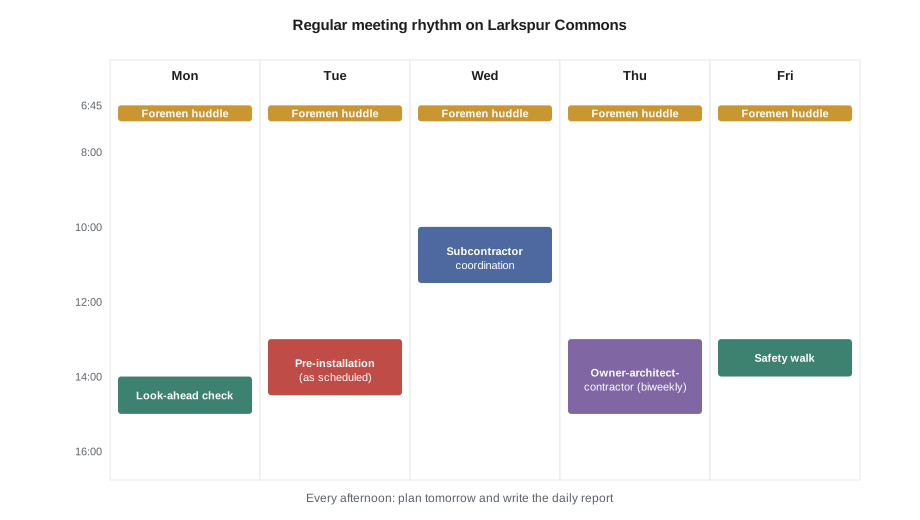
| Meeting | Purpose | Who attends | Typical length |
|---|---|---|---|
| Daily foremen huddle | Today’s work, locations, overlaps, hazards, deliveries, inspections | Superintendent, assistants, all foremen | 10 to 15 min, standing |
| Crew huddle or pre-task meeting | Crew’s tasks, hazards and controls for the day | Foreman and crew | 5 to 10 min |
| Weekly subcontractor coordination | Review last week, commit to next week, look-ahead, constraints, safety | Superintendent, PM, subcontractor foremen or supervisors | 60 to 90 min |
| Owner-architect-contractor | Progress, schedule, RFIs, submittals, changes, owner decisions | Owner, consultants, PM, superintendent | 1 to 2 h, often biweekly |
| Trade start-up | How a new trade will work on site (lesson 5) | Superintendent, PM, trade foreman and supervisor | 30 to 60 min |
| Pre-installation | Review drawings, submittals, sequence, quality and interfaces before a work item starts | Superintendent, trades involved, consultant if required | 30 to 60 min |
| Pre-pour or pre-lift | Confirm readiness and roles for a critical operation | Everyone involved | 15 to 30 min |
| Safety committee | Review inspections, incidents and concerns; recommend improvements | Worker and management representatives | As required by law and policy |
Some meetings are required. Occupational health and safety laws in most Canadian jurisdictions require joint health and safety committees or representatives on larger workplaces, and many apply specific rules to construction projects; in the United States, some states require safety committees, and many contracts and company programs require regular safety meetings. HSE-405 covers committees and worker participation. Contract documents often specify the owner-architect-contractor meetings and pre-installation meetings for particular specification sections.
Principles of effective meetings
Research on meetings, much of it by Steven Rogelberg and colleagues, and decades of practical experience point to a short list of principles.
- Have a clear purpose. Every meeting should be able to answer the question 'what will be different when this meeting ends?' If the answer is nothing, cancel it or replace it with a message.
- Invite the right people. Include those who must contribute or decide, and nobody else. A person who sits through an hour to answer one question should be invited for ten minutes or asked in advance.
- Send an agenda. List the topics, the purpose of each (inform, discuss, decide) and the time allowed. Put the most important items first.
- Start and finish on time. Starting late punishes the people who arrived on time and rewards those who did not. A meeting that always overruns teaches people to arrive late.
- Keep it short and focused. Daily huddles work standing up. Long discussions between two people should be taken offline.
- Make decisions and record actions. Every action needs an owner, a description and a date. A meeting without recorded actions is a conversation.
- Follow up. Start each regular meeting by reviewing the previous actions. Nothing builds accountability like knowing your open items will be read out next week.
- Review the meeting itself. Occasionally ask attendees what is working and what is not, and change the format.
The action log
The action log, sometimes called the open items list, is the single most important output of most site meetings. It records each action, its owner, the date it was raised, the date it is due and its status. Reviewed at every meeting, it turns talk into accountability. Several practical points make action logs work. Each item should have one owner, not 'all' or 'TBD'; it should be phrased as a specific action ('Ridgeline to provide revised truss layout for level 6') rather than a topic ('trusses'); the due date should be agreed with the owner rather than imposed; and old items should be closed, escalated or deliberately dropped rather than carried forward for months.
The worked example analyses Larkspur Commons' coordination meeting action log to find overdue and long-running items.
# Ageing analysis of a coordination meeting action log (invented items; dates as day numbers)
today = 140
log = [  # (id, owner, raised, due, closed or None, description)
    (101, "Ridgeline", 98, 112, 110, "Revised truss layout level 6"),
    (104, "Thornbury PM", 105, 119, None, "Answer RFI 37 on corridor bulkheads"),
    (107, "Northgate", 112, 126, 124, "Sleeve layout levels 5-6"),
    (109, "Ashgrove", 112, 133, None, "Confirm suite panel locations"),
    (111, "Owner", 119, 126, None, "Select retail storefront hardware"),
    (113, "Thornbury super", 126, 133, 131, "Hoist schedule for drywall stocking"),
    (115, "Summit", 126, 140, None, "Board delivery plan levels 3-4"),
    (116, "Architect", 133, 147, None, "Stair handrail detail"),
]
open_items = [r for r in log if r[4] is None]
print(f"Open items: {len(open_items)} of {len(log)}")
for i, owner, raised, due, closed, desc in sorted(open_items, key=lambda r: r[3]):
    age = today - raised
    late = today - due
    status = f"OVERDUE {late} d" if late > 0 else ("due today" if late == 0 else f"due in {-late} d")
    print(f"  #{i} {owner:16s} age {age:3d} d  {status:14s} {desc}")
closed = [r for r in log if r[4] is not None]
on_time = sum(1 for r in closed if r[4] <= r[3])
print(f"Closed on time: {on_time}/{len(closed)}")Open items: 5 of 8 #104 Thornbury PM age 35 d OVERDUE 21 d Answer RFI 37 on corridor bulkheads #111 Owner age 21 d OVERDUE 14 d Select retail storefront hardware #109 Ashgrove age 28 d OVERDUE 7 d Confirm suite panel locations #115 Summit age 14 d due today Board delivery plan levels 3-4 #116 Architect age 7 d due in 7 d Stair handrail detail Closed on time: 3/3
Three items are overdue, and two of them belong to people outside the subcontractor group: the general contractor's own project manager and the owner. That is common, and it is a reminder that the action log holds everyone accountable, including the general contractor. The owner's storefront hardware selection is two weeks late; if the hardware has a long lead time, Dana needs Priya to raise it formally at the next owner meeting, with the schedule impact spelled out.
Running the weekly coordination meeting
The weekly subcontractor coordination meeting is usually the superintendent's most important meeting. A proven structure starts with safety (incidents, near misses, upcoming high-risk work), reviews last week's commitments and the reasons any were missed, then works through the three-week look-ahead area by area with each foreman committing to next week's work and crew size, identifies constraints that must be removed (information, materials, access, inspections, prerequisite work) and assigns them to owners, and finishes by reviewing the action log. CON-410 shows how the Last Planner System formalizes this with percent plan complete and reasons for variance; even without the full system, asking 'what did you commit to, did you do it, and if not why not?' every week transforms reliability.
Foremen should leave the meeting knowing exactly what they are expected to do next week, what the general contractor will provide and what other trades will be doing in their areas. Commitments made publicly, in front of peers, are more likely to be kept than private promises, which is one reason this meeting works.
Worked problem
Rescuing a failing meeting
Dana inherits a weekly coordination meeting on Larkspur Commons that routinely runs two and a half hours, has no agenda, is dominated by a long argument between the mechanical and electrical foremen every week and produces no written actions. Foremen have started sending apprentices instead. What should she change?
Show solution
- Reset the purpose: the meeting exists to agree next week's work and remove constraints. Announce that it will run 75 minutes, start at 10:00 sharp and be held at the site plan wall.
- Publish a standing agenda: safety, last week's commitments, look-ahead by area, constraints, action log.
- Require foremen or supervisors who can commit their crews, not apprentices.
- Take the mechanical and electrical coordination offline: schedule a separate 30-minute coordination session for those two trades with the drawings and Mei, the field engineer.
- Record every action with an owner and a date, and start each meeting by reviewing them.
- After four weeks, ask the foremen what is working and adjust.
Answer: A clear purpose, a fixed agenda and time box, the right attendees, offline handling of side issues and a visible action log usually turn a dreaded meeting into a useful one within a few weeks.
Facilitation skills
Running a meeting well is a skill. The facilitator keeps the meeting on purpose, makes sure the right voices are heard and moves the group to decisions. Useful techniques include restating the purpose when discussion drifts, using a parking lot (a visible list of off-topic issues to deal with later), time-boxing each item and warning when time is nearly up, asking quiet participants directly for their view, summarizing agreements before moving on and closing each item with 'so the action is ... who owns it ... by when?'.
Dominant personalities are a common problem. A respectful but firm intervention, 'thanks, Dave, I want to hear from the others on this before we decide', usually works. Persistent conflict between two people is better handled outside the meeting (lesson 10). When conflict erupts in the meeting itself, the facilitator should acknowledge it, refocus on the shared goal and the facts, and if necessary take a short break or move the issue offline. Never let a meeting become a public humiliation of one trade or person; everyone else is watching and learning what happens when they bring problems forward.
The superintendent in owner and design team meetings
The owner-architect-contractor meeting is usually chaired by the architect, the owner or the general contractor's project manager, depending on the contract and the company. The superintendent's role is typically to report on field progress, the look-ahead, upcoming inspections and milestones, field issues needing design answers and any safety matters affecting the owner. A few habits make the superintendent effective in these meetings. Prepare: know the status of every RFI and submittal affecting the next six weeks. Be factual and calm: report problems with their impact and a proposed solution rather than complaints. Agree with the project manager beforehand on the main messages and on who will raise what. Do not commit to changes in scope, price or time in the meeting; those go through the contract process. And record what owner representatives say they will do, because their decisions are often the constraints on the schedule.
Owner meetings are also where relationships with the design team are built or damaged. Consultants who feel blamed for every problem become defensive; those who feel the contractor is solving problems with them become allies. A superintendent who arrives with photos, a marked-up drawing and a suggested fix gets faster answers than one who arrives with a list of complaints.
Remote and hybrid meetings
Video meetings have become normal for owner and design team meetings, especially when consultants are based in other cities. They save travel but carry costs: people multitask, field conditions are harder to show and side conversations in the room exclude remote attendees. Good practice includes sharing the screen with drawings or photos rather than describing them, using a site camera or a phone to show conditions live, keeping cameras on for discussion items, and making sure remote participants are asked for their input explicitly. Field coordination between foremen still works best in person, at the work.
Common mistakes
MistakeHolding regular meetings without an agenda or a clear purpose.
InsteadDefine what should be different when the meeting ends and publish a standing agenda with times.
MistakeLetting meetings start late and overrun.
InsteadStart on time, time-box items and finish on time; respect for time is respect for people.
MistakeRecording topics instead of actions, or assigning actions to 'all'.
InsteadRecord specific actions with one owner and an agreed date, and review them at the start of the next meeting.
MistakeAllowing a two-trade argument to consume the whole meeting.
InsteadTake it offline into a focused coordination session with the right people and drawings.
MistakeCommitting to scope or price changes in the owner meeting.
InsteadReport facts and impacts in the meeting and route changes through the contract process.
Summary and key terms
- Meetings are expensive; their value depends on purpose, attendance, structure and follow-up.
- Site meetings include daily huddles, crew huddles, weekly coordination, owner-architect-contractor, trade start-up, pre-installation, pre-pour and safety committee meetings.
- Effective meetings have a clear purpose, the right people, an agenda, time limits, recorded decisions and actions, and follow-up.
- The action log, with one owner and a date per item, turns discussion into accountability and should be reviewed every meeting.
- The weekly coordination meeting reviews safety, last week's commitments, the look-ahead, constraints and actions.
- Facilitators keep meetings on purpose, draw out quiet voices, manage dominant ones and move conflict offline.
- In owner meetings, superintendents prepare, report facts with impacts and solutions, and avoid committing to contract changes.
- Action log
- A list of agreed actions with owners, dates and status, reviewed at each meeting.
- Agenda
- A list of meeting topics with their purpose and time allowed.
- Time box
- A fixed amount of time allocated to a meeting or agenda item.
- Parking lot
- A visible list of off-topic issues to be dealt with after the meeting.
- Pre-installation meeting
- A meeting before a work item starts to review drawings, submittals, sequence, quality and interfaces.
- Owner-architect-contractor meeting
- A regular project meeting of owner, design team and contractor to review progress and resolve issues.
- Facilitation
- Guiding a meeting so that it achieves its purpose and all relevant voices are heard.
- Constraint
- Anything that must be resolved before planned work can start, such as information, materials or access.
Practice problems
Work each problem on paper first, then reveal the answer to check.
What question tests whether a meeting needs to happen?
Show answer
What will be different when this meeting ends?
Roughly how many person-hours does a 90-minute meeting of 16 people consume?
Show answer
24 person-hours, plus travel and disruption.
List four elements of a good action log entry.
Show answer
Specific action, single owner, date raised and due date, status.
In the action log example, which items were overdue?
Show answer
The RFI 37 answer, the storefront hardware selection and the suite panel locations.
Give the standing agenda for a weekly coordination meeting.
Show answer
Safety, last week's commitments, look-ahead by area with commitments, constraints, action log.
How should a facilitator handle a long argument between two trades?
Show answer
Acknowledge it, refocus on the goal, and take it offline into a focused session with the right people.
What should a superintendent avoid doing in owner meetings?
Show answer
Committing to changes in scope, price or time outside the contract process.
Name two good practices for video meetings.
Show answer
Share drawings or photos on screen and explicitly ask remote participants for input.
Lesson quiz · 5 questions
Score 60% or more to complete this lesson.
Create a free account to save your progress, take quizzes and earn a certificate.