
CON-305 · Lesson 4 of 12 · 28 min
Leading crews: expectations, motivation and accountability
A crew performs well when three conditions are met: people know what is expected, they want to do it and they are held to it fairly. Supervisors control all three. This lesson covers how to set clear expectations, what research and experience say about motivating construction workers, how to give recognition and feedback, how to hold people accountable without destroying morale, and how to bring new workers onto a crew safely. It applies the motivation theories from BUS-130 to the crews a foreman or superintendent leads directly, such as Thornbury's self-performed formwork crew on Larkspur Commons. Leading subcontractor crews is the subject of lesson 5, and formal discipline under collective agreements and employment law belongs to CON-365.
Setting expectations
Many performance problems on site are really expectation problems. The worker did not know the tolerance, the deadline, the sequence or the standard of housekeeping, or was told once in passing and forgot. Good supervisors make expectations explicit, specific and visible. 'Get the wall forms done' is vague. 'Form, brace and check the three north core walls today, plumb within 1/4 in over the height, ties at the spacing on the shop drawing, ready for Mei's check at 2 p.m. so we can pour tomorrow at 7' is clear. The second version takes thirty seconds longer and saves hours.
Expectations fall into several groups, and a new crew member needs to hear about all of them.
| Type of expectation | Examples on Larkspur Commons | How to communicate it |
|---|---|---|
| Safety rules | Fall protection at 6 ft and above, tie-off points, hard hat and eye protection everywhere, no work under loads | Site orientation, signage, toolbox talks, enforcement |
| Quality standards | Formwork tolerances, embed locations, clean deck before pour | Drawings, checklists, mock-ups, inspection before pour |
| Production | Square feet of formwork per crew-day, pour schedule | Daily plan, weekly targets, visible tracking board |
| Conduct | Start and break times, respect, no harassment, phones away when working | Orientation, written site rules, consistent example |
| Communication | Report hazards, mistakes and delays immediately; radio protocol | Huddles, explicit invitations to speak up, thanks for reports |
| Housekeeping | Clean as you go; scrap to the bins at end of shift | Daily walk, clear standard, recognition of good areas |
Production expectations deserve special care. They should come from the estimate and the plan, not from guesswork. If the estimate assumed a formwork crew of eight would place 1,300 ft² of wall forms a day, the foreman needs to know that number, why it matters and what it depends on: material at the workface, crane time, drawings answered. Lesson 8 shows how to track output against such targets. A target set without the means to achieve it is not an expectation but a source of frustration.
Goal-setting research by Edwin Locke and Gary Latham, one of the best-supported findings in organizational psychology, shows that specific, challenging goals usually produce better performance than vague goals such as 'do your best', provided people accept the goals, have the ability to reach them and get feedback on progress. The same research warns that very hard goals tied to rewards can encourage shortcuts. On a construction site, a production target that pushes crews to skip bracing or tie-off is worse than no target at all.
What motivates construction workers
Motivation theory offers several lenses. Frederick Herzberg distinguished hygiene factors, such as pay, working conditions, job security and supervision, whose absence causes dissatisfaction, from motivators, such as achievement, recognition, responsibility and growth, which create real satisfaction. Self-determination theory, developed by Edward Deci and Richard Ryan, argues that people are most motivated when three needs are met: autonomy (some control over how they work), competence (feeling skilled and effective) and relatedness (belonging to a group that cares about them). Expectancy theory adds that people put in effort when they believe effort leads to performance and performance leads to outcomes they value.
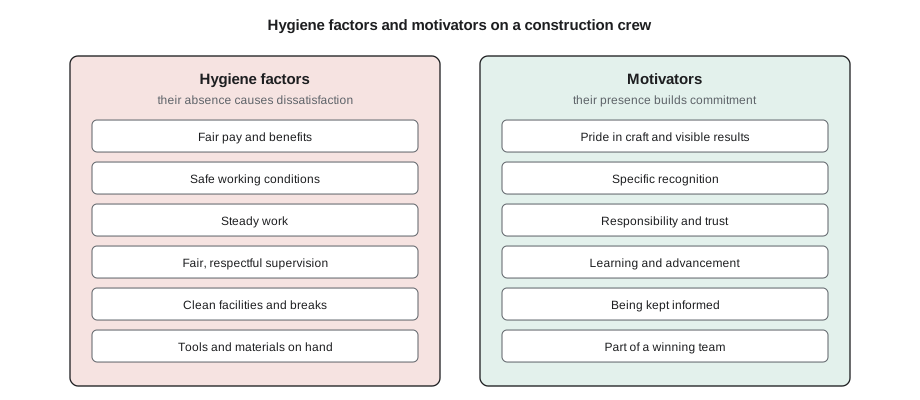
Put these ideas together with what tradespeople themselves say and a consistent picture emerges. Construction workers are motivated by pride in their craft and in a visible, lasting result; by being treated fairly and with respect; by steady work and fair pay; by a safe site where the employer clearly cares; by being kept informed about what is happening and why; by having the tools and materials to do the job without waiting; by recognition from people whose opinion they value; and by opportunities to learn and advance. They are demotivated by disorganization, waiting for materials or information, unfairness, public criticism, being ignored when they raise problems and unsafe conditions.
Look at how many of these factors the supervisor controls. Pay rates may be set by the company or a collective agreement, but the supervisor decides whether the material is at the workface, whether the crew knows the plan, whether good work is noticed and whether concerns are taken seriously. Research on construction productivity repeatedly finds that a large share of a crew's time is lost to waiting, searching and traveling, and that disorganization is one of the most frustrating parts of the job for tradespeople. Making work ready (CON-410's make-ready process) is therefore not just a productivity tool; it is one of the most powerful motivators a supervisor has.
Recognition
Recognition is cheap, effective and underused. Effective recognition is specific ('the wall forms on grid line C were dead plumb and the ties were exactly on layout; Mei signed off without a single correction'), timely (as close to the work as possible), sincere and proportionate. The common rule of thumb is to praise in public and correct in private, although some people dislike public attention and a quiet word suits them better. Recognition should cover behavior as well as results: the apprentice who stopped work to report a damaged guardrail deserves as much recognition as the crew that beat its production target.
Formal recognition programs, such as safety awards or crew of the month, can help but carry risks. Safety incentive programs that reward low injury counts can discourage reporting, which is why OSHA and many Canadian regulators and safety organizations warn against incentives tied to injury statistics rather than to positive actions such as hazard reports, inspections and training. Recognition of leading indicators, such as good observations and near-miss reports, avoids that problem (CON-355).
Feedback
Feedback is information about performance that helps a person improve. Most supervisors give too little of it, and when they do give it, it is often vague ('good job', 'that's sloppy') or delayed until a problem is serious. A simple and widely used structure is the situation, behavior, impact model developed by the Center for Creative Leadership. Describe the situation, describe the specific behavior you observed and explain its impact, then invite the other person's view and agree what happens next.
Worked problem
Giving corrective feedback with the situation, behavior, impact model
Ben notices that a carpenter on his crew, Tyler, left offcuts and form ties scattered on the level 2 deck for the third day running. How should Ben raise it?
Show solution
- Choose the setting: privately, at the end of the shift, not in front of the crew.
- Situation: 'Tyler, on the level 2 deck today, after you finished the column forms on line D...'
- Behavior: '...the offcuts and about twenty form ties were left on the deck, and that's the third day this week.'
- Impact: 'The laborers had to clear it before the rebar crew could start, we lost about half an hour, and loose ties on a deck are a trip hazard.'
- Invite and agree: 'What's going on? ... So from tomorrow, clean as you go and a sweep before you leave the area. I'll check with you Friday.'
Answer: The feedback is specific, about behavior rather than character, linked to real consequences and ends with a clear agreement and a follow-up, which makes it far more likely to change behavior than 'you're a slob'.
Positive feedback uses the same structure and is just as important. Research on high-performing teams suggests they hear considerably more positive than negative comments, although the exact ratio quoted in popular books has been challenged. The practical lesson is to notice and mention good work often, so that corrective feedback lands in a relationship that already feels fair.
Accountability
Accountability means people answer for their commitments and the agreed standards. It is not the same as blame. A healthy accountability loop has five steps: set a clear expectation, make sure the person has what they need to meet it, observe the work, give feedback and then either recognize success or address the gap.
When performance falls short, the first question is why. Robert Mager and Peter Pipe's classic approach asks whether the person can't do it or won't do it. If they could do it to save their life, the problem is probably not skill but something in the situation: an obstacle, a missing tool, a conflicting instruction, or a consequence that makes poor performance easier or more rewarding than good performance. If they genuinely cannot, training, coaching or a change of task is needed. Only when the person can do it, has what they need and still chooses not to is it a motivation or conduct problem.
| Diagnosis | Signs | Supervisor response |
|---|---|---|
| Unclear expectation | Worker surprised by the standard; different people told different things | Clarify and write it down; check understanding |
| Obstacle in the situation | Waiting for material, wrong tools, conflicting direction | Remove the obstacle; fix the system |
| Skill gap | Tries but cannot meet the standard | Train, coach, pair with an experienced worker |
| Consequences upside down | Poor work is easier or faster with no follow-up; good work goes unnoticed | Follow up consistently; recognize good work |
| Conduct or motivation | Knows, can, has resources, still does not | Clear private conversation, documented; then progressive discipline under company policy and any collective agreement |
When a conduct problem persists, most employers use progressive discipline: a verbal warning, a written warning, a suspension and finally dismissal, with each step documented. Serious misconduct, such as violence, deliberate safety violations that put others at immediate risk or theft, may justify skipping steps. The rules differ between unionized and non-union workplaces and between jurisdictions, and supervisors should involve their manager or human resources before formal discipline. CON-365 covers the legal and collective agreement side. The supervisor's job is to act early, be consistent and keep accurate notes of what was said and agreed.
Attendance and turnover
Absenteeism and turnover are expensive and partly within a supervisor's influence. Every absent worker disrupts crew balance, and every worker who quits takes their experience with them and leaves the cost of hiring and training a replacement. Studies of why tradespeople leave employers often point to supervision, along with pay, steady work and safety. People rarely quit a company because of one bad day; they quit after months of feeling disrespected, disorganized or ignored.
The worked example estimates what absenteeism and turnover cost Thornbury's self-performed crew on Larkspur Commons over a year, using illustrative assumptions.
# Cost of absenteeism and turnover for a self-performed crew (illustrative assumptions)
crew_size = 12
loaded_rate = 68.0          # $/h wages plus burden, averaged across the crew
hours_per_day = 8
work_days = 230
absence_rate = 0.045        # 4.5 % of scheduled days missed
disruption_factor = 0.5     # extra lost output per absent day from rebalancing the crew
leavers_per_year = 4
replacement_cost = 9500     # $ per leaver: hiring, orientation, training, lost output while learning

absent_days = crew_size * work_days * absence_rate
absence_cost = absent_days * hours_per_day * loaded_rate * (1 + disruption_factor)
turnover_cost = leavers_per_year * replacement_cost
print(f"Absent crew-days per year: {absent_days:.0f}")
print(f"Cost of absence incl. disruption: ${absence_cost:,.0f}")
print(f"Turnover rate: {leavers_per_year/crew_size:.0%}, cost ${turnover_cost:,.0f}")
total = absence_cost + turnover_cost
print(f"Total: ${total:,.0f} per year, about ${total/crew_size:,.0f} per crew position")
# What if better supervision cut absence to 3 % and leavers to 2?
better = crew_size*work_days*0.03*hours_per_day*loaded_rate*(1+disruption_factor) + 2*replacement_cost
print(f"Improved case: ${better:,.0f} (saving ${total-better:,.0f})")Absent crew-days per year: 124 Cost of absence incl. disruption: $101,347 Turnover rate: 33%, cost $38,000 Total: $139,347 per year, about $11,612 per crew position Improved case: $86,565 (saving $52,782)
On these assumptions, absence and turnover cost the crew about $139,000 a year, roughly $11,600 per position. Reducing absence by a point and a half and losing two fewer workers would save more than $50,000. The numbers are illustrative and every company's will differ, but the order of magnitude explains why good employers treat supervision quality as a business issue, not just a matter of morale.
Bringing new workers onto the crew
New workers are at higher risk of injury. Research by Ontario's Institute for Work & Health found that workers in their first month on a job had a substantially higher risk of a lost-time injury than workers who had been in the job for more than a year, and regulators across Canada and the United States emphasize new and young worker orientation for that reason. On a construction site the risk is magnified: new workers do not know the site's hazards, its rules or its people, and they may be reluctant to ask questions.
A good onboarding process includes a site orientation before work starts (required in most jurisdictions), an introduction to the crew and the foreman, a clear explanation of the work and its hazards, a buddy or mentor for the first weeks, close supervision on unfamiliar tasks (the directing style from lesson 3), explicit permission and encouragement to ask questions and refuse unsafe work, and check-ins at the end of the first day, first week and first month. CON-365 covers apprentices and training in more depth.
Toolbox talks are a regular part of keeping crews informed. They work best when they are short, specific to the work this week, interactive and recorded. The worked example below checks attendance records for Ben's crew over six weekly toolbox talks to find anyone who has missed more than one, so that Ben can brief them individually.
# Toolbox talk attendance for six weekly talks (1 = attended, 0 = missed); invented records
talks = ["Formwork stripping", "Silica dust", "Ladder use", "Heat stress", "Crane signals", "Housekeeping"]
att = {
    "Ben K": [1, 1, 1, 1, 1, 1], "Tyler R": [1, 0, 1, 1, 0, 1], "Apprentice A": [1, 1, 1, 1, 1, 1],
    "Apprentice B": [1, 1, 0, 1, 1, 1], "Carpenter C": [0, 1, 1, 0, 1, 0], "Carpenter D": [1, 1, 1, 1, 1, 1],
    "Helper E": [0, 0, 1, 1, 1, 1], "Helper F": [1, 1, 1, 1, 1, 0],
}
n = len(talks)
overall = sum(map(sum, att.values())) / (n * len(att))
print(f"Overall attendance: {overall:.0%}")
for t_i, t in enumerate(talks):
    print(f"  {t:20s} {sum(v[t_i] for v in att.values())}/{len(att)}")
print("Needs individual catch-up briefing (missed 2 or more):")
for name, v in att.items():
    missed = [talks[i] for i, a in enumerate(v) if a == 0]
    if len(missed) >= 2:
print(f" {name}: {', '.join(missed)}")Overall attendance: 81% Formwork stripping 6/8 Silica dust 6/8 Ladder use 7/8 Heat stress 7/8 Crane signals 7/8 Housekeeping 6/8 Needs individual catch-up briefing (missed 2 or more): Tyler R: Silica dust, Crane signals Carpenter C: Formwork stripping, Heat stress, Housekeeping Helper E: Formwork stripping, Silica dust
Overall attendance is decent, but three people missed two or more talks, and two of them missed the silica dust talk, which covers one of the most serious health hazards on this job. Records like these support due diligence (lesson 11), but their real value is in making sure every worker actually receives the information.
Common mistakes
MistakeGiving vague instructions such as 'get the forms done' and blaming the crew when the result is wrong.
InsteadState the task, the standard, the deadline and the check, and confirm understanding.
MistakeAssuming pay is the only motivator for tradespeople.
InsteadPay matters, but organization, fairness, information, recognition, safety and pride in craft are powerful and largely in the supervisor's control.
MistakeCorrecting people in front of the crew.
InsteadCorrect privately and specifically; recognize good work promptly and sincerely.
MistakeJumping to discipline whenever performance falls short.
InsteadFirst ask whether the cause is an unclear expectation, an obstacle, a skill gap or upside-down consequences.
MistakeRewarding low injury counts.
InsteadRecognize positive actions such as hazard reports and good inspections, which do not discourage reporting.
Summary and key terms
- Crews perform when expectations are clear, people are motivated and accountability is fair.
- Expectations cover safety, quality, production, conduct, communication and housekeeping, and should be explicit and checked.
- Specific, accepted goals with feedback improve performance; targets must never push crews to cut safety corners.
- Hygiene factors prevent dissatisfaction; motivators such as achievement, recognition and growth create commitment.
- Making work ready, keeping crews informed and treating people fairly are among the strongest motivators a supervisor controls.
- Feedback should be specific, timely and about behavior; the situation, behavior, impact model is a useful structure.
- Diagnose performance gaps before acting, and use progressive discipline consistently and with documentation when needed.
- Absence and turnover are costly; good onboarding protects new workers, who face higher injury risk.
- Hygiene factors
- Job conditions such as pay, safety and supervision whose absence causes dissatisfaction (Herzberg).
- Motivators
- Factors such as achievement, recognition and growth that create satisfaction and commitment (Herzberg).
- Self-determination theory
- A theory that motivation grows when needs for autonomy, competence and relatedness are met.
- Goal setting
- Using specific, challenging and accepted goals with feedback to improve performance.
- Situation, behavior, impact
- A feedback model that describes the situation, the specific behavior and its impact.
- Accountability loop
- The cycle of setting expectations, enabling, observing, giving feedback and recognizing or correcting.
- Progressive discipline
- A graduated sequence of documented responses to repeated misconduct.
- Onboarding
- The process of orienting, training and integrating a new worker into a crew and site.
Practice problems
Work each problem on paper first, then reveal the answer to check.
Rewrite 'get the wall forms done' as a clear expectation.
Show answer
For example: form and brace the three north core walls today, plumb within 1/4 in, ties per shop drawing, ready for checking at 2 p.m. for a 7 a.m. pour.
What conditions does goal-setting research say are needed for specific goals to work?
Show answer
Goal acceptance, ability, and feedback on progress.
Give two motivators and two hygiene factors for a construction crew.
Show answer
Motivators: pride in craft, recognition. Hygiene: fair pay, safe conditions.
Why is making work ready a motivator as well as a productivity tool?
Show answer
Waiting and disorganization are among the most frustrating parts of the job; removing them shows respect and lets people achieve.
Why can safety incentive programs based on injury counts be harmful?
Show answer
They can discourage injury and incident reporting.
What are the three parts of the situation, behavior, impact model?
Show answer
Describe the situation, the specific behavior and its impact.
A worker could meet the standard but poor work is faster and nobody checks. What is the diagnosis?
Show answer
The consequences are upside down; the fix is consistent follow-up and recognition of good work.
In the cost example, about how much did absence and turnover cost per crew position?
Show answer
About $11,600 per position per year.
Lesson quiz · 5 questions
Score 60% or more to complete this lesson.
Create a free account to save your progress, take quizzes and earn a certificate.