
CON-305 · Lesson 6 of 12 · 27 min
Communication on site
Ask any superintendent what goes wrong most often on a construction site and communication will be near the top of the list. A crew installs sleeves to an old drawing revision; a crane operator misreads a signal; a foreman thinks a pour is tomorrow when it is today; an inspector arrives and nobody knows; a worker misunderstands an instruction because English is his second language and is too embarrassed to ask. Construction is a business of coordinating many people from many companies in a noisy, changing, sometimes dangerous environment, and every handoff of information is a chance for error.
This lesson covers the basics of how communication works and fails, how to choose the right channel, how to give instructions that are understood, how to use read-backs and radio protocols, how to listen, how to communicate with multilingual crews and how to run toolbox talks and huddles. Meetings are covered in lesson 7, difficult conversations in lesson 10 and written project documentation in CON-375. BUS-120 covers business communication more generally.
How communication works and fails
A simple model, going back to Claude Shannon's work on communication systems in the 1940s, describes a sender who encodes a message, a channel that carries it, noise that distorts it and a receiver who decodes it. Later models added feedback, the receiver's response that tells the sender whether the message arrived as intended. The model is basic, but it points to every place where site communication breaks down.
| Stage | Typical site failure | Countermeasure |
|---|---|---|
| Sender | Assumes the receiver knows the context; uses jargon or vague words | Give context, be specific, use plain language |
| Message | Too many instructions at once; key detail missing | One task at a time; include what, where, when, how, why |
| Channel | A critical change sent by email to a foreman who reads email at night | Match the channel to urgency and importance |
| Noise | Equipment, hearing protection, distance, wind, radio static | Move to a quiet place, use visuals, repeat key points |
| Receiver | Distracted, tired, different first language, reluctant to ask | Check understanding, invite questions, use interpreters |
| Feedback | Nod and "yep" taken as understanding | Ask for a read-back or a summary in their own words |
The most dangerous failure is the illusion of understanding: the sender believes the message has been received and the receiver believes they understood it, but they have different pictures in their heads. A foreman says 'pour the east wall' meaning the wall on grid line 7; the concrete crew hears the wall on the east side of the elevator core. Both are confident. The cure is to make understanding visible, by pointing at the drawing, walking to the location or asking for a read-back.
Choosing the channel
Different channels carry different amounts of information. Media richness theory, developed by Richard Daft and Robert Lengel in the 1980s, ranks channels by how much they convey: face-to-face conversation is the richest, with words, tone, expression, gestures and immediate feedback; a phone call loses visual cues; a text or email loses tone and immediate feedback; a posted notice is leaner still. Rich channels suit complex, ambiguous or emotional messages. Lean channels suit simple, routine messages and messages that need a record.
| Channel | Best for | Weaknesses | Larkspur Commons example |
|---|---|---|---|
| Face to face at the work | Complex instructions, problems, feedback, anything safety-critical | No automatic record; needs presence | Dana and the framing foreman at a beam pocket that does not match the drawing |
| Huddle or toolbox talk | Daily plans, hazards, short briefings to a group | Limited detail; not everyone present | The 6:45 foremen huddle |
| Radio | Quick coordination, crane and hoist operations, emergencies | Noise, interruptions, everyone hears | Calling the hoist operator for a material lift |
| Phone call | Urgent issues with people off site | No visual; no record | Calling Ridgeline’s owner about manpower |
| Text or app message | Quick confirmations, photos of conditions | Easy to miss; tone lost; may not be retained | Photo of a damaged guardrail to the safety coordinator |
| Email or project platform | Records, formal notices, documents, follow-ups | Slow; often unread in the field; tone misread | Confirming a verbal instruction to a subcontractor |
| Drawings, sketches, mark-ups | Locations, dimensions, sequences | Can be out of date | A marked-up slab plan showing pour breaks |
| Posted notices and signs | Standing rules, hazards, schedules | People stop noticing them | Hoist booking board at the gate |
A good rule is to use the richest practical channel for anything complex, urgent or safety-critical, and then use a lean channel to make a record. Dana explains a change in the stair sequence face to face with the two foremen involved, at the stair, with the drawing, and then sends a short message on the project platform summarizing what was agreed. The conversation creates understanding; the message creates a record (CON-375).
Electronic channels have transformed site communication. Foremen can see the current drawings on a tablet, photos can be shared instantly and RFIs can be answered in hours rather than weeks (CON-260). But they bring problems too: notification overload, messages sent at night that create pressure to answer, important information buried in long threads and the temptation to text rather than talk. Some companies set norms, such as no non-urgent messages outside working hours, or one channel for each type of message, to keep the benefits without the burnout.
Giving instructions that are understood
A clear instruction answers the questions the receiver will need: what to do, where exactly, when it must be done, how (if the method matters), to what standard, and why. The why is often skipped, but it helps people make good decisions when the situation changes. Instructions should be given one task at a time where possible, in the order the work will happen, using words the receiver uses. Pointing at the actual location, or marking it on the drawing, removes a whole class of errors.
Compare two instructions to a laborer on Larkspur Commons. The first: 'Clean up level 3 before the drywall guys get here.' The second: 'Level 3, the east corridor and units 301 to 306. Get all the framing offcuts and packaging into the bin on the hoist landing and sweep the floors. Summit Drywall starts there at 7 tomorrow and they need clear floors to stage their board. Should take you and Sam about three hours; let me know when you're done and I'll have a look.' The second takes fifteen seconds longer and is far more likely to produce the right result.
Read-backs and closed-loop communication
In aviation, pilots read back air traffic control clearances; in hospitals, many teams use read-backs for medication orders and handovers; on ships and in the military, orders are repeated before they are executed. These practices, known as closed-loop communication, grew out of investigations into accidents caused by misunderstood messages. The sender gives the message, the receiver repeats it back in their own words, and the sender confirms it or corrects it.
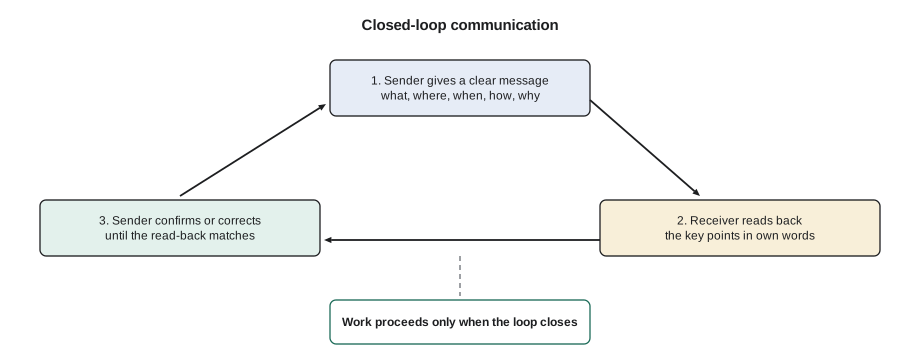
On a construction site, read-backs are most valuable for safety-critical and high-cost instructions: lift plans, lockout and energization, pour locations and quantities, excavation limits near utilities, and changes in sequence. A simple habit is to end an important instruction with 'just so I know I explained it properly, tell me what you're going to do'. Framing it as a check on the sender's explanation, rather than a test of the receiver, avoids making people feel patronized.
Radio protocol
Two-way radios are essential on larger sites, especially for crane, hoist and concrete operations. Good radio use follows a few rules: agree channels for different purposes (for example, one for crane operations only), identify yourself and the person you are calling, keep messages short and specific, wait for acknowledgment, use read-backs for critical instructions and keep the channel clear during lifts and emergencies. Crane signaling must follow the signals and procedures required by the applicable regulations and standards, and only designated, qualified signal persons should direct lifts; CON-325 and the rigging courses cover crane operations.
| Step | Example on the hoist channel |
|---|---|
| Call: who you are calling and who you are | "Hoist, this is Omar on level five." |
| Wait for acknowledgment | "Omar, hoist, go ahead." |
| Message: short and specific | "Need the car at five for two carts of drywall screws and corner bead, then down to the ground." |
| Read-back of key points | "Five for two carts, then to ground. Copy." |
| Confirm and close | "Correct. Thanks, hoist." |
Listening
Supervisors spend much of their communication time talking, but listening is at least as important. Active listening means giving full attention, not interrupting, asking questions to understand rather than to argue, summarizing what you heard and checking that you got it right. On a site, it also means listening for what is not said: the apprentice who goes quiet when asked if he has done this before, the foreman who says 'we'll try' instead of 'we'll do it'. People who feel listened to are far more likely to raise problems early, which links back to the psychological safety discussed in lesson 3.
How many channels?
Communication becomes harder as the number of people grows, because the number of possible person-to-person links rises much faster than the number of people. With \(n\) people, the number of two-way channels is
Four people have 6 possible channels; eight people have 28; fifteen foremen and supervisors have 105. This is one reason large sites need structure: a regular huddle where everyone hears the same plan, clear points of contact for each trade and written records that everyone can check. The worked example also estimates how a message degrades as it is passed along a chain, a reminder of why direct communication beats relays.
# Possible two-way channels among n people, and message survival along a relay chain
for n in [4, 8, 15, 30]:
    print(f"{n:3d} people -> {n*(n-1)//2:4d} possible channels")

# Suppose each person who relays a message keeps every key detail correct with probability p.
# Probability the message arrives intact after k relays is p**k (illustrative assumption).
for p in [0.95, 0.90]:
    row = ", ".join(f"{k} relays {p**k:.0%}" for k in [1, 2, 3, 4])
print(f"p = {p:.2f}: {row}")4 people -> 6 possible channels 8 people -> 28 possible channels 15 people -> 105 possible channels 30 people -> 435 possible channels p = 0.95: 1 relays 95%, 2 relays 90%, 3 relays 86%, 4 relays 81% p = 0.90: 1 relays 90%, 2 relays 81%, 3 relays 73%, 4 relays 66%
Even if each person in a chain passes a message on with 90 % accuracy, a message relayed through three people arrives intact only about 73 % of the time. The assumption is illustrative, but the lesson is real: when a message matters, go direct, or use a written record that everyone reads.
Multilingual crews and plain language
Construction crews in both Canada and the United States are increasingly multilingual. Immigrants make up a large and growing share of the trades workforce in Canada, and in the United States Hispanic and Latino workers make up roughly a third of the construction workforce according to recent federal labor statistics. Many workers are fluent in English; others are not, and some may read better in another language, or may read little in any language. Research on immigrant workers' safety in both countries has found that language barriers contribute to misunderstanding of hazards and procedures and to under-reporting of injuries.
Supervisors have several tools. Use plain language: short sentences, common words, one idea at a time, no slang or idioms. Show rather than tell: demonstrate the task, point at the location, use photos and diagrams. Use bilingual lead hands or co-workers as interpreters where appropriate, while remembering that safety-critical training may require a qualified interpreter or materials in the worker's language. Check understanding by asking people to show you or explain in their own words, not by asking 'do you understand?', which almost always gets a yes. In many jurisdictions, employers must provide safety information and training in a way workers can understand, which can mean translated materials or interpreters (lesson 11).
Respect matters as much as technique. Mocking accents, refusing to let workers speak their own language on breaks or assuming that someone with limited English has limited skill all damage trust and can amount to discrimination. Many superintendents learn key safety phrases in the main languages on their sites; the effort is noticed and appreciated.
Huddles and toolbox talks
Daily huddles and weekly toolbox talks are the backbone of group communication on site. The foremen huddle is a short coordination meeting, often 10 to 15 minutes, standing, at the same time and place every day, where each foreman says what their crew is doing, where and what they need, and the superintendent highlights overlaps, hazards, inspections and deliveries. Crew-level huddles then pass the plan on. Toolbox talks are short safety briefings on a specific topic, usually weekly and often required by regulation or company policy.
Worked problem
Planning a five-minute crew huddle
Ben's formwork crew is starting to strip the level 2 deck formwork and reshore. Plan a five-minute start-of-shift huddle.
Show solution
- What we are doing today and where: stripping bays C to E on level 2 and installing reshores per the reshoring drawing; the rebar crew is on level 3 above.
- Who does what: two pairs stripping, one pair reshoring behind them, one laborer moving material to the hoist; Ben checks reshore spacing before each bay is released.
- Hazards and controls: falling panels and props (exclusion zone below, no one under the bay being stripped), manual handling (two-person lifts for panels), silica if any grinding (water suppression).
- Quality and sequence: never strip a bay until the reshores for the adjacent bay are in; report any cracking or deflection immediately.
- Questions and concerns: ask each person, by name, if anything is unclear; finish with a read-back from the reshoring pair.
Answer: The huddle covers what, where, who, hazards, quality and questions in about five minutes, and ends by checking understanding rather than assuming it.
Toolbox talks work best when they are about this week's actual work, involve the crew (asking questions, getting people to share experiences), are short and are recorded. Reading a generic sheet aloud while the crew stares at their phones meets the letter of a requirement and achieves almost nothing. CON-355 covers safety communication in depth.
Written communication in the field
Supervisors also write: daily reports, emails, notes on drawings, instructions to subcontractors and incident reports. Field writing should be factual, specific, dated and neutral in tone. Write as though the document may one day be read by a judge, an arbitrator or an inspector, because it might be (CON-420 shows how field records decide disputes). Avoid opinions about people, sarcasm and speculation. A good daily report records weather, manpower by trade, work done by area, deliveries, inspections, delays and their causes, instructions given and received, incidents and visitors. CON-375 covers documentation systems and daily reports in detail.
Common mistakes
MistakeTaking a nod or 'yep' as proof that an instruction was understood.
InsteadAsk for a read-back or a summary in the receiver's own words for anything important.
MistakeSending a critical change by email to someone working in the field.
InsteadUse a rich channel such as face to face or a call, then confirm in writing.
MistakeGiving several instructions at once, in a noisy area, without pointing at the work.
InsteadGive one task at a time, move somewhere quieter and show the location on the drawing or on site.
MistakeAsking 'do you understand?' to check understanding with a worker whose English is limited.
InsteadAsk them to show you or explain what they will do; use plain language, visuals and interpreters.
MistakeWriting emotional or speculative comments in daily reports and emails.
InsteadKeep field writing factual, specific, dated and neutral.
Summary and key terms
- Communication fails at every stage from sender to feedback; the most dangerous failure is the illusion of understanding.
- Rich channels such as face-to-face conversation suit complex, urgent or safety-critical messages; lean channels suit routine messages and records.
- Clear instructions cover what, where, when, how, the standard and why, one task at a time, ideally at the work.
- Closed-loop communication with read-backs prevents errors in safety-critical and high-cost instructions.
- Radio use needs agreed channels, short messages, acknowledgments and read-backs; only qualified signal persons direct lifts.
- The number of channels grows as n(n−1)/2, so large sites need structure and direct communication.
- Multilingual crews need plain language, visuals, interpreters where needed and checks of understanding, delivered with respect.
- Huddles, toolbox talks and factual written records are the backbone of group communication on site.
- Noise
- Anything that distorts or blocks a message between sender and receiver.
- Media richness
- The amount of information a channel can carry, from rich face-to-face conversation to lean written notices.
- Read-back
- The receiver repeating the key points of a message so the sender can confirm or correct it.
- Closed-loop communication
- A sequence of message, read-back and confirmation used to prevent misunderstanding.
- Active listening
- Listening with full attention, asking clarifying questions and summarizing to confirm understanding.
- Plain language
- Clear, simple wording that the intended audience can understand the first time.
- Huddle
- A short, regular, usually standing meeting to coordinate the day’s work.
- Toolbox talk
- A short safety briefing to a crew on a specific topic.
Practice problems
Work each problem on paper first, then reveal the answer to check.
Name the stages of the basic communication model.
Show answer
Sender, message, channel, noise, receiver and feedback.
What is the illusion of understanding?
Show answer
Sender and receiver both believe the message was understood but hold different pictures of it.
Which channel should be used for a complex safety-critical instruction, and how should it be recorded?
Show answer
Face to face at the work, followed by a written confirmation.
List the elements of a clear instruction.
Show answer
What, where, when, how, to what standard and why.
How can a supervisor ask for a read-back without sounding patronizing?
Show answer
Frame it as a check on their own explanation: 'tell me what you're going to do so I know I explained it properly'.
How many two-way channels exist among 15 people?
Show answer
15 × 14 / 2 = 105.
If each relay is 90 % accurate, what is the chance a message survives three relays intact?
Show answer
0.9³ ≈ 73 %.
Give three techniques for communicating with workers who have limited English.
Show answer
Plain language, demonstration and visuals, interpreters or bilingual lead hands, checking understanding by having them show or explain.
Lesson quiz · 5 questions
Score 60% or more to complete this lesson.
Create a free account to save your progress, take quizzes and earn a certificate.