
CON-305 · Lesson 5 of 12 · 26 min
Leading subcontractors and trades you don't employ
On Larkspur Commons, about nine out of ten workers on site at peak are employed by subcontractors. Dana cannot hire them, fire them, set their pay or tell them how their company should run. Yet she is responsible for making sure their work is safe, correct, coordinated and on time. This is the defining challenge of general contractor supervision: leading people over whom you have little formal authority. This lesson looks at where a superintendent's influence comes from, how to start a subcontractor relationship well, how to track and secure manpower commitments, how to escalate when performance falls short, and why treating subcontractors fairly is good business as well as good manners.
The commercial side of subcontracting, from prequalification and buyout to subcontract terms, payments and back charges, is covered in CON-330, and changes and claims in CON-420. Detailed coordination between trades, including look-ahead and short-interval planning, belongs to CON-335. Here the focus is on the supervisor's leadership of the people in the field.
Where influence comes from
In 1959, John French and Bertram Raven described five bases of social power. Legitimate power comes from a recognized position or role. Reward power comes from the ability to give things people value. Coercive power comes from the ability to impose penalties. Expert power comes from knowledge and skill. Referent power comes from being respected and liked. Raven later added informational power, which comes from controlling or sharing information others need.
| Base of power | Superintendent's sources with subcontractors | Notes |
|---|---|---|
| Legitimate | Contract role as the general contractor’s representative; site rules | Real but limited; foremen take direction from their own employers |
| Reward | Making work ready, crane and hoist time, good sequences, prompt sign-off of progress, recommendations for future work | Often the most powerful lever |
| Coercive | Removal from site for safety violations, back charges and default (through the PM) | Necessary at times; overuse destroys relationships |
| Expert | Knowing the drawings, the sequence and the trades | Earns respect from experienced foremen |
| Referent | Being fair, reliable and respected | Built over time; carries through hard times |
| Informational | Look-ahead schedules, design changes, inspection dates, other trades’ plans | Sharing it freely builds cooperation |
Research on influence generally finds that expert and referent power produce commitment, while coercive power produces compliance at best and resistance at worst. On a construction site, the superintendent's most valuable lever with subcontractors is often reward power in a particular form: making their work possible. A subcontractor who arrives to find the area ready, the materials accessible, the hoist booked and the previous trade finished will make money and will want to work for that superintendent again. One who arrives to find the area blocked, the information missing and three other trades in the way will lose money and will protect itself, often by pulling workers to other projects.
The contract as foundation, not weapon
The subcontract sets out the scope, schedule obligations, safety requirements, cleanup responsibilities and remedies for non-performance. A superintendent should know the subcontracts for every trade on site, at least the scope, the exclusions and the schedule requirements. Asking 'is that in their scope?' before demanding something avoids arguments that the general contractor will lose.
But the contract works best as a foundation that both sides understand, not as a weapon brandished at every disagreement. Formal contract remedies, such as notices of default, supplementing a subcontractor's forces at its cost or terminating the subcontract, are serious steps that are normally taken by the project manager, often with company management and legal advice, following the notice procedures in the subcontract. The superintendent's role is to supply accurate, dated field records, such as daily reports, manpower counts and photos, that show what happened (CON-375 covers documentation).
Starting well: the trade start-up meeting
Most problems with subcontractors are cheaper to prevent than to fix. A trade start-up or pre-mobilization meeting, held on site before a subcontractor's crew starts work, sets expectations on both sides. CON-330 describes the commercial content; the superintendent's part covers how the trade will work on this site.
| Topic | What to agree at start-up on Larkspur Commons |
|---|---|
| People | Names and phone numbers of the foreman, the subcontractor’s superintendent or PM, the safety contact; who can make decisions |
| Schedule | Start date, sequence by floor or area, durations, interfaces with other trades, crew size by week |
| Site logistics | Access, parking, laydown, hoist and crane booking, deliveries, storage on floors (CON-325) |
| Safety | Site orientation, site-specific hazards, fall protection, hot work, permits, emergency procedures, safety documents required |
| Quality | Mock-ups, hold points, inspection and testing, deficiency process (CON-345) |
| Communication | Daily huddle attendance, weekly meeting, how RFIs and questions are raised, radio channel |
| Housekeeping and cleanup | Clean as you go, scrap bins, who pays when cleanup is not done |
| Changes | No extra work without written direction through the PM; how time and material tickets are signed |
The start-up meeting is also the beginning of a relationship. Dana makes a point of walking the site with each new foreman after the meeting, showing them their work areas, laydown and access, and asking what they need from Thornbury to be productive. That walk often surfaces problems, such as a missing blocking detail or a laydown area too far from the hoist, that would otherwise have appeared on the first day of work.
Building working relationships with subcontractor foremen
Subcontractor foremen are the people who actually lead most of the work on site. Treating them as partners rather than as people to be ordered about pays off. Practical habits include learning their names and their crews' names, involving them in planning their own work (people commit to plans they helped make), sharing information early, including bad news, keeping promises about access and sequence, giving credit publicly when their crews do good work, raising problems with them privately before going to their bosses, and being fair when disputes arise between trades.
Fairness matters especially when the general contractor's own crews work alongside subcontractors. If Thornbury's carpenters always get the best hoist slots and the subcontractors' complaints are ignored, the subcontractors will notice. Dana's rule is that the schedule, not ownership, decides priority.
Manpower commitments
The most common field complaint about subcontractors is manpower: too few workers on site to keep up with the schedule. Subcontractors juggle several projects and move workers between them, often toward whichever general contractor shouts loudest or whichever job is most profitable to work on. A superintendent who wants reliable manpower needs to make specific commitments visible and track them.
At the weekly coordination meeting, each foreman should commit to the work their crew will complete next week and the crew size needed. Those commitments are written down and reviewed the following week. CON-410 explains how the Last Planner System measures percent plan complete (PPC); a simpler measure for manpower is the ratio of actual worker-days on site to committed worker-days. Daily reports should record each subcontractor's headcount every day, which also provides the evidence the project manager needs if formal action becomes necessary.
The worked example analyses ten working days of headcounts for four subcontractors on Larkspur Commons against what each committed at the weekly meeting.
# Planned versus actual headcount for ten working days (invented daily report data)
committed = {"Ridgeline Framing": 14, "Northgate Mechanical": 8, "Ashgrove Electric": 7, "Summit Drywall": 6}
actual = {
    "Ridgeline Framing":    [14, 13, 11, 10, 9, 10, 9, 8, 9, 9],
    "Northgate Mechanical": [8, 8, 9, 8, 8, 7, 8, 8, 9, 8],
    "Ashgrove Electric":    [7, 7, 6, 7, 7, 7, 8, 7, 6, 7],
    "Summit Drywall":       [0, 0, 6, 6, 6, 6, 6, 6, 6, 6],
}
for sub, all_days in actual.items():
    late = next(i for i, d in enumerate(all_days) if d > 0)   # days before mobilizing
    days = all_days[late:]
    plan = committed[sub] * len(days)
    got = sum(days)
    short = [d for d in days if d < committed[sub]]
    trend = sum(days[-3:]) / 3 - sum(days[:3]) / 3
    flag = "ESCALATE" if got / plan < 0.85 else ("watch" if got / plan < 0.95 else "ok")
    print(f"{sub:22s} {got:4d}/{plan:4d} worker-days = {got/plan:5.0%}  late start {late}d  "
f"days short {len(short):2d} trend {trend:+.1f}/day {flag}")Ridgeline Framing 102/ 140 worker-days = 73% late start 0d days short 9 trend -4.0/day ESCALATE Northgate Mechanical 81/ 80 worker-days = 101% late start 0d days short 1 trend +0.0/day ok Ashgrove Electric 69/ 70 worker-days = 99% late start 0d days short 2 trend +0.0/day ok Summit Drywall 48/ 48 worker-days = 100% late start 2d days short 0 trend +0.0/day ok
The numbers tell a clear story. Mechanical and electrical are close to their commitments. Drywall started two days late, which Dana records separately as a late mobilization, but has held its committed crew since. Framing is the problem: it started at full strength but has drifted down to nine workers against a commitment of fourteen, about 73 % of committed worker-days and falling. Framing is on the critical path for the upper floors, so this matters. The trend line is often more telling than the total: a subcontractor whose numbers are falling is usually being pulled toward another project.
Worked problem
Escalating a manpower shortfall
Ridgeline Framing has averaged under ten workers for a week against its commitment of fourteen, and level 4 framing is now three days behind the look-ahead. What should Dana do, step by step?
Show solution
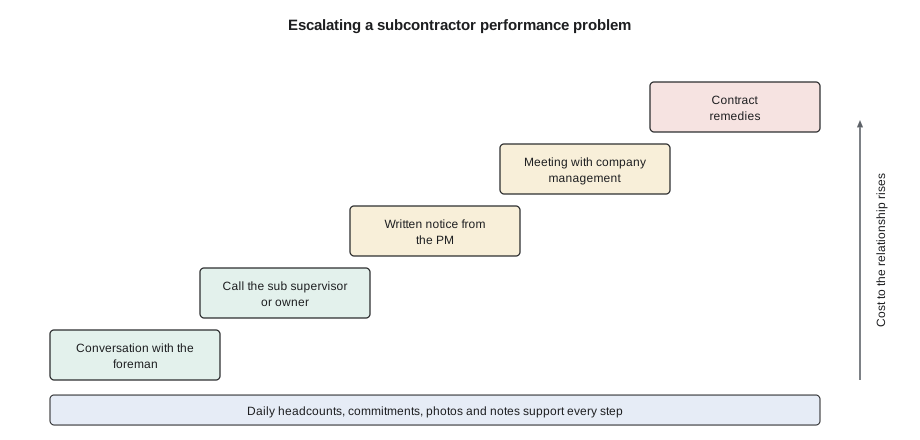
- Talk to Ridgeline's foreman first, privately, with the numbers. Ask what is going on: is there a problem on Thornbury's side, such as late trusses, blocked access or missing information, or are workers being sent elsewhere? Fix anything that is Thornbury's fault.
- If the foreman cannot fix it, call Ridgeline's superintendent or owner the same day, explain the impact on the schedule and other trades, and ask for a specific recovery commitment: how many workers, starting when.
- Record the conversations, commitments and daily headcounts in the daily reports, and brief Priya, the project manager.
- If the commitment is not met, Priya sends written notice under the subcontract's default or schedule provisions, and a meeting with Ridgeline's management is arranged.
- Only if that fails does Thornbury consider contract remedies, such as supplementing Ridgeline's forces at its cost, following the subcontract procedure with company management involved.
Answer: Escalation moves step by step from relationship to contract, each step is documented, and the general contractor checks its own contribution to the problem before blaming the subcontractor.
When the general contractor is the problem
Superintendents need the honesty to ask whether the general contractor caused a subcontractor's poor performance. Common causes include areas not ready when promised, previous trades not finished, unresolved RFIs, late approvals of shop drawings, trade stacking (too many trades crowded into the same area), unreliable hoist or crane access, poor housekeeping by others, and frequent changes in sequence. A study of any project's delays usually finds that a significant part of what looked like subcontractor non-performance began with workflow problems the general contractor controlled. Lean construction (CON-410) is largely a response to this. A superintendent who fixes those problems first has far more credibility when demanding performance.
Problems with subcontractor workers
Sometimes the issue is not a whole subcontractor but one of its workers: unsafe behavior, poor workmanship, disrespect or harassment. The superintendent's first step is normally to raise the issue with the worker's foreman, who is responsible for supervising that worker. Where there is imminent danger, anyone should stop the work immediately, and site rules usually give the general contractor the right to remove a person from site for serious safety or conduct violations. Removal decisions should follow the site rules and the subcontract, be documented and be communicated to the subcontractor's management. In unionized settings, the collective agreements of each trade and any project labor agreement may also apply (CON-365).
Harassment and discrimination against subcontractor workers are not someone else's problem. General contractors control the site and, under occupational health and safety and human rights laws in many jurisdictions, may have obligations to prevent and respond to harassment that affects anyone working there. HSE-108 covers workplace violence and harassment prevention, and lesson 11 covers the supervisor's legal and ethical duties.
Multi-employer sites and safety
On a site with many employers, safety responsibilities overlap. In Canada, provincial laws generally give the constructor or prime contractor overall responsibility for coordinating safety on the project, while each employer remains responsible for its own workers. In the United States, OSHA's multi-employer citation policy can hold a general contractor responsible as the controlling employer for hazards it could reasonably have prevented or detected, even when the exposed workers belong to a subcontractor. In practice, this means a superintendent cannot treat a subcontractor's unsafe practice as purely the subcontractor's business. Lesson 11 maps the law, and CON-355 covers safety leadership on multi-employer sites.
Supporting small and new subcontractors
Many subcontractors are small firms with limited office support. Some are new businesses, including firms owned by women, Indigenous people or members of other groups underrepresented in construction, which public owners increasingly encourage through social procurement policies (CON-330). A superintendent can help such firms succeed without lowering standards: explaining the general contractor's systems clearly, giving early notice of document requirements, being patient with first-time paperwork and pointing out problems early while they are cheap to fix. Firms that grow into reliable subcontractors strengthen the whole supply chain.
Common mistakes
MistakeRelying on threats and back charges to get subcontractor performance.
InsteadUse reward, expert and informational power first: make work ready, share plans and earn respect; keep coercive steps for when they are needed.
MistakeDemanding work without checking the subcontract scope.
InsteadKnow the scope and exclusions; ask 'is that in their scope?' before insisting.
MistakeSkipping the trade start-up meeting to save time.
InsteadHold a start-up meeting and site walk with every trade to agree people, schedule, logistics, safety, quality and communication.
MistakeBlaming subcontractors for delays caused by unready areas or missing information.
InsteadCheck the general contractor's own contribution first and fix workflow problems.
MistakeEscalating straight to contract default without records.
InsteadEscalate step by step and keep daily headcounts, commitments and conversations in the daily reports.
Summary and key terms
- Most site workers are employed by subcontractors, so superintendents lead largely through influence rather than authority.
- Bases of power include legitimate, reward, coercive, expert, referent and informational power; expert and referent power build commitment.
- Making a subcontractor's work possible is often the strongest lever a superintendent has.
- The subcontract is a foundation that must be known; formal remedies are normally taken by the project manager, supported by field records.
- A trade start-up meeting and site walk set expectations on people, schedule, logistics, safety, quality, communication, cleanup and changes.
- Track manpower commitments daily and watch trends; escalate step by step from conversation to contract.
- Fix the general contractor's own workflow problems first, treat subcontractor workers fairly and remember shared safety duties on multi-employer sites.
- Legitimate power
- Influence that comes from a recognized position or role.
- Reward power
- Influence that comes from the ability to provide things others value.
- Coercive power
- Influence that comes from the ability to impose penalties.
- Expert power
- Influence that comes from knowledge and skill.
- Referent power
- Influence that comes from being respected and liked.
- Trade start-up meeting
- A meeting held before a subcontractor mobilizes to agree how its work will be carried out on site.
- Manpower commitment
- A subcontractor’s promise to provide a stated crew size for planned work.
- Trade stacking
- Crowding several trades into the same area at the same time, reducing productivity and safety.
- Controlling employer
- Under OSHA’s multi-employer policy, an employer with general supervisory authority over a worksite.
Practice problems
Work each problem on paper first, then reveal the answer to check.
Name French and Raven's five original bases of power.
Show answer
Legitimate, reward, coercive, expert and referent.
Which power base is often a superintendent's strongest lever with subcontractors, and in what form?
Show answer
Reward power, in the form of making their work possible: ready areas, access, materials and information.
Who normally issues formal default notices to a subcontractor, and what does the superintendent contribute?
Show answer
The project manager, with company management; the superintendent supplies dated field records.
List five topics for a trade start-up meeting.
Show answer
People and contacts, schedule, site logistics, safety, quality, communication, cleanup, changes.
In the manpower example, which subcontractor should be escalated and why?
Show answer
Ridgeline Framing, at about 73 % of committed worker-days and falling, on the critical path.
What should Dana check before blaming a subcontractor for poor production?
Show answer
Whether Thornbury caused the problem through unready areas, missing information, trade stacking, access or sequence changes.
How should a superintendent deal with an unsafe subcontractor worker in a non-emergency situation?
Show answer
Raise it with the worker's foreman first, follow site rules and the subcontract, and document it; stop work immediately if danger is imminent.
Why can't a general contractor ignore a subcontractor's unsafe practices?
Show answer
Constructor or prime contractor duties in Canada and OSHA's multi-employer policy in the US can make the general contractor responsible.
Lesson quiz · 5 questions
Score 60% or more to complete this lesson.
Create a free account to save your progress, take quizzes and earn a certificate.