
CON-365 · Lesson 11 of 12 · 19 min
Discipline, grievances and arbitration
Most workers on a construction site never face discipline, and most supervisors would rather never impose it. But sooner or later a supervisor has to deal with a worker who is repeatedly late, ignores a safety rule, damages equipment, harasses a co-worker or simply cannot do the work. How the supervisor handles it decides whether the problem is corrected, whether the crew sees the response as fair, and whether the decision survives a grievance or legal claim. This lesson covers the principles of fair discipline, how grievances and arbitration work in unionized construction, and the different rules that apply to non-union workers.
The purpose of discipline
Discipline in a well-run workplace is corrective, not punitive. Its purpose is to make clear what standard is expected, give the worker a fair chance to meet it, and protect the crew and the work. Punishment for its own sake breeds resentment and rarely changes behavior. That is why labor arbitrators, and good supervisors, look for progressive discipline: a sequence of increasingly serious responses that gives the worker notice and an opportunity to improve, except for misconduct so serious that it justifies immediate dismissal.
| Step | Typical use | Record |
|---|---|---|
| Coaching or verbal reminder | First minor issue: late twice, untidy work area | Supervisor's note with date and what was said |
| Written warning | Repeated minor issues or a more serious first issue | Letter to the worker, copy to the union and file |
| Suspension without pay | Continued problems after warnings, or a serious breach such as a safety violation | Letter stating reasons, length and that further breaches may lead to dismissal |
| Final warning or last chance agreement | Before dismissal, especially where there are mitigating factors | Agreement signed by the worker, the union and the employer |
| Dismissal | Continued problems after the steps above, or very serious misconduct | Letter stating reasons; record of the whole history |
Some conduct can justify skipping steps: violence, theft, serious harassment, deliberately disabling a safety device, or working while impaired in a safety-sensitive job. Even then, the employer must investigate, give the worker a chance to respond, and consider the circumstances before deciding.
Just cause in US labor arbitration
Almost every collective agreement says that employees may be disciplined or discharged only for just cause. Many US arbitrators use a framework of seven tests derived from arbitrator Carroll Daugherty's 1966 decision in Enterprise Wire: whether the employee had notice of the rule and its consequences; whether the rule was reasonable; whether the employer investigated before disciplining; whether the investigation was fair; whether there was substantial evidence; whether the rule was applied without discrimination; and whether the penalty was reasonably related to the offense and the employee's record. Arbitrators can reduce penalties they find excessive.
In deciding whether a penalty was excessive, arbitrators consider factors such as:
- The seriousness of the conduct and its effect on safety, co-workers and the employer.
- The worker's length of service and disciplinary record.
- Whether the conduct was a momentary lapse or premeditated.
- Provocation, personal circumstances, and whether the worker acknowledged the problem and apologized.
- Whether the rule was known, clear and consistently enforced, including against other workers.
- Whether the employer followed its own procedures and the agreement's requirements, such as notice to the union.
Consistency is where employers most often lose. If Luis suspends one carpenter for not tying off at the slab edge but a foreman let another carpenter off with a word for the same thing last month, an arbitrator may find the suspension discriminatory or excessive. Calder Ridge's discipline records are kept centrally by Grace so that supervisors can check how similar cases were handled.
Investigating before deciding
A supervisor who disciplines first and investigates later is likely to lose at arbitration and, more importantly, may punish the wrong person. Calder Ridge's investigation steps are short but required.
- Get the facts: what happened, when, where, who saw it; photographs and documents.
- Interview the worker, with a steward present if the worker requests one under Weingarten rights or the agreement provides for it, and hear their side.
- Interview witnesses, separately where possible.
- Check the worker's record and how similar cases were handled.
- Decide, considering the factors above, and record the reasons.
- Tell the worker the decision and the reasons, in writing, with a copy to the union where required.
Where the conduct creates an immediate risk, such as suspected impairment or violence, the worker can be removed from work with pay pending the investigation. The decision on discipline comes afterwards.
The grievance procedure
A grievance is a formal complaint that the employer has violated the collective agreement. It can be filed by a worker, by the union on behalf of a group, or sometimes by the employer. Nearly every construction agreement sets out steps and time limits, ending in final and binding arbitration, in exchange for the union's promise not to strike during the agreement. Under the Supreme Court's 1960 Steelworkers Trilogy, courts generally enforce agreements to arbitrate and defer to arbitrators' interpretations of the agreement.
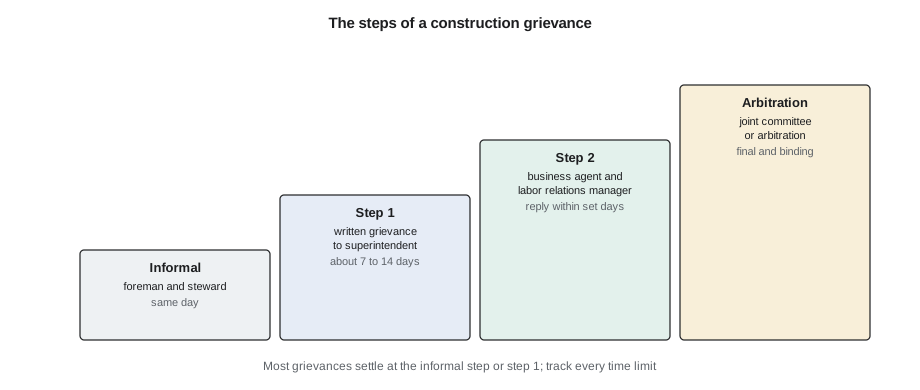
Construction moves fast, and waiting a year for an arbitrator does not suit a project that will be finished by then. Many construction agreements provide for joint labor-management committees that hear grievances at the area level, sometimes with a deadlocked case going to a national joint board or to arbitration, and many provide for expedited arbitration. The electrical industry's Council on Industrial Relations is a well-known example of a joint body that decides unresolved disputes. These faster routes are one reason construction grievances tend to be resolved within months rather than years.
Most grievances are settled long before arbitration, usually at the first or second step, and the best way to settle them is to deal with the issue early. Luis expects his foremen to talk to the steward when a worker is unhappy, before anyone writes anything down, and to call Grace as soon as a written grievance appears.
Managing time limits
Grievance procedures have strict time limits: a grievance must be filed within a set number of days of the event, and each step must be answered or advanced within a set time. Missing them can cost a party its case, although arbitrators in many jurisdictions have some power to extend limits where the delay caused no real harm. Grace tracks every open grievance in a simple log.
# Open grievance log with days to the next deadline (as of a review date; illustrative)
from datetime import date, timedelta
today = date(2026, 10, 19)
grievances = [
    # (id, subject, step, date of last action, days allowed for next action, who acts next)
    ("G-14", "overtime distribution, forming crew B", 1, date(2026, 10, 12), 7, "Calder Ridge (step 1 reply)"),
    ("G-15", "show-up pay, wind cancellation", 2, date(2026, 10, 2), 14, "Calder Ridge (step 2 meeting)"),
    ("G-16", "3-day suspension, fall protection", 2, date(2026, 10, 9), 10, "Calder Ridge (step 2 reply)"),
    ("G-17", "apprentice wage step not applied", 1, date(2026, 10, 15), 7, "Calder Ridge (step 1 reply)"),
    ("G-12", "subcontracting of acoustic ceilings", 3, date(2026, 9, 1), 30, "union (refer to arbitration)"),
]
for gid, subject, step, last, allowed, who in sorted(grievances, key=lambda g: g[3] + timedelta(days=g[4])):
    due = last + timedelta(days=allowed)
    left = (due - today).days
    status = "OVERDUE" if left < 0 else ("due this week" if left <= 5 else "")
print(f"{gid} step {step} due {due} ({left:+3d} days) {who:30s} {subject} {status}")G-12 step 3 due 2026-10-01 (-18 days) union (refer to arbitration) subcontracting of acoustic ceilings OVERDUE G-15 step 2 due 2026-10-16 ( -3 days) Calder Ridge (step 2 meeting) show-up pay, wind cancellation OVERDUE G-14 step 1 due 2026-10-19 ( +0 days) Calder Ridge (step 1 reply) overtime distribution, forming crew B due this week G-16 step 2 due 2026-10-19 ( +0 days) Calder Ridge (step 2 reply) 3-day suspension, fall protection due this week G-17 step 1 due 2026-10-22 ( +3 days) Calder Ridge (step 1 reply) apprentice wage step not applied due this week
On the review date, the log shows problems on both sides. G-12 is 18 days past the union's deadline to refer the subcontracting grievance to arbitration, which Calder Ridge may be able to rely on. But G-15 is three days past Calder Ridge's own deadline for the step 2 meeting, so Grace called the business representative that morning to apologize and set a date, rather than give the union a reason to argue that the company had forfeited its position. G-14 and G-16 are due today. G-17 is the kind of grievance Calder Ridge should simply settle: if the apprentice qualified for the higher wage step, the company owes the difference and should pay it promptly, which also builds credibility with the union for disputes that are genuinely contested.
A discipline case from Elmwood
In month 9, the safety coordinator found a carpenter with eleven years' service working at an unprotected slab edge on level 5 without tying off, about 30 minutes after the crew's morning huddle had covered the edge protection on that floor. He had received a written warning two years earlier for a similar breach on another project. The investigation, with Tom Kowalski present, found that his lanyard had been available, that the anchor point was installed, and that he had decided it was quicker to finish a short task without tying off.
Luis considered dismissal, because fall protection breaches are among the most serious on a site. He weighed the long service, the fact that the earlier warning was two years old, the immediate admission and apology, and the company's record of handling similar first and second breaches. He imposed a three-day suspension and a final written warning stating that any further fall protection breach would lead to dismissal. The union grieved the suspension at step 1, arguing for a one-day suspension, but withdrew the grievance at step 2 after reviewing the earlier warning and Calder Ridge's records of similar cases. The carpenter finished the project without further incident.
The case illustrates the balance arbitrators look for: a serious safety breach, real consequences, consideration of the mitigating factors, and consistency with how others had been treated.
Running a discipline meeting
The meeting where discipline is delivered is short, but it shapes how the worker and the crew see the decision. Luis coaches his foremen to hold it privately, never in front of the crew; to have the steward present where the agreement provides or the worker asks; to state the facts, the rule, the decision and the reasons plainly; to say what is expected from now on and what will happen if the problem continues; and to give the worker a chance to speak. The written record is handed over at the meeting or sent the same day. What supervisors should avoid is arguing about the decision, bringing up unrelated complaints, or making remarks about the worker's character. A worker who leaves the meeting understanding what went wrong and believing they were treated fairly is much more likely to improve, and much less likely to grieve.
The steward's role in the meeting is to represent the worker, ask questions and make sure the process is fair. Stewards sometimes argue strongly. A supervisor who stays calm, listens, and does not take it personally will usually find the steward easier to work with the next time.
Non-union workers
Calder Homes' non-union workers have no grievance procedure or arbitrator. Ohio, like most states, follows employment at will: either party can end the employment at any time for any lawful reason. But the exceptions are significant. Employers may not discipline or dismiss workers for reasons prohibited by discrimination laws, in retaliation for complaints of discrimination, wage violations or safety concerns, or for reasons that violate public policy. Section 7 of the NLRA protects non-union workers who act together to raise concerns about pay or working conditions. Good practice is therefore much the same as in the union setting: clear rules, investigation, progressive discipline and consistent records, which are an employer's best evidence if a dismissal is challenged.
Common mistakes
MistakeDisciplining first and investigating later.
InsteadInvestigate, hear the worker's side with representation where provided, then decide and record reasons.
MistakeTreating similar breaches differently on different crews.
InsteadCheck how similar cases were handled and apply rules consistently.
MistakeIgnoring grievance time limits.
InsteadTrack every grievance's deadlines and respond on time.
MistakeFighting grievances the company should simply settle.
InsteadSettle clear errors promptly and save credibility for genuine disputes.
MistakeAssuming employment at will means any dismissal is safe.
InsteadDiscrimination, retaliation, public policy and Section 7 protections still apply.
Summary and key terms
- Discipline is corrective: progressive steps give notice and a chance to improve, except for very serious misconduct.
- Arbitrators often apply the seven tests of just cause from Enterprise Wire.
- Service, record, premeditation, provocation, apology and consistency affect whether a penalty stands.
- Investigate before deciding, with representation where provided, and record reasons.
- Courts defer to grievance arbitration under the Steelworkers Trilogy; joint committees and expedited arbitration speed construction cases.
- Track grievance time limits and settle clear errors promptly.
- At-will employment has major exceptions for discrimination, retaliation, public policy and concerted activity.
- Just cause
- A fair and sufficient reason for discipline, as judged by an arbitrator.
- Progressive discipline
- Increasingly serious responses to repeated or continuing problems.
- Seven tests
- The just cause framework from Enterprise Wire (1966) used by many US arbitrators.
- Last chance agreement
- An agreement that a further breach will lead to dismissal, in exchange for a lesser penalty now.
- Grievance
- A formal complaint that the collective agreement has been violated.
- Steelworkers Trilogy
- The 1960 Supreme Court decisions that made courts defer to labor arbitration.
- Employment at will
- The rule that employment can be ended by either party for any lawful reason.
Practice problems
Work each problem on paper first, then reveal the answer to check.
Name four factors arbitrators consider in deciding whether a penalty was excessive.
Show answer
Any four: seriousness, service, record, premeditation, provocation, apology, consistency, procedure.
Which grievances in Grace's log needed action, and which deadline had Calder Ridge itself missed?
Show answer
G-14 and G-16 were due that day and G-17 within three days; Calder Ridge had missed the G-15 step 2 deadline by three days, while G-12 was past the union's deadline.
Why should Calder Ridge settle G-17 quickly?
Show answer
If the apprentice qualified, the company owes the difference; settling clear errors builds credibility for genuine disputes.
What did Luis weigh in the slab-edge case?
Show answer
The seriousness of the breach against long service, the age of the earlier warning, the admission and apology, and consistency with similar cases.
Why are consistent records important for non-union discipline too?
Show answer
They are the employer's best evidence if a dismissal is challenged under discrimination, retaliation or other protections.
Lesson quiz · 5 questions
Score 60% or more to complete this lesson.
Create a free account to save your progress, take quizzes and earn a certificate.