
CON-365 · Lesson 2 of 12 · 19 min
Unions, open shops and alternative models
When Calder Ridge was founded in the 1980s, it was a small concrete forming company with a non-union crew. It became a union contractor in the 1990s when it joined its local contractor association and signed the carpenters' and laborers' agreements, and it has worked under them ever since. Its sister company, Calder Homes, has stayed non-union. Nadia Okafor is often asked by younger managers which model is better. Her answer is that each model solves the same problems in a different way, and a contractor that understands the trade-offs makes better decisions whichever model it works under. This lesson compares the main models in American construction.
The problems every model must solve
Whatever the labor model, a contractor has to solve the same six problems. It must find qualified workers when it wins work and release them when the work ends. It must train new workers in a skilled trade. It must set wages that attract workers but still allow it to win bids. It must provide health benefits and retirement savings to people who may work for it for only a few months. It must handle complaints and discipline fairly. And it must keep the work moving without disputes. The models differ mainly in who solves each problem: the individual employer, a union, a joint union-employer body, or an industry association.
| Problem | Building trades union model | Open shop model |
|---|---|---|
| Finding workers | Union hiring hall dispatches members; employer may name-request | Employer recruits directly, through staffing agencies or referrals |
| Training | Joint union-employer apprenticeship programs funded by hourly contributions | Employer or association programs, colleges, or on-the-job training |
| Wages | Set by collective agreement for each classification | Set by the employer, often by individual skill and market |
| Benefits | Multi-employer health and pension plans that follow the worker | Employer plans, often lost when the worker leaves |
| Complaints and discipline | Grievance procedure ending in binding arbitration | Employer policy; courts or tribunals for legal claims |
| Work continuity | No-strike clause during agreement; disputes go to grievances | No union strikes, but more turnover risk |
The building trades unions
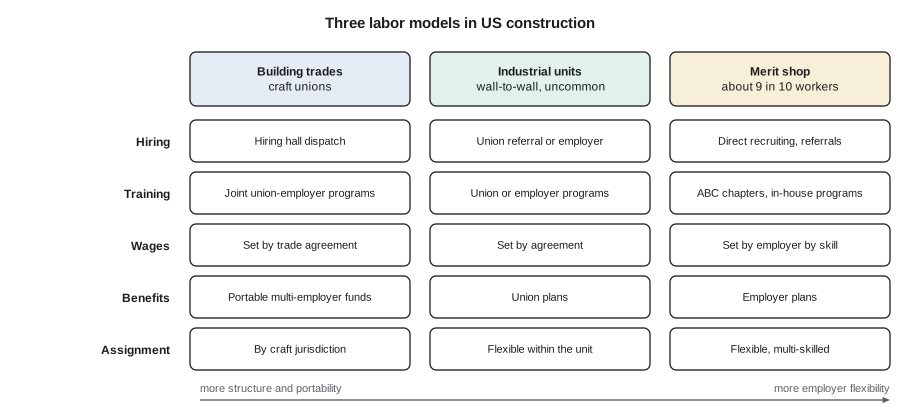
The traditional construction unions in the United States are the building trades: craft unions such as the carpenters, laborers, electrical workers, plumbers and pipefitters, ironworkers, sheet metal workers, bricklayers, operating engineers, boilermakers, insulators, painters and others. They act together through North America's Building Trades Unions (NABTU) nationally and through state and local building trades councils. Each union represents one trade, has its own locals covering geographic areas, and claims particular work as belonging to its members.
The building trades model is built around the trade, not the employer. A carpenter's skills, apprenticeship, pension and health coverage belong to the carpenter and move with them from contractor to contractor. Employers pay hourly contributions to trust funds run jointly by union and employer trustees, and the funds provide the benefits. The union hiring hall acts as a labor pool that any signatory contractor can draw from, which lets a contractor add forty carpenters for a six-month pour sequence and release them afterwards without the cost of recruiting and laying off its own permanent staff.
Critics point to the costs: higher hourly labor costs, rules that restrict which trade may perform which task, and less flexibility to assign one worker across several crafts. Supporters answer that the higher wage buys trained, certified and productive workers, a supply of labor on demand, and a shared investment in training that individual contractors would not make on their own.
Industrial and wall-to-wall approaches
In the United States, nearly all construction unions are craft unions, but some construction workers are represented in broader units, particularly in industrial maintenance, where one union may represent several crafts at a plant, and in some residential and specialty sectors. Some unions, most visibly the laborers, also organize across a wide range of tasks. Industrial-style units give an employer more flexibility to assign workers across tasks, but they are uncommon on commercial building projects, where craft lines remain the norm.
Disputes over which union should represent a group of workers are handled by the NLRB through representation proceedings, and disputes between craft unions over particular work are handled through the jurisdictional procedures in lesson 5. Within the building trades, internal disputes are often settled by the unions' own agreements.
Merit shop contractors
Merit shop or open shop contractors operate without union agreements, and they perform the large majority of American construction: about nine in ten construction workers are not union members. Associated Builders and Contractors (ABC) is their main national association, and many belong to chapters that run apprenticeship and craft training programs. Merit shop employers set their own wages and benefits, recruit directly, often use multi-skilled workers across traditional trade lines, and pay workers according to individual skill and performance rather than a single classification rate.
The open shop model gives employers flexibility and often lower hourly labor costs. Its challenges are the mirror image of the union model's strengths: recruiting quickly when a large job starts, keeping workers through the downturn so they are available for the next upturn, and funding training. Many open shop firms solve these by paying above-market wages to key workers, keeping a core crew employed year-round, and investing heavily in their own training.
Double-breasting
Calder Ridge and Calder Homes are an example of double-breasting: related companies, one union and one non-union. Double-breasting is lawful, but the NLRB and courts look closely at it. If the two companies are really one business, the Board can find them a single employer, or the non-union company can be found to be an alter ego of the union one, created to avoid the union. The single-employer test looks at common ownership, common management, interrelation of operations and centralized control of labor relations, and the Board then asks whether the employees form one appropriate bargaining unit. Nadia keeps the companies genuinely separate: different markets (commercial work and townhouses), separate management and payroll, separate equipment, and no transfers of workers between them.
| Factor | Calder Ridge | Calder Homes | Risk |
|---|---|---|---|
| Ownership | Okafor family holding company | Okafor family holding company | Common (expected) |
| Management | Own president, VP operations, estimators | Own general manager and estimator | Low |
| Work performed | Commercial buildings over $10 million | Townhouses and small residential | Low if markets stay separate |
| Labor relations | Grace Thibodeau | Calder Homes general manager | Low |
| Equipment and yard | Own yard and fleet | Rented equipment | Low |
| Workers | No transfers to Calder Homes | No transfers to Calder Ridge | High if this ever changes |
The review is not paperwork for its own sake. A single employer finding could bind Calder Homes to the collective agreements retroactively, with large back-pay and benefit contribution claims.
Comparing the cost of a crew
The most common question about labor models is cost, and it is also the most often misunderstood. Comparing hourly wages alone ignores benefits, payroll taxes, training, productivity and turnover. Ben Morrison asked Grace to compare the cost of forming a typical floor on Elmwood under Calder Ridge's union crews and under a hypothetical open shop crew, using realistic assumptions.
# Cost of forming one Elmwood floor: union crew vs a hypothetical merit shop crew (illustrative)
crews = {
    # name: (wage $/h, fringe benefits $/h, payroll taxes and workers' comp % of wage, productivity sq ft per worker-hour, rework %)
    "union carpenters":      (39.50, 22.85, 0.13, 10.8, 0.03),
    "merit shop carpenters": (31.00, 8.20, 0.13, 9.5, 0.06),
}
floor_area = 25800  # sq ft of formwork per floor
for name, (wage, ben, tax, prod, rework) in crews.items():
    cost_per_hour = wage + ben + wage * tax
    hours = floor_area / prod * (1 + rework)
    total = cost_per_hour * hours
print(f"{name:22s} ${cost_per_hour:6.2f}/h {hours:6.0f} h ${total:9,.0f} ${total / floor_area:5.2f}/sq ft")union carpenters $ 67.48/h 2461 h $ 166,051 $ 6.44/sq ft merit shop carpenters $ 43.23/h 2879 h $ 124,448 $ 4.82/sq ft
With these assumptions the union crew costs about 56 percent more per hour, but because it is assumed to be more productive and to need less rework, the gap per square foot is much smaller, about 33 percent. The numbers are illustrative, and the real answer depends on the market. In a tight labor market, a merit shop contractor may pay close to union rates to attract workers; in a region with a strong hiring hall and apprenticeship system, the union crew's productivity advantage may be larger. The point is that the comparison must be made on the cost of the work, not the cost of the hour.
How owners and the market shape the choice
Contractors do not choose a labor model in a vacuum. In many Midwestern and Northeastern cities, large owners and general contractors work mainly with union subcontractors, and a contractor that signs area agreements is bound to them for covered work in their geographic area. In much of the South and in residential construction, the merit shop dominates, and union contractors compete mainly on large industrial jobs. Some owners insist on an open site, where union and non-union bidders compete on equal terms. And project labor agreements, covered in lesson 6, can require all contractors on a project to work under one set of terms whatever their usual model.
The model also affects risk over the business cycle. In a boom, union contractors can draw on the hall while open shop contractors bid against each other for scarce workers; in a slump, open shop contractors can cut costs faster, while union contractors keep paying the agreed rates. Calder Ridge's strategy, Nadia says, is to be very good at the model it has rather than to wish it had the other one.
When a union organizes
Merit shop contractors may face organizing campaigns, including salting, in which union members or organizers apply for jobs in order to organize from within. In NLRB v. Town & Country Electric (1995), the Supreme Court held that paid union organizers can be employees protected by the NLRA, so an employer may not refuse to hire or fire them because of their union activity. Supervisors are the people most likely to break the rules during a campaign, often without meaning to.
A widely used memory aid lists four things supervisors must not do during an organizing campaign, often remembered as TIPS:
- Threaten: no suggestion that the company will close, cut hours, lose work or discipline people if they support the union.
- Interrogate: no questions about how a worker feels about the union, who has signed cards or what happened at a meeting.
- Promise: no promises of raises, better schedules or other benefits in exchange for rejecting the union.
- Spy: no watching union meetings, monitoring who talks to organizers, or creating the impression of surveillance.
Employers may share facts and opinions in a way that is not threatening, may continue to enforce rules consistently, and must report a campaign to management so that the company can get advice. NLRB doctrine on employer speech, such as mandatory meetings and statements about the consequences of unionization, has changed several times in recent years, which is one more reason for supervisors to involve management early.
What the model means for a superintendent
Luis Ferreira has run both kinds of crew. With union crews he works closely with the steward, plans manpower requests to the hiring hall days in advance, respects trade lines when assigning work, and follows the agreement on overtime, travel and breaks to the letter, because a careless instruction becomes a grievance. With open shop crews he has more freedom to move workers between tasks, but he spends more time recruiting, training and keeping good workers, and he must make sure company policies on pay and discipline are applied consistently, because there is no grievance procedure to catch his mistakes before they reach a tribunal or court. In both cases, he says, the crews that work best are the ones that trust their supervisor.
Common mistakes
MistakeComparing union and open shop costs on hourly wages alone.
InsteadCompare the cost of the work: wages, benefits, taxes, productivity, rework and turnover.
MistakeMoving workers or equipment freely between a union company and its non-union sister company.
InsteadKeep management, labor relations, work, equipment and workers genuinely separate, and review the separation regularly.
MistakeAsking a worker whether they have signed a union card.
InsteadNever threaten, interrogate, promise or spy; report a campaign to management and get advice.
MistakeAssuming every union contractor can assign workers freely across tasks.
InsteadCraft agreements and jurisdictional claims usually limit cross-trade assignment on commercial projects.
Summary and key terms
- Every labor model must solve hiring, training, wages, benefits, complaints and work continuity; models differ in who solves them.
- Building trades craft unions organize by trade, run hiring halls and joint training, and provide portable multi-employer benefits.
- Industrial or wall-to-wall units exist but are uncommon on commercial building projects.
- Merit shop contractors employ about nine in ten construction workers and train through ABC chapters and their own programs.
- Double-breasting is lawful only if the companies are genuinely separate; otherwise single-employer or alter ego findings follow.
- Labor costs must be compared per unit of work, not per hour.
- During organizing, supervisors must not threaten, interrogate, promise or spy.
- Building trades
- The craft unions that represent construction workers trade by trade.
- Hiring hall
- A union referral system that dispatches members to signatory employers.
- Merit shop
- A contractor operating without union agreements; also called open shop.
- Double-breasting
- Operating related union and non-union companies.
- Alter ego
- A company found to be a disguised continuation of another, created to avoid a union obligation.
- Salting
- Union members or organizers seeking jobs with a non-union employer in order to organize it.
- TIPS
- Threaten, interrogate, promise, spy: four things supervisors must not do during an organizing campaign.
Practice problems
Work each problem on paper first, then reveal the answer to check.
Name three of the six problems every labor model must solve.
Show answer
Any three: finding workers, training, wages, benefits, complaints and discipline, work continuity.
Why do building trades benefits follow the worker?
Show answer
Employers contribute to multi-employer trust funds, so coverage moves with the worker between signatory contractors.
In Grace's crew comparison, why was the cost gap per unit of work smaller than the gap per hour?
Show answer
The union crew was assumed to be more productive and to need less rework.
Which factor in the separation review carried the highest risk if it changed?
Show answer
Transfers of workers between the two companies.
A foreman asks an apprentice who started the union talk on the crew. Which rule has he broken?
Show answer
Interrogation, one of the TIPS prohibitions.
Lesson quiz · 5 questions
Score 60% or more to complete this lesson.
Create a free account to save your progress, take quizzes and earn a certificate.