
CON-365 · Lesson 5 of 12 · 21 min
Trade jurisdiction and work assignment disputes
On a union construction site, every task belongs to some trade. Carpenters build formwork, ironworkers place reinforcing steel and erect structural steel, laborers strip forms and place concrete, electricians pull wire, and so on. The boundaries between trades are mostly clear, but there are thousands of tasks on a hospital tower and some fall on the line: who installs the steel door frames, who builds the scaffolds, who sets the anchor bolts, who installs the firestopping around pipes passing through a rated wall. When two unions both claim a task, the result is a jurisdictional dispute, and handled badly it can stop a site. This lesson explains why these disputes happen, how they are prevented, and how they are resolved.
Why trade jurisdiction matters to workers
To a contractor, a jurisdictional dispute can look like a quarrel about who gets paid for a few hours of work. To the workers involved, it is about their livelihood. A union's claim to a type of work defines what its members are trained to do, what its apprenticeship teaches, and how many jobs its members will have over decades. If one trade loses a category of work, such as installing a new kind of wall panel or a new type of fire protection, its members lose that work on every future project. That is why unions defend their jurisdiction firmly, why they record agreements and decisions about it carefully, and why new materials and methods often spark disputes.
Jurisdiction also affects cost and productivity for contractors. Assigning work to the trade with the right skills and tools produces better work; assigning it to a trade whose rate is lower, or whose crew happens to be idle, may look efficient but can provoke a dispute that costs far more than it saves.
How work is assigned
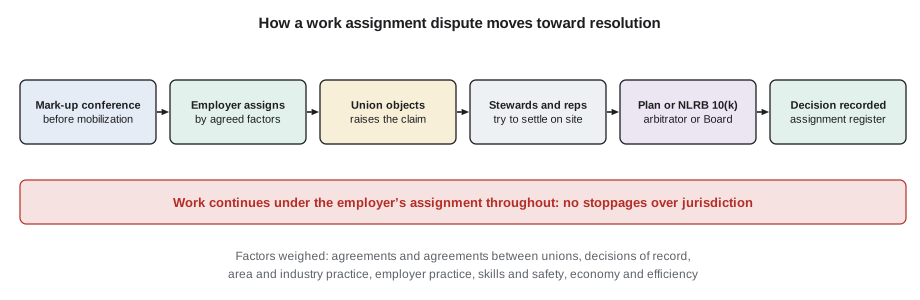
In the United States, the employer assigns the work. Calder Ridge's superintendent decides which of its crews, or which subcontractor, performs each task. If the contractor and the unions are bound to the Plan for the Settlement of Jurisdictional Disputes in the Construction Industry, discussed below, the assignment must follow the Plan's criteria. Otherwise the employer assigns based on its agreements, past practice and efficiency, and a union that disagrees can pursue its claim but may not strike or picket to force a reassignment.
The key moment for preventing disputes is before work starts. Experienced contractors hold a pre-job or mark-up conference: the contractor lists the major work items in its scope, states which trade it will assign each to, and gives the unions a chance to raise objections before anyone is on site. On Elmwood, Luis held separate mark-up meetings with the carpenters, laborers and ironworkers in the month before mobilization, covering about 140 items, and sent the minutes to each union and to Grace.
Sources of jurisdiction
When Luis assigns a disputed item, he looks at the same sources a labor board or arbitrator would look at later.
| Source | What it shows | Example on Elmwood |
|---|---|---|
| Collective agreement scope clauses | Which work each union's agreement with the employer covers | The carpenters' agreement lists hollow metal door frames; the ironworkers' lists miscellaneous metals |
| Agreements between unions | Settlements between unions on how particular work is divided | A national agreement between the carpenters and ironworkers on door frames in masonry and drywall walls |
| Decisions of record | Past board, plan or arbitration decisions on similar work | Prior decisions assigning scaffold erection in the area |
| Area and industry practice | How the work is normally assigned by contractors in the area | Local contractors normally assign firestopping to the trade that installs the penetrating service |
| Employer practice | How this contractor has assigned the work before | Calder Ridge has always used its own carpenters for temporary stairs |
| Skills, safety and efficiency | Which trade has the training and tools, and which assignment avoids extra crews | Ironworkers have the rigging certification for heavy embeds |
No single source settles every question. Scope clauses in different unions' agreements often overlap, because each union writes its agreements to claim as much as it can. Agreements between unions settle many common disputes, but they do not cover every task and they apply only where both unions are parties. That is why the order and weight of the factors matters.
Resolving disputes in the US
Two systems resolve construction jurisdictional disputes. The first is statutory. Section 8(b)(4)(D) of the NLRA makes it an unfair labor practice for a union to strike, picket or threaten to force an employer to assign work to it rather than to another group of workers. When such a charge is filed, Section 10(k) requires the NLRB to hear and determine the dispute. The Board weighs certifications and collective agreements, the employer's preference and past practice, area and industry practice, relative skills and training, and economy and efficiency, and it usually awards the work in line with the employer's assignment when the factors are balanced.
The second system is private. The Plan for the Settlement of Jurisdictional Disputes in the Construction Industry, created by the building trades unions and national contractor associations, binds unions and employers that have stipulated to it, either directly or through their associations. Under the Plan, the employer must assign work according to decisions and agreements of record and, where none apply, according to prevailing practice in the locality and the industry. A union that disagrees files a complaint, an arbitrator decides quickly, and the employer's assignment stands meanwhile. Work stoppages over jurisdiction are prohibited. Where all parties are bound to the Plan, the NLRB generally defers to it.
Scoring a disputed assignment
When a task is genuinely contested, Grace helps Luis structure the decision. The scoring below is not a legal test, and the weights are Calder Ridge's own judgment, but writing down the reasons makes the assignment consistent and defensible, and makes it easier to explain to both unions.
# Structured review of three disputed Elmwood assignments (illustrative weights and scores, 0 to 3)
weights = {"agreements": 3, "union_agreement_or_decision": 3, "area_practice": 2,
           "employer_practice": 2, "skills_safety": 2, "efficiency": 1}
items = {
    "hollow metal frames in drywall walls": {
        "carpenters": dict(agreements=3, union_agreement_or_decision=3, area_practice=3, employer_practice=3, skills_safety=2, efficiency=3),
        "ironworkers": dict(agreements=2, union_agreement_or_decision=1, area_practice=1, employer_practice=0, skills_safety=2, efficiency=1)},
    "heavy embed plates for the crane tie-ins": {
        "carpenters": dict(agreements=1, union_agreement_or_decision=1, area_practice=1, employer_practice=2, skills_safety=1, efficiency=2),
        "ironworkers": dict(agreements=3, union_agreement_or_decision=2, area_practice=3, employer_practice=1, skills_safety=3, efficiency=2)},
    "firestopping at pipe penetrations": {
        "insulators": dict(agreements=2, union_agreement_or_decision=1, area_practice=2, employer_practice=1, skills_safety=2, efficiency=2),
        "plumbers": dict(agreements=2, union_agreement_or_decision=2, area_practice=2, employer_practice=2, skills_safety=2, efficiency=3)},
}
for item, trades in items.items():
    scores = {t: sum(weights[k] * v for k, v in f.items()) for t, f in trades.items()}
    best = max(scores, key=scores.get)
    margin = sorted(scores.values())[-1] - sorted(scores.values())[-2]
    note = "clear" if margin >= 8 else "close: meet both unions before assigning"
print(f"{item:40s} " + ", ".join(f"{t} {s}" for t, s in scores.items()) + f" -> {best} ({note})")hollow metal frames in drywall walls carpenters 37, ironworkers 16 -> carpenters (clear) heavy embed plates for the crane tie-ins carpenters 16, ironworkers 31 -> ironworkers (clear) firestopping at pipe penetrations insulators 21, plumbers 27 -> plumbers (close: meet both unions before assigning)
The door frames and the embeds come out clearly, and the reasons match what an outside decision-maker would likely weigh. Firestopping is close, which is a signal to meet both unions and the mechanical subcontractor before deciding, and to record the outcome. On Elmwood the parties agreed that the plumbers would firestop their own penetrations and the insulators would firestop where their insulation passed through rated assemblies, which reflected the area practice and kept each trade responsible for its own work.
When a dispute flares up on site
Despite good preparation, disputes happen. In month 7 on Elmwood, a laborers' foreman told his crew to start erecting a system scaffold on the east elevation that the carpenters' steward believed was carpenters' work under a local practice. Within an hour, the carpenters on the next bay had stopped work to talk about it. Luis's response followed the steps Calder Ridge teaches every superintendent.
- Keep the work going and safe: work continued under the existing assignment, and the carpenters were reminded, calmly, that the agreement does not allow stoppages over jurisdiction.
- Get the facts: what the task was, how it had been assigned at the mark-up meeting, and what the minutes said.
- Involve the right people: both stewards, then both unions' business representatives, and Grace.
- Look at the sources: the agreements, any agreement between the unions on scaffolds, area practice, and Calder Ridge's own practice on earlier projects.
- Decide and record: Luis confirmed the assignment that had been made at mark-up, which matched the company's practice, and offered both unions a meeting to discuss future scaffold work.
- Follow up: the carpenters' union filed a complaint, which was later settled, and the settlement terms were added to Calder Ridge's assignment records for future projects.
The stoppage lasted less than an hour because Luis had the mark-up minutes in his truck and knew whom to call. Without them, the same dispute could have stopped the east elevation for days.
New materials and methods
Jurisdictional disputes cluster around change. Prefabricated wall panels, modular bathroom pods, mass timber, new firestopping products and building-integrated technology all blur traditional trade lines. On Elmwood, the prefabricated headwall units in the patient rooms combined electrical, medical gas and finishing work in a single factory-built assembly. Before ordering them, Ben and Grace met the electricians, plumbers and carpenters to agree who would receive, set, connect and finish them on site. The meeting took an afternoon; a dispute after installation began could have cost weeks.
A good rule for any new product or method is to raise the jurisdiction question at the design or procurement stage, when there is time to consult the unions and check precedents, rather than when the material arrives on site.
Non-union subcontractors and jurisdiction
Jurisdictional rules apply among unionized trades. A non-union subcontractor on the same site has no jurisdictional claims of its own and assigns its workers as it chooses, but its presence can still provoke a dispute if a union believes the work falls within its scope and should have gone to a signatory contractor. That question is about the subcontracting clause, covered in lesson 4, rather than about jurisdiction between trades, and it should be answered before the subcontract is awarded.
Keeping an assignment record
Calder Ridge keeps a company-wide assignment register: a simple table of every work item that has been the subject of a mark-up discussion, objection, settlement or decision, with the trade it was assigned to, the reasons, the date and the project. Before every mark-up meeting, Luis checks the register so that his assignments are consistent with the company's past practice, which is itself one of the factors that labor boards and arbitrators weigh. A contractor whose assignments change from project to project weakens its own position in every future dispute, because it can no longer point to a consistent practice.
The register also helps with estimating and scheduling. If firestopping is split between the plumbers and the insulators, the estimate must carry both crews, and the schedule must sequence the two trades through each rated wall. If the carpenters erect the scaffolds and the laborers dismantle them, both must be in the plan for the east elevation. Jurisdiction is not just a labor relations question; it shapes crew sizes, cost codes and the order of work.
- Record the item in plain language, with drawing or specification references.
- Record the trade assigned, the reasons, and the unions present when it was discussed.
- Attach any agreement between unions, settlement or decision that applied.
- Note any objection and how it was resolved, including settlements reached later.
Common mistakes
MistakeAssigning a borderline task to whichever crew is idle.
InsteadAssign according to agreements, decisions of record, practice, skills and efficiency, and record the reasons.
MistakeSkipping the mark-up meeting to save time.
InsteadHold a mark-up conference before mobilizing and keep the minutes on site.
MistakeChanging an assignment because one union is louder.
InsteadKeep the existing assignment while the dispute is resolved through the proper procedure.
MistakeOrdering prefabricated assemblies without considering which trades install them.
InsteadResolve jurisdiction at the procurement stage with the unions involved.
MistakeAllowing a stoppage over jurisdiction to continue while the issue is discussed.
InsteadKeep work going safely; stoppages over jurisdiction are not allowed during the agreement.
Summary and key terms
- Trade jurisdiction defines each union's work and its members' future, so unions defend it firmly.
- The employer assigns the work; the assignment generally stands while a dispute is resolved.
- Mark-up conferences before mobilization prevent most disputes.
- Sources of jurisdiction include agreements, agreements between unions, decisions of record, area and employer practice, skills, safety and efficiency.
- Section 10(k) and the Plan for the Settlement of Jurisdictional Disputes resolve disputes without stoppages.
- A structured, recorded review makes contested assignments consistent and defensible.
- New materials and methods should be cleared for jurisdiction at procurement.
- Trade jurisdiction
- The work that a union claims for its members.
- Jurisdictional dispute
- A disagreement between unions, or between a union and an employer, about which trade should perform work.
- Mark-up conference
- A pre-job meeting where the contractor states its assignment of work by trade.
- Scope clause
- The part of a collective agreement describing the work it covers.
- Section 8(b)(4)(D)
- The NLRA provision making it unlawful for a union to strike or picket to force a work assignment.
- Section 10(k)
- The NLRA provision requiring the NLRB to hear and determine jurisdictional disputes.
- The Plan
- The private Plan for the Settlement of Jurisdictional Disputes in the Construction Industry.
Practice problems
Work each problem on paper first, then reveal the answer to check.
Why do new materials often lead to jurisdictional disputes?
Show answer
They blur traditional trade lines, and losing a category of work affects a trade's future employment.
What is the purpose of a mark-up conference?
Show answer
To state the assignment of major work items by trade and hear objections before work starts.
Which Elmwood item came out close in Grace's scoring, and what did that signal?
Show answer
Firestopping at pipe penetrations; it signaled a meeting with both unions before assigning.
What allowed Luis to end the scaffold stoppage in under an hour?
Show answer
He had the mark-up minutes and knew whom to call, and he kept work going under the existing assignment.
Does a non-union subcontractor have jurisdictional claims?
Show answer
No; disputes about its work concern the subcontracting clause, not jurisdiction between trades.
Why does a company-wide assignment register strengthen a contractor's position in future disputes?
Show answer
Employer practice is one of the factors decision-makers weigh, and the register shows a consistent practice; it also lets estimators and schedulers carry the right crews for split work.
How was the firestopping question on Elmwood finally settled?
Show answer
The plumbers firestop their own penetrations and the insulators firestop where their insulation passes through rated assemblies, reflecting area practice and keeping each trade responsible for its own work.
Lesson quiz · 5 questions
Score 60% or more to complete this lesson.
Create a free account to save your progress, take quizzes and earn a certificate.