
CON-365 · Lesson 3 of 12 · 20 min
Representation, pre-hire agreements and bargaining structure
Before a union can bargain for workers, the law has to decide that it represents them. Before a contractor can bid a job, it needs to know what its labor costs will be. In construction these two needs pull against each other, because the workers who will build a project usually have not been hired when the price is set. American law resolves the tension by allowing construction employers to sign pre-hire agreements, and by letting contractor associations bargain area-wide agreements for whole trades. This lesson explains how a construction union comes to represent workers, how bargaining is organized, and what that means for Calder Ridge.
Two routes to a union relationship
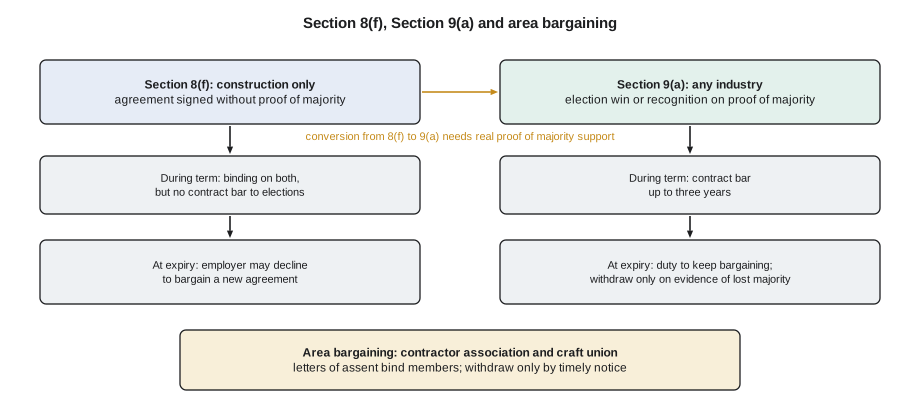
Under the NLRA there are two ways a construction union can come to bargain with an employer. The first, available to every industry, is Section 9(a): the union shows that a majority of employees in an appropriate unit want it, either by winning an NLRB-supervised secret ballot election or by the employer voluntarily recognizing it on proof of majority support. The second, available only in construction, is Section 8(f): the employer and union simply sign a collective agreement, before or after workers are hired, without any showing of majority support.
The 9(a) route works much as it does elsewhere. A union files a petition supported by a showing of interest from at least 30 percent of the employees in the proposed unit, and the NLRB holds an election. In construction, the Board uses special eligibility rules so that workers who have been employed for a meaningful amount of time in the year before the election can vote even if they are between jobs. The Board's 2023 Cemex decision made it harder for employers to refuse a majority demand without promptly seeking an election; the newly constituted Board may revisit that rule, so current advice from counsel matters.
Most construction relationships in the United States, including Calder Ridge's, begin under 8(f). A contractor joins a local contractor association, signs a letter of assent agreeing to be bound by the area agreements the association negotiates with each craft, and draws workers from the union hiring halls. No election ever takes place. Because the relationship rests on the agreement rather than on proven majority support, the law treats it differently from a 9(a) relationship in important ways.
8(f) and 9(a) compared
The Board's 1987 decision in John Deklewa & Sons set out the modern rules for 8(f) relationships. During the term of an 8(f) agreement, both parties must honor it, and the employer cannot walk away. But unlike a 9(a) agreement, an 8(f) agreement does not bar an election during its term, and when it expires the employer may decline to bargain a new one, and the union may picket only within the limits that apply to non-recognized unions. In a 9(a) relationship, by contrast, the employer must keep bargaining after the agreement expires and may withdraw recognition only on objective evidence that the union has lost majority support.
| Point | Section 8(f) relationship | Section 9(a) relationship |
|---|---|---|
| How it starts | Employer and union sign an agreement; no majority needed | Election win, or voluntary recognition on proof of majority |
| Construction only? | Yes | No, any industry |
| Election bar during term | No contract bar; employees may petition | Contract bar for up to three years |
| At expiry | Employer may decline to bargain a new agreement | Employer must continue to bargain |
| Withdrawing recognition | At expiry, without proof | Only on objective evidence of lost majority |
Unions often try to convert 8(f) relationships into 9(a) relationships, because 9(a) gives them security. In Staunton Fuel & Material (2001), the Board said contract language could show conversion if it stated that the union had requested recognition as majority representative and the employer had recognized it based on a showing of majority support. Courts, notably the D.C. Circuit in Nova Plumbing (2003) and Colorado Fire Sprinkler (2018), have insisted on real evidence of majority support rather than contract language alone. Calder Ridge's agreements contain recognition clauses that Grace has reviewed with counsel, and she keeps the question of 8(f) or 9(a) status on her list for every renewal.
Area and multi-employer bargaining
In most American cities, construction collective bargaining takes place between a local or regional union for each craft and a contractor association that bargains on behalf of the contractors who have given it bargaining rights. The resulting area agreement covers a defined geographic area, often several counties, and sets wages and fringe benefits for every signatory contractor in that craft. Electrical contractors usually bargain through chapters of the National Electrical Contractors Association, mechanical contractors through the Mechanical Contractors Association, and general contractors through chapters of the Associated General Contractors or local builders' associations.
Multi-employer bargaining gives contractors a level playing field on labor costs and gives unions a single table. It also creates obligations. A contractor that has given an association its bargaining rights is bound by the agreement the association reaches; under the Board's Retail Associates rule, it can withdraw from multi-employer bargaining only by giving timely written notice before negotiations for the next agreement begin. Contractors that are not association members can sign the area agreement independently, usually through a short-form agreement adopting it.
What gets bargained and how
Construction bargaining usually covers wages and fringe benefits first, because they drive bid prices, followed by working conditions such as hours, overtime, shift premiums, travel and board allowances, apprenticeship ratios and training contributions, and language on subcontracting, jurisdiction and grievances. The negotiations are shaped by the construction calendar. Unions have the most leverage when work is plentiful and the building season is beginning; contractors have more when work is scarce.
Area agreements usually run for three to five years with scheduled annual increases, often stated as a total package that the union may allocate between wages and fringe funds. Grace builds the escalation in each agreement into Calder Ridge's estimating rates for every bid that extends past the next increase date.
# Escalating a carpenter package for a bid that runs through future increases (illustrative)
# Package = wage + fringes; increases take effect each June 1 under the area agreement.
package = 62.35          # $/h total package for the current year
increases = {"2027-06-01": 2.75, "2028-06-01": 2.90}   # scheduled package increases, $/h
hours_by_period = {      # planned carpenter hours on Elmwood by period
    "to 2027-05-31": 96_000,
    "2027-06-01 to 2028-05-31": 132_000,
    "after 2028-05-31": 41_000,
}
rates = [package, package + 2.75, package + 2.75 + 2.90]
total = 0
for (period, hours), rate in zip(hours_by_period.items(), rates):
    cost = hours * rate
    total += cost
    print(f"{period:26s} {hours:8,d} h at ${rate:6.2f} = ${cost:12,.0f}")
flat = sum(hours_by_period.values()) * package
print(f"total ${total:,.0f}; at today's rate only ${flat:,.0f}; escalation ${total - flat:,.0f} ({(total - flat) / flat:.1%})")to 2027-05-31 96,000 h at $ 62.35 = $ 5,985,600 2027-06-01 to 2028-05-31 132,000 h at $ 65.10 = $ 8,593,200 after 2028-05-31 41,000 h at $ 68.00 = $ 2,788,000 total $17,366,800; at today's rate only $16,772,150; escalation $594,650 (3.5%)
Ignoring the scheduled increases would have understated the carpenter labor cost by about $595,000. Where an increase is not yet bargained, Grace uses an assumed figure and flags it as a risk in the bid.
Worked problem
Counting a showing of interest
A union petitions to represent the carpenters of a framing contractor in Columbus. The contractor employs 38 carpenters and apprentices this week; 3 more were laid off two weeks earlier and 2 were hired this morning. The union files signed authorization cards from 21 of them.
Show solution
- Showing of interest: 21 / 38 = 55.3 percent, well above the 30 percent needed to file.
- The Board will hold an election; construction eligibility rules may let recently laid-off workers with enough recent employment vote, so the voter list could grow.
- The union needs a majority of valid votes cast, not of the whole unit.
- A showing of interest is confidential; the employer is not told who signed.
Answer: An election will be held; the result depends on votes cast, and eligibility rules matter.
Changing or ending a union relationship
Union relationships can change in several ways. Employees can file a decertification petition, but only when no contract bar applies; under 8(f) there is no bar, so a petition can be filed at any time during the agreement. A rival union can petition to represent the unit. If a business is sold, the buyer may be a successor obligated to bargain with the union if it hires a majority of its workforce from the seller, though it is usually free to set initial terms unless it makes clear it will keep the old ones. And as lesson 2 explained, related businesses can be found to be a single employer or alter ego. Each of these is decided by the NLRB, often with strict timelines, and each can change a contractor's labor costs overnight.
For Calder Ridge the practical lesson is that the company's labor relations status is an asset and a liability that must be managed deliberately. Before buying another contractor, opening a new division or entering a new market, Nadia asks Grace and the company's labor counsel what bargaining obligations the move would bring with it.
A bargaining checklist for contractors
Even contractors that bargain through an association have work to do before and during each round. Grace's checklist, prepared a year before each expiry, keeps Calder Ridge ready:
- List every agreement, its expiry date and the association or agency that bargains it.
- Review the bids and backlog that extend past the expiry, and estimate the cost of different settlement levels.
- Gather field input: which clauses caused grievances, disputes or productivity problems, and which worked well.
- Send priorities to the association before its bargaining committee sets its proposals.
- Plan the schedule around the expiry: critical pours, lifts and deliveries before the date, and contingency plans for a stoppage.
- Prepare supervisors: what to say and not say, and who to call.
- After settlement, update estimating rates, payroll and the project cost reports the same week.
Strikes, lockouts and the site
Picketing on a shared construction site raises special issues. Under the Supreme Court's 1951 Denver Building Trades decision, a union with a dispute with one employer may not picket in a way that pressures neutral employers on the same site. In practice, sites use reserved gates: a separate entrance for the employer in dispute, so that picketing is confined to it under standards developed in the Moore Dry Dock case, while other contractors use a neutral gate. When a dispute is possible, Nadia's team plans ahead: critical concrete pours are scheduled around agreement expiry dates, materials are stocked, and reserved-gate signs and procedures are ready.
Luis keeps a simple rule for supervisors: if anyone mentions a strike, picket, work stoppage or slowdown, call Grace immediately and do not say anything to workers about it until she has advised. The legal consequences of a mistake are often far larger than the event itself.
What the structure means on site
For a superintendent, the bargaining structure shows up in practical ways. Every Calder Ridge carpenter on Elmwood is paid under the same area agreement as carpenters on every other signatory contractor's site in the region, so there is little point in a worker asking Luis for a better rate, and no point in Luis offering one: wages above the agreement are possible but create expectations across the crew and are rarely worth it. When a subcontractor's workers are covered by a different trade's agreement, their hours, breaks and overtime rules may differ from Calder Ridge's, and Luis plans shared activities such as concrete pours and crane lifts with those differences in mind. And when a worker asks a question about union membership, dues, or whether a new hire must join, Luis sends it to the steward or to Grace rather than guessing.
Common mistakes
MistakeAssuming an 8(f) agreement works exactly like a 9(a) agreement.
InsteadAn 8(f) agreement can be ended at expiry and does not bar elections; 9(a) status brings a continuing duty to bargain.
MistakeWithdrawing from association bargaining after negotiations have started.
InsteadGive timely written notice before negotiations begin.
MistakeBidding a multi-year job at this year's labor rates.
InsteadBuild scheduled and assumed package increases into the estimate and flag unbargained increases as a risk.
MistakeSupervisors commenting to workers about strikes or picketing.
InsteadCall labor relations staff first; mistakes have large legal consequences.
Summary and key terms
- A construction union relationship can begin under 9(a), with majority support, or under 8(f), without it.
- Under Deklewa, 8(f) agreements bind both parties during their term but allow elections and can end at expiry.
- Conversion to 9(a) needs real evidence of majority support, not contract language alone.
- Area agreements are bargained between craft unions and contractor associations; withdrawal requires timely notice.
- Bids must include scheduled and assumed labor package increases.
- Reserved gates confine picketing to the employer in dispute on shared sites.
- Section 9(a)
- Majority-based union representation, by election or voluntary recognition.
- Section 8(f)
- The construction exception allowing pre-hire agreements without proof of majority support.
- Deklewa
- The 1987 NLRB decision setting the rules for 8(f) agreements.
- Letter of assent
- A document by which a contractor agrees to be bound by agreements its association negotiates.
- Contract bar
- The rule that a valid 9(a) agreement bars elections during its term, up to three years.
- Reserved gate
- A separate site entrance for an employer in a labor dispute, used to confine picketing.
- Showing of interest
- Support from at least 30 percent of a unit, required for an election petition.
Practice problems
Work each problem on paper first, then reveal the answer to check.
How does an 8(f) relationship usually begin for a contractor like Calder Ridge?
Show answer
By signing a letter of assent to be bound by the area agreements its contractor association negotiates.
Can employees petition for an election during the term of an 8(f) agreement?
Show answer
Yes; 8(f) agreements do not create a contract bar.
What must a union show to file an election petition?
Show answer
A showing of interest from at least 30 percent of the employees in the proposed unit.
By how much did ignoring scheduled increases understate the carpenter cost in Grace's escalation example?
Show answer
About $595,000, or 3.5 percent.
What is a reserved gate used for?
Show answer
Confining picketing to the employer in a dispute so neutral employers on a shared site are not pressured.
Lesson quiz · 5 questions
Score 60% or more to complete this lesson.
Create a free account to save your progress, take quizzes and earn a certificate.