
CON-365 · Lesson 8 of 12 · 20 min
Apprenticeship and training
Every skilled tradesperson on Elmwood learned their trade somewhere, and for most of them it was through apprenticeship: years of paid work on site under the guidance of experienced workers, combined with blocks of technical training in a classroom and shop. Apprenticeship is how the construction industry reproduces its skills, and with large numbers of experienced workers retiring, it is also how the industry will survive. For a contractor, apprentices are a cost in their first years and an investment that pays back for decades. This lesson explains how apprenticeship works, what the rules require, how to plan apprentices into crews, and what makes apprentices finish.
How apprenticeship works in the US
In the United States, Registered Apprenticeship is governed by the National Apprenticeship Act of 1937 and federal regulations in 29 CFR parts 29 and 30. Programs are registered either with the Department of Labor's Office of Apprenticeship or, in states such as Ohio, with a recognized State Apprenticeship Agency. A program sponsor, which may be a single employer, a group of employers or a joint labor-management committee, writes standards that set out the work processes the apprentice must learn, the hours of on-the-job learning, the related technical instruction, the wage progression and the ratio of apprentices to journeyworkers. Apprentices who complete the program receive a nationally recognized certificate. Some trades also require a state or local license, such as electricians and plumbers in many jurisdictions.
Union apprenticeship programs are usually run by joint apprenticeship and training committees (JATCs), with equal union and employer trustees, and funded by hourly training contributions from every signatory contractor under the collective agreement. Merit shop apprenticeship is often run by Associated Builders and Contractors chapters or other associations as group programs, or by individual employers, frequently using standardized curricula. Both kinds of program can be registered.
Ratios and supervision
Program standards set ratios of apprentices to journeyworkers, and collective agreements often set their own. On federally funded projects covered by the Davis-Bacon Act, apprentices may be paid apprentice rates only if they are registered in an approved program and employed within the program's ratio; any apprentice beyond the ratio, or not registered, must be paid the full journeyworker rate for the classification. The point of a ratio is that each apprentice gets real supervision and teaching. A crew of eight apprentices and two journeyworkers may be legal under some rules and still be a bad crew, because the apprentices will learn less and be at greater risk.
Luis builds apprentices into every crew deliberately. On Elmwood each forming crew of ten had three apprentices of different years and seven journeyworkers, so that a first-year apprentice could learn from a fourth-year as well as from the journeyworkers, and so that the crew still had the experience to work safely at the slab edge.
# Check apprentice ratios by crew against the program standards (illustrative rule: max 1 apprentice per journeyworker,
# and no more than 1 first-year apprentice per 3 journeyworkers)
crews = {
    "Forming crew A": {"journeyworkers": 7, "apprentices": [1, 2, 4]},
    "Forming crew B": {"journeyworkers": 6, "apprentices": [1, 1, 3]},
    "Deck crew":      {"journeyworkers": 4, "apprentices": [1, 1, 2, 3, 4]},
    "Finishing crew": {"journeyworkers": 3, "apprentices": [2]},
}
for name, c in crews.items():
    j, a = c["journeyworkers"], c["apprentices"]
    first = a.count(1)
    problems = []
    if len(a) > j:
        problems.append(f"{len(a)} apprentices for {j} journeyworkers")
    if first > j // 3:
        problems.append(f"{first} first-year apprentices, max {j // 3}")
print(f"{name:15s} J {j} A {len(a)} (years {a}) " + ("; ".join(problems) or "within ratio"))Forming crew A J 7 A 3 (years [1, 2, 4]) within ratio Forming crew B J 6 A 3 (years [1, 1, 3]) within ratio Deck crew J 4 A 5 (years [1, 1, 2, 3, 4]) 5 apprentices for 4 journeyworkers; 2 first-year apprentices, max 1 Finishing crew J 3 A 1 (years [2]) within ratio
The deck crew has too many apprentices for its journeyworkers and too many first-period apprentices. Luis moved one experienced carpenter from crew A and one first-period apprentice to the finishing crew, which brought every crew within the rules without changing the total workforce.
The business case for apprentices
Apprentices cost less per hour than journeyworkers, but in their first months they also produce less and need more supervision. Over the course of an apprenticeship, the balance shifts: by the third and fourth periods, a good apprentice produces close to a journeyworker's output at a lower rate. Calder Ridge's estimators model this to set realistic crew productivity and to show project managers why apprentices are worth having.
# Apprentice cost and output relative to a journeyworker, by period (illustrative)
journey_wage = 48.50
periods = {
    # period: (wage as share of journey rate, output as share of journeyworker output, journeyworker time spent teaching per hour)
    1: (0.60, 0.40, 0.15),
    2: (0.70, 0.70, 0.08),
    3: (0.80, 0.88, 0.04),
    4: (0.90, 0.97, 0.01),
}
for p, (w, out, teach) in periods.items():
    cost = journey_wage * w + journey_wage * teach      # apprentice wage plus journeyworker teaching time
    cost_per_unit = cost / out
print(f"period {p}: cost ${cost:5.2f}/h, output {out:.0%}, cost per unit of work ${cost_per_unit:5.2f} (journeyworker ${journey_wage:.2f})")period 1: cost $36.38/h, output 40%, cost per unit of work $90.94 (journeyworker $48.50) period 2: cost $37.83/h, output 70%, cost per unit of work $54.04 (journeyworker $48.50) period 3: cost $40.74/h, output 88%, cost per unit of work $46.30 (journeyworker $48.50) period 4: cost $44.13/h, output 97%, cost per unit of work $45.50 (journeyworker $48.50)
In this example, a first-period apprentice costs almost twice as much per unit of work as a journeyworker, a second-period apprentice about 11 percent more, and third- and fourth-period apprentices about 5 and 6 percent less. The numbers ignore benefits, which are often similar for apprentices and journeyworkers, and the many intangible benefits: a pipeline of trained workers who know Calder Ridge's methods, loyalty, and the experienced workers' own learning from teaching. Contractors that hire apprentices only when targets or ratios force them to are paying the cost without collecting the return.
Why apprentices do not finish
Completion is the weak point of apprenticeship. A substantial share of registered apprentices in construction do not complete their programs, and studies of those who leave point to several causes: interrupted work during downturns, financial strain, poor supervision or mentoring, harassment or a hostile work environment, and difficulty with the related instruction. Union programs, which provide continuous referral through the hiring hall and structured instruction, have generally reported higher completion rates than many other programs, although data quality varies.
| Reason apprentices leave | What Calder Ridge does |
|---|---|
| Gaps in work between projects | Carries apprentices to the next project where possible; coordinates with the union or other employers when not |
| Money during in-school training | Helps apprentices plan for instruction blocks; times layoffs and training blocks together |
| Poor mentoring | Assigns a named mentor, trains mentors, checks in quarterly |
| Being given only low-skill tasks | Rotates apprentices through the work processes in their logbook |
| Harassment or exclusion | Clear expectations and fast response (lesson 10) |
| Exam difficulty | Study groups and paid time to prepare before the certification exam |
Aisha Rahman, the second-year apprentice on Elmwood, nearly quit in her first year. She was on a crew where she spent most days cleaning and moving material, and the foreman rarely explained anything. When Grace's month-one review uncovered it, Luis moved her to forming crew A, assigned a journeyworker mentor, and made sure her logbook started filling up. A year later she was leading the layout of embeds on one floor under her mentor's supervision, and she plans to write her certification exam on time.
Mentoring that works
A mentor is not the same as a supervisor. The foreman directs the apprentice's work each day; the mentor is an experienced tradesperson who takes responsibility for the apprentice's learning over months or years. Calder Ridge asks each mentor to do four things: show the apprentice how a task is done and explain why, then watch the apprentice do it and give specific feedback; check the logbook with the apprentice every month and plan which work processes come next; talk with the foreman so that the apprentice is assigned to the work they need; and be someone the apprentice can raise problems with, including problems with the crew.
Mentoring takes time, and time costs money on a fixed-price job. Calder Ridge recognizes it by giving mentors a short training course, counting mentoring as part of their job rather than an extra, and recognizing good mentors publicly at the annual safety and awards dinner. Luis also matches mentors and apprentices with care: a patient, articulate journeyworker is worth more as a mentor than the fastest carpenter on the floor.
| Good mentoring | Poor mentoring |
|---|---|
| Explains why as well as how | Says "just watch me" |
| Lets the apprentice do the task and gives specific feedback | Takes over whenever the apprentice is slow |
| Plans the next skills with the logbook | Leaves learning to chance |
| Raises the apprentice's needs with the foreman | Accepts whatever task the apprentice is given |
| Is approachable about problems | Treats questions as a nuisance |
Bringing new people into the trades
Many apprentices arrive through pre-apprenticeship programs: short courses, often run by community colleges, union training centers, community organizations or workforce boards, that teach basic safety, tools, trade math and site expectations and help participants enter a registered program. Calder Ridge takes several pre-apprenticeship graduates each year, and its experience is that they stay at higher rates than workers hired with no preparation, because they know what the work involves before they start. Youth apprenticeship and career-technical programs in high schools give students an earlier start.
Worked problem
What an apprentice earns over four periods
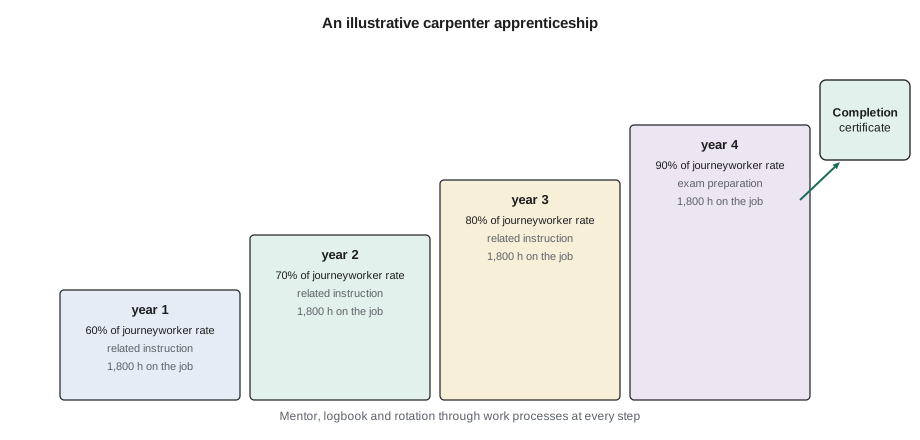
A carpenter apprenticeship runs four periods of about 1,800 hours each, at 60, 70, 80 and 90 percent of a journeyworker wage of $48.50 an hour. What does the apprentice earn in wages over the apprenticeship, and how does that compare with four years at the journeyworker rate?
Show solution
- Period wages: 0.60 x 48.50 = $29.10; 0.70 x 48.50 = $33.95; 0.80 x 48.50 = $38.80; 0.90 x 48.50 = $43.65.
- Earnings: 1,800 x (29.10 + 33.95 + 38.80 + 43.65) = 1,800 x 145.50 = $261,900.
- Four periods at the journeyworker rate: 7,200 x 48.50 = $349,200.
- The apprentice earns 75 percent of the journeyworker amount while learning the trade, without tuition debt beyond the in-school fees.
Answer: About $262,000 in wages over the apprenticeship, three-quarters of the journeyworker amount; this earn-while-you-learn feature is one of apprenticeship's strongest selling points.
Government and industry support
Federal and state governments support apprenticeship through grants to program sponsors, workforce development funds and tax incentives in some states. An April 2025 executive order set a goal of reaching one million new active apprentices and directed agencies to expand Registered Apprenticeship and related programs. Prevailing wage and apprenticeship requirements attached to some federal clean energy tax credits have encouraged contractors on those projects to employ registered apprentices for a set share of labor hours, although later legislation narrowed several of those credits. Ohio offers its own incentives for registered apprenticeship programs. Because these programs change frequently, Grace checks current rules before advising apprentices or bidding work that depends on them.
Training beyond apprenticeship
Training does not stop at certification. Journeyworkers need training on new materials, equipment and methods; foremen need supervisory and leadership training; and everyone needs refresher safety training. Union training centers and trade associations offer much of this, and many contractors run their own programs. Calder Ridge's foreman development program covers planning a crew's week, running toolbox talks, the collective agreement, documentation, respectful supervision and coaching apprentices. It started the program after noticing that most of its foremen had been promoted because they were the best carpenters, not because anyone had taught them to lead.
Common mistakes
MistakeLoading crews with apprentices because they are cheaper per hour.
InsteadStay within ratios and build balanced crews where apprentices get real teaching.
MistakeGiving apprentices only cleaning and material handling.
InsteadRotate them through the work processes they must learn and track their logbook.
MistakePaying unregistered or over-ratio apprentices apprentice rates on Davis-Bacon work.
InsteadPay journeyworker rates to any apprentice who is not registered or is beyond the ratio.
MistakeTreating apprentices as a short-term cost.
InsteadModel their cost per unit of work over the whole apprenticeship and invest in completion.
MistakePromoting the best tradesperson to foreman without training.
InsteadTrain foremen to plan, lead, document and coach.
Summary and key terms
- Registered Apprenticeship is governed by the National Apprenticeship Act and 29 CFR 29 and 30, through DOL or state agencies.
- Union JATCs and merit shop association programs both train apprentices and can be registered.
- Ratios ensure supervision; good crews mix apprentices of different years with enough journeyworkers.
- Apprentices become cheaper per unit of work as they progress; the return comes over the whole apprenticeship.
- Completion is the weak point; gaps in work, money, mentoring, task variety, harassment and exams all matter.
- Federal and state incentives support apprenticeship, but they change often.
- Foremen need leadership training, not just trade skills.
- Apprentice
- A worker learning a trade through supervised work and related instruction in a registered program.
- Journeyworker
- A fully qualified worker in a trade.
- JATC
- A joint apprenticeship and training committee of union and employer trustees.
- Program standards
- The registered rules of an apprenticeship program, including work processes, hours, wages and ratios.
- Ratio
- The maximum number of apprentices per journeyworker.
- Related technical instruction
- The classroom or online instruction that accompanies on-the-job learning.
- Completion rate
- The share of registered apprentices who finish their programs.
Practice problems
Work each problem on paper first, then reveal the answer to check.
Which crew in the ratio check broke the rules, and how?
Show answer
The deck crew: five apprentices for four journeyworkers, and two first-period apprentices where only one was allowed.
At which period did apprentices become cheaper per unit of work than a journeyworker in the example?
Show answer
From the third period: about $90.94 per unit in period 1, $54.04 in period 2, $46.30 in period 3 and $45.50 in period 4, against $48.50 for a journeyworker.
Name three reasons apprentices fail to complete.
Show answer
Any three: gaps in work, money during training, poor mentoring, only low-skill tasks, harassment, exam difficulty.
What changed for Aisha after the month-one review?
Show answer
She moved to a crew with a named mentor and began rotating through the work processes in her logbook.
Why did Calder Ridge start a foreman development program?
Show answer
Its foremen had been promoted for trade skill without being taught to lead.
Lesson quiz · 5 questions
Score 60% or more to complete this lesson.
Create a free account to save your progress, take quizzes and earn a certificate.