
ITIL-110 · Lesson 3 of 12 · 29 min
Organizations, service providers and service consumers
Every service involves at least two parties: one that provides and one that consumes. ITIL gives these parties precise names and breaks the consumer side into three distinct roles: customer, user and sponsor. Confusing these roles is one of the most common reasons services disappoint. A service can satisfy the people who pay for it while frustrating the people who use it, or delight users while failing the sponsor who must justify its cost. This lesson defines organizations, service providers and service consumers, explains the customer, user and sponsor roles, and shows how one organization can play several roles at once.
Organizations
ITIL defines an organization as a person or a group of people that has its own functions with responsibilities, authorities and relationships to achieve its objectives. The definition is deliberately broad. An organization can be:
- A single person, such as a freelance consultant or a customer buying a phone plan.
- A team or department, such as the payroll team or the IT operations group.
- A whole company, charity or government department.
- A group of organizations working together, such as a joint venture or a consortium.
Organizations vary in size and complexity, and in their legal form, from sole proprietors to multinational corporations and public bodies. What they share is that they have objectives and the responsibilities and authority to pursue them. In a service relationship, organizations take on the roles of provider and consumer.
Service providers
A service provider is the role an organization plays when it provides services to consumers. Being a provider is a role, not a type of organization. An internal IT department is a service provider to the rest of the company. A cloud company is a provider to its customers. A government agency providing passports is a provider to citizens. A single developer who maintains a small library for others is, in a sense, a provider too.
To provide services well, a provider needs a clear understanding of who its consumers are, what they want to achieve, what other parties are involved, and what its own role is. ITIL stresses that providers should look beyond the immediate consumer to the wider network of stakeholders, including suppliers, partners and regulators.
| Provider type | Example | Typical consumers |
|---|---|---|
| Internal provider | Corporate IT department | Employees and business units of the same organization |
| External provider | Managed services company | Client organizations |
| Shared services | A central HR or IT unit serving several departments | Multiple business units or agencies |
| Public provider | Passport office | Citizens and residents |
| Platform provider | App marketplace | App developers and end customers |
Service consumers
A service consumer is the role an organization plays when it receives services. Like the provider role, it is a role rather than a type of organization. The same organization can be a consumer of some services and a provider of others. A hospital consumes cloud, electricity and medical supply services while providing health services to patients. An IT department consumes services from telecom and software suppliers while providing services to employees.
Being a consumer is more complex than it first appears. ITIL identifies three roles within the consumer side, and in many organizations they are played by different people with different interests.
Customer, user and sponsor
The three consumer roles are:
- Customer: a person who defines the requirements for a service and takes responsibility for the outcomes of service consumption.
- User: a person who uses services.
- Sponsor: a person who authorizes budget for service consumption.
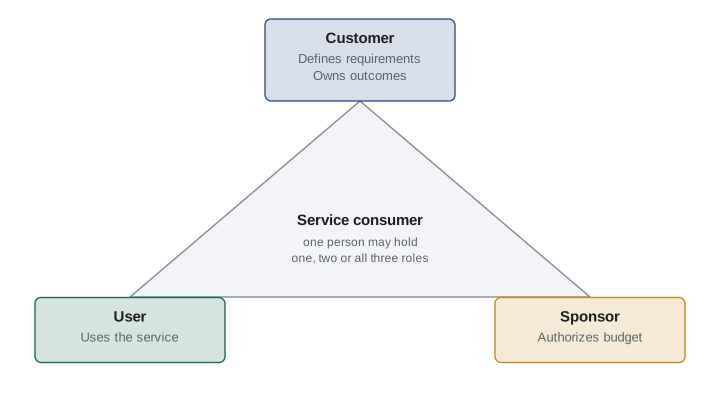
In a household buying a home internet plan, one person might hold all three roles: they decide what speed they need (customer), use the connection (user) and pay the bill (sponsor). In a large company buying a customer relationship management system, the roles are usually split:
- The head of sales is the customer, defining what the system must do and answering for whether it helps the sales team hit its targets.
- Hundreds of sales representatives are users, working in the system every day.
- The chief financial officer is the sponsor, approving the budget and expecting a return on it.
Each role judges the service by different criteria. Users care about ease of use, speed and reliability in their daily work. Customers care about whether the service supports the outcomes they are accountable for. Sponsors care about cost, value for money and alignment with the organization's plans. A provider that listens to only one of these roles will build a service that disappoints the others.
| Role | Main question | What they notice first |
|---|---|---|
| Customer | Does this service help us achieve our outcomes? | Fit with requirements, results, service levels |
| User | Can I get my work done easily with it? | Usability, speed, availability, support |
| Sponsor | Is this a good use of our money? | Cost, value for money, return, risk |
Worked problem
Identifying the roles
A university buys a learning management system (LMS). The vice-provost for teaching specified the requirements and is accountable for improving online learning. Instructors and students log in every day. The university's chief financial officer approved a five-year contract. Identify the customer, users and sponsor, and give one thing each is likely to care about most.
Show solution
- Customer: the vice-provost, who defined requirements and answers for learning outcomes. Cares about whether the LMS improves teaching and student success.
- Users: instructors and students. Instructors care about building courses quickly; students care about finding materials and submitting work without problems.
- Sponsor: the chief financial officer, who authorized the budget. Cares about total cost over five years and value for money.
Answer: Customer = vice-provost; users = instructors and students; sponsor = CFO. A successful service must satisfy all three.
When roles conflict
Conflicts between consumer roles are normal. A sponsor may push for the cheapest option, while users need a more expensive tool that saves them hours each week. A customer may specify a long list of features that users never use, adding cost and complexity. Users may request changes that make their own work easier but undermine the outcomes the customer is accountable for, such as skipping a compliance step.
Service providers can help by making the trade-offs visible. For example, showing the sponsor the cost of user time wasted by a slow tool can change the conversation from "cheapest license" to "lowest total cost". Bringing users into requirement discussions helps customers avoid specifying features nobody needs. Relationship management, covered in lesson 7, is the practice that keeps these conversations going.
Worked problem
Making a trade-off visible
A sponsor prefers a ticketing tool costing $20,000 a year over one costing $32,000 a year. Testing shows the cheaper tool adds about 3 minutes of extra work per ticket for support agents. The team handles 40,000 tickets a year, and agent time costs $45 per hour fully loaded. Which tool has the lower total cost?
Show solution
- Extra time per year with the cheaper tool: 40,000 × 3 minutes = 120,000 minutes = 2,000 hours.
- Cost of that time: 2,000 × $45 = $90,000.
- Total for the cheaper tool: $20,000 + $90,000 = $110,000.
- Total for the more expensive tool: $32,000 (plus normal agent time, which is the same baseline).
- Difference: $110,000 − $32,000 = $78,000 in favor of the more expensive tool.
Answer: The "expensive" tool is about $78,000 a year cheaper once user time is included. Showing this to the sponsor connects user needs to the sponsor's concern for value for money.
One organization, many roles
Because provider and consumer are roles, organizations play several at once. A regional bank, for example, consumes cloud hosting, card processing and software licenses from suppliers. It provides banking services to retail customers and small businesses. Inside the bank, the IT department provides services to branches and head office, which in turn consume them. A single employee might be a user of the bank's internal email, a customer for a new analytics tool their team requested, and a sponsor for a small budget line.
| Relationship | Provider | Consumer |
|---|---|---|
| Cloud hosting | Cloud company | Bank |
| Mobile banking | Bank | Retail customers |
| Branch systems | Bank IT department | Branch staff and managers |
| Payroll processing | External payroll provider | Bank HR department |
Recognizing these chains matters because a problem in one link often surfaces somewhere else. If the cloud company has an outage, retail customers cannot use mobile banking, and they blame the bank, not the cloud company. Lesson 8 returns to these chains and the wider service ecosystem.
Internal and external consumers
Some practitioners treat internal consumers (colleagues in the same organization) as less important than external, paying customers. ITIL encourages the opposite habit: apply the same service thinking to both. Internal services enable the external ones; a slow internal purchasing service can delay a product launch just as surely as a supplier failure. The differences are in governance and funding. Internal services are often funded centrally or charged back to departments, and their "customers" cannot always switch to an alternative provider. That makes listening to them even more important, because dissatisfaction may not show up as lost business.
Worked problem
Spotting a missing role
An IT team builds a new self-service portal after interviewing department heads about their requirements. After launch, usage is low and staff keep emailing the service desk instead. Which consumer role was likely overlooked, and what should the team do?
Show solution
- Department heads acted as customers, defining requirements.
- Staff are the users, and they were not involved in design.
- The portal may meet the customers' requirements on paper but be hard to use, or not cover the requests staff actually make.
- The team should observe and interview users, test the portal with them and redesign the most common tasks.
Answer: The user role was overlooked. Involving users in design and testing is essential to co-create value.
Roles in exam scenarios
Foundation questions often describe a scenario and ask which role a person plays. A reliable approach is to ask three questions in turn. Does this person define the requirements and answer for the results? Then they are the customer. Do they use the service in their work or life? Then they are a user. Do they approve the money? Then they are the sponsor. If the scenario describes one person doing all three, as with an individual buying a personal phone plan, the answer is that one person holds all three roles. Watch for distractors such as "service owner" or "supplier", which are real roles but belong to the provider side or to the supply chain rather than to the consumer.
Common mistakes
MistakeTreating "provider" and "consumer" as fixed types of organization.
InsteadTreat them as roles that the same organization can play in different relationships.
MistakeUsing "customer" and "user" as synonyms.
InsteadRemember the customer defines requirements and owns outcomes; the user uses the service.
MistakeForgetting the sponsor until the budget is cut.
InsteadEngage the sponsor early with clear cost and value information.
MistakeDesigning only from the customer's requirements list.
InsteadInvolve users in design and testing.
MistakeTreating internal consumers as less important.
InsteadApply the same service thinking to internal and external consumers.
Summary and key terms
- An organization is a person or group with its own functions, responsibilities, authorities and relationships to achieve objectives.
- Service provider and service consumer are roles organizations play, not fixed types.
- The customer defines requirements and takes responsibility for outcomes.
- The user uses services; the sponsor authorizes budget.
- One person may hold all three consumer roles, or they may be held by different people.
- Conflicts between roles are normal; providers help by making trade-offs visible.
- Organizations are consumers in some relationships and providers in others, forming chains.
- Organization
- A person or a group of people that has its own functions with responsibilities, authorities and relationships to achieve its objectives.
- Service provider
- A role performed by an organization in a service relationship to provide services to consumers.
- Service consumer
- A role performed by an organization in a service relationship to receive services.
- Customer
- A person who defines the requirements for a service and takes responsibility for the outcomes of service consumption.
- User
- A person who uses services.
- Sponsor
- A person who authorizes budget for service consumption.
- Internal provider
- A provider that serves consumers within the same organization.
- External provider
- A provider that serves consumers in other organizations.
- Shared services
- A central unit providing services to several parts of an organization or to several organizations.
- Total cost
- The full cost of a choice, including effects such as user time, not just the purchase price.
Practice problems
Work each problem on paper first, then reveal the answer to check.
Define an organization in ITIL terms.
Show answer
A person or group with its own functions, responsibilities, authorities and relationships to achieve objectives.
Is "service provider" a type of organization or a role?
Show answer
A role.
Which consumer role authorizes budget?
Show answer
The sponsor.
Which consumer role defines requirements and owns outcomes?
Show answer
The customer.
In a household phone plan, who might hold all three consumer roles?
Show answer
The person who chooses, uses and pays for the plan.
Give an example of an organization acting as both provider and consumer.
Show answer
A hospital consumes cloud services and provides health services to patients.
30,000 tickets × 2 extra minutes at $50 per hour costs how much?
Show answer
60,000 minutes = 1,000 hours × $50 = $50,000.
What is a common consequence of ignoring users in design?
Show answer
Low adoption and workarounds such as emailing the service desk.
Why should internal consumers be listened to closely?
Show answer
They often cannot switch providers, so dissatisfaction may stay hidden.
What practice keeps conversations with consumer roles going?
Show answer
Relationship management.
Lesson quiz · 5 questions
Score 60% or more to complete this lesson.
Create a free account to save your progress, take quizzes and earn a certificate.