
ITIL-110 · Lesson 7 of 12 · 30 min
Service relationships: provision, consumption and relationship management
A service is not a one-off transaction; it is a relationship that continues for as long as the service is used. ITIL defines a service relationship as a cooperation between a service provider and a service consumer, and divides it into three groups of activity: service provision, service consumption and service relationship management. This lesson explains each group, shows how they fit together, introduces the journey a relationship goes through, and gives practical tools for keeping relationships healthy.
What a service relationship includes
ITIL describes service relationships as being established between two or more organizations to co-create value. Each relationship includes:
- Service provision: activities performed by an organization to provide services.
- Service consumption: activities performed by an organization to consume services.
- Service relationship management: joint activities performed by a service provider and a service consumer to ensure continual value co-creation based on agreed and available service offerings.
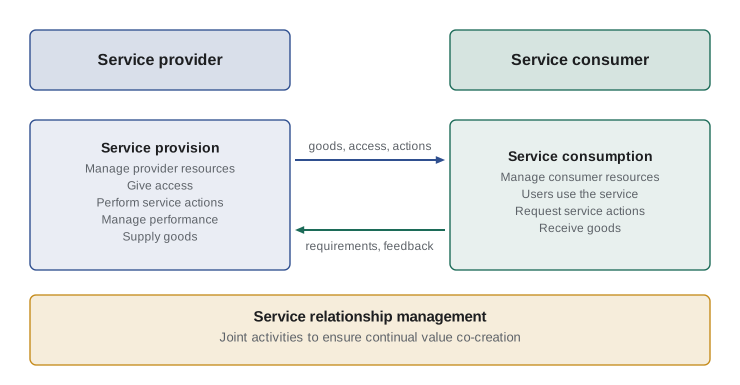
Service provision
Service provision is everything the provider does to make the service available and useful. ITIL lists activities such as:
- Managing the provider's resources configured to deliver the service, such as servers, staff and supplier contracts.
- Ensuring users have access to these resources, for example by creating accounts or issuing licenses.
- Fulfillment of the agreed service actions, such as installations, support and configuration.
- Service performance management and continual improvement.
- Supplying goods, where the offering includes them.
Much of what people imagine when they think of "IT operations" or "customer support" is service provision. It is necessary but not sufficient: a provider that provisions perfectly but never listens to consumers will drift away from what they need.
Service consumption
Service consumption is everything the consumer does to use the service. ITIL lists activities such as:
- Management of the consumer's own resources needed to consume the service, for example devices, network connections, data and staff time.
- Service actions performed by users, including using the provider's resources and requesting service actions.
- Receiving or acquiring goods, where the offering includes them.
Consumption is easy to overlook because it happens on the consumer's side. Yet many service failures begin there: users without the right devices, staff who were never trained, data that is incomplete or wrong, or departments that never changed their processes to take advantage of a new service. Good providers help consumers plan their consumption activities, for example with onboarding guides and readiness checklists.
| Activity | Provision or consumption? | Example in a video-conferencing service |
|---|---|---|
| Running servers and networks | Provision | Provider operates meeting infrastructure |
| Creating user licenses | Provision | Provider assigns licenses to staff |
| Buying webcams and headsets for staff | Consumption | Consumer equips meeting rooms and home offices |
| Joining and hosting meetings | Consumption | Users schedule and run calls |
| Answering support questions | Provision | Provider's help desk solves audio problems |
| Training staff on meeting etiquette and features | Consumption (often supported by provider) | Consumer's HR team runs short sessions |
Service relationship management
Service relationship management is the joint part: what provider and consumer do together. It includes agreeing what will be provided, reviewing how the service is performing, discussing changes in needs, resolving disputes, planning improvements and, eventually, ending or renewing the relationship. It is the activity that keeps provision and consumption aligned over time.
In practice, relationship management happens through regular service reviews, account management meetings, joint planning sessions, escalation paths and informal conversations. It is supported by the relationship management practice, which ITIL describes in more detail in later material. For Foundation, the key point is that value co-creation needs continual joint effort; it does not happen automatically once a contract is signed.
Worked problem
Spotting a relationship management gap
A managed print provider meets every service level: printers are repaired within four hours and toner is delivered on time. Yet the client's finance director is unhappy because printing costs have risen 20 % while the company moved to mostly digital workflows. What went wrong?
Show solution
- Service provision is fine: repairs and supplies meet targets.
- Service consumption changed: the client moved to digital workflows and needs fewer printers.
- No one reviewed the offering against the client's changing needs, so the client still pays for a large fleet.
- This is a gap in service relationship management, the joint activity of reviewing and adjusting the relationship.
Answer: The relationship was not managed jointly. A regular review would have identified the change and right-sized the fleet, restoring value for both parties.
The journey of a service relationship
Relationships evolve. ITIL 4's Drive Stakeholder Value guidance described a customer journey through stages, and the same idea remains useful whichever edition you study. A simplified version:
| Stage | What happens | Typical questions |
|---|---|---|
| Explore | Provider and consumer learn about each other's needs and capabilities | Who are our potential consumers? Who could provide this? |
| Engage | They build trust and start talking about specific needs | Can we work together? What matters most? |
| Offer | The provider shapes offerings to meet demand | Which offering fits this consumer? |
| Agree | They agree on scope, service levels, price and responsibilities | What exactly will each party do? |
| Onboard | The consumer starts using the service; resources are set up | Are users, data and processes ready? |
| Co-create | Ongoing use, support and improvement | Is the service working? What should change? |
| Realize | Value is assessed and the relationship renewed, changed or ended | Did we achieve the outcomes we wanted? |
The journey is not strictly linear. A consumer may revisit the agree stage when needs change, or return to explore when considering an alternative provider. The point is that each stage needs attention from both sides.
Trust and mutual responsibility
Relationships depend on trust. Trust grows when each party does what it says, communicates openly and treats problems as shared. It erodes when one side hides information, blames the other or exploits contract wording. ITIL encourages providers to see consumers as partners in value co-creation rather than as parties to a contract to be managed defensively.
Mutual responsibility can be made explicit. A responsibility matrix lists the main activities and who is responsible for each. For example, in a payroll service the provider may be responsible for calculating pay correctly, while the consumer is responsible for submitting accurate hours by a cut-off time. When pay is wrong, the matrix helps the parties see whether the cause lay in provision or consumption, and fix it without argument.
| Activity | Provider | Consumer |
|---|---|---|
| Submit employee hours and changes by cut-off | Responsible | |
| Calculate pay and deductions | Responsible | |
| Keep tax rules up to date | Responsible | |
| Approve the pay run | Responsible | |
| Distribute pay statements | Responsible | |
| Answer employee pay questions | First line | HR policy questions |
Worked problem
Tracing a failure through the matrix
In March, 14 of 600 employees were paid incorrectly. Investigation shows 11 errors came from late or missing overtime submissions by managers, and 3 came from a tax table that the provider updated a week late. What share of errors came from each side, and what should each party do?
Show solution
- Consumer-side errors: 11 ÷ 14 ≈ 79 %.
- Provider-side errors: 3 ÷ 14 ≈ 21 %.
- Error rate overall: 14 ÷ 600 ≈ 2.3 %.
- Consumer action: remind managers of the cut-off and add an automatic reminder two days before.
- Provider action: improve the process for applying tax table changes before their effective date.
Answer: About 79 % of errors came from consumption and 21 % from provision. Both parties have improvements to make, which a joint review can agree.
Measuring relationship health
Relationships can be assessed regularly. Some organizations use a simple scorecard rated by both parties, covering areas such as communication, responsiveness, delivery against agreements, flexibility and strategic fit. Comparing the provider's and consumer's ratings shows where perceptions differ, which is often more useful than the scores themselves.
Worked problem
A two-sided scorecard
Provider and consumer each rate five areas from 1 (poor) to 5 (excellent). Provider ratings: communication 4, responsiveness 5, delivery 5, flexibility 4, strategic fit 4. Consumer ratings: 3, 4, 4, 2, 3. Calculate each side's average and identify the biggest gap.
Show solution
- Provider average: (4 + 5 + 5 + 4 + 4) ÷ 5 = 22 ÷ 5 = 4.4.
- Consumer average: (3 + 4 + 4 + 2 + 3) ÷ 5 = 16 ÷ 5 = 3.2.
- Gaps by area: communication 1, responsiveness 1, delivery 1, flexibility 2, strategic fit 1.
- The biggest gap is flexibility: the provider thinks it is flexible, the consumer does not.
Answer: Provider 4.4, consumer 3.2. The flexibility gap of 2 points is the best place to start a conversation.
Communication in a service relationship
Healthy relationships depend on communication that flows both ways and at several levels. At the operational level, users and support staff communicate about requests and problems every day. At the tactical level, service owners and customer representatives review performance, agree changes and plan releases, typically monthly or quarterly. At the strategic level, senior leaders on both sides discuss direction, investment and the long-term fit of the relationship, perhaps once or twice a year. A relationship that communicates well at one level but not the others tends to drift: daily support may be excellent while strategic needs go unheard, or leaders may agree ambitious plans that the operational teams never learn about.
| Level | Typical participants | Typical frequency | Main topics |
|---|---|---|---|
| Operational | Users, service desk, support teams | Daily | Requests, incidents, quick questions |
| Tactical | Service owner, customer representatives | Monthly or quarterly | Service levels, changes, improvements |
| Strategic | Senior leaders on both sides | Once or twice a year | Direction, investment, renewal |
Communication also matters most when things go wrong. During a major incident, consumers want to know what has happened, what it means for them and when to expect the next update, even if the cause is not yet known. Providers that communicate early and honestly during failures often find that trust increases afterwards, while providers that stay silent lose trust even when they fix the problem quickly.
Worked problem
Planning review effort
A provider has 12 major consumer departments. It plans a one-hour monthly tactical review with each, needing two provider staff, plus two hours of preparation per review. How many provider staff hours does this take per year?
Show solution
- Per review: 2 staff × 1 hour meeting = 2 hours, plus 2 hours preparation = 4 hours.
- Per year per department: 4 × 12 = 48 hours.
- All departments: 48 × 12 = 576 hours a year.
Answer: About 576 staff hours a year, roughly a third of one full-time person. Relationship management is a real cost that should be planned, and its frequency matched to each relationship's importance.
Writing down the agreed communication plan, including who attends each review and how urgent issues are escalated, helps new staff on both sides understand how the relationship works.
Good relationships, in short, are planned, resourced and reviewed like any other part of a service.
Common mistakes
MistakeTreating the relationship as finished once the contract is signed.
InsteadManage the relationship continually through joint reviews.
MistakeAssuming all service failures are the provider's fault.
InsteadCheck consumption activities too, such as data quality and user readiness.
MistakeEquating meeting service levels with creating value.
InsteadReview whether the offering still fits the consumer's changing needs.
MistakeLeaving responsibilities implicit.
InsteadMake them explicit, for example in a responsibility matrix.
MistakeComparing only average satisfaction scores.
InsteadLook for gaps between provider and consumer perceptions.
Summary and key terms
- A service relationship is a cooperation between a service provider and a service consumer.
- It includes service provision, service consumption and service relationship management.
- Provision covers managing provider resources, access, service actions, performance and goods.
- Consumption covers managing consumer resources, user actions and receiving goods.
- Relationship management is joint activity to ensure continual value co-creation.
- Relationships move through a journey from exploring to realizing value, not always in a straight line.
- Trust, explicit responsibilities and two-sided reviews keep relationships healthy.
- Service relationship
- A cooperation between a service provider and a service consumer.
- Service provision
- Activities performed by an organization to provide services.
- Service consumption
- Activities performed by an organization to consume services.
- Service relationship management
- Joint activities performed by a provider and a consumer to ensure continual value co-creation based on agreed and available offerings.
- Service review
- A regular meeting to assess service performance and fit.
- Responsibility matrix
- A table showing which party is responsible for each activity.
- Onboarding
- Preparing a consumer to start using a service.
- Customer journey
- The stages a consumer goes through in a relationship with a provider.
- Trust
- Confidence that the other party will act as agreed and in good faith.
- Perception gap
- The difference between how provider and consumer rate the same aspect of a relationship.
Practice problems
Work each problem on paper first, then reveal the answer to check.
Define a service relationship.
Show answer
A cooperation between a service provider and a service consumer.
Name the three parts of a service relationship.
Show answer
Service provision, service consumption and service relationship management.
Is buying headsets for staff provision or consumption?
Show answer
Consumption.
Is creating user accounts provision or consumption?
Show answer
Provision.
Which part is performed jointly?
Show answer
Service relationship management.
Name the final stage of the simplified journey.
Show answer
Realize.
9 of 12 errors came from the consumer. What percentage is that?
Show answer
75 %.
Average of ratings 3, 5, 4, 4 and 4?
Show answer
20 ÷ 5 = 4.0.
Why compare provider and consumer ratings?
Show answer
To find where perceptions differ.
What tool makes responsibilities explicit?
Show answer
A responsibility matrix.
Lesson quiz · 5 questions
Score 60% or more to complete this lesson.
Create a free account to save your progress, take quizzes and earn a certificate.