
ITIL-110 · Lesson 4 of 12 · 29 min
Products, services and service offerings
People use the words product, service and offering loosely, often interchangeably. ITIL gives each a specific meaning, and the distinctions help providers design what they sell or provide internally and help consumers understand what they are getting. This lesson defines products and services, explains how a single product can support many different service offerings, and breaks offerings down into goods, access to resources and service actions. It ends with worked examples of designing offerings for different consumer groups.
Products
ITIL defines a product as a configuration of an organization's resources designed to offer value for a consumer. Resources here means anything the organization can draw on: people, information, technology, facilities, partners and money. A product is how those resources are put together.
Products are usually complex and are not fully visible to the consumer. A mobile network operator's product includes radio towers, spectrum licenses, billing systems, customer support teams, roaming agreements with other operators and much more. A customer sees only part of this, such as the coverage map and the app, but the whole configuration exists to offer value.
An important point is that the provider decides what goes into a product, but it is designed with consumers in mind. Products are created for target consumer groups, and different parts of a product may be exposed to different groups in different ways. That is where service offerings come in.
Services
ITIL defines a service as a means of enabling value co-creation by facilitating outcomes that customers want to achieve, without the customer having to manage specific costs and risks. Services are based on one or more products. The mobile network product enables services such as voice calls, mobile data, text messaging and international roaming.
A useful way to think about it: the product is what the provider configures; the service is what that configuration enables the consumer to achieve. The same product can enable many services, and a service may draw on several products. For the exam, remember that services facilitate outcomes and remove specific costs and risks from the customer.
Service offerings
A service offering is a formal description of one or more services, designed to address the needs of a target consumer group. Offerings are what the consumer is actually presented with: a phone plan, a support package, a software subscription tier, a menu of internal IT services. The same product can be packaged into many offerings for different groups.
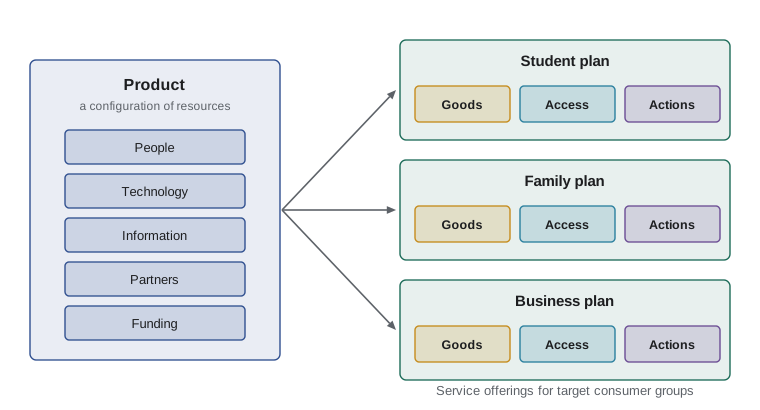
ITIL describes three kinds of component that an offering may include:
- Goods: supplied to the consumer, with ownership transferred to the consumer, who then takes responsibility for their future use. A phone handset sold outright, a printed manual or a security key are goods.
- Access to resources: granted or licensed to the consumer under agreed terms and conditions, with ownership staying with the provider. Access to the mobile network, cloud storage, a software platform or a shared office space are examples.
- Service actions: performed by the provider to address a consumer need, often as agreed in the offering. Installing equipment, answering support calls, resetting a password or training users are service actions.
| Component | Ownership | Who is responsible afterwards | Examples |
|---|---|---|---|
| Goods | Transferred to consumer | Consumer | Handset, laptop bought outright, printed material |
| Access to resources | Stays with provider | Provider maintains the resource; consumer uses it under terms | Network access, SaaS license, shared storage |
| Service actions | Not applicable (activities) | Provider performs them as agreed | Installation, support, configuration, training |
Why the distinction matters
Separating goods, access and actions clarifies who is responsible for what, which in turn reduces disputes. If a consumer buys a laptop outright (goods), the consumer is responsible for it after delivery, subject to warranty terms. If the laptop is provided as part of a managed device service (access to resources), the provider remains the owner and is usually responsible for repair and replacement. If the provider agrees to set up the laptop (service action), the consumer can expect it to arrive configured.
The distinction also affects cost and risk. Goods move costs and risks to the consumer over time: depreciation, breakdowns and disposal. Access keeps many of these with the provider, which charges for them through subscription fees. Service actions add cost for the provider but reduce effort for the consumer. Designing an offering is largely about choosing the mix of components that best suits a consumer group.
Worked problem
Classifying components
A home security company offers a package: the customer buys door sensors and a hub, receives 24-hour monitoring of alarms, gets an app that shows the system status, and has a technician install everything. Classify each component as goods, access to resources or service action.
Show solution
- Door sensors and hub, bought by the customer: goods, because ownership transfers.
- 24-hour monitoring: a service action performed by the provider's monitoring staff when alarms occur, supported by access to the provider's monitoring platform.
- The app: access to resources, because the customer is licensed to use software the provider owns.
- Installation by a technician: a service action.
Answer: Goods: sensors and hub. Access to resources: the app and monitoring platform. Service actions: monitoring responses and installation.
Designing offerings for different consumer groups
Because one product can support many offerings, providers can serve different groups without building separate products for each. A software company might offer a free tier with limited features and community support, a professional tier with full features and email support, and an enterprise tier with single sign-on, a dedicated account manager and a guaranteed response time. The underlying product is largely the same; the offerings differ in what is exposed, the access granted and the service actions included.
| Feature | Free | Professional | Enterprise |
|---|---|---|---|
| Access: core features | Limited | Full | Full plus admin controls |
| Access: storage | 5 GB | 100 GB | 1 TB per user |
| Service action: support | Community forum | Email, 1 business day | Phone, 1 hour for critical issues |
| Service action: onboarding | Self-service guides | Webinar | Dedicated onboarding manager |
| Goods | None | None | Hardware security keys for admins |
Internal providers design offerings too. A corporate IT department might offer a standard laptop package for most staff, a high-performance package for engineers and designers, and a loan pool for short-term contractors. Presenting these as clear offerings, often in a service catalog, helps consumers choose and helps the provider plan capacity and costs.
Worked problem
Pricing tiers from components
An internal IT department charges departments for laptop offerings. The standard laptop costs $1,200 and is replaced every 4 years. Support costs $15 per user per month. The engineering package uses a $2,400 laptop replaced every 3 years, with support at $25 per user per month. What is the monthly charge per user for each package, ignoring other costs?
Show solution
- Standard: $1,200 ÷ 48 months = $25 per month for the device.
- Standard total: $25 + $15 = $40 per user per month.
- Engineering: $2,400 ÷ 36 months = about $66.67 per month for the device.
- Engineering total: $66.67 + $25 ≈ $91.67 per user per month.
Answer: About $40 per user per month for the standard package and about $92 for the engineering package.
Products, services and offerings together
It helps to see the three terms side by side with one example. A public library system configures resources (buildings, librarians, a catalog system, e-book licenses and partnerships with publishers) into a product. That product enables services such as borrowing physical books, borrowing e-books, using computers and attending programs. The library then defines offerings for groups such as adults, children, newcomers and businesses. A newcomer offering might bundle a free card (access), a welcome tour and language-learning help (service actions) and a printed guide to local services (goods).
| Term | Library example | Key idea |
|---|---|---|
| Product | Buildings, staff, catalog, licenses and partners configured together | A configuration of resources |
| Service | Borrowing e-books | Facilitates outcomes without the consumer managing specific costs and risks |
| Service offering | Newcomer package | A formal description of services for a target group |
| Goods | Printed welcome guide | Ownership transferred |
| Access to resources | Library card and e-book platform | Ownership stays with provider |
| Service actions | Welcome tour, language help | Activities performed by the provider |
Offerings and the service catalog
Many organizations publish their offerings in a service catalog: a structured list of the services and offerings available, with descriptions, how to request them, costs or charges, and expected service levels. The service catalog management practice is covered in later courses; for now, notice that a good catalog describes offerings in the consumer's language. "Email account with 50 GB mailbox, mobile access and spam filtering, available within one business day" is useful. "Exchange Online Plan 2 provisioning" means little to most users.
Worked problem
Rewriting an offering description
An internal catalog entry reads: "VPN client deployment via MDM, AD group membership required." Rewrite it so a typical employee understands what they get, what they must do and how long it takes.
Show solution
- State the outcome: secure access to company systems from home or while traveling.
- State what the provider does: installs the secure connection app on your company laptop or phone.
- State what the consumer must do: request access through the portal with your manager's approval.
- State the timeline and support: usually ready within one business day; help available from the service desk.
Answer: "Remote access: connect securely to company systems from home or on the road. Request it in the portal with your manager's approval and we will install the app on your company device, usually within one business day."
Common classification puzzles
Some components are easy to misclassify. A phone that is leased rather than bought is access to resources, because ownership stays with the provider, even though the consumer holds it every day. Software that is "bought" as a perpetual license is still usually access to resources, since the consumer receives the right to use it under terms rather than ownership of the code. A training course is a service action, while the printed workbook handed out at the end is goods. When in doubt, ask two questions: does ownership transfer, and is this a thing or an activity? Ownership transfer points to goods; a resource used under agreed terms points to access; an activity performed by the provider points to a service action.
These rules matter in contracts too, because ownership decides who pays for repairs, insurance and eventual disposal.
Common mistakes
MistakeUsing "product" and "service" as synonyms.
InsteadA product is a configuration of resources; a service is what that configuration enables.
MistakeCalling network access "goods".
InsteadOwnership stays with the provider, so it is access to resources.
MistakeBuilding a separate product for every consumer group.
InsteadPackage the same product into different offerings.
MistakeWriting catalog entries in technical jargon.
InsteadDescribe offerings in terms of outcomes and what the consumer does.
MistakeForgetting that goods transfer responsibility to the consumer.
InsteadMake ownership and responsibility clear in every offering.
Summary and key terms
- A product is a configuration of an organization's resources designed to offer value for a consumer.
- A service enables value co-creation by facilitating outcomes without the customer managing specific costs and risks.
- A service offering is a formal description of one or more services for a target consumer group.
- Offerings may include goods, access to resources and service actions.
- Goods transfer ownership; access keeps ownership with the provider; service actions are activities.
- One product can be packaged into many offerings for different groups.
- Offerings should be described in the consumer's language, often in a service catalog.
- Product
- A configuration of an organization's resources designed to offer value for a consumer.
- Service
- A means of enabling value co-creation by facilitating outcomes customers want to achieve, without the customer having to manage specific costs and risks.
- Service offering
- A formal description of one or more services, designed to address the needs of a target consumer group.
- Goods
- Offering components whose ownership is transferred to the consumer.
- Access to resources
- Offering components granted or licensed under agreed terms, with ownership staying with the provider.
- Service actions
- Actions performed by the provider to address a consumer need.
- Resources
- People, information, technology, facilities, partners and money an organization can use.
- Target consumer group
- A set of consumers with similar needs for whom an offering is designed.
- Service catalog
- A structured list of services and offerings available to consumers.
- Tier
- One of several offerings at different levels of features and support.
Practice problems
Work each problem on paper first, then reveal the answer to check.
Define a product in ITIL terms.
Show answer
A configuration of an organization's resources designed to offer value for a consumer.
Define a service offering.
Show answer
A formal description of one or more services designed for a target consumer group.
Name the three components an offering may include.
Show answer
Goods, access to resources and service actions.
Is a SaaS subscription goods or access to resources?
Show answer
Access to resources.
Is a password reset by the service desk goods, access or a service action?
Show answer
A service action.
Who is responsible for goods after delivery?
Show answer
The consumer.
A $1,800 laptop used for 36 months costs how much per month?
Show answer
$50.
Why can one product support many offerings?
Show answer
Offerings package parts of the product differently for different consumer groups.
What should a good catalog description include?
Show answer
The outcome, what the provider does, what the consumer does, timing and support.
Give an example of goods in a phone offering.
Show answer
A handset sold outright.
Lesson quiz · 5 questions
Score 60% or more to complete this lesson.
Create a free account to save your progress, take quizzes and earn a certificate.