
LES-101 · Lesson 4 of 12 · 20 min
The history of policing: from Peel's principles to today
▶ Video coming soon A video version of this lesson is on the way.
Professor Desjardins begins the fourth class by handing out a card with a single sentence on it: the police are the public and the public are the police. It is often attributed to Sir Robert Peel, the British home secretary who created London's Metropolitan Police in 1829, and it hangs on the wall of the Port Ardent Police Department's training room. Jesse reads it twice and says that it does not describe how his grandparents experienced police. Professor Desjardins nods. Both things are true, he says. Modern policing was built on an ideal of consent, and it was also used to enforce laws and policies that many communities never consented to. Understanding that double history is the purpose of this lesson.
Before modern police
For most of history there were no police in the modern sense. In England, order was kept by unpaid parish constables chosen from local householders, by night watchmen of uneven quality and by the hue and cry, the duty of every citizen to chase a criminal. Justices of the peace handled most offenses. As cities grew in the eighteenth century, this system broke down. London had hundreds of thousands of residents, crowded slums, gin shops and frequent riots, and the response was mostly private: victims hired thief-takers, who were paid for recovering stolen goods and were often criminals themselves. The novelist and magistrate Henry Fielding formed a small group of paid officers in 1749 that became known as the Bow Street Runners, and in 1798 the Thames River Police was created to protect cargo on the docks. These experiments showed that a paid, organized force could prevent crime rather than merely react to it.
Many people in England nonetheless opposed a professional police. They associated police with the French model, a centralized force used by the state to spy on citizens and suppress dissent. The tension between wanting order and fearing state power is the same tension you met in lesson 1, and it shaped the design of the first modern police.
Peel and the Metropolitan Police
The Metropolitan Police Act of 1829 created a full-time, uniformed, salaried force for London, under two commissioners, Charles Rowan and Richard Mayne. Its founders made deliberate choices to win public acceptance. Officers wore blue coats rather than military red, carried a wooden truncheon rather than a firearm, and were expected to be polite, patient and visible. Their primary task was to prevent crime by patrolling fixed beats, not to catch criminals after the fact. Recruits had to be literate, of good character and fit, and many early recruits were dismissed for drunkenness or misconduct. Londoners called the officers bobbies or peelers after their founder.
The so-called Peelian principles are usually listed as nine statements. The most quoted are that the basic mission of police is to prevent crime and disorder; that police depend on public approval and cooperation; that cooperation diminishes as force is used; that police should use only the minimum force necessary, and only when persuasion and warning fail; that the police are the public and the public are the police; and that the test of police efficiency is the absence of crime and disorder, not the visible evidence of police action in dealing with it. Historians have shown that Peel never wrote this list. It was compiled in the twentieth century by writers drawing on the instructions given to the first officers. The principles remain valuable as a statement of the ideal of policing by consent, even if their history is more complicated than the plaques suggest.
| Principle (paraphrased) | What it means in practice today |
|---|---|
| Prevent crime and disorder | Patrol, problem-solving and partnerships rather than only responding after harm |
| Depend on public approval | Legitimacy and procedural justice are operational necessities |
| Use minimum force | De-escalation first; force only when persuasion fails, and proportionate |
| Police are the public | Officers are citizens in uniform, bound by the same laws, drawn from the community |
| Measure success by absence of crime | Judge police by safety and trust, not by arrests or tickets |
Policing comes to the United States
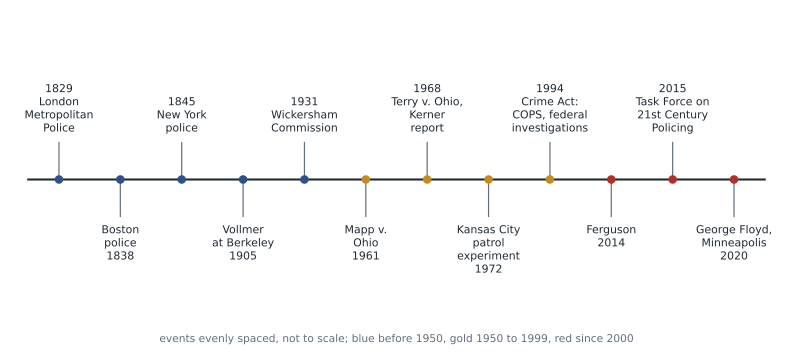
In the colonial era, towns relied on watches and constables, as in England. In the South, slave patrols organized from the early eighteenth century had the job of catching people who escaped slavery, preventing revolts and enforcing slave codes, and some historians see them as one of the roots of Southern policing. Boston created a day police force in 1838, and New York formed a unified police department in 1845, with other cities following. Early American departments borrowed the uniform and beat patrol of London, but not its insulation from politics.
The frontier West saw a mix of county sheriffs, town marshals and state forces such as the Texas Rangers, formed in the 1820s and 1830s, whose history includes both frontier protection and violence against Mexican Americans and Native Americans. On reservations, the federal government created Indian police in the 1870s, under the control of federal agents, who enforced federal policy, including efforts to suppress traditional religious practices and compel children to attend boarding schools. Federal law enforcement grew slowly: the US Marshals date from 1789, and the Bureau of Investigation, later the FBI, from 1908.
Three eras of policing
The researchers George Kelling and Mark Moore described the history of American policing in three eras, a framework that also fits much of Canada's experience. In the political era, from the 1840s to the early 1900s, police were closely tied to local politicians, who hired officers as a reward for loyalty. Officers walked beats, knew their neighborhoods and provided many social services, such as housing homeless people in station houses, but corruption was widespread and standards were low. In the reform or professional era, from roughly the 1920s to the 1970s, leaders tried to free police from politics by making them efficient, disciplined crime fighters, with centralized command, civil service hiring, training and new technology. In the community problem-solving era, beginning in the late 1970s and 1980s, police tried to rebuild relationships with communities and work with them to solve the problems behind repeated calls.
The professional era brought real gains. August Vollmer, police chief of Berkeley, California, from 1905 to 1932, pushed for college-educated officers, crime laboratories and scientific methods, and his student O. W. Wilson spread modern management across the country. The Wickersham Commission of 1931 exposed widespread use of the third degree, the beating of suspects to obtain confessions, and states began to set training standards, first through California's Commission on Peace Officer Standards and Training in 1959. Patrol cars, two-way radios and later emergency telephone numbers transformed patrol. But the same changes took officers off foot beats and put them in cars racing from call to call, cutting them off from the people they served. Success was measured by response times, arrests and clearance rates, which the community era would later question.
A minority view challenges the three-era story. Writing in 1990, Hubert Williams, a former police chief, and Patrick Murphy argued that the eras look very different from the perspective of Black Americans, for whom policing began with slave patrols, continued through the enforcement of segregation and only slowly offered equal protection. The same critique applies in Canada to the experience of Indigenous peoples, for whom police were long the most visible arm of policies of control and assimilation. Professor Desjardins tells the class that a police officer does not have to carry personal guilt for history, but does have to understand why some people meet a uniform with suspicion, because that suspicion is the starting point of many encounters.
Research and the community era
From the 1970s, research began to test assumptions that police had taken for granted. The Kansas City Preventive Patrol Experiment of 1972 and 1973 varied the amount of random car patrol in different beats and found no meaningful difference in crime, fear of crime or citizen satisfaction. Studies of rapid response found that most crimes are reported too late for speed to matter. Studies of detectives found that most cases are solved because victims and witnesses identify suspects, not through brilliant detective work. These findings did not mean police were useless; they meant that police needed better strategies. Herman Goldstein's problem-oriented policing, proposed in 1979, urged police to analyze recurring problems and tailor responses. James Q. Wilson and George Kelling's broken windows article of 1982 argued that visible disorder signals that no one cares, inviting more serious crime. Community policing, which spread widely in both countries in the 1990s, emphasized partnerships, foot and bicycle patrol and shared responsibility for safety.
The civil rights era exposed the role of police in enforcing segregation, as in Birmingham in 1963, and urban unrest in the 1960s led the Kerner Commission of 1968 to identify police practices as a major grievance in Black communities. The Supreme Court, in cases such as Mapp v. Ohio (1961), Miranda v. Arizona (1966) and Terry v. Ohio (1968), which arose from a stop by a Cleveland detective, set constitutional rules for searches, interrogation and stops. The 1994 Violent Crime Control and Law Enforcement Act funded community policing officers through the COPS Office and gave the Justice Department power to investigate patterns or practices of unconstitutional policing. New York's CompStat, introduced in 1994, used crime data to hold commanders accountable. After the attacks of 11 September 2001, many agencies took on homeland security duties. The death of Michael Brown in Ferguson, Missouri, in 2014 led to the President's Task Force on 21st Century Policing in 2015, and the murder of George Floyd by a Minneapolis officer in May 2020 led to protests around the world and a wave of state reforms.
Why history matters on patrol
History can seem far from the work of a patrol officer answering a noise complaint. Professor Desjardins argues the opposite. When he started in Port Ardent, he says, he treated every encounter as a fresh start. He learned that the people he met carried memories of earlier encounters, their own and their families', and that those memories shaped whether they called police, whether they answered questions and how they reacted to an order. Officers who understand history are better at explaining themselves, better at listening and less likely to take hostility personally. Jesse adds that his community remembers individual officers who treated people well for decades, so history is not only a burden; every officer is adding to it.
Marco asks whether the principles still apply when officers face armed suspects and violent crime that London's bobbies never imagined. Professor Desjardins answers that the minimum force principle has never meant no force; it means force that is necessary and proportionate, after persuasion and warning have failed or when there is no time for them. Modern de-escalation training is a direct descendant of that idea. Amara points out that the test of efficiency principle sits uneasily with services that report arrest counts and ticket numbers as achievements. That tension, Professor Desjardins says, is exactly what lesson 11 on reform is about.
Worked problem
Applying the principles to a modern decision
A business association in Port Ardent asks the police to clear people who are sleeping in a downtown park. A sergeant must decide how to respond. How do the principles of policing by consent help frame the decision?
Show solution
- Prevention: the goal is to reduce the underlying problem, such as lack of shelter space and addiction, not just to move people to another block.
- Public approval: both the business owners and the people in the park are members of the public; a response that serves one group by humiliating the other will cost trust.
- Minimum force: persuasion, outreach workers and offers of shelter should come first; enforcement, where lawful, should be a last resort.
- Test of efficiency: success is measured by whether the park becomes safe and usable and whether people are connected to help, not by how many tickets are written.
Answer: The sergeant arranges joint visits with outreach workers and the city, enforces only where there is a clear offense or safety risk, and reports results in terms of people housed and complaints reduced. The principles do not give an automatic answer, but they rule out a purely enforcement-based response.
Common mistakes
MistakePeel wrote nine principles of policing.
InsteadThe list was compiled by later writers from instructions given to the first officers; it is an ideal, not a document Peel wrote.
MistakeEarly police were welcomed by everyone.
InsteadMany people feared a professional police as a tool of state control, and some communities experienced police as enforcers of unjust laws.
MistakePolice reform began only in 2020.
InsteadReform has come in waves, including the professional era, the Warren Court decisions, the 1994 Crime Act and the 2015 task force.
MistakeResearch shows that patrol does nothing.
InsteadRandom patrol showed little effect, but focused strategies such as hot spots and problem-oriented policing have shown benefits.
Summary and key terms
- Before 1829, order relied on unpaid constables, watchmen and private thief-takers, and many people feared a professional police.
- The Metropolitan Police of 1829 aimed to prevent crime through visible, unarmed, civilian patrol based on public consent.
- The Peelian principles, compiled later, stress prevention, public approval, minimum force and measuring success by the absence of crime.
- American policing grew from watches, slave patrols and city forces tied to politics, and passed through reform and civil rights eras.
- Kelling and Moore's three eras (political, reform, community problem-solving) are a useful framework, but minority views stress that Black and Indigenous communities experienced each era differently.
- Research from the 1970s led to problem-oriented and community policing, and inquiries and scandals have repeatedly driven reform.
- Policing by consent
- The idea that police power depends on public approval and cooperation rather than force.
- Peelian principles
- A list of principles of policing by consent associated with the 1829 Metropolitan Police.
- Professional era
- The period of policing that stressed efficiency, central control, technology and crime fighting.
- Community policing
- A philosophy of policing based on partnerships with the community and shared responsibility for safety.
- Problem-oriented policing
- An approach in which police analyze recurring problems and design tailored responses.
- Broken windows
- The theory that visible disorder, left unattended, invites more serious crime.
Practice problems
Work each problem on paper first, then reveal the answer to check.
Why did many English people oppose the creation of a professional police in the early 1800s?
Show answer
They feared a force like the French police, used by the state for surveillance and suppression of dissent.
What did the Kansas City Preventive Patrol Experiment find?
Show answer
Varying levels of random car patrol made no meaningful difference to crime, fear of crime or citizen satisfaction.
Explain the minority view of the three eras of policing.
Show answer
Black and Indigenous communities experienced policing as control and enforcement of unjust laws in eras usually described as progress.
Which principle is in tension with reporting arrest and ticket counts as achievements?
Show answer
The test of efficiency is the absence of crime and disorder, not visible police action.
Lesson quiz · 5 questions
Score 60% or more to complete this lesson.
Create a free account to save your progress, take quizzes and earn a certificate.