
LES-101 · Lesson 6 of 12 · 19 min
Police governance and civilian oversight
▶ Video coming soon A video version of this lesson is on the way.
In week six the class attends a public meeting of the Port Ardent city council's public safety committee, held in a council chamber with about forty residents in the seats. On the agenda are the chief's quarterly report, a budget request for eight new officers, a delegation from a tenants' group upset about an arrest at their building and a presentation on body-worn cameras. Linh is struck by how ordinary it feels: people with name cards, a microphone that keeps cutting out, a clerk taking minutes. Professor Desjardins tells her that this ordinariness is the point. In a democracy, the most powerful public servants in the city answer, in public, to people who are not police. Today's lesson explains who governs the police, who oversees them and how officers are held to account.
Governance and oversight: two different jobs
Governance means setting direction: deciding what a police service should prioritize, approving its budget and policies, choosing its leader and holding that leader accountable for results. Oversight means checking conduct: investigating complaints, reviewing serious incidents, auditing practices and deciding whether officers or services broke the rules. Both are needed. A service can be well governed and still have officers who abuse their powers, and an oversight body can discipline individual officers without fixing the policies that put them in difficult situations. Both also have to respect a line between policy and operations. Elected officials and boards can set policies, priorities and budgets, but they must not direct officers to investigate, arrest or ignore particular people. That line protects police independence, which is the guarantee that the law is applied impartially rather than for political advantage.
In the United States, the principle is less formal but still powerful. Mayors and councils set policy and budgets, but interfering in a criminal investigation for political reasons can be misconduct or even a crime, and prosecutors and courts make the final decisions on charges. Elected sheriffs answer directly to voters, which gives them more independence from county boards but less protection from political pressure.
Who governs American police
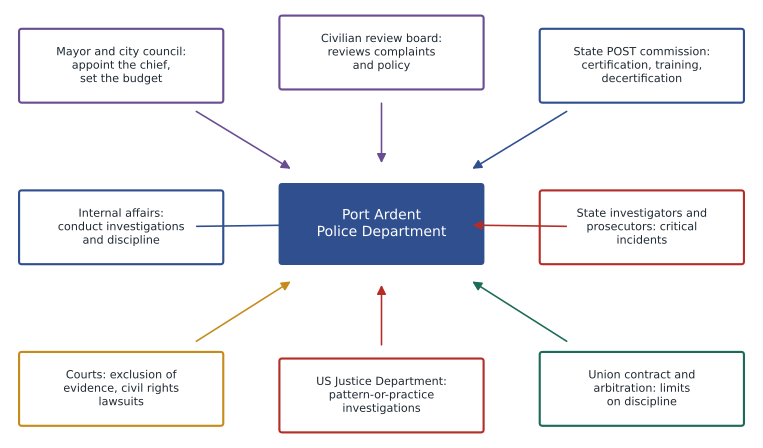
City police departments in the United States are usually governed directly by elected officials. In Port Ardent, as in most cities, the mayor appoints the chief with council approval, the city council sets the budget and passes ordinances, and a public safety committee of council reviews police matters. Some cities have police commissions with real authority over policy and hiring, such as Los Angeles, while in others the chief is a city employee managed by a city manager. Sheriffs are elected, usually every four years, and answer to voters rather than to a board. State laws set minimum standards. In Ohio, the Ohio Collaborative Community-Police Advisory Board, created in 2015, sets statewide standards on topics such as the use of force, recruitment and hiring, community engagement and body-worn cameras, and certifies agencies that adopt them.
Boards and councils face real limits. Members are often volunteers or busy elected officials with little time and less expertise, and they depend on the chief for most of their information. Researchers who study police governance have found that many boards rubber-stamp what the chief proposes. Others go to the opposite extreme and try to manage operations, which damages independence. The best boards ask hard questions about results, demand data, listen to the community and leave operational decisions to the chief. At the meeting Linh attends, a board member asks the chief why calls about one neighborhood have doubled. The chief explains a problem with an abandoned building and a plan to work with the city to secure it. That, Professor Desjardins whispers, is governance working as it should.
Oversight inside the service
The first line of accountability is inside the police service. Sergeants review reports, attend serious calls and watch body-worn camera video. An internal affairs unit investigates complaints and allegations of misconduct and recommends discipline, which can range from counseling and retraining to loss of pay, demotion or dismissal. Early intervention systems track indicators such as complaints, use-of-force reports, sick days and collisions, and flag officers who may need support before problems grow. Policies require officers to report every use of force, and supervisors review those reports. Internal accountability is fast and informed by expert knowledge of police work, but the public often doubts that police can investigate themselves fairly, especially in the most serious cases.
Civilian oversight in the United States
Civilian oversight in the United States is local and varied. More than 200 jurisdictions have some form of civilian oversight, which usually takes one of three forms: review boards, made up of residents, that review internal affairs findings and recommend outcomes; investigative agencies, staffed by civilian investigators, that investigate complaints themselves; and auditors or inspectors general, who examine policies and patterns rather than individual complaints. Port Ardent created a seven-member Civilian Police Review Board in 2021, appointed by council, which reviews every internal affairs investigation of force or discrimination and can recommend a different finding to the chief. Officer-involved shootings and deaths are usually investigated by an outside agency; in Ohio many departments ask the Attorney General's Bureau of Criminal Investigation to investigate, and the county prosecutor decides, often with a grand jury, whether to bring charges. State peace officer standards commissions can decertify officers who commit serious misconduct, so that they cannot simply move to another department.
Federal oversight has changed sharply. Since 1994, the Justice Department has had power to investigate departments for a pattern or practice of unconstitutional policing and to sue for reform, often resolved by court-supervised consent decrees with independent monitors, as in Cleveland in 2015. In May 2025 the department moved to dismiss the consent decrees it had reached with Minneapolis and Louisville after the deaths of George Floyd and Breonna Taylor, and closed investigations of several other departments, including Phoenix and Memphis. Within days a federal judge dismissed the Minneapolis case. Minneapolis remains bound by a separate, court-enforceable agreement with the Minnesota Department of Human Rights, showing that states can step in where federal oversight retreats.
Courts, coroners and other checks
Courts check police every day. Judges suppress evidence obtained in violation of the Constitution, and criminal defendants can challenge police conduct at trial. People can sue officers and cities for violations of constitutional rights under federal civil rights law, known as Section 1983 claims, although the doctrine of qualified immunity protects officers unless they violated clearly established law. Cities pay large settlements each year for police misconduct, which can create financial pressure for reform. Officers can be prosecuted under state law or under federal civil rights law, and medical examiners and coroners investigate deaths in custody. The news media, community organizations and video recorded by bystanders have also become powerful forms of oversight, as several of the cases in lesson 4 showed.
Professor Desjardins tells the class about the first time he was the subject of a complaint, early in his career, after an arrest at a bar. He was angry and certain he had done nothing wrong. The investigation cleared him, but the investigator pointed out that his notes were thin and that he had not explained the reason for the arrest clearly to the man's friends, who had filed the complaint. He says he became a better officer because of a complaint that was not sustained. Oversight is not only about punishment; done well, it is a feedback system.
Measuring complaints
Complaint numbers are hard to interpret. A rise in complaints might mean officers are behaving worse, or it might mean residents trust the process enough to use it. Most complaints are not substantiated, which does not mean they were false; it often means the evidence was insufficient either way. Analysts look at rates rather than raw counts, at the share substantiated, at the types of complaints and at whether a few officers account for a large share. The code below summarizes Port Ardent's public complaints for 2025.
# Port Ardent public complaints, 2025
officers = 204
contacts = 54300          # calls for service, as a rough measure of contact with the public
outcomes = {"screened out or withdrawn": 18, "resolved informally": 11,
            "investigated, not sustained": 25, "investigated, sustained": 10}
total = sum(outcomes.values())
for k, v in outcomes.items():
    print(f"{k:32s} {v:3d}  {v / total:5.1%}")
investigated = outcomes["investigated, not sustained"] + outcomes["investigated, sustained"]
print(f"total complaints: {total}")
print(f"complaints per 100 officers: {total / officers * 100:.1f}")
print(f"complaints per 10,000 calls: {total / contacts * 10000:.1f}")
print(f"sustained share of investigated complaints: {outcomes['investigated, sustained'] / investigated:.0%}")screened out or withdrawn 18 28.1% resolved informally 11 17.2% investigated, not sustained 25 39.1% investigated, sustained 10 15.6% total complaints: 64 complaints per 100 officers: 31.4 complaints per 10,000 calls: 11.8 sustained share of investigated complaints: 29%
About 12 complaints were made for every 10,000 calls, and 29% of investigated complaints were sustained. The board or committee should ask follow-up questions: are complaints concentrated among a few officers or in a particular unit, how long do investigations take, and do complainants feel they were heard? Linh notices that the 18 complaints screened out or withdrawn are more than a quarter of the total and wonders whether people gave up. That, Professor Desjardins says, is exactly the kind of question oversight bodies should ask.
What makes oversight effective
Oversight bodies differ widely in how well they work, and research and reviews point to a handful of features that matter. Independence comes first: investigators should not be serving officers of the service they investigate, and the body should not depend on police goodwill for its budget or information. Adequate resources and legal powers matter, including the power to compel officers and services to provide documents and video. Timeliness matters, because investigations that take years leave officers, complainants and the public in limbo. Transparency matters: the National Association for Civilian Oversight of Law Enforcement recommends that oversight agencies publish their findings, reports and data so that the public can test their reasoning. Finally, oversight needs legitimacy with both the community and police. A body that the community sees as toothless will not restore trust, and one that officers see as biased against them will meet resistance at every step. Linh, who is thinking about a career in analysis, notes that many oversight bodies hire civilian investigators and analysts, which is another route into public safety work.
Oversight also works best when it looks beyond individual blame to the systems that produce misconduct. A single complaint about a rough arrest may reveal a training gap, a policy that encourages risky tactics or a supervisor who never reviews body-worn camera video. Systemic reviews, which examine patterns across many incidents, can recommend changes that prevent future harm in a way that disciplining one officer cannot.
Worked problem
Who investigates?
Three incidents occur in Port Ardent in one week: (a) a driver fleeing a traffic stop crashes and breaks a leg while officers follow; (b) a resident complains that an officer swore at her during a noise call; (c) a council member demands that the chief stop investigating a local developer who is a friend. Who should handle each?
Show solution
- (a) A serious injury connected to police conduct is usually investigated by an outside agency, such as the state Bureau of Criminal Investigation, with the prosecutor deciding on any charges; internal affairs reviews policy compliance.
- (b) A conduct complaint goes to internal affairs, and the Civilian Police Review Board reviews the finding if the complaint involves force or discrimination; minor complaints may be resolved informally.
- (c) The council member is trying to interfere in a specific investigation. The chief should refuse and document the request; political interference can be misconduct and may be referred to the prosecutor or state authorities.
Answer: Each incident goes to a different body because each raises a different kind of accountability: criminal responsibility for serious harm, professional conduct and the independence of investigations from politics.
Common mistakes
MistakeGoverning the police means telling officers whom to arrest.
InsteadGovernance sets policy, priorities and budgets; directing specific investigations violates police independence.
MistakeAn unsubstantiated complaint was a false complaint.
InsteadMost unsubstantiated complaints lack enough evidence either way.
MistakeCivilian oversight means police have no role in accountability.
InsteadInternal supervision, professional standards units and early intervention systems remain essential alongside civilian bodies.
MistakeFederal consent decrees are the main form of oversight.
InsteadOversight is mostly local and state; federal pattern-or-practice enforcement was sharply reduced in 2025.
Summary and key terms
- Governance sets direction and holds leaders to account; oversight checks conduct. Both must respect police independence in specific investigations.
- Mayors and councils appoint chiefs and set budgets; sheriffs answer to voters; state bodies such as the Ohio Collaborative set standards.
- Internal accountability includes supervision, professional standards investigations and early intervention systems.
- Civilian oversight includes local review boards, outside investigations of shootings, POST decertification and federal pattern-or-practice enforcement, which was sharply reduced in 2025.
- Courts, coroners, tribunals, the media and bystander video are also powerful checks.
- Complaint data should be read as rates and patterns, not raw counts.
- Governance
- Setting the direction, priorities, policies and budget of a police service and holding its leaders accountable.
- Oversight
- Checking the conduct of police through investigation, review and audit.
- Police independence
- The principle that investigations are directed by police and the law, not by politicians.
- Civilian review board
- A body of residents that reviews complaints or police policies.
- Pattern-or-practice investigation
- A federal investigation into whether a department systematically violates constitutional rights.
- Early intervention system
- A system that flags officers whose patterns of complaints or force suggest a need for support.
Practice problems
Work each problem on paper first, then reveal the answer to check.
What is the difference between governance and oversight?
Show answer
Governance sets direction and policy and holds leaders accountable; oversight checks the conduct of officers and services.
Why must boards and councils not direct specific investigations?
Show answer
To protect police independence and ensure that the law is applied impartially rather than for political advantage.
In the complaints code, what is the rate per 10,000 calls if total complaints rise to 80?
Show answer
80 / 54,300 × 10,000 = 14.7.
Give two reasons a complaint might not be substantiated even if the complainant told the truth.
Show answer
No independent witnesses or video; conflicting accounts; insufficient evidence either way.
Lesson quiz · 5 questions
Score 60% or more to complete this lesson.
Create a free account to save your progress, take quizzes and earn a certificate.