
LES-101 · Lesson 5 of 12 · 19 min
How police services are organized: ranks, units and shifts
▶ Video coming soon A video version of this lesson is on the way.
Before the first ride-alongs, Professor Desjardins invites Sergeant Lisa Haddad, a patrol supervisor with the Port Ardent Police Department, to speak to the class. She brings a printed organization chart and a shift calendar marked in four shades. Marco studies the calendar for a long time. He wants to know how often he would work nights, how weekends are shared and whether officers with young children ever get a regular schedule. Sergeant Haddad smiles and says that this is the first question every recruit's partner asks. Today's lesson explains how police services are organized, from the chief's office down to the four platoons that keep patrol cars on the road around the clock.
A paramilitary hierarchy
Police services are organized as hierarchies with ranks borrowed partly from the military. Every member has a clear place in a chain of command, which runs from the chief down to the newest officer. Orders flow down the chain and reports flow up it. Several principles from classical management shape the design. Unity of command means each person reports to one supervisor, so instructions do not conflict. Span of control is the number of people one supervisor can effectively oversee; in patrol it is often eight to twelve officers per sergeant. Specialization divides work into units with particular skills, such as investigations or traffic. Written policies and procedures set out how routine tasks should be done, so that officers act consistently and can be held accountable.
The hierarchy exists for good reasons. Police must respond to emergencies where there is no time for debate, coordinate many officers at major incidents and account for the use of powers that can take away liberty. Clear authority helps in all of these. But critics point out that the paramilitary model sits awkwardly with the reality of patrol work, where most decisions are made by individual officers alone, out of sight of supervisors, using judgment rather than orders. A hierarchy that punishes every mistake can also discourage officers from reporting problems. Modern services try to combine clear command for emergencies with more flexible, team-based approaches for problem-solving and community work.
The ranks
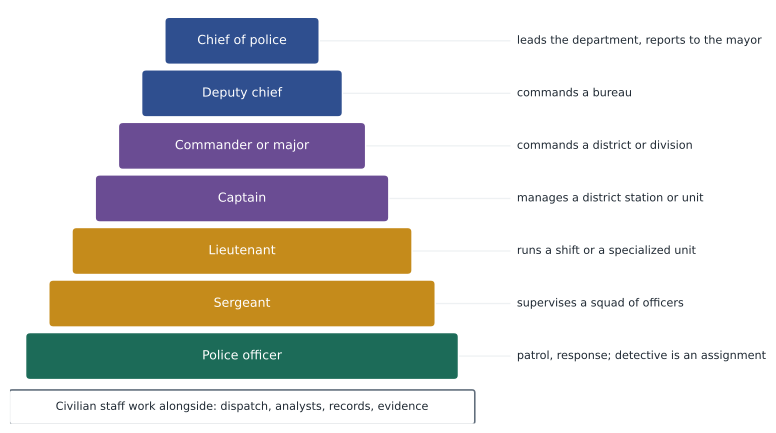
In a typical American city department, new officers start as police officers or patrol officers and complete probation before gaining full standing. Detective is often an assignment or a separate rank reached by examination. Sergeants supervise squads of officers, lieutenants run shifts or units, captains manage district stations or divisions, and commanders, majors or inspectors (titles vary) command larger parts of the department. The chief, who is usually appointed by the mayor or city manager, leads the department. Sheriff's offices use titles such as deputy, corporal and chief deputy, and the sheriff is elected. State agencies often use military-style titles such as trooper, corporal and captain. Promotion usually requires a written examination, an interview or assessment center, a review of performance and, increasingly, education. Some officers spend their whole career at the first rank by choice, because they prefer the road to a desk.
Civilian members are a large and growing part of every service. They work in communications, records, crime analysis, forensics, finance, human resources, information technology, victim services and court administration. Moving tasks that do not require police powers from officers to civilians, called civilianization, can save money and free officers for patrol, and it brings in specialists such as analysts and digital forensic examiners. Civilians make up roughly a third of all law enforcement employees in the United States, and the share is higher in sheriff's offices that run jails. Linh realizes that the communications center at Port Ardent, where call-takers and dispatchers work twelve-hour shifts just like patrol officers, is one of the busiest parts of the service.
How Port Ardent is organized
The Port Ardent Police Department has 204 sworn officers led by Chief Diane Kowalczyk and a deputy chief. The Patrol Bureau contains 96 officers, 12 sergeants and 4 lieutenants in four platoons, plus a traffic unit of 10 officers, a community policing unit of 10 and 8 school resource officers. The Investigations Bureau has 38 detectives and officers in persons crimes, property crimes, special victims, narcotics and a crime scene unit. Internal affairs, training and administration take 14 officers, and 12 senior officers make up the command staff. The department has a part-time SWAT team drawn from across the department, two canine teams and agreements with the Ardent County Sheriff's Office and the state highway patrol for other specialized needs. Small services cannot afford every specialty, so they share. A dog handler, a negotiator or a forensic video analyst may be called from another agency on a busy night.
| Unit | Sworn officers | Main work |
|---|---|---|
| Patrol (four platoons) | 112 | Calls for service, proactive patrol, first response |
| Investigations | 38 | Follow-up of serious and complex cases |
| Traffic | 10 | Collision investigation, enforcement, road safety |
| Community and schools | 18 | Problem locations, schools, community partnerships |
| Standards, training, administration | 14 | Complaints, discipline, training, policy, budgets |
| Command staff | 12 | Leadership and planning |
Patrol: the backbone of policing
Patrol is the largest unit in almost every service, typically half or more of all officers, and the one most people meet. Patrol officers answer calls for service, investigate minor crimes, write reports, enforce traffic laws, conduct proactive patrol in problem areas and make most arrests. They are generalists who must be ready for anything, and they are the people who arrive first at the most serious incidents. Port Ardent divides the city into eight patrol zones, each covered by at least one car on every shift, with additional cars that float between zones at busy times. Sergeant Haddad explains that the zones were redrawn in 2023 using call data, so that each one carries a roughly equal workload rather than an equal area.
Most new officers spend their first several years on patrol, and many services require a minimum period on patrol before an officer can apply to specialized units. Amara asks whether that is a waste of time for someone who wants to be a detective. Sergeant Haddad says no: the best detectives she knows learned on patrol how to talk to people, how to write a report a prosecutor can use and how quickly a scene can be contaminated. Investigations units take over cases that need sustained follow-up, while patrol handles the large volume of minor cases from start to finish.
Shifts and around-the-clock coverage
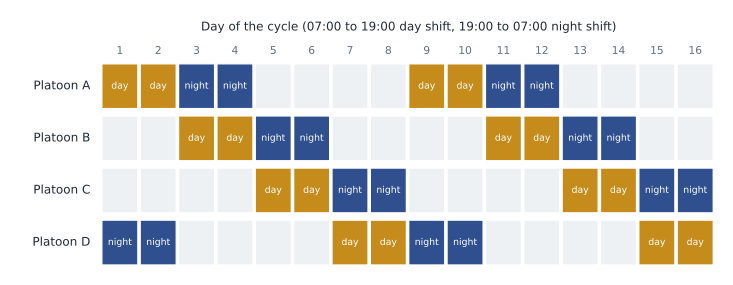
Police services never close, so patrol works in shifts. Common systems use eight-hour, ten-hour or twelve-hour shifts. Port Ardent uses twelve-hour shifts, from 07:00 to 19:00 and 19:00 to 07:00, in four platoons. Each platoon works two day shifts, two night shifts and then has four days off, an eight-day cycle that repeats all year. Officers like the long stretches of days off; critics worry about fatigue in the last hours of a twelve-hour night. Ten-hour systems create overlapping shifts at the busiest times of day, which helps match staffing to demand. There is no perfect schedule, and schedules are often negotiated in contracts between the city and the police union.
Scheduling is a matter of arithmetic and probability. A platoon of 24 officers is never fully available. On any given shift, some officers are on vacation, some at training, some in court, some sick or injured and some on modified duties. If the minimum safe staffing is 14 officers on a day shift and 16 on a night shift, the service needs enough officers in each platoon that the number actually available rarely falls below that minimum. When it does, officers are called in on overtime, which is expensive and adds to fatigue. The code below estimates how often a platoon of 24 falls short, assuming each officer is independently available with a probability of 0.78.
# Shift coverage for a 2-2-4 twelve-hour schedule (Port Ardent patrol)
from math import comb
officers_per_platoon = 24
p_available = 0.78          # after vacation, training, court, sickness and injury
shifts_per_year = 365 * 8 / 16   # each officer works 8 shifts in every 16 days
hours = shifts_per_year * 12
print(f"shifts per officer per year: {shifts_per_year:.1f}, scheduled hours: {hours:.0f}")
print(f"compare a 40-hour week: {40 * 52} hours; difference {hours - 40 * 52:.0f} hours")
expected = officers_per_platoon * p_available
print(f"expected officers available on a shift: {expected:.1f}")
def p_below(minimum, n=officers_per_platoon, p=p_available):
    return sum(comb(n, k) * p**k * (1 - p)**(n - k) for k in range(minimum))
for label, minimum in (("day", 14), ("night", 16)):
    risk = p_below(minimum)
print(f"{label} minimum {minimum}: short-staffed on {risk:.1%} of shifts, about {risk * 365:.0f} shifts a year")shifts per officer per year: 182.5, scheduled hours: 2190 compare a 40-hour week: 2080 hours; difference 110 hours expected officers available on a shift: 18.7 day minimum 14: short-staffed on 0.8% of shifts, about 3 shifts a year night minimum 16: short-staffed on 6.2% of shifts, about 23 shifts a year
The output shows two things Sergeant Haddad deals with daily. First, a 2-2-4 schedule produces about 2,190 scheduled hours a year, more than a standard 40-hour week, so contracts usually give officers extra days off or pay to balance the difference. Second, with a minimum of 16 on nights, a platoon of 24 falls short on a meaningful number of shifts each year, which means call-ins and overtime. Adding two officers to each platoon, or reducing absences, would cut the shortfall sharply. Real services also account for absences being correlated: illness spreads, and training courses take several officers at once.
Marco does the arithmetic for his own life. He would work about half the weekends of the year, two nights in every eight days, and every second holiday season. Sergeant Haddad tells him that many officers with families make it work, but that it requires planning, a supportive partner and a service that respects schedules. Lesson 10 returns to shift work and fatigue as health issues.
Police unions and collective bargaining
Most American officers belong to unions or associations, such as local lodges of the Fraternal Order of Police, that bargain with cities and counties where state law allows. In Ohio, public safety officers have collective bargaining rights but may not strike; unresolved disputes go to binding conciliation. Contracts shape scheduling, overtime, minimum staffing, discipline procedures and promotion, and some contract provisions, such as limits on how long complaints stay in an officer's file, have become controversial in debates about accountability. Unions and associations protect officers from unfair treatment and advocate for safety and wellness. They also influence how quickly services can change policies, which is why they appear again in lessons 6 and 11.
Worked problem
Staffing a platoon to cover the minimum
Port Ardent wants its night shift to fall below the minimum of 16 officers on no more than about 5% of shifts. Each officer is available with probability 0.78. Is a platoon of 24 enough, and what happens with 26?
Show solution
- With 24 officers, the expected number available is 24 × 0.78 = 18.7.
- The code shows that with 24 officers the probability of fewer than 16 available is about 6.2%, slightly above the target, or about 23 short nights a year.
- With 26 officers, the expected number is 26 × 0.78 = 20.3, about 1.6 more officers on every shift.
- Recomputing the binomial probability with n = 26 gives about 1.6%, or roughly 6 short nights a year, comfortably under the target.
Answer: A platoon of 24 narrowly misses the target; adding two officers to each platoon (eight in total) cuts short-staffed nights by about three quarters. The service could also reduce absences, for example by scheduling training on days when demand is low.
Common mistakes
MistakeA strict chain of command means patrol officers make few decisions.
InsteadMost patrol decisions are made alone, out of sight of supervisors, using discretion.
MistakeA platoon of 24 means 24 officers on the road.
InsteadVacation, training, court and illness mean that only about three quarters are available on a typical shift.
MistakeCivilians are only clerical staff.
InsteadCivilians include analysts, forensic specialists, communicators and other professionals essential to modern policing.
MistakeSpecialized units are where the real police work happens.
InsteadPatrol is the largest unit, handles most calls from start to finish and is the training ground for nearly every specialty.
Summary and key terms
- Police services are paramilitary hierarchies built on chain of command, unity of command, span of control, specialization and written policy.
- American ranks typically run from police officer through sergeant, lieutenant, captain and commander to deputy chief and chief; titles vary.
- Civilians are a large and growing share of police personnel.
- Patrol is the largest unit and the foundation of nearly every police career.
- Shift systems of eight, ten or twelve hours keep coverage around the clock; staffing must allow for absences so that minimums are met.
- Police unions bargain collectively where state law allows; in Ohio disputes go to binding conciliation rather than strikes.
- Chain of command
- The line of authority from the chief to the newest officer, through which orders and reports flow.
- Span of control
- The number of people one supervisor can effectively oversee.
- Unity of command
- The principle that each member reports to one supervisor.
- Platoon
- A group of patrol officers who work the same shift schedule.
- Civilianization
- Moving tasks that do not require police powers from sworn officers to civilian staff.
- Minimum staffing
- The fewest officers that must be on duty for a shift to operate safely.
Practice problems
Work each problem on paper first, then reveal the answer to check.
Why do police services use a chain of command?
Show answer
To coordinate quickly in emergencies, ensure clear authority and keep the use of police powers accountable.
In a 2-2-4 schedule, how many shifts does an officer work in a 16-day period?
Show answer
Eight: four day shifts and four night shifts.
A platoon of 30 officers has an availability of 0.75. How many officers are expected to be available on a shift?
Show answer
30 × 0.75 = 22.5.
Give two advantages of civilianization.
Show answer
It can lower costs, free officers for patrol and bring in specialists such as analysts.
Lesson quiz · 5 questions
Score 60% or more to complete this lesson.
Create a free account to save your progress, take quizzes and earn a certificate.