
LES-101 · Lesson 9 of 12 · 19 min
Policing diverse communities and building trust
▶ Video coming soon A video version of this lesson is on the way.
Linh has been waiting for this lesson. She tells the class about her cousin Bao, who was stopped by police in Toledo four times in one year while walking home from a restaurant job late at night. Each officer was polite enough, she says, and none of the stops led to a charge. But no one explained why he was stopped, and by the fourth time he started taking a longer route home. Her family now hesitates to call police even when they need help. Jesse adds that in his community, trust in police depends on which officer shows up. Professor Desjardins listens and then asks the class a question: how does a police service build trust with people whose experience of police has given them good reasons for doubt? That is the subject of this lesson, and of a full course later in the program.
Diverse communities
The United States is also highly diverse. In the 2020 census, about four in ten Americans identified as Hispanic or Latino or as a race other than white, and about one in seven was born abroad. Ohio is less diverse than the country as a whole, but cities such as Toledo and Port Ardent have large Black communities, growing Latino and Middle Eastern communities and recent refugees from several countries. Diversity also includes religion, language, age, sexual orientation and gender identity, disability, income and housing. People experiencing homelessness, people with mental illness and people with addictions are among the residents who have the most frequent contact with police.
Each community brings its own history with police. Newcomers may come from countries where police were corrupt or brutal and may be afraid to approach officers at all. Black Americans have documented generations of concerns about stops, use of force and discrimination, supported by data from investigations such as the Justice Department's 2015 report on Ferguson. Native Americans have some of the highest rates of police killings relative to population. Some LGBTQ residents remember police raids on gay bars, such as the 1969 raid on the Stonewall Inn in New York. Officers who understand these histories are better prepared for the reactions they meet.
How trust is measured
Police services measure trust through surveys, which ask residents how much confidence they have in police, whether police treat people fairly and with respect, and whether they would report a crime or provide information. National polls such as Gallup's annual confidence survey regularly find that about half of Americans express a great deal or quite a lot of confidence in police, among the highest of any institution, but with much lower levels among Black Americans and young adults. Local surveys are more useful for a particular service, because trust depends heavily on local experience.
Port Ardent ran a community survey in 2025, with 1,200 randomly selected residents answering by phone and online. Overall, 68% said they trusted the police to do a good job. The results by group show a familiar pattern: trust was lowest among young adults, Black residents and Indigenous residents, and highest among older residents and, perhaps surprisingly, among recent immigrants, who often compare local police favorably with police in their countries of origin. Residents who had contact with police in the previous year reported lower trust than those who had none.
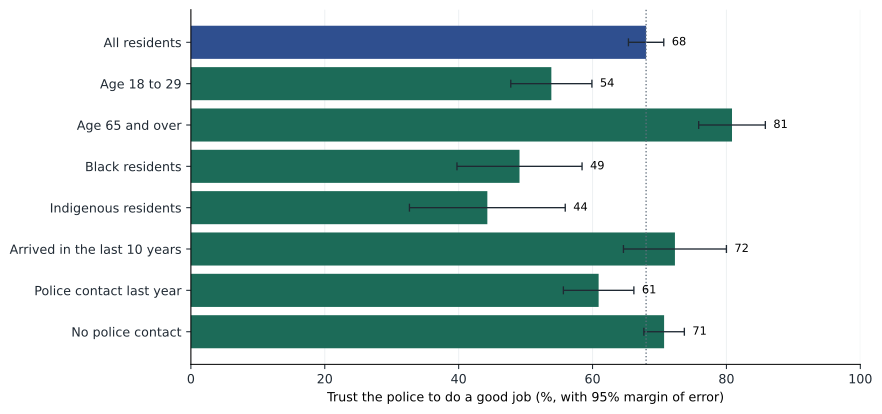
Survey results must be read with care. Small groups produce wide margins of error: with only 70 Indigenous respondents, the true share could be well above or below the 44% measured. Differences between groups may be real or may reflect chance. The code below calculates margins of error and tests whether the difference between residents with and without police contact is likely to be real.
# Port Ardent community survey 2025: trust in police by group
from math import sqrt
groups = {   # group: (respondents, number who trust police)
    "All residents": (1200, 816), "Age 18 to 29": (260, 140), "Age 65 and over": (240, 194),
    "Black residents": (110, 54), "Indigenous residents": (70, 31),
    "Arrived in last 10 years": (130, 94), "Police contact last year": (330, 201),
    "No police contact": (870, 615),
}
for g, (n, k) in groups.items():
    p = k / n
    moe = 1.96 * sqrt(p * (1 - p) / n)
    print(f"{g:26s} n={n:5d}  trust {p:5.1%}  margin of error +/- {moe:5.1%}")
# Two-proportion z-test: contact vs no contact
n1, k1 = groups["Police contact last year"]; n2, k2 = groups["No police contact"]
p1, p2 = k1 / n1, k2 / n2
pooled = (k1 + k2) / (n1 + n2)
z = (p1 - p2) / sqrt(pooled * (1 - pooled) * (1 / n1 + 1 / n2))
print(f"difference {p1 - p2:+.1%}, z = {z:.2f} (beyond +/-1.96 means unlikely to be chance at the 5% level)")All residents n= 1200 trust 68.0% margin of error +/- 2.6% Age 18 to 29 n= 260 trust 53.8% margin of error +/- 6.1% Age 65 and over n= 240 trust 80.8% margin of error +/- 5.0% Black residents n= 110 trust 49.1% margin of error +/- 9.3% Indigenous residents n= 70 trust 44.3% margin of error +/- 11.6% Arrived in last 10 years n= 130 trust 72.3% margin of error +/- 7.7% Police contact last year n= 330 trust 60.9% margin of error +/- 5.3% No police contact n= 870 trust 70.7% margin of error +/- 3.0% difference -9.8%, z = -3.24 (beyond +/-1.96 means unlikely to be chance at the 5% level)
The gap of almost 10 points between residents with and without police contact produces a z value of about minus 3.2, so it is very unlikely to be chance. That finding matches research in many places. The criminologist Wesley Skogan found that the effect of having a bad experience with police is many times greater than the effect of a good one, an asymmetry that means every negative encounter costs far more trust than a positive encounter can earn back. The finding does not mean police should avoid contact; it means the quality of each contact matters enormously.
Procedural justice in practice
Lesson 1 introduced procedural justice: people judge police legitimacy mainly by whether they are treated fairly. In practice, this means officers explain why they stopped someone, give people a chance to speak, make decisions based on facts and policy, treat people with dignity and show that they care about the person's wellbeing. These are not soft skills added to real police work. A study in Queensland, Australia, in which officers at random breath-testing checkpoints followed a short script built on procedural justice principles, found that drivers who received the script reported more positive views of police. Other studies have found that training officers in procedural justice can reduce complaints and use of force. For Linh's cousin, an officer who explained the reason for the stop, such as a description of a suspect in a nearby break-in, and thanked him for his patience would have left a different impression even if the stop itself was the same.
Community policing and problem-solving
Community policing treats residents as partners rather than as sources of complaints. Its core elements are community partnerships, problem-solving and organizational changes that support both, such as assigning officers to the same neighborhoods long enough to know them. Problem-oriented policing often uses the SARA model: scanning to identify a recurring problem, analysis to understand its causes, response tailored to those causes and assessment to see whether the response worked. Port Ardent's community response unit used SARA in 2024 for a plaza that generated more than 200 calls a year. Analysis showed that most calls came between 21:00 and 01:00 from a closed parking area used for late-night gatherings; the response combined better lighting, a later bus route, a youth drop-in at a nearby recreation center and a few targeted patrols. Calls fell by more than half the following year.
Community policing also means being present outside emergencies: attending cultural events, visiting places of worship, meeting with newcomer agencies, coaching sports and staffing school programs. Many departments have liaison officers for particular communities and advisory councils that meet with the chief. Critics warn that such programs can become public relations if they are not matched by changes in how ordinary patrol officers behave. Trust is built mostly on the street, one encounter at a time.
Bias and fair policing
Everyone carries biases, including officers. Explicit bias is a conscious belief or attitude; implicit bias is an automatic association that a person may not be aware of and may even reject. Implicit associations linking particular groups with crime or danger can affect split-second decisions, such as whom to watch, whom to stop and how quickly to perceive a threat. Many services have introduced implicit bias training, but evaluations have been disappointing: a large randomized study of such training in New York found that it changed officers' knowledge and attitudes but not the racial patterns in their enforcement. Most researchers now argue that reducing biased outcomes requires changing systems: clear policies on when stops are allowed, collecting and analyzing data, supervision and accountability, and reducing the discretionary low-level stops where bias has the most room to operate.
Stop-and-frisk is an example. New York police made hundreds of thousands of stops a year in the late 2000s, mostly of Black and Latino young men, and most found no weapon or crime. In Floyd v. City of New York (2013), a federal judge found that the city's practices violated the Constitution, and stops dropped sharply afterward without the rise in crime that critics had predicted. Lesson 11 returns to this debate.
Who becomes police
Many services aim to reflect the communities they serve. Officers from racial and ethnic minority groups make up roughly three in ten local police officers nationally, and women about one in seven. The 30x30 Initiative, launched in 2021 and joined by hundreds of agencies, aims to raise women's share of recruits to 30% by 2030. Research on whether diverse services police differently is mixed; some studies find differences in the use of force or in how officers handle particular calls, while others find that officers of all backgrounds behave similarly once trained and socialized in the same organization. Representation still matters for legitimacy and for the range of languages, experiences and perspectives a service can draw on. Amara, Jesse, Priya, Marco and Linh are themselves a picture of the recruits services want to attract. Jesse points out that representation is not only about who is hired but about who stays and who is promoted.
Language is a practical part of trust. A victim who cannot explain what happened, or a suspect who does not understand a caution, is poorly served by any police service. Port Ardent uses telephone interpretation for more than fifty languages, keeps a list of officers and civilian staff who speak other languages and translates key information, such as how to make a complaint, into the languages most spoken in the city.
Worked problem
How big a survey sample is needed?
Port Ardent wants to repeat its survey and measure trust among Black residents with a margin of error of no more than 6 points at 95% confidence. Assume trust is about 50%. How many Black respondents are needed?
Show solution
- The margin of error for a proportion is 1.96 × √(p(1 − p)/n).
- Set 1.96 × √(0.5 × 0.5 / n) = 0.06, so √(0.25 / n) = 0.06 / 1.96 = 0.0306.
- Square both sides: 0.25 / n = 0.000937, so n = 0.25 / 0.000937 = 267.
- The 2025 survey had 110 Black respondents; to reach 267 without surveying thousands of extra people, the city can oversample Black residents and weight the results.
Answer: About 267 Black respondents are needed. Oversampling smaller groups, with weighting to correct the overall results, is the standard way to get reliable estimates for groups whose experiences matter most for trust.
Common mistakes
MistakeTrust is the same everywhere in a city.
InsteadTrust varies by age, background, neighborhood and experience with police, and small groups need large enough samples to measure.
MistakeA positive encounter cancels out a negative one.
InsteadResearch shows negative encounters have a much larger effect on trust than positive ones.
MistakeOne day of implicit bias training fixes biased policing.
InsteadEvaluations show limited effects on enforcement; policies, data, supervision and accountability matter more.
MistakeCommunity policing is public relations.
InsteadDone properly, it changes how officers work through partnerships and problem-solving, as the SARA example shows.
Summary and key terms
- Communities differ in history, language, culture and experience with police; officers who understand those histories are better prepared.
- Trust is measured by surveys; it is usually lower among young people, Black and Indigenous residents and people who have had negative contact with police.
- Margins of error and significance tests are needed to read survey differences correctly, especially for small groups.
- Negative encounters affect trust far more than positive ones, so the quality of every contact matters.
- Procedural justice, community policing and problem-solving with the SARA model build legitimacy.
- Reducing bias requires changing systems, such as limits on low-level stops, data collection and accountability, not only training.
- Implicit bias
- An automatic association between a group and a trait that may influence decisions without awareness.
- SARA model
- A problem-solving process of scanning, analysis, response and assessment.
- Margin of error
- The range around a survey estimate within which the true value probably lies.
- Oversampling
- Surveying more members of a small group than its population share, then weighting results.
- Community policing
- A philosophy based on partnerships, problem-solving and shared responsibility for safety.
- Asymmetry of contact
- The finding that negative police encounters affect trust much more than positive ones.
Practice problems
Work each problem on paper first, then reveal the answer to check.
Why might recent immigrants report higher trust in police than long-time residents?
Show answer
They often compare local police favorably with police in their countries of origin.
Using the code, what is the margin of error for Indigenous respondents?
Show answer
About 11.6 points, because the sample is only 70.
Describe the four steps of the SARA model.
Show answer
Scanning identifies a problem; analysis studies its causes; response is tailored to those causes; assessment checks whether it worked.
Why did researchers conclude that implicit bias training alone is not enough?
Show answer
A large randomized study found it changed knowledge and attitudes but not enforcement disparities.
Lesson quiz · 5 questions
Score 60% or more to complete this lesson.
Create a free account to save your progress, take quizzes and earn a certificate.