
LES-101 · Lesson 8 of 12 · 19 min
The work of a patrol officer: calls for service and daily duties
▶ Video coming soon A video version of this lesson is on the way.
Amara is the first student to complete her ride-along. She reports to the Port Ardent Police Department at 18:30 on a Friday for a night shift with Officer Dev Malhotra, a nine-year veteran on B platoon. She signs a waiver and a confidentiality agreement, is issued a body armor vest for the night and sits in on the platoon briefing, where Sergeant Haddad reviews a stolen vehicle, a missing teenager, two people wanted on warrants and a string of break-ins at storage units. By 07:00 Amara has seen eleven calls, one arrest, a collision, a long wait at a hospital and an hour and a half of report writing. She arrives at class the following week saying that nothing was like television and everything was more interesting. This lesson describes the work she saw.
How a call reaches a patrol car
Most patrol work begins with a call for service. A resident dials 911, or a non-emergency line, or a business alarm company calls in, or an officer reports something seen on patrol. A call-taker in the communications center asks a structured set of questions: what is happening, where, is anyone hurt, are there weapons, who is involved? The call is entered into a computer-aided dispatch system, which assigns it a priority. In Port Ardent, priority 1 means an immediate threat to life, such as a violent crime in progress or a serious collision; priority 2 means urgent but not life-threatening; priority 3 covers routine calls that need an officer but can wait; and priority 4 and 5 calls can be handled by appointment, by phone or online. A dispatcher assigns available units, tracks their status and relays updates. On a busy Friday night, calls queue up and lower-priority callers may wait an hour or more.
Not every call needs a police officer. Many services now take reports of minor property crimes online, send civilian staff to collect information and divert some calls to other agencies. Since July 2022, Americans can call or text 988 to reach the suicide crisis helpline, and some communications centers transfer appropriate calls there. Port Ardent's communications center transferred about 600 calls to crisis lines and other services in 2025, and diverting low-risk calls is one of the main topics of current debate about what police should do, which lesson 11 examines.
What patrol officers actually do
The Port Ardent figures for 2025 are typical of a mid-size city. Of about 54,300 calls, the largest categories were traffic complaints and stops, disturbances and noise, suspicious persons or vehicles, and thefts and property crimes. Well-being checks and calls involving mental health made up about one call in ten. Assaults and other violent crimes made up only about 3% of calls, and domestic and family incidents another 5%. These numbers match research in many cities: violent crime is a small share of what patrol officers are asked to do, although it takes up a disproportionate share of their time and attention because such calls are complex, dangerous and require extensive follow-up.
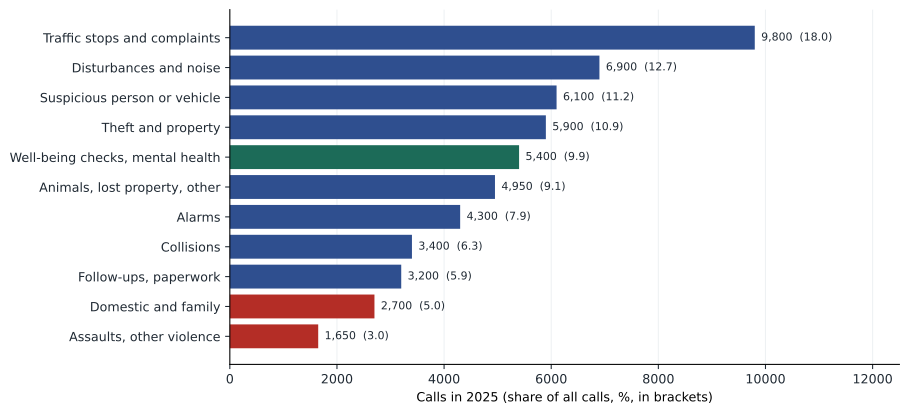
A count of calls tells only part of the story. A false alarm may take one officer fifteen minutes, while an assault can tie up two or three officers for hours: securing the scene, caring for the victim, arresting and processing the suspect, taking statements and writing reports. Workload analysis therefore multiplies each type of call by the average officer time it consumes. The code below estimates how patrol time in Port Ardent is spent and how much is left for proactive work.
# Patrol workload in Port Ardent, 2025: calls and officer time
calls = {   # type: (calls per year, average officer-minutes per call, including reports)
    "Traffic stops and complaints": (9800, 35),
    "Disturbances and noise": (6900, 50),
    "Suspicious person or vehicle": (6100, 40),
    "Theft and property": (5900, 75),
    "Well-being checks, mental health": (5400, 110),
    "Animals, lost property, other": (4950, 30),
    "Alarms": (4300, 25),
    "Collisions": (3400, 90),
    "Follow-ups, paperwork": (3200, 60),
    "Domestic and family": (2700, 180),
    "Assaults, other violence": (1650, 200),
}
total_calls = sum(n for n, m in calls.values())
total_hours = sum(n * m for n, m in calls.values()) / 60
print(f"{'type':34s} {'calls':>6s} {'share':>6s} {'hours':>7s} {'share':>6s}")
for t, (n, m) in sorted(calls.items(), key=lambda kv: -kv[1][0] * kv[1][1]):
    h = n * m / 60
    print(f"{t:34s} {n:6,d} {n / total_calls:6.1%} {h:7,.0f} {h / total_hours:6.1%}")
print(f"total: {total_calls:,d} calls, {total_hours:,.0f} officer-hours")
# patrol hours available: 96 constables, 182.5 shifts, 12 hours, 78% availability, minus 1.5 h a shift for briefing and breaks
available = 96 * 182.5 * 0.78 * (12 - 1.5)
print(f"patrol hours available: {available:,.0f}; committed to calls: {total_hours / available:.0%}")type calls share hours share Well-being checks, mental health 5,400 9.9% 9,900 16.8% Domestic and family 2,700 5.0% 8,100 13.7% Theft and property 5,900 10.9% 7,375 12.5% Disturbances and noise 6,900 12.7% 5,750 9.7% Traffic stops and complaints 9,800 18.0% 5,717 9.7% Assaults, other violence 1,650 3.0% 5,500 9.3% Collisions 3,400 6.3% 5,100 8.6% Suspicious person or vehicle 6,100 11.2% 4,067 6.9% Follow-ups, paperwork 3,200 5.9% 3,200 5.4% Animals, lost property, other 4,950 9.1% 2,475 4.2% Alarms 4,300 7.9% 1,792 3.0% total: 54,300 calls, 58,975 officer-hours patrol hours available: 143,489; committed to calls: 41%
The output shows that well-being and mental health calls, domestic incidents and assaults together account for a much larger share of officer time than of calls. About two fifths of available patrol time, 41% in this estimate, is committed to answering calls, leaving the rest for proactive patrol, traffic enforcement, follow-up investigations, court and training. That uncommitted time is not idle: it is when officers can visit problem locations, talk to business owners and residents and respond quickly when a serious call comes in. It is also unevenly distributed. On a Friday night almost all time is committed, while a Tuesday morning may be quiet.
The rhythm of a shift
Calls do not arrive evenly. In Port Ardent, as in most cities, calls are fewest between 03:00 and 06:00 and rise through the day to a peak in the late afternoon and early evening, when people are out, traffic is heavy and disputes erupt after work and school. Weekends and summer evenings are busier still. Matching staffing to this demand is a constant challenge. Port Ardent's twelve-hour schedule puts the same number of officers on every day shift, even though the morning is quiet and the late afternoon is busy. The service sets a higher minimum for nights because night calls are more often dangerous and backup is farther away.
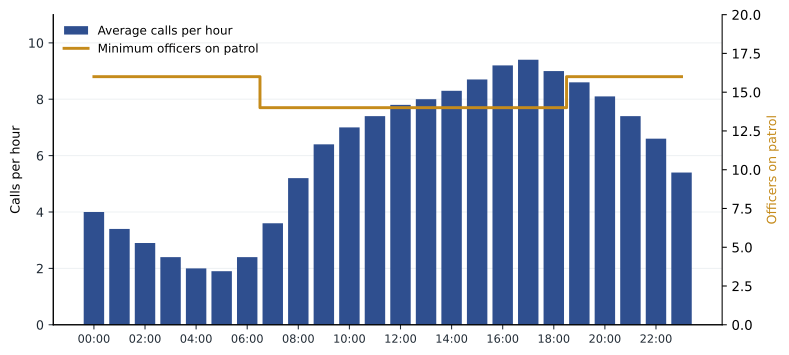
Amara's shift followed this rhythm. Between 19:00 and 02:00 Dev and his colleagues ran from call to call: a fight outside a bar, a collision with minor injuries, a noise complaint at a house party, a shoplifter held by store security, a call about a man shouting in a parking lot who turned out to be in a mental health crisis, and a domestic dispute where a woman wanted her intoxicated partner removed. After 02:00 the pace slowed. Dev checked the storage units on the break-in list, stopped a car with no lights and spent two hours writing reports in the parking lot of a closed grocery store, close enough to respond if needed.
Duties beyond answering calls
Patrol officers also do proactive work, meaning activity they start themselves rather than in response to a call: traffic enforcement, checking known problem locations, foot patrol in business districts, following up with victims and executing warrants. Research shows that proactive work focused on small areas where crime concentrates, known as hot spots, can reduce crime there without simply moving it around the corner. Proactive stops of people, however, carry risks for legitimacy when they are frequent, poorly explained or concentrated on particular groups, as lessons 9 and 11 discuss.
Paperwork takes a large share of every shift. Every call that results in an investigation needs a report, and an arrest can require hours of documentation: the arrest report, use-of-force report if any force was used, reports and evidence logs for the prosecutor, property and evidence forms and sometimes a request for a warrant. Detailed, timely reports are critical: prosecutors, defense attorneys and juries rely on them, and inconsistencies between a report and body-worn camera video can destroy an officer's credibility. Body-worn cameras add the task of tagging and reviewing video. Officers also spend time in court, sometimes on their days off, and in mandatory training each year.
Calls involving mental health
One of the hardest parts of patrol work involves people in mental health crisis. Under Ohio law, a police officer may take a person to a hospital for emergency evaluation if the officer has reason to believe the person is mentally ill and represents a substantial risk of physical harm to self or others; the form used is commonly called a pink slip. In Port Ardent, an officer who takes a person to hospital must usually wait until hospital staff accept responsibility, which can take hours. On Amara's shift, Dev and a second officer waited three hours in the emergency department with the man from the parking lot, which took two cars off the road at the busiest time of night. Co-response teams, which pair an officer with a mental health worker, aim to resolve more of these calls safely in the community; Port Ardent runs one team on weekday afternoons and evenings.
Professor Desjardins tells the class that he took hundreds of people in crisis to hospital in his career, and that the calls he remembers most are the ones where talking for twenty minutes made force unnecessary. Patrol officers need the tactical skills to handle the rare call that turns violent, which later courses teach, but most of the time their most important tool is communication: calm voice, patience, explaining what is happening and listening.
What patrol demands of officers
Patrol work demands a mix of qualities that few other jobs combine. Officers must make quick decisions with incomplete information and then explain those decisions in writing and in court. They must switch in minutes from comforting a victim to confronting a suspect to directing traffic. They must know a wide range of laws and policies, be physically capable, drive safely at speed, use technology and keep their temper when insulted. They work largely alone or with one partner, with a supervisor on the radio rather than at their side. Marco, who has done his own ride-along by now, says that the closest comparison he can think of is a military deployment, except that the people you meet are your own neighbors. Priya, who rode with the traffic unit, was surprised by how much of a collision investigation is measurement, photography and careful arithmetic.
Worked problem
Response time for priority 1 calls
Port Ardent's target is to arrive at priority 1 calls within 7 minutes of dispatch at least 80% of the time. A sample of ten priority 1 calls from one month had travel times (minutes) of 4.2, 5.8, 6.1, 3.9, 9.4, 6.8, 7.6, 5.2, 4.8 and 12.1. Is the target met?
Show solution
- Sort the times: 3.9, 4.2, 4.8, 5.2, 5.8, 6.1, 6.8, 7.6, 9.4, 12.1.
- Count those of 7 minutes or less: 3.9, 4.2, 4.8, 5.2, 5.8, 6.1 and 6.8, which is 7 of 10, or 70%.
- The median is the average of the 5th and 6th values: (5.8 + 6.1) / 2 = 5.95 minutes.
- The two slow calls, 9.4 and 12.1 minutes, should be examined: were they at the edge of the city, during a shift change, or when all cars were committed?
Answer: Only 70% of calls in the sample met the 7-minute target, below the 80% goal, even though the median of 5.95 minutes looks good. A small sample can mislead, so the service should look at a full year of data and at the causes of slow responses before changing deployment.
Common mistakes
MistakeMost patrol time is spent on violent crime.
InsteadViolent crime is a small share of calls, though it takes a large amount of time per call.
MistakeA quiet hour on patrol is wasted time.
InsteadUncommitted time allows proactive work and keeps officers ready to respond quickly to serious calls.
MistakeThe median response time shows whether a target is met.
InsteadA target stated as a share of calls within a time limit must be checked directly; a good median can hide many slow calls.
MistakeReport writing is a minor part of the job.
InsteadDocumentation takes a large share of every shift and determines whether cases succeed in court.
Summary and key terms
- Calls for service reach patrol through call-takers and dispatchers, who assign priorities using computer-aided dispatch.
- Most calls involve traffic, disorder, suspicious activity, property crime and requests for help; violent crime is a small share of calls.
- Workload analysis weighs calls by officer time; mental health, domestic and violent calls take far longer than most others.
- Demand varies by hour and day, peaking in the late afternoon and evening, while many schedules staff evenly.
- Patrol duties include proactive work, extensive report writing, court and training.
- Mental health calls are frequent and time-consuming; co-response teams and crisis lines offer alternatives.
- Call for service
- A request for police assistance from the public or an alarm company, or an incident an officer reports.
- Computer-aided dispatch
- The system that records calls, assigns priorities and tracks police units.
- Priority
- The urgency assigned to a call, which determines how quickly a unit is sent.
- Proactive work
- Police activity started by officers rather than in response to a call.
- Hot spot
- A small area where crime is concentrated.
- Co-response team
- An officer and a mental health worker who respond together to crisis calls.
Practice problems
Work each problem on paper first, then reveal the answer to check.
Why is a count of calls not enough to understand patrol workload?
Show answer
Different calls take very different amounts of officer time; workload must weigh each call by its duration and number of officers.
Using the code, which call type uses the most officer-hours?
Show answer
Well-being checks and mental health calls, about 9,900 hours.
Give two reasons calls peak in the late afternoon and evening.
Show answer
More people are out and moving, traffic is heavy and disputes arise after work and school.
Why does a hospital wait for a person in mental health crisis affect the whole city?
Show answer
It takes officers off the road, reducing the cars available for other calls, often at busy times.
Lesson quiz · 5 questions
Score 60% or more to complete this lesson.
Create a free account to save your progress, take quizzes and earn a certificate.