
LES-101 · Lesson 6 of 12 · 19 min
Police governance and civilian oversight
▶ Video coming soon A video version of this lesson is on the way.
In week six the class attends a public meeting of the Port Ardent Police Service Board, held in a council chamber with about forty residents in the seats. On the agenda are the chief's quarterly report, a budget request for eight new officers, a delegation from a tenants' group upset about an arrest at their building and a presentation on body-worn cameras. Linh is struck by how ordinary it feels: people with name cards, a microphone that keeps cutting out, a clerk taking minutes. Professor Desjardins tells her that this ordinariness is the point. In a democracy, the most powerful public servants in the city answer, in public, to people who are not police. Today's lesson explains who governs the police, who oversees them and how officers are held to account.
Governance and oversight: two different jobs
Governance means setting direction: deciding what a police service should prioritize, approving its budget and policies, choosing its leader and holding that leader accountable for results. Oversight means checking conduct: investigating complaints, reviewing serious incidents, auditing practices and deciding whether officers or services broke the rules. Both are needed. A service can be well governed and still have officers who abuse their powers, and an oversight body can discipline individual officers without fixing the policies that put them in difficult situations. Both also have to respect a line between policy and operations. Elected officials and boards can set policies, priorities and budgets, but they must not direct officers to investigate, arrest or ignore particular people. That line protects police independence, which is the guarantee that the law is applied impartially rather than for political advantage.
In Canada, the principle of police independence in investigations was affirmed by the Supreme Court in R. v. Campbell (1999), which held that an RCMP officer investigating a crime is not acting as a servant of the government and is answerable to the law alone. Ontario's Community Safety and Policing Act, 2019 writes the line into law: a police service board may not direct the chief on specific investigations, the conduct of specific operations, the discipline of specific officers or day-to-day administration.
Police service boards in Ontario
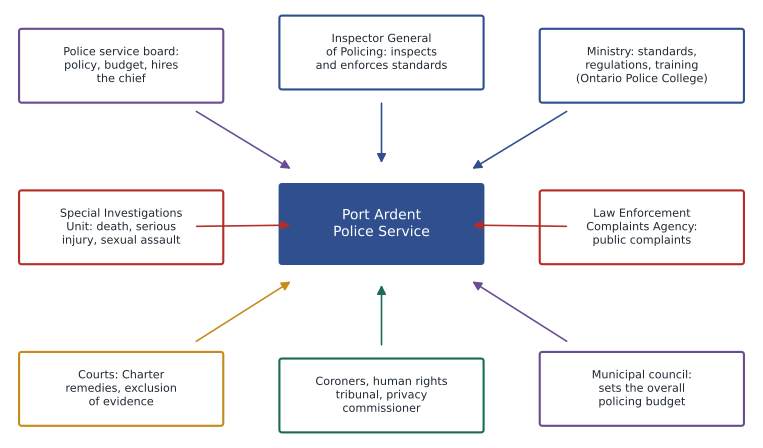
Every municipal police service in Ontario is governed by a police service board made up of members of municipal council, residents appointed by council and members appointed by the province. The board hires the chief and deputy chiefs, sets objectives and priorities in a strategic plan, makes policies, approves a budget that it submits to municipal council, and monitors the chief's performance. Council decides the total amount of money, but it cannot tell the board how to spend it line by line. Under the 2019 act, the OPP also has detachment boards so that communities policed by the OPP have a local voice, and First Nations can create boards for their services if they opt into the provincial framework. Board members must complete training, and boards must post their meetings publicly, except for confidential matters such as personnel decisions.
Boards and councils face real limits. Members are often volunteers or busy elected officials with little time and less expertise, and they depend on the chief for most of their information. Researchers who study police governance have found that many boards rubber-stamp what the chief proposes. Others go to the opposite extreme and try to manage operations, which damages independence. The best boards ask hard questions about results, demand data, listen to the community and leave operational decisions to the chief. At the meeting Linh attends, a board member asks the chief why calls about one neighbourhood have doubled. The chief explains a problem with an abandoned building and a plan to work with the city to secure it. That, Professor Desjardins whispers, is governance working as it should.
Oversight inside the service
The first line of accountability is inside the police service. Sergeants review reports, attend serious calls and watch body-worn camera video. A professional standards unit investigates complaints and allegations of misconduct and recommends discipline, which can range from counselling and retraining to loss of pay, demotion or dismissal. Early intervention systems track indicators such as complaints, use-of-force reports, sick days and collisions, and flag officers who may need support before problems grow. Policies require officers to report every use of force, and supervisors review those reports. Internal accountability is fast and informed by expert knowledge of police work, but the public often doubts that police can investigate themselves fairly, especially in the most serious cases.
Civilian oversight in Ontario
Ontario has one of the most developed systems of civilian oversight in the world. The Special Investigations Unit, created in 1990, is a civilian agency that investigates incidents in which an officer's conduct may have caused death or serious injury, in which a firearm was discharged at a person, or in which sexual assault is alleged. Its director decides whether there are reasonable grounds to charge the officer and publishes reports explaining decisions. Police must notify the SIU immediately and must not interview the officers involved before it arrives. Public complaints about officer conduct, such as rudeness, unlawful searches or excessive force that does not reach the SIU's threshold, go to the Law Enforcement Complaints Agency, which replaced the Office of the Independent Police Review Director in 2024. Its complaints director can investigate a complaint directly or send it to the police service, while keeping oversight of the result. The Inspector General of Policing, a new office under the 2019 act, inspects police services and boards, investigates complaints about them and can issue directions when they fail to meet the province's standards. Disciplinary hearings are decided by independent adjudicators, with appeals to the Ontario Police Arbitration and Adjudication Commission.
The RCMP has its own oversight system. The Civilian Review and Complaints Commission for the RCMP has handled public complaints, and legislation passed in 2024 creates a new Public Complaints and Review Commission to oversee both the RCMP and the Canada Border Services Agency. Serious incidents involving RCMP officers in contract provinces are investigated by provincial civilian agencies such as the Independent Investigations Office in British Columbia and the Alberta Serious Incident Response Team. Every province now has some form of civilian investigation of serious incidents.
Courts, coroners and other checks
Courts check police every day. Judges exclude evidence obtained in breach of the Charter, stay cases for abuse of process and criticize police conduct in written decisions that are read across the country. Officers can be charged criminally like anyone else, and people can sue police for wrongful arrest, negligent investigation or excessive force. Coroners' inquests examine deaths in police custody and make recommendations to prevent future deaths; in Ontario an inquest is mandatory when a person dies in police custody. Human rights tribunals hear complaints of discrimination by police, and privacy commissioners investigate the collection and use of personal information. The news media, community organizations and video recorded by bystanders have also become powerful forms of oversight, as several of the cases in lesson 4 showed.
Professor Desjardins tells the class about the first time he was the subject of a complaint, early in his career, after an arrest at a bar. He was angry and certain he had done nothing wrong. The investigation cleared him, but the investigator pointed out that his notes were thin and that he had not explained the reason for the arrest clearly to the man's friends, who had filed the complaint. He says he became a better officer because of a complaint that was not sustained. Oversight is not only about punishment; done well, it is a feedback system.
Measuring complaints
Complaint numbers are hard to interpret. A rise in complaints might mean officers are behaving worse, or it might mean residents trust the process enough to use it. Most complaints are not substantiated, which does not mean they were false; it often means the evidence was insufficient either way. Analysts look at rates rather than raw counts, at the share substantiated, at the types of complaints and at whether a few officers account for a large share. The code below summarizes Port Ardent's public complaints for 2025.
# Port Ardent public complaints, 2025
officers = 172
contacts = 54300          # calls for service, as a rough measure of contact with the public
outcomes = {"screened out or withdrawn": 18, "resolved informally": 11,
            "investigated, not substantiated": 25, "investigated, substantiated": 10}
total = sum(outcomes.values())
for k, v in outcomes.items():
    print(f"{k:32s} {v:3d}  {v / total:5.1%}")
investigated = outcomes["investigated, not substantiated"] + outcomes["investigated, substantiated"]
print(f"total complaints: {total}")
print(f"complaints per 100 officers: {total / officers * 100:.1f}")
print(f"complaints per 10,000 calls: {total / contacts * 10000:.1f}")
print(f"substantiated share of investigated complaints: {outcomes['investigated, substantiated'] / investigated:.0%}")screened out or withdrawn 18 28.1% resolved informally 11 17.2% investigated, not substantiated 25 39.1% investigated, substantiated 10 15.6% total complaints: 64 complaints per 100 officers: 37.2 complaints per 10,000 calls: 11.8 substantiated share of investigated complaints: 29%
About 12 complaints were made for every 10,000 calls, and 29% of investigated complaints were substantiated. The board or committee should ask follow-up questions: are complaints concentrated among a few officers or in a particular unit, how long do investigations take, and do complainants feel they were heard? Linh notices that the 18 complaints screened out or withdrawn are more than a quarter of the total and wonders whether people gave up. That, Professor Desjardins says, is exactly the kind of question oversight bodies should ask.
What makes oversight effective
Oversight bodies differ widely in how well they work, and research and reviews point to a handful of features that matter. Independence comes first: investigators should not be serving officers of the service they investigate, and the body should not depend on police goodwill for its budget or information. Adequate resources and legal powers matter, including the power to compel officers and services to provide documents and video. Timeliness matters, because investigations that take years leave officers, complainants and the public in limbo. Transparency matters: after Justice Michael Tulloch's 2017 Independent Police Oversight Review recommended it, Ontario's SIU began publishing detailed reports explaining its decisions not to charge officers, which has helped the public understand and test its reasoning. Finally, oversight needs legitimacy with both the community and police. A body that the community sees as toothless will not restore trust, and one that officers see as biased against them will meet resistance at every step. Linh, who is thinking about a career in analysis, notes that many oversight bodies hire civilian investigators and analysts, which is another route into public safety work.
Oversight also works best when it looks beyond individual blame to the systems that produce misconduct. A single complaint about a rough arrest may reveal a training gap, a policy that encourages risky tactics or a supervisor who never reviews body-worn camera video. Systemic reviews, which examine patterns across many incidents, can recommend changes that prevent future harm in a way that disciplining one officer cannot.
Worked problem
Who investigates?
Three incidents occur in Port Ardent in one week: (a) a driver fleeing a traffic stop crashes and breaks a leg while officers follow; (b) a resident complains that an officer swore at her during a noise call; (c) a board member demands that the chief stop investigating a local developer who is a friend. Who should handle each?
Show solution
- (a) A serious injury connected to police conduct falls within the SIU's mandate. The service must notify the SIU immediately, and the SIU, not the police, investigates.
- (b) A conduct complaint goes to the Law Enforcement Complaints Agency, which can investigate it, send it to the service's professional standards unit or resolve it informally with consent.
- (c) The board member is trying to direct a specific investigation, which the 2019 act forbids. The chief should refuse and can report the matter to the Inspector General.
Answer: Each incident goes to a different body because each raises a different kind of accountability: criminal responsibility for serious harm, professional conduct and the independence of investigations from politics.
Common mistakes
MistakeGoverning the police means telling officers whom to arrest.
InsteadGovernance sets policy, priorities and budgets; directing specific investigations violates police independence.
MistakeAn unsubstantiated complaint was a false complaint.
InsteadMost unsubstantiated complaints lack enough evidence either way.
MistakeCivilian oversight means police have no role in accountability.
InsteadInternal supervision, professional standards units and early intervention systems remain essential alongside civilian bodies.
MistakeThe SIU investigates every complaint about police.
InsteadThe SIU handles deaths, serious injuries, firearm discharges at people and sexual assault allegations; other complaints go to the Law Enforcement Complaints Agency.
Summary and key terms
- Governance sets direction and holds leaders to account; oversight checks conduct. Both must respect police independence in specific investigations.
- Ontario police service boards hire the chief, set policy and priorities and approve budgets, while council sets the total amount.
- Internal accountability includes supervision, professional standards investigations and early intervention systems.
- Civilian oversight in Ontario includes the SIU, the Law Enforcement Complaints Agency and the Inspector General of Policing; the RCMP has its own complaints commission.
- Courts, coroners, tribunals, the media and bystander video are also powerful checks.
- Complaint data should be read as rates and patterns, not raw counts.
- Governance
- Setting the direction, priorities, policies and budget of a police service and holding its leaders accountable.
- Oversight
- Checking the conduct of police through investigation, review and audit.
- Police independence
- The principle that investigations are directed by police and the law, not by politicians.
- Police service board
- The civilian body that governs a municipal police service in Ontario.
- Special Investigations Unit
- Ontario civilian agency that investigates serious incidents involving police.
- Early intervention system
- A system that flags officers whose patterns of complaints or force suggest a need for support.
Practice problems
Work each problem on paper first, then reveal the answer to check.
What is the difference between governance and oversight?
Show answer
Governance sets direction and policy and holds leaders accountable; oversight checks the conduct of officers and services.
Why must boards and councils not direct specific investigations?
Show answer
To protect police independence and ensure that the law is applied impartially rather than for political advantage.
In the complaints code, what is the rate per 10,000 calls if total complaints rise to 80?
Show answer
80 / 54,300 × 10,000 = 14.7.
Give two reasons a complaint might not be substantiated even if the complainant told the truth.
Show answer
No independent witnesses or video; conflicting accounts; insufficient evidence either way.
Lesson quiz · 5 questions
Score 60% or more to complete this lesson.
Create a free account to save your progress, take quizzes and earn a certificate.