
LES-101 · Lesson 7 of 12 · 20 min
Policing and the law: legislation, policy and discretion
▶ Video coming soon A video version of this lesson is on the way.
Professor Desjardins starts week seven with a story from his first year on patrol. At 2 a.m. he stopped a car weaving across the centre line. The driver was a nurse coming off a sixteen-hour shift, exhausted but sober. The law allowed him to write a ticket for careless driving; policy required him to check for impairment, which he did; nothing told him what to do next. He followed her home with his lights on and told her to call a taxi next time. Was that the right decision? Amara says yes. Marco is not sure: what if she had crashed the next night? Linh asks whether a young man in an old car would have received the same kindness. Professor Desjardins says that all three reactions go to the heart of today's topic. Police officers act under law and policy, but in the space between them is discretion, and that space is where much of policing actually happens.
Where police powers come from
Police officers can do only what the law allows. Their powers come from several sources arranged in a hierarchy. At the top is the constitution, which limits what any government official, including police, may do. The Charter of Rights and Freedoms protects against unreasonable search or seizure, arbitrary detention and imprisonment, and guarantees rights on arrest or detention. Below the constitution are statutes. The Criminal Code defines most crimes and gives police their main powers of arrest, search and use of force. Provincial statutes such as Ontario's Highway Traffic Act, Liquor Licence and Control Act, Mental Health Act and Trespass to Property Act give police further powers, and the Community Safety and Policing Act, 2019 sets out their duties, oaths and standards. Then come regulations made under those statutes, such as provincial or state standards for training and equipment.
Common law, the body of rules developed by judges, also matters. Canadian courts have recognized ancillary police powers that are reasonably necessary to carry out police duties, such as the power to enter a home in response to a disconnected 911 call to make sure no one is hurt, recognized in R. v. Godoy (1999), and the power to briefly detain a person for investigation when there are reasonable grounds to suspect a connection to a recent crime, recognized in R. v. Mann (2004). The Supreme Court has also warned that these powers must be narrow, and in Fleming v. Ontario (2019) it refused to recognize a power to arrest a lawful protester to prevent a breach of the peace by others. Finally, each police service issues its own policies and procedures, which can be stricter than the law but never looser. A service may forbid vehicle pursuits for minor offences, for example, even though the law allows them.
| Source | Canadian example | What it does |
|---|---|---|
| Constitution | Charter, sections 8 to 10 | Sets the outer limits of police power |
| Statutes | Criminal Code; Highway Traffic Act | Defines offences and grants powers |
| Regulations | Provincial standards under the 2019 act | Fills in detail under statutes |
| Court decisions | R. v. Mann; R. v. Grant | Interprets law; recognizes or limits powers |
| Service policy | Pursuit, use of force, body-worn camera policies | Directs how officers use their powers |
Powers of arrest and the use of force
Under section 495 of the Criminal Code, an officer may arrest without a warrant a person who has committed an indictable offence, or whom the officer believes on reasonable grounds has committed or is about to commit one, or a person found committing any criminal offence. Reasonable grounds means more than suspicion: a credible basis that a reasonable person in the officer's position would accept. The same section tells officers not to arrest for less serious offences when the public interest, such as establishing identity, preserving evidence and preventing repetition, can be met without arrest. Section 25 protects officers who use as much force as is necessary in carrying out their duties on reasonable grounds, and limits force intended or likely to cause death or grievous bodily harm to situations where the officer believes on reasonable grounds it is necessary to protect someone from death or grievous bodily harm. You will study police powers in depth in a later course; for now, notice that each power comes with conditions, and that the conditions often require judgment.
What discretion is
The legal scholar Kenneth Culp Davis defined discretion this way: a public officer has discretion whenever the effective limits on his or her power leave the officer free to make a choice among possible courses of action or inaction. Police discretion operates at every level. A chief decides to make impaired driving a priority. A sergeant decides to send two cars to a call rather than one. A patrol officer decides whether to stop a car, whether to search, whether to arrest or caution, whether to write a ticket for 20 over the limit or 25 over. Discretion includes the choice not to act, which is invisible in most statistics because nothing is recorded.
Discretion exists for practical and principled reasons. Practically, there are far more offences than police could ever enforce; full enforcement of every law would swamp the courts and turn the public against police. The law is also written in general terms and cannot anticipate every situation. In principle, justice often requires judgment. A rigid rule that treats a hungry teenager who steals a sandwich the same as a professional shoplifter produces outcomes most people consider unjust. Researchers began to take police discretion seriously in the 1950s, when the American Bar Foundation's survey of criminal justice found that officers routinely chose not to arrest in situations where the law allowed it, contrary to the official view that police simply enforced the law.
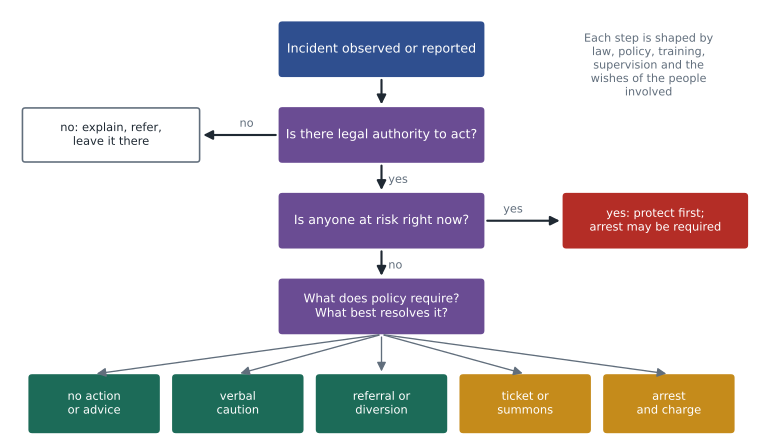
What shapes discretionary decisions
Research on how officers use discretion has found consistent patterns. The seriousness of the offence matters most: officers rarely ignore serious violence. The strength of the evidence matters, as does whether there is a complainant who wants action. In a famous set of observational studies in the 1960s, Donald Black and Albert Reiss found that officers' decisions to arrest in minor disputes depended heavily on whether the complainant wanted an arrest. The relationship between the parties matters; officers have historically been less likely to arrest when the parties are family members, which is why many jurisdictions changed their policies on domestic violence. The suspect's attitude matters: people who are hostile or disrespectful are more likely to be arrested, although later research showed that part of this effect reflects hostile people also committing more serious offences or resisting.
Characteristics of the people involved, such as race, age, gender and class, should not matter, but research in both countries shows that they sometimes do. Some disparities reflect where police are deployed and the kinds of calls they receive; some reflect individual or institutional bias. Distinguishing the two is difficult, which is why services increasingly collect data on stops, searches and outcomes and analyze it carefully. Ontario's Anti-Racism Act requires police services to collect race-based data on use of force, and several services publish it. Organizational factors also shape discretion: the service's priorities, supervisors' expectations, performance measures, training and peer culture. An officer in a unit where everyone writes ten tickets a shift will make different choices from one in a unit focused on problem-solving.
Structuring discretion
Because unchecked discretion can lead to unfairness, police services structure it. Some decisions are taken out of officers' hands. Since the 1980s, Canadian jurisdictions have directed police to lay charges in cases of intimate partner violence where there are reasonable grounds, rather than leaving the decision to the victim, who may be under pressure from the abuser. The Youth Criminal Justice Act requires officers to consider extrajudicial measures, such as warnings, cautions and referrals, before charging a young person, and states that such measures are presumed adequate for a non-violent first offence. Use-of-force policies set out when different options may be used and require reporting and review. Pursuit policies weigh the danger of a chase against the seriousness of the offence. Body-worn cameras and supervisory review make discretionary decisions more visible.
Discretion is not unlimited even when no policy applies. In R. v. Beaudry (2007), the Supreme Court of Canada upheld the conviction for obstructing justice of an officer who chose not to proceed with an impaired driving investigation of a fellow officer. The Court said police discretion is real but must be justified both subjectively, meaning the officer honestly believed the decision was right, and objectively, meaning it was reasonable in the circumstances. Favouring a colleague failed both tests.
Discretion and fairness: reading the data
Data can reveal patterns in discretion, but it must be read with care. Suppose Port Ardent's traffic unit notices that young drivers who are stopped receive tickets more often than older drivers. Is the unit treating young drivers more harshly? Before reaching a conclusion, an analyst must ask whether the stops differ in ways that legitimately affect the outcome, such as how far over the limit the drivers were going. The code below compares ticket rates overall and within speed bands.
# Ticket rates after speeding stops: overall and within speed bands (illustrative data)
stops = {   # band: (young stops, young tickets, older stops, older tickets)
    "under 20 over": (300, 90, 2000, 600),
    "20 to 39 over": (500, 300, 1500, 900),
    "40 or more over": (200, 190, 200, 190),
}
ys = sum(v[0] for v in stops.values()); yt = sum(v[1] for v in stops.values())
os_ = sum(v[2] for v in stops.values()); ot = sum(v[3] for v in stops.values())
print(f"overall: young {yt / ys:.1%} ticketed, older {ot / os_:.1%}, ratio {(yt / ys) / (ot / os_):.2f}")
for band, (a, b, c, d) in stops.items():
    print(f"{band:16s} young {b / a:5.1%}  older {d / c:5.1%}")
print(f"share of young drivers' stops at 20 or more over: {(500 + 200) / ys:.0%}; older: {(1500 + 200) / os_:.0%}")overall: young 58.0% ticketed, older 45.7%, ratio 1.27 under 20 over young 30.0% older 30.0% 20 to 39 over young 60.0% older 60.0% 40 or more over young 95.0% older 95.0% share of young drivers' stops at 20 or more over: 70%; older: 46%
Overall, young drivers are ticketed at 1.27 times the rate of older drivers, but within each speed band the rates are identical. The overall difference arises because a larger share of young drivers were stopped for higher speeds. This pattern, known as Simpson's paradox, shows why raw disparities do not prove unfair treatment. The reverse is also true: equal overall rates can hide unequal treatment within groups. And the analysis leaves another question open: are young drivers stopped more often in the first place for the same driving? Good analysis of discretion asks about every decision point, which Linh, the aspiring analyst, finds fascinating.
Worked problem
Using the decision tree
On patrol, Constable Dev Malhotra is called to a pharmacy where a 16-year-old has been caught taking 30 dollars of cosmetics. She has no prior record, is crying and apologetic, and the store manager wants the goods back and the girl banned but says he does not care about charges. What should he do?
Show solution
- Legal authority: there are reasonable grounds to believe a theft was committed, so the officer has authority to act.
- Risk: no one is at risk of harm, so there is no need for immediate arrest to protect anyone.
- Policy and law: under the Youth Criminal Justice Act, the officer must consider extrajudicial measures and they are presumed adequate for a non-violent first offence.
- Judgment: a caution or referral, with the girl's parent called, the goods returned and the store's trespass notice explained, meets the purposes of accountability and prevention without a court record.
Answer: A caution or referral to a youth program, with the parent involved and the store's wishes respected, is the response most consistent with law, policy and the circumstances. The officer records the decision and the reasons, so that it can be reviewed and so that a later officer knows about the earlier incident.
Common mistakes
MistakePolice discretion means officers can do whatever they think best.
InsteadDiscretion operates only within the limits of law and policy, and must be justified as honest and reasonable.
MistakeFull enforcement of every law would be fairer.
InsteadFull enforcement is impossible and would often produce unjust outcomes; structured discretion is the realistic alternative.
MistakeA raw difference in outcomes between groups proves bias.
InsteadOutcomes must be compared within comparable situations, and every decision point, including who is stopped, must be examined.
MistakeService policy can give officers more power than the law.
InsteadPolicy can restrict how officers use legal powers but cannot expand them.
Summary and key terms
- Police powers come from the constitution, statutes, regulations, court decisions and service policies, in that order of authority.
- Arrest without warrant requires reasonable grounds; section 25 of the Criminal Code governs the use of force.
- Discretion is the freedom to choose among courses of action or inaction within the limits of power, and it exists at every level of policing.
- Seriousness, evidence, complainant wishes, relationships and the suspect's attitude shape discretion; race, age and class should not, but research shows they sometimes do.
- Services structure discretion through charging policies, youth diversion, use-of-force and pursuit policies, data collection and review.
- Data on discretion must be compared within comparable situations to avoid false conclusions.
- Discretion
- The freedom to choose among possible courses of action or inaction within the limits of one's power.
- Reasonable suspicion
- A lower standard than grounds for arrest, based on specific facts, that allows a brief investigative stop.
- Ancillary powers
- Powers not written in statute but recognized by courts as necessary for police duties.
- Extrajudicial measures
- Responses to youth offending outside the courts, such as warnings, cautions and referrals.
- Simpson's paradox
- A pattern in which a difference between groups reverses or disappears when the data are split into subgroups.
- Policy
- A written rule issued by a police service directing how officers use their legal powers.
Practice problems
Work each problem on paper first, then reveal the answer to check.
Give two reasons police discretion exists.
Show answer
There are too many offences to enforce fully; laws are general and justice often requires judgment.
What did Black and Reiss find about arrests in minor disputes?
Show answer
The complainant's wishes strongly influenced whether officers arrested.
In the ticket data, why are young drivers ticketed more often overall?
Show answer
A larger share of their stops were at higher speeds, where everyone is ticketed more often.
Why might a service forbid pursuits for minor offences even though the law allows them?
Show answer
Because the danger of a chase to the public and officers outweighs the benefit of catching a minor offender immediately.
Lesson quiz · 5 questions
Score 60% or more to complete this lesson.
Create a free account to save your progress, take quizzes and earn a certificate.