
LES-101 · Lesson 12 of 12 · 19 min
Capstone: a ride-along report and a profile of a police service
▶ Video coming soon A video version of this lesson is on the way.
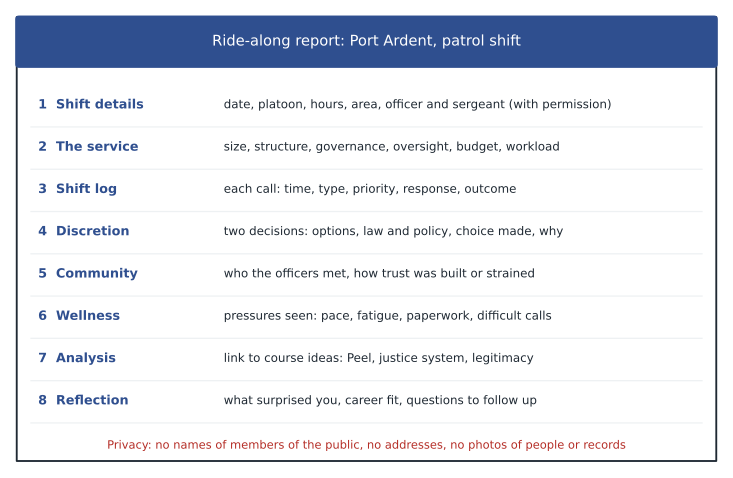
The final lesson brings the course together in one assignment. Every student has now completed a ride-along with the Port Ardent Police Service: Amara on a Friday night with Constable Dev Malhotra, Marco on a Sunday day shift, Priya with the traffic unit, Linh in the communications centre followed by four hours in a patrol car, and Jesse with the Nimkii Bay Anishinaabe Police Service, which welcomed him back to his own community in a new role. Each must write a report with two parts: a profile of the police service, based on public information and what they learned, and an analysis of the shift, connecting what they saw to the ideas of the course. This lesson walks through how to do both well, using Amara's report as a model.
Before, during and after a ride-along
A ride-along is a privilege, not a right, and it comes with responsibilities. Before the shift, students sign a waiver and a confidentiality agreement, read the service's ride-along rules and dress appropriately. During the shift, they follow the officer's instructions without argument, especially about where to stand and when to stay in the car; they do not interfere with police work, touch equipment or speak for the police; and they do not take photographs or recordings. Afterward, they protect the privacy of everyone they met. The report must never include the names, addresses, licence plates or identifying details of members of the public, and it should name officers only with their permission. Professor Desjardins reminds the class that the people they saw on the worst night of their lives did not agree to become case studies.
A ride-along also requires observation skills that are useful for police work itself. Good observers note times, sequences and exact words where they matter, write their notes as soon as possible and separate what they saw from what they concluded. Amara kept a small notebook and wrote a line after each call, which made her shift log accurate. Marco, who relied on memory, found that by the next morning he could not remember the order of the calls. That, Professor Desjardins says, is the same lesson every new officer learns about notebooks.
Part 1: profiling the police service
The service profile describes the organization the student rode with, using the frameworks from lessons 2 to 6. It should answer six questions. Where does the service fit in the system: what level of government is it, what is its jurisdiction and which other agencies share or border its territory? How big is it: officers, civilians, budget and population served, with rates per 100,000 residents for comparison? How is it organized: ranks, divisions, units and shift system? How is it governed and overseen: who sits on the board, how the budget is approved and which civilian bodies investigate complaints and serious incidents? What is its workload: calls for service, the main types and response times? And how does the community see it: survey results, complaints and recent controversies or successes?
Most of this information is public. Services publish annual reports, budgets and strategic plans, and board meetings, agendas and minutes are posted online. National statistics provide comparisons. Students should cite their sources and note when figures are estimates or come from an interview. The code below shows how Amara turned Port Ardent's published figures into the key indicators for her profile.
# Port Ardent Police Service: key indicators for the service profile (2025)
population = 98000
officers, civilians = 172, 71
budget = 46_800_000          # gross operating budget, dollars
calls = 54300
p1_minutes = [4.2, 5.8, 6.1, 3.9, 9.4, 6.8, 7.6, 5.2, 4.8, 12.1, 6.4, 5.5]  # sample of priority 1 travel times
complaints = 64
trust = 0.68                 # community survey, all residents
p1 = sorted(p1_minutes); n = len(p1)
median = (p1[n // 2 - 1] + p1[n // 2]) / 2 if n % 2 == 0 else p1[n // 2]
print(f"officers per 100,000 residents: {officers / population * 1e5:.1f} (Ontario 178, Canada 180)")
print(f"civilian share of personnel: {civilians / (officers + civilians):.0%} (Canada 29%)")
print(f"cost per resident: {budget / population:,.0f} dollars")
print(f"calls per officer per year: {calls / officers:.0f}")
print(f"priority 1 median travel time: {median:.2f} min; within 7 min: {sum(t <= 7 for t in p1) / n:.0%}")
print(f"complaints per 100 officers: {complaints / officers * 100:.1f}; trust {trust:.0%}")officers per 100,000 residents: 175.5 (Ontario 178, Canada 180) civilian share of personnel: 29% (Canada 29%) cost per resident: 478 dollars calls per officer per year: 316 priority 1 median travel time: 5.95 min; within 7 min: 75% complaints per 100 officers: 37.2; trust 68%
The indicators give the profile a factual backbone. Each number should be interpreted, not just reported. Amara notes that Port Ardent has slightly fewer officers per resident than the Ontario average and the same civilian share as the national figure, yet officers like Dev still spend a large part of each shift on paperwork, which suggests looking at whether more tasks could move to civilians or online reporting. She also notes that the priority 1 sample, with three quarters of calls within the 7-minute target, below the 80% goal, is too small to draw firm conclusions, and recommends that the service publish full-year figures.
Part 2: the shift log and analysis
The shift log lists each call or activity with the time, type, priority, what the officers did and the outcome, without identifying anyone. Amara's log for her night shift with Dev began like this: at 19:22 a priority 2 fight outside a bar, two people separated, one cautioned, no injuries, 35 minutes; at 20:10 a priority 1 collision with minor injuries, scene secured, paramedics attended, one driver charged with careless driving, 95 minutes; at 21:45 a priority 3 noise complaint, party host agreed to turn music down, 15 minutes; at 22:30 a priority 2 call about a man shouting in a parking lot, who was in crisis, taken to hospital under the Mental Health Act, three hours including the wait. The log continued through eleven calls and ended with two hours of reports.
The analysis is the heart of the report. It connects what the student saw to the ideas of the course, using at least four lessons. Amara's analysis made several connections. Most of the shift involved order maintenance and help rather than crime, illustrating Bittner's view of police work from lesson 1. The careless driving charge would now enter the justice funnel from lesson 2, and Dev's detailed notes would determine whether it survived review. At the bar fight, Dev chose a caution rather than an arrest after both men calmed down, and Amara walked through the decision tree from lesson 7: legal authority existed, the risk had passed, policy allowed discretion and a caution resolved the problem. At the parking lot, Dev spent fifteen minutes talking before the man agreed to go to hospital voluntarily, an example of the minimum force principle from lesson 4 and the procedural justice ideas from lessons 1 and 9. The three-hour hospital wait illustrated the workload problem from lesson 8 and the case for co-response teams from lesson 11.
Writing about discretion, community and wellness
The report asks students to analyze two discretionary decisions in depth. For each, they should describe the situation, list the options available, identify the law and policy that applied, state the choice made and evaluate it. Amara chose the bar fight and a later traffic stop, in which Dev gave a young driver a warning for a burned-out headlight rather than a ticket after explaining the reason for the stop. She wondered whether the outcome would have been the same for a driver who was rude, and connected the question to the research on attitude and discretion from lesson 7. Good analysis raises questions honestly without accusing anyone.
The community section describes who the officers met and how trust was built or strained. Amara noticed that Dev greeted several business owners by name and that he explained every stop. She also noticed that at the house party, a group of young people filmed the officers on their phones the moment they arrived, which Dev said was now routine and which he accepted as part of the job. The wellness section describes the pressures the student observed. Amara described the pace of the evening, the long hospital wait, the hurried meal eaten in the car at 01:30 and the moment, after the collision, when Dev sat silently for a minute before driving to the next call. She connected these to the operational and organizational stressors in lesson 10.
Reflection and next steps
The reflection is personal. Students describe what surprised them, what they learned about themselves and whether the shift changed their career plans. Amara wrote that she had expected excitement and instead found that the skill she admired most was patience. Marco wrote that his Sunday day shift was quieter than he expected and that he now understands why scheduling matters so much to officers with families. Priya discovered that traffic investigation uses many of the analytical skills from her fraud work. Linh wrote that the communications centre was the most intense workplace she had ever seen and that she is now applying for a part-time call-taker position; she also wrote that Dev's habit of explaining every stop was exactly what her cousin never received. Jesse wrote that riding in his own community as an observer rather than a resident confirmed his choice, and that the officers there carry knowledge of families and history that no training course could teach.
| Criterion | What excellent work shows | Weight |
|---|---|---|
| Service profile | Accurate facts with sources, rates per 100,000, structure, governance and oversight explained | 25% |
| Shift log | Complete, precise and anonymous; times, types, priorities and outcomes | 15% |
| Analysis | Connects observations to at least four lessons with specific concepts | 30% |
| Discretion, community, wellness | Two decisions analyzed with options, law and policy; trust and stress discussed | 20% |
| Reflection and writing | Honest, specific reflection; clear organization; privacy respected | 10% |
Professor Desjardins ends the course where it began, with the question of what police are for. The students' answers are now more complicated and more interesting. Police are for keeping people safe, enforcing the law and responding when something ought not to be happening; they hold powers that democracies grant reluctantly and check constantly; they work inside a system of courts and corrections they do not control; they are shaped by a history that communities remember; and they depend, every day, on the trust of the people they serve. The courses that follow in the program will build the legal knowledge, investigative skills, community understanding and tactical abilities that the work requires. This course has tried to give them the map.
Students also present a five-minute summary of their report to the class. The presentation should highlight one finding from the profile, one discretionary decision and one question the student would like the service to answer. Professor Desjardins invites Sergeant Haddad to the presentations, and in past years several of her answers have changed how the service publishes its data.
Worked problem
Building the profile indicators
Using the Port Ardent figures, calculate officers per 100,000 residents, the civilian share of personnel, cost per resident and calls per officer, and compare them with Ontario and national figures.
Show solution
- Officers per 100,000: 172 / 98,000 × 100,000 = 175.5, slightly below Ontario's 178 and Canada's 180.
- Civilian share: 71 / (172 + 71) = 29%, about the same as the national share.
- Cost per resident: 46,800,000 / 98,000 = 478 dollars.
- Calls per officer: 54,300 / 172 = 316 calls per officer per year.
Answer: Port Ardent is close to provincial and national averages in officer and civilian numbers, at a cost of about 478 dollars per resident per year. The profile should explain what these numbers mean for workload and service, not just list them.
Common mistakes
MistakeA ride-along report should describe the most exciting calls in detail.
InsteadIt should give a complete, accurate log and analyze ordinary calls as carefully as dramatic ones.
MistakeIncluding names and addresses makes the report more realistic.
InsteadPrivacy of members of the public must be protected; reports must be anonymous.
MistakeThe profile should list as many statistics as possible.
InsteadA few well-chosen indicators, with rates and comparisons, interpreted clearly, are more useful.
MistakeAnalysis means giving opinions about the officers.
InsteadAnalysis connects observations to concepts, raises questions fairly and supports claims with evidence.
Summary and key terms
- A ride-along requires following the officer's instructions, not interfering and protecting everyone's privacy.
- The service profile covers jurisdiction, size, structure, governance and oversight, workload and community perceptions, with sources.
- Indicators such as officers per 100,000, civilian share, cost per resident and calls per officer must be interpreted, not just reported.
- The shift log is complete, precise and anonymous; the analysis connects observations to at least four lessons.
- Discretionary decisions are analyzed through options, law, policy and outcome; community and wellness observations link to lessons 9 and 10.
- Police work combines safety, law, democratic limits, history and trust, which the rest of the program builds on.
- Ride-along
- An observation shift with a police officer, governed by waiver, confidentiality and safety rules.
- Service profile
- A structured description of a police service's jurisdiction, size, organization, governance, workload and community standing.
- Shift log
- A chronological, anonymous record of calls and activities during a shift.
- Indicator
- A number, such as a rate or share, used to describe and compare performance or capacity.
- Cost per resident
- A police budget divided by the population served.
- Reflection
- A personal analysis of what was learned and how it affects one's goals.
Practice problems
Work each problem on paper first, then reveal the answer to check.
List three rules students must follow during a ride-along.
Show answer
Follow the officer's instructions; do not interfere or touch equipment; take no photographs or recordings.
Why should the shift log record ordinary calls as carefully as dramatic ones?
Show answer
Ordinary calls are most of police work and reveal discretion, workload and community relationships.
A service of 120 officers serves 75,000 people with a budget of 33 million dollars. Calculate officers per 100,000 and cost per resident.
Show answer
160 officers per 100,000 and 440 dollars per resident.
Name four lessons Amara connected to her shift.
Show answer
Lesson 1 (Bittner), lesson 2 (funnel), lesson 7 (discretion), lesson 4 (minimum force), lessons 8 and 11 (workload and co-response), lesson 9 (procedural justice).
Lesson quiz · 5 questions
Score 60% or more to complete this lesson.
Create a free account to save your progress, take quizzes and earn a certificate.