
LES-115 · Lesson 12 of 12 · 20 min
Capstone: a victim-focused review of three Port Ardent files
▶ Video coming soon A video version of this lesson is on the way.
For the final lesson, Desjardins and Brooks set the class a task that Port Ardent's case review committee carries out every quarter. Each student group takes one of the three files the class has followed, Ruth Lindqvist's break-in, Grace Whitford's fraud and Daniel Ferreira's assault, and reviews it from the victim's point of view. The question is not whether the investigation was competent, which earlier courses examined, but whether the victim was treated in the way the law, the research and good practice require. 'Every file looks good from the police side when there is an arrest at the end,' Desjardins says. 'This review asks how it looked from the other side of the counter.'
The review framework
Brooks gives the groups a framework with ten elements, drawn from the lessons of the course. Each element is scored from 0 to 2: 2 means it was done well, 1 means it was done partly or late, and 0 means it was missed. The elements are: first contact, meaning safety, medical needs, calm and an absence of blame (Lessons 4 and 5); written information about rights, services and the file on the day of the report (Lesson 6); referral to victim services, proactive where appropriate (Lesson 8); a trauma-informed interview (Lessons 4 and 5); keeping the victim informed, including about delays, before they hear another way (Lessons 6 and 7); protection, including no-contact conditions and safety planning (Lesson 7); participation, including consultation on pleas and the chance to give an impact statement (Lesson 7); help with financial recovery (Lesson 9); attention to particular needs such as language, age or disability (Lesson 10); and closure, meaning the victim is told the outcome and what happens next (Lessons 6 and 7).
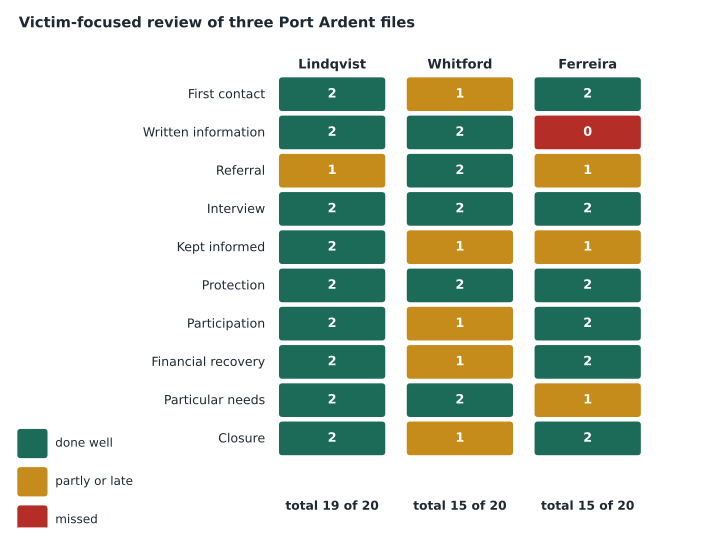
Brooks warns the groups about two traps. The first is hindsight: judge each step by what the officers knew and could reasonably do at the time. The second is scoring the investigation instead of the victim's experience. An arrest is good police work, but it does not make up for a victim who was never told about it.
File 1: Ruth Lindqvist
Amara Okafor's group reviews the break-in. Malhotra's first contact at 03:35 was strong: he told Ruth the suspect was in custody, gently answered her self-blame and explained what officers were doing. She received a victim information card with the file number that morning. The referral was passive: she was given the victim services number, and did not call; Brooks's agency contacted her only when Liu asked for help with the impact statement months later, which scores 1. Her interview was short and appropriate for a property crime victim. She was told about the release conditions the same morning by Sergeant Haddad, and kept informed by the officer in charge through the guilty plea. She was consulted about restitution, helped with her impact statement and offered a restorative meeting, which she chose to attend. Particular needs did not arise in a way that required accommodation, so the group scores that element 2. She was told the sentence the day it was imposed.
The group's main finding is about the referral. Ruth said later that she had not called because she thought victim services were 'for people who got hurt'. If she had been referred proactively in March, she might have had help with her sleep problems and fear months earlier. The group recommends that officers make proactive referrals for business owners and residents after break-ins, not only for violent crime.
File 2: Grace Whitford
Priya Sandhu's group reviews the fraud. The first contact was weak. Grace first reported by phone, and the call-taker, who was busy, told her that these scams were very common and that there was not much police could do about money sent overseas. Grace said afterward that she almost hung up and did not call back for two days, until her daughter insisted. The group scores this 1, because the call-taker did take the report and gave a file number, but the words added to Grace's shame and delayed the investigation. Written information, the referral and the interview were all done well by Detective Park, as Lessons 5 and 8 described. But after the interview, Grace heard nothing for six weeks, while the fraud unit worked on the courier arrest connected to her case. She learned about the arrest from a neighbor who saw it in the news.
Protection scores 2: the bank alert Park arranged stopped the second fraud. Participation scores 1: there was no prosecution connected to Grace's loss, but no one explained to her whether she could take part in the courier's case as a related victim, or give a statement. Financial recovery scores 1: Park helped with the bank, which refunded part of the loss, but no one told Grace about the civil and reporting options until Brooks's agency did. Particular needs score 2: her age and isolation were recognized, and her wish not to be named was respected. Closure scores 1: the file was closed without a call to explain that the people who took her money would probably never be found.
The group's main findings are about communication. A single sentence from the call-taker undid a great deal, and the group recommends a short training module for communications staff on fraud victims. A six-week silence and a closure without a call left Grace feeling forgotten. The group recommends a rule that victims are updated at least every 30 days while a file is open, and always told when it is closed.
File 3: Daniel Ferreira
Marco DiSanto's group reviews the assault. First contact on Front Street was good: Malhotra knelt, introduced himself, attended to medical needs and asked only what he needed for the broadcast. Written information scores 0, because Daniel left in the ambulance without any and spent two days not knowing whom to call. The referral scores 1: it was a warm handoff, which was excellent, but it came only after Malhotra realized his mistake the next day. The interviews scored 2 once the detective arranged a Portuguese interpreter, and the group notes that the detective handled the changing account in exactly the way Lesson 4 recommends. Keeping informed scores 1: Daniel learned of the first adjournment from a court notice before anyone called him, which coincided with the bad night in his recovery ratings.
Protection, participation and financial recovery all score 2: Daniel received a copy of the release conditions, was consulted about the plea, gave an impact statement through an interpreter and was helped with the compensation application. Particular needs score 1: an interpreter was used for the second interview and in court, but not at the hospital the morning after the assault, when his English was weakest. Closure scores 2: Liu called him after sentencing and explained Vance's sentence and the no-contact condition that would continue while he was on community control.
The program below totals the scores for the three files and identifies the elements that scored lowest across all of them.
# Victim-focused review scores (0 missed, 1 partly or late, 2 done well)
elements = ["first contact", "written information", "referral", "interview", "kept informed",
            "protection", "participation", "financial recovery", "particular needs", "closure"]
scores = {
    "Lindqvist": [2, 2, 1, 2, 2, 2, 2, 2, 2, 2],
    "Whitford":  [1, 2, 2, 2, 1, 2, 1, 1, 2, 1],
    "Ferreira":  [2, 0, 1, 2, 1, 2, 2, 2, 1, 2],
}
for name, s in scores.items():
    print(f"{name:10} {sum(s):2} of {2 * len(s)}")
totals = {e: sum(s[i] for s in scores.values()) for i, e in enumerate(elements)}
lowest = min(totals.values())
print("element totals:", totals)
print("weakest elements:", [e for e, t in totals.items() if t == lowest])Lindqvist 19 of 20
Whitford 15 of 20
Ferreira 15 of 20
element totals: {'first contact': 5, 'written information': 4, 'referral': 4, 'interview': 6, 'kept informed': 4, 'protection': 6, 'participation': 5, 'financial recovery': 5, 'particular needs': 5, 'closure': 5}
weakest elements: ['written information', 'referral', 'kept informed']What the review shows
The three files scored 19, 15 and 15 out of 20. The weakest elements across all three were written information, referral and keeping victims informed, each totaling 4 of a possible 6. Written information was done well in two files and missed entirely in the third, which shows how a single lapse can pull an element down. Brooks says this matches what review committees find almost everywhere. The parts of victim care that depend on a single moment, the first contact, the interview, the impact statement, are usually done reasonably well, because officers and prosecutors are present and focused. The parts that depend on follow-through over weeks and months, the referral sent, the call made before the delay, the update every month, are the ones that slip, because no single person owns them and there is always a more urgent call.
The class turns the findings into recommendations for the service, which Desjardins promises to send to Chief Kowalczyk. Make proactive referrals the default for all victims of violent crime, break-ins and fraud, with an opt-out rather than an opt-in. Give every victim written information at the scene or, if that is impossible, by text or email within 24 hours, with the file number and a named contact. Set a 30-day maximum between updates on open files and require a call when a file is closed. Call victims before they receive a court notice about an adjournment. Train communications staff in the first words to say to fraud victims. And use a qualified interpreter from the first substantive conversation, not only from the formal interview.
Sharing findings with victims
Brooks raises one more question before the class writes its recommendations: should the victims be told what the review found? Port Ardent's committee had debated it. Some members worried that telling a victim about a mistake would invite complaints. Brooks argued the opposite, and the committee agreed to try it. With their consent, Grace and Daniel were each sent a short letter thanking them for their patience, acknowledging the specific gaps in their files, and describing what the service was changing as a result. Grace phoned Brooks after reading hers. She said it was the first time anyone had admitted that the call-taker's words were wrong, and that knowing other people might be spared the same experience made her own a little easier to carry. Desjardins tells the class that acknowledging a failure honestly is itself part of treating victims with respect.
Looking back on the course
Desjardins asks each student to name one thing they will do differently as an officer or civilian member because of the course. Amara says she will stop asking why. Jesse says he will remember that for some victims, trust has to be earned before anything else can happen. Priya says she will never again treat a fraud victim's shame as a minor detail. Marco says he will write the victim's file number on a card before he leaves any scene, every time. Linh, who now takes 911 calls three nights a week, says she will remember Grace's call-taker and choose her first sentence carefully.
Brooks has the last word. She reminds the class that most victims will never see the inside of a courtroom, never receive compensation and never meet the person who harmed them. For most, the police officer who came to the door, the call-taker who answered and the detective who phoned back are the justice system. 'You will not be able to undo what happened to them,' she says. 'But you will decide, every single time, whether you add to it or help them carry it.'
Worked problem
Writing a review finding
The committee asks Marco's group to write the finding on written information for Daniel's file in the form used in quarterly reports: what happened, why it matters, and the recommendation. What should it say?
Show solution
- What happened: Daniel was transported by ambulance at about 01:30 without a victim information card, file number or contact name; he received written information two days later.
- Why it matters: Marsy's Law and chapter 2930 require written rights information at first contact, and Daniel spent two days unable to reach the investigator, delaying his referral and his access to help.
- Context without blame: the officer was managing a scene, a broadcast and medical care, and the omission was an oversight rather than a choice.
- Recommendation: when a victim is transported before receiving written information, the officer sends the information by text or email, or leaves it with hospital staff, before the end of the shift.
- Follow-up: the service checks compliance in the next quarterly review.
Answer: The finding records the two-day gap, explains its effect on Daniel's rights and access to help, notes the context fairly and recommends a specific end-of-shift rule with follow-up monitoring.
Common mistakes
MistakeA file with an arrest and conviction must have treated the victim well.
InsteadInvestigative success and victim care are different; the review looks at the victim's experience.
MistakeReviews should judge officers by what we know now.
InsteadJudge each step by what was known and reasonably possible at the time.
MistakeThe most common failures happen at the scene.
InsteadThe most common failures are in follow-through: referrals, updates and closure.
MistakeOnly violent crime victims need proactive referral.
InsteadProperty and fraud victims can also need support and benefit from proactive referral.
Summary and key terms
- A victim-focused review scores ten elements from first contact to closure.
- Ruth's file was strongest but missed a proactive referral; Grace's suffered from poor first words, long silences and closure without a call; Daniel's missed written information at the scene and an early update on delays.
- Across files, written information, referrals and keeping victims informed were weakest, a common pattern because follow-through has no single owner.
- Recommendations include default proactive referral, written information within 24 hours, 30-day updates, calls before adjournment notices, call-taker training and early interpreters.
- For most victims, the officers and call-takers they meet are the justice system.
- Case review
- A structured examination of how a file was handled, used to improve practice.
- Hindsight bias
- Judging past decisions by information that was not available at the time.
- Follow-through
- The continuing steps after first contact, such as referrals, updates and closure.
- Opt-out referral
- A referral made by default unless the victim declines.
- Closure contact
- A call or letter telling the victim the outcome of their file and what happens next.
- Finding
- A review statement of what happened, why it matters and what should change.
Practice problems
Work each problem on paper first, then reveal the answer to check.
What two traps does Brooks warn the review groups about?
Show answer
Hindsight, and scoring the investigation instead of the victim's experience.
Which element scored 0 in Daniel's file, and why?
Show answer
Written information, because he left in the ambulance without it and waited two days.
In the code example, what were the totals for the weakest elements?
Show answer
Written information, referral and kept informed, each 4 of 6.
Why do follow-through elements fail more often than first-contact elements?
Show answer
Because no single person owns them and more urgent work always competes for attention.
Lesson quiz · 5 questions
Score 60% or more to complete this lesson.
Create a free account to save your progress, take quizzes and earn a certificate.