
LES-115 · Lesson 9 of 12 · 19 min
Financial recovery: compensation, restitution and civil remedies
▶ Video coming soon A video version of this lesson is on the way.
Most victims of crime lose money. Ruth Lindqvist paid a 1,000-dollar insurance deductible and lost two days of sales. Grace Whitford lost 18,400 dollars from her savings. Daniel Ferreira lost six weeks of wages, a new phone and a wallet, and faced bills for dental and jaw care. Brooks tells the class that financial loss is one of the most common reasons victims contact her agency, and one of the hardest to fix. 'People assume that if a crime caused the loss, someone must pay it back,' she says. 'Sometimes someone does. Often no one does, or it takes years.' This lesson covers the three main routes to financial recovery: state compensation, restitution from the offender and civil remedies, along with insurance and other sources that usually come first.
Why financial help matters
Financial harm compounds the other harms of crime. A victim who cannot work may fall behind on rent; a victim whose locks were broken may stay in a home they no longer feel safe in because they cannot afford new ones; a family that must pay for a funeral may go into debt at the worst possible time. Research on victims' needs consistently lists practical and financial help among the most important, especially for victims with low incomes, who are more likely to be victimized and less likely to have insurance or savings. Brooks adds that financial help can also be a form of recognition: a payment from a compensation program tells the victim that society acknowledges the harm.
The Ohio Victims of Crime Compensation Program
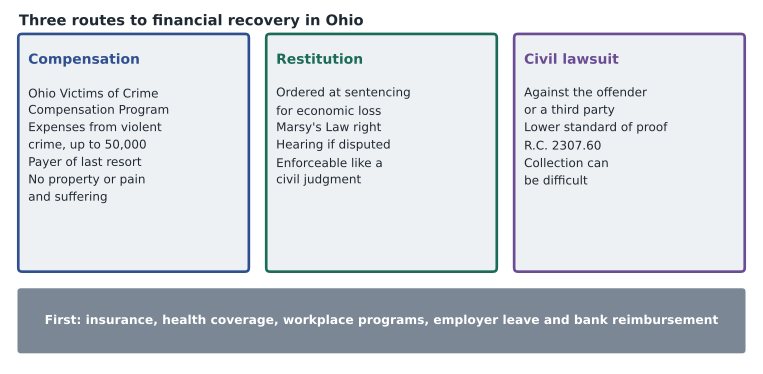
Every state has a victim compensation program, partly funded by federal VOCA grants. In Ohio, the program is run by the Attorney General's office. It pays for expenses resulting from violent crime, up to a total of 50,000 dollars for a claim, and some categories have lower limits of their own. It does not pay for pain and suffering, or for property that was stolen, damaged or lost. Applicants generally must file within three years of the crime, and minors have until their 24th birthday.
Covered expenses include medical and dental care, counseling for the victim and, in some cases, family members, lost wages, financial support for dependents of a victim who died, funeral and burial costs, the cost of securing a home after a crime, replacing evidence taken by police, and some travel costs. The program is the payer of last resort: it will not pay expenses that can be covered by health insurance, auto insurance, workers' compensation, restitution or any other source.
Eligibility rules matter, and officers often hold the key. The crime must have been reported to law enforcement, and the victim must cooperate with the investigation and prosecution. Claims can be reduced or denied for contributory misconduct, meaning conduct by the victim that contributed to the injury, and for some felony convictions. A police report number is usually the first thing the program asks for. Brooks has seen applications delayed for weeks because the victim did not have a file number, which is one more reason for the written information described in Lesson 6.
The program below shows how Brooks worked out what Daniel could expect from the program. It applies the rule that other sources come first, and the program's limits.
# Daniel's claim to the Ohio Victims of Crime Compensation Program (amounts in dollars)
CAP = 50000
claims = [
    ("medical and dental", 31800, 26400),   # (expense, cost, amount paid by insurance or other sources)
    ("counseling", 1450, 0),
    ("lost wages", 4200, 0),
    ("replacement phone", 380, 0),          # stolen property is not covered
]
covered = {"medical and dental", "counseling", "lost wages"}
eligible = 0
for item, cost, other in claims:
    amount = cost - other if item in covered else 0   # payer of last resort: other sources first
    eligible += amount
    print(f"{item:20} cost {cost:6}  other {other:6}  eligible {amount:6}")
award = min(eligible, CAP)
print("award:", award)
print("left for Daniel:", sum(c for _, c, _ in claims) - sum(o for _, _, o in claims) - award)medical and dental cost 31800 other 26400 eligible 5400 counseling cost 1450 other 0 eligible 1450 lost wages cost 4200 other 0 eligible 4200 replacement phone cost 380 other 0 eligible 0 award: 11050 left for Daniel: 380
The program would cover his medical and dental balance, counseling and lost wages, but not the phone, which counted as stolen property. Brooks pointed out that the phone could be included in a restitution request if Vance was convicted. Desjardins notes that none of this money comes quickly. Ohio claims commonly take months to process. A victim who needs a locksmith tonight needs a different answer, which is why many victim services agencies keep small emergency funds.
Where the money comes from
Desjardins asks the class who pays for compensation and victim services. The answer, in both countries, is partly offenders. Ohio's compensation program is paid for largely by additional court costs charged to people convicted of offenses in Ohio, together with federal VOCA compensation grants, which reimburse a share of what the state pays out each year. Federal VOCA money itself comes from fines and penalties paid by federal offenders, as Lesson 8 described, so a large part of the help Ohio victims receive is ultimately paid for by people convicted of crimes. Brooks notes that this creates a tension. When fewer people are convicted or when courts reduce fines for people who cannot pay, the money available for victims can fall, even though the number of victims has not.
Helping with the paperwork
For many victims, the obstacle to financial recovery is not eligibility but the paperwork. Compensation forms ask for receipts, medical records, employer letters and police information. Insurers ask for police reports and lists of stolen property with serial numbers. Banks ask for affidavits. A victim in the recoil phase described in Lesson 4, struggling to concentrate and sleep, may simply not manage it. Brooks's agency spends a large share of its time helping people gather documents and fill in forms, and she asks officers to help in three small ways: give victims the file number and the name of the officer in charge in writing, tell them early to keep every receipt and to photograph damage, and respond promptly when an insurer or compensation program asks to confirm a report. A two-minute phone call from an officer can release a payment that a victim has been waiting on for weeks.
Restitution from the offender
Restitution is an order made at sentencing requiring the offender to pay the victim for losses caused by the offense. It has an obvious moral appeal: the person who caused the harm pays for it. Ohio courts can order restitution as part of a felony sentence under Revised Code 2929.18 and a misdemeanor sentence under 2929.28, based on the victim's economic loss: property loss, medical costs, lost wages and similar losses caused directly and proximately by the offense. Marsy's Law makes full and timely restitution a constitutional right, and if the amount is disputed the court must hold a hearing. An unpaid restitution order can be enforced in the same way as a civil judgment.
The weakness of restitution is collection. Many offenders have little money, and some are in custody with no income at all. Orders can be paid in installments over months or years, and many are never paid in full. Brooks tells victims to hope for restitution but not to plan their finances around it. Kyle Brandt, a laborer, was ordered to pay Ruth Lindqvist her 1,000-dollar deductible and her lost sales, in monthly installments over a year, as a condition of community control. Ruth told Brooks that she did not care much about the money, but that she wanted him to understand that her losses were real.
Grace Whitford's case shows the harder side. The callers who defrauded her were part of an organized group operating from several countries. A courier who collected cash from another victim was arrested in Port Ardent, but the people who received Grace's money by wire transfer were never identified. Without a conviction connected to her loss, there could be no restitution. The compensation program does not cover money lost to fraud. Her bank reviewed the transfer and refunded part of it, because its own staff had missed warning signs, but most of the money was gone. Priya Sandhu tells the class that this is common in her old field, and that the best financial protection for fraud victims is prevention: the bank alerts and trusted contacts that stopped the second fraud.
Civil remedies
A victim can also sue the offender in civil court for damages, including losses that criminal courts do not compensate, such as pain and suffering. The standard of proof is lower than in a criminal case, a balance of probabilities rather than proof beyond a reasonable doubt, and a conviction can be used as evidence. Ohio's Revised Code 2307.60 allows anyone injured by a criminal act to sue for damages, and the Ohio Supreme Court has held that a criminal conviction is not required to bring such a claim. Claims for smaller amounts can be brought in small claims court without a lawyer.
Civil suits face the same collection problem as restitution, and they cost time and money. They are most useful when the offender or a third party has assets or insurance. Third-party claims, against an institution that failed to prevent abuse, a landlord who ignored repeated warnings about security, or a business whose negligence enabled a crime, are sometimes the only route to significant compensation, and are common in cases of institutional abuse. Brooks refers victims who want to explore civil options to legal clinics and to lawyers who specialize in this work, and reminds them that limitation periods apply and are often short, though for sexual assault and some other claims many jurisdictions have extended or removed them.
Other sources
In practice, most victims' financial recovery comes from ordinary sources. Home, business, tenant and auto insurance cover much property loss. Health insurance and health insurance plans and Medicaid cover much medical care. Workplace compensation programs cover employees injured at work, including staff injured in robberies. Employers may offer paid leave and employee assistance programs. Banks may reimburse some fraud losses, especially where an account was accessed without authorization. Brooks's practical advice to officers is to tell victims about these sources early: to call their insurer, to keep receipts, to photograph damage before repairs, and to ask the police for the documents insurers and compensation programs will need.
Worked problem
Building Ruth's restitution request
Margaret Liu asks Ruth Lindqvist to document her losses before Kyle Brandt's sentencing. What should the request include, and what should be left for other routes?
Show solution
- List losses that are readily calculated: the 1,000-dollar insurance deductible, with the insurer's letter, and two days of lost sales, with her records for the same days in the previous weeks.
- Exclude what insurance already paid: the insurer paid for the stolen tools and door, so claiming them again would be double recovery; the insurer may pursue its own claim.
- Leave out losses that are hard to measure, such as stress and lost sleep, which belong in her victim impact statement or a civil claim, not a restitution order.
- Provide the documents to the prosecutor in time for sentencing, so the court can consider them.
- Explain collection: the order may be paid in installments, and if it is not paid, it can be enforced in civil court.
Answer: Ruth's request covers the deductible and lost sales with supporting documents, excludes insured losses and non-financial harms, and comes with a realistic explanation of collection.
Common mistakes
MistakeIf a crime caused a loss, the government will pay it back.
InsteadCompensation programs cover only certain expenses from violent crime, with limits and conditions.
MistakeCompensation pays for stolen property and money lost to fraud.
InsteadCompensation programs generally do not cover property or fraud losses; insurance, restitution and civil claims may.
MistakeA restitution order means the victim will be paid.
InsteadMany orders are paid slowly or not at all, though unpaid orders can be enforced as civil judgments.
MistakeA victim can only sue if the offender was convicted.
InsteadCivil claims use a lower standard of proof and do not always require a conviction.
Summary and key terms
- Financial harm is common after crime and can compound the other harms.
- The Ohio Victims of Crime Compensation Program pays expenses from violent crime up to 50,000 dollars, as payer of last resort.
- Compensation generally excludes property, fraud losses and, in most programs, pain and suffering.
- Restitution covers the victim's economic loss, is a Marsy's Law right and can be enforced as a civil judgment.
- Civil suits can recover broader damages but face collection problems and limitation periods.
- Insurance, health coverage, workplace programs and banks are often the first sources of recovery.
- Compensation program
- A government program that pays certain expenses of victims of violent crime.
- Payer of last resort
- A program that pays only what no other source covers.
- Restitution order
- A sentencing order requiring the offender to repay the victim's losses.
- Readily ascertainable
- Able to be calculated easily, without a complex hearing.
- Civil remedy
- A lawsuit seeking damages from the offender or a responsible third party.
- Limitation period
- The time limit for starting a civil lawsuit.
Practice problems
Work each problem on paper first, then reveal the answer to check.
Why does a compensation program need the police file number?
Show answer
Because programs usually require that the crime was reported and ask for proof of the report.
What is the main weakness of restitution orders?
Show answer
Collection: many offenders cannot or do not pay.
In the code example, what award would the program make?
Show answer
11,050 dollars for medical and dental, counseling and lost wages.
Why should Ruth not include the stolen tools in her restitution request?
Show answer
Because her insurer already paid for them, so claiming them would be double recovery.
Lesson quiz · 5 questions
Score 60% or more to complete this lesson.
Create a free account to save your progress, take quizzes and earn a certificate.