
LES-115 · Lesson 2 of 12 · 20 min
Who becomes a victim: risk, vulnerability and repeat victimization
▶ Video coming soon A video version of this lesson is on the way.
Nadia Brooks opens the second lesson with a question that makes the class uncomfortable: 'If I gave you a list of every person in Port Ardent, could you predict who will be victimized this year?' Marco DiSanto says no, crime is random. Linh Tran says partly, because she works with the service's crime data and knows that the same streets appear again and again. Brooks says Linh is closer to the truth. Crime is not evenly spread. It concentrates among certain people, places and times, and the patterns are strong enough that a police service can use them to prevent harm. The trick, she says, is to use the patterns without turning them into blame.
Lifestyle and exposure
In 1978 Michael Hindelang, Michael Gottfredson and James Garofalo proposed the lifestyle exposure theory of victimization. They noticed that victimization risk varied with age, sex, marital status, income and other characteristics, and argued that these characteristics mattered mainly because they shaped how people spent their time. A young person who works late, goes out at night, uses public transit and spends time with other young people in public places is exposed to more potential offenders than an older person who works days and spends evenings at home. Exposure, not character, explained most of the difference.
The survey data the class will study in Lesson 3 still show this pattern. The National Crime Victimization Survey has found for decades that people aged 12 to 24 have the highest rates of violent victimization and people 65 and older the lowest. Brooks notes that age is not a cause in itself. Young people are more often out late, more often in crowded places where alcohol is served, and more often in contact with other young people, who commit a disproportionate share of street crime.
Routine activities
The class already met routine activities theory in LES-102. Lawrence Cohen and Marcus Felson argued in 1979 that a direct-contact crime needs three things to come together in time and space: a motivated offender, a suitable target and the absence of a capable guardian. A guardian need not be a police officer. It can be a neighbor, a shop employee, a parent, a locked door or a camera. Cohen and Felson argued that the rise in crime in the United States after the Second World War was driven in part by changes in everyday life: more homes left empty during the day as more people worked outside the home, and more portable valuables such as televisions and car radios.
Brooks shows how the theory helps explain the three victims the class is following. Lakeshore Hardware was a suitable target: it held portable, valuable, easily resold tools, and at two in the morning it was empty and guarded only by an alarm. Daniel Ferreira was walking alone at 01:10 through a quiet stretch of Front Street, carrying a new phone, after the bars had closed. Grace Whitford lived alone, had a landline listed in a directory, and had savings she could reach quickly. None of them did anything wrong. Each was in a situation that offenders had learned to look for.
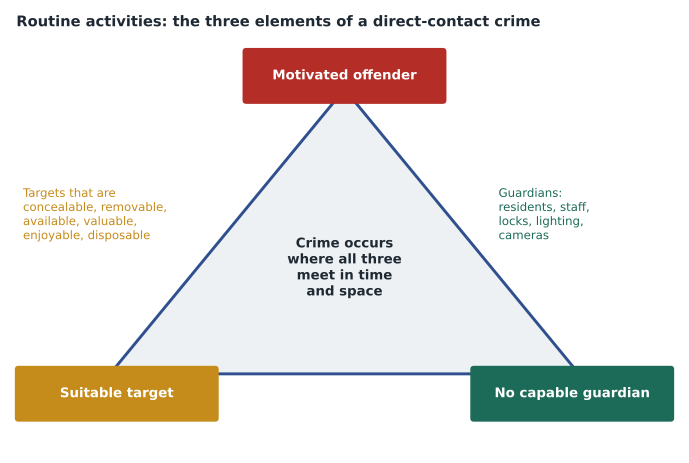
Target attractiveness: CRAVED
Felson and Ronald Clarke later described what makes a property target attractive with the acronym CRAVED: concealable, removable, available, valuable, enjoyable and disposable. Cordless drills meet every condition: they fit in a backpack, can be carried away quickly, are on open shelves, cost hundreds of dollars, are useful and can be sold easily online or at a pawnshop. Phones meet the same tests, which is why phone robberies like the one Daniel suffered rose sharply as smartphones spread, and fell in some cities after manufacturers introduced remote locking that made stolen phones harder to sell.
Vulnerability
Exposure is not the whole story. Some people face higher risk because they are less able to protect themselves or less likely to be believed. Children depend on adults for protection and may not have the words to describe abuse. Older adults can be isolated, may have health or memory problems, and may control savings that offenders want. People with disabilities can depend on caregivers who abuse that position. People who are homeless have no locked door and are exposed to the street all night. People with addictions, people in the sex trade and people without legal immigration status may avoid the police because they fear arrest or deportation, and offenders know it.
The NCVS has consistently found that people with disabilities experience violent victimization at more than twice the rate of people without disabilities, after adjusting for age. American Indian and Alaska Native people experience some of the highest rates of violence of any group, and studies funded by the National Institute of Justice have found that most American Indian and Alaska Native women have experienced violence in their lifetimes. Lesbian, gay and bisexual people, and especially bisexual women, report higher rates than heterosexual people. Brooks stresses that these figures describe risks created by circumstances, histories and the choices of offenders, not flaws in the people who are harmed.
Jesse Morningstar adds a point from his own community: a group can be at higher risk of victimization and, at the same time, less likely to be protected when it happens, because of a history of being ignored or mistreated by the system. Brooks agrees and calls this the double burden. It is one reason victim services work hard to build relationships with communities that have little reason to trust police, a theme the class will return to in Lesson 10.
Fear of crime and actual risk
Brooks ends the section on risk with a puzzle that surprises most students. The groups who are most afraid of crime are often not the groups most likely to be victimized. Surveys in many countries have found that older people and women report more fear of walking alone at night than young men, even though young men are victimized in public places far more often. Researchers have offered several explanations. Older people and women may feel less able to defend themselves and may expect worse consequences from an attack. Women's fear may also reflect the risk of sexual violence, much of which is never reported and so never appears in the statistics. And people who have been victimized once, or know someone who has, may reasonably see the world as more dangerous.
For police the lesson is practical. Fear has real costs even when the risk is low: people who are afraid stay home, avoid parks and transit, and lose trust in their neighborhood. After Daniel's assault, several restaurant workers on Front Street told their managers they no longer wanted to walk home after closing. Responding to the fear, with visible patrols, better lighting and clear information about what happened, is part of responding to the crime.
Repeat victimization
The most useful single finding in victimology for a police officer, Brooks says, is that the best predictor of being victimized is having been victimized before. Graham Farrell and Ken Pease summarized the research in 1993 in a report titled Once Bitten, Twice Bitten. A small share of households, businesses and people account for a large share of all victimizations. A home that has been burgled is far more likely than its neighbors to be burgled again, and the risk is highest in the days and weeks right after the first crime, then fades over the following months.
There are two main explanations. The boost explanation says the first crime makes a repeat more likely: the burglar learned the layout, knows what was left behind, expects stolen goods to be replaced, or tells others about an easy target. The flag explanation says the target had features that made it attractive in the first place, such as poor locks or an isolated location, and those features remain. Both are usually at work. Near-repeat victimization adds another layer: homes on the same street as a burglary also face higher risk for a short time, because offenders return to areas they know.
Repeat victimization is not limited to property crime. Intimate partner violence is by its nature repeated. Fraud victims are often targeted again, sometimes by the same offenders posing as investigators who promise to recover the lost money for a fee. Grace Whitford received exactly such a call three weeks after the first fraud: a man claiming to be from a federal fraud recovery office said he could get her 18,400 dollars back for a processing fee of 1,500. Her bank teller, who had been alerted after the first loss, stopped the transfer.
Brooks points out that repeat victimization is good news for prevention. If risk is concentrated, then protecting the people and places already victimized prevents a large share of future crime, and they are easy to find because they have already reported. The Kirkholt project in Rochdale, England, in the late 1980s focused on homes that had already been burgled, with security upgrades and cocooning, in which neighbors were asked to watch the victimized home. Burglary in the area fell sharply over the following years. Similar approaches have been used for domestic violence, with fast follow-up visits after a first call, and for businesses that are repeatedly robbed.
Linh Tran ran a quick analysis of Port Ardent's break-and-enter reports for the previous year to see how concentrated they were. The program below shows her method.
# Port Ardent break and enters last year: how many addresses were hit more than once?
from collections import Counter
# number of break and enters recorded at each victimized address
hits = [1] * 412 + [2] * 51 + [3] * 14 + [4] * 5 + [6] * 2
per_address = Counter(hits)
addresses = len(hits)
incidents = sum(hits)
repeat_addresses = sum(1 for h in hits if h > 1)
repeat_incidents = sum(h for h in hits if h > 1)
print("victimized addresses:", addresses, "incidents:", incidents)
print("addresses hit more than once:", repeat_addresses, round(repeat_addresses / addresses, 3))
print("incidents at those addresses:", repeat_incidents, round(repeat_incidents / incidents, 3))
for k in sorted(per_address):
print(f"hit {k} times: {per_address[k]} addresses")victimized addresses: 484 incidents: 588 addresses hit more than once: 72 0.149 incidents at those addresses: 176 0.299 hit 1 times: 412 addresses hit 2 times: 51 addresses hit 3 times: 14 addresses hit 4 times: 5 addresses hit 6 times: 2 addresses
Only about one victimized address in seven was hit more than once, but those addresses accounted for more than a quarter of all incidents. Haddad used the analysis to set a rule for the patrol platoons: after any residential or commercial break-in, the responding officer gives crime prevention advice before leaving, the community response unit visits within a week, and nearby homes on the same block receive a short notice asking residents to watch for anything unusual. Brooks adds one condition. The advice must be framed as protecting the victim from a second crime, not as a list of what they did wrong the first time.
| Type of risk | What drives it | Example in Port Ardent | Prevention response |
|---|---|---|---|
| Exposure | Routine activities that bring people near offenders without guardians | Daniel walking alone at 01:10 after closing time | Safer routes, lighting, late transit, staff walk-home programs |
| Target attractiveness | CRAVED goods and easy access | Power tools on open shelves near a back door | Locked displays, stronger doors, marked property |
| Vulnerability | Isolation, dependence, fear of police, disability | Grace living alone with a listed number | Bank alerts, trusted contacts, outreach |
| Repeat | Boost and flag effects after a first crime | A second call to Grace from a fake recovery office | Fast follow-up, target hardening, warning the victim |
Worked problem
Advising a victim without blaming them
Two days after the break-in, Ruth Lindqvist asks Officer Malhotra whether it will happen again. He knows from the repeat victimization research that her risk is higher than usual for the next few weeks. How should he answer?
Show solution
- Be honest about the risk: explain that businesses that have been broken into face a higher chance of a second break-in for a short time, and that this is a known pattern, not a judgment about her.
- Explain why: offenders who succeed sometimes return, expecting stolen stock to be replaced, or tell others.
- Offer specific steps: the community response unit can do a free security review, and simple changes such as moving power tools away from the back door and adding a security bar can help.
- Make the blame explicit and place it correctly: the person who broke in is responsible, and the steps are about making the next attempt harder.
- Follow up: arrange a patrol check over the next two weeks and a call from the community response officer.
Answer: He answers honestly, explains the repeat pattern, offers practical protection and makes clear that responsibility lies with the offender.
Common mistakes
MistakeCrime is spread randomly across a city.
InsteadVictimization concentrates among certain people, places and times, and especially among those already victimized.
MistakeHigher rates for a group show something about the group's character.
InsteadRates reflect exposure, circumstances, history and offender choices, not flaws in the people harmed.
MistakeOnce a burglary is over, the victim is no more at risk than anyone else.
InsteadRisk of a repeat is highest in the days and weeks after the first crime.
MistakePrevention advice to a victim is a form of blame.
InsteadAdvice framed as protection against a repeat is one of the most useful things an officer can offer.
Summary and key terms
- Lifestyle exposure theory explains much of the variation in victimization by how people spend their time.
- Routine activities theory says a crime needs a motivated offender, a suitable target and no capable guardian.
- CRAVED describes what makes property attractive to offenders.
- Vulnerability from age, disability, isolation or fear of police raises risk and can reduce protection.
- Prior victimization is the best single predictor of future victimization, with risk highest soon after the first crime.
- Focusing prevention on repeat victims prevents a large share of crime.
- Lifestyle exposure theory
- The idea that differences in victimization reflect differences in daily activities that bring people into contact with offenders.
- Capable guardian
- A person or thing whose presence discourages a crime.
- CRAVED
- Concealable, removable, available, valuable, enjoyable and disposable; features of attractive targets.
- Repeat victimization
- The same person, household or place being victimized more than once.
- Near-repeat
- Higher risk for places close to a recent crime for a short time.
- Cocooning
- Asking neighbors to watch a home or business that has just been victimized.
Practice problems
Work each problem on paper first, then reveal the answer to check.
What three elements does routine activities theory say a direct-contact crime needs?
Show answer
A motivated offender, a suitable target and the absence of a capable guardian.
What is the difference between the boost and flag explanations of repeat victimization?
Show answer
Boost says the first crime makes a repeat more likely; flag says the target's lasting features attract offenders.
In the code example, what share of incidents occurred at addresses hit more than once?
Show answer
176 of 588, about 0.30.
Why is repeat victimization good news for prevention?
Show answer
Because risk is concentrated among people and places that have already reported, so they are easy to find and protect.
Lesson quiz · 5 questions
Score 60% or more to complete this lesson.
Create a free account to save your progress, take quizzes and earn a certificate.