
LES-115 · Lesson 8 of 12 · 20 min
Victim services: police-based, community and court-based programs
▶ Video coming soon A video version of this lesson is on the way.
Nadia Brooks brings her own office to class, or at least a photograph of it: a converted house two blocks from the police station, with a kitchen, three small interview rooms with soft chairs, a play corner, and a whiteboard covered in the week's on-call schedule. The victim advocate unit has six staff and about forty trained volunteers. Last year they supported more than 2,300 people. 'Most of what we do is not dramatic,' she says. 'We sit with people. We explain things. We help them fill in forms, find a locksmith, get to the hospital, call their employer, understand a court date. And we make sure they are not alone with it.' This lesson is about the different kinds of victim services, what each can offer, and how police officers connect victims with them.
Kinds of victim services
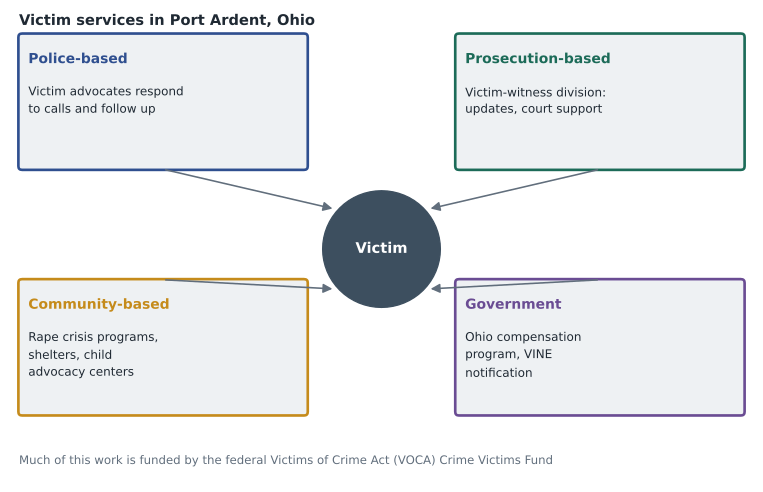
Victim services in both countries come in several models, and most communities have more than one. Brooks sorts them into four groups. Police-based services are located in or attached to a police service and are usually the first to reach a victim after a call. Court-based or prosecution-based services help victims once charges are laid, keeping them informed and preparing them for court. Community-based services are independent agencies, often non-profit, that focus on particular kinds of victimization, such as sexual assault centers, shelters for people leaving abusive partners, and child advocacy centers. System-wide services include compensation programs, notification systems and help lines run by governments.
In Ohio, many police departments, like Port Ardent's, employ victim advocates who respond to calls and follow up with victims, and every county prosecutor's office has a victim-witness division. Community agencies include rape crisis programs, domestic violence shelters and child advocacy centers. Much of this work is funded through the federal Victims of Crime Act. The Crime Victims Fund created by the Act is financed by criminal fines, penalties, forfeitures and special assessments paid by federal offenders, not by taxpayers, and since the VOCA Fix Act of 2021, by money from deferred and non-prosecution agreements. The federal Office for Victims of Crime distributes most of the money to the states as victim assistance and compensation grants, and in Ohio the Attorney General's office passes the assistance grants on to hundreds of local programs.
What victim services do
Brooks describes the work in five parts. Crisis response: being with a victim in the first hours, at the scene, at the hospital or at home, providing emotional support, practical help and information. Practical assistance: arranging emergency shelter, repairs, transportation, child care, replacement documents and contact with employers, banks and insurers. Information and advocacy: explaining the justice process, rights and options, and speaking up for the victim with agencies that are not listening. Court support: preparation, accompaniment and updates, as Lesson 7 described. Referral: connecting victims with counseling, health care, legal help, housing and specialized services that victim services do not provide themselves.
What victim services do not do is just as important. Advocates do not investigate, take statements about the offense, or decide whether a crime occurred. Most do not provide long-term therapy, though they can refer to counselors. They do not tell victims what to do; they help victims understand their options and make their own decisions. Brooks says the hardest part of training volunteers is teaching them not to fix things for people, but to help people fix things for themselves.
Confidentiality and disclosure
Students are often surprised to learn that whether a victim's conversations with an advocate are confidential depends on who the advocate works for. Advocates employed by a police department or prosecutor's office work for the government, and information they learn that is favorable to the defense may have to be disclosed under Brady v. Maryland and its progeny. Advocates at many community agencies have stronger confidentiality protections, and federal grant rules under the Violence Against Women Act restrict funded programs from sharing victims' personal information without consent. Brooks tells victims about these differences at the start, so they can decide what to share and with whom. Officers should know them too, so they do not promise confidentiality that does not exist.
Making a good referral
The officer's most important role in victim services is the referral. Brooks distinguishes two kinds. A passive referral gives the victim a card or a phone number and leaves it to them to call. A proactive referral, with the victim's consent, sends the victim's name and contact information directly to the agency, which then reaches out. Research and the service's own data show that proactive referrals lead to far more victims receiving help, because victims in crisis rarely make the call themselves, especially in the first days, and many do not know what victim services could offer.
Port Ardent changed its policy two years ago, after an analysis like the one below. Before the change, officers usually gave victims a card. After it, officers were required to ask every victim of a violent crime, and victims of property crime and fraud who seemed distressed or vulnerable, whether they would like a call from victim services, and to send the referral electronically before the end of their shift.
# Share of referred victims who received help, before and after the proactive referral policy
before = {"cards given": 1180, "victims who called the agency": 213}
after = {"proactive referrals sent": 1240, "victims reached by the agency": 1032, "accepted support": 811}
passive_rate = before["victims who called the agency"] / before["cards given"]
reached = after["victims reached by the agency"] / after["proactive referrals sent"]
accepted = after["accepted support"] / after["proactive referrals sent"]
print("passive referral, victims who made contact:", round(passive_rate, 2))
print("proactive referral, victims reached:", round(reached, 2))
print("proactive referral, victims who accepted support:", round(accepted, 2))
print("victims helped per 100 referrals, before and after:", round(passive_rate * 100), round(accepted * 100))passive referral, victims who made contact: 0.18 proactive referral, victims reached: 0.83 proactive referral, victims who accepted support: 0.65 victims helped per 100 referrals, before and after: 18 65
Under the old system, fewer than one victim in five who received a card ever made contact. Under the new one, about two in three accepted support. Brooks notes that the remaining third were not failures: many simply did not need help, and the agency's call reassured them that it was available if they changed their minds. Several called back weeks later, when a court date or an anniversary brought the event back.
Brooks gives the class a script for asking. Officers who ask, 'You don't want victim services, do you?' get a no. Officers who ask, 'Would it be all right if someone from victim services called you tomorrow? They can help with things like repairs, forms and court, and you can tell them if you don't need anything,' get a yes far more often. The second question explains what is on offer, makes saying yes easy and reassures the victim that saying yes commits them to nothing.
A warm handoff goes one step further. Instead of sending a referral, the officer calls the agency while the victim is present and introduces them, or arranges for an advocate to come to the scene. Warm handoffs are especially valuable for victims who are frightened, isolated, unfamiliar with services or wary of agencies. Malhotra called the on-call worker from the hospital for Daniel the day after the assault, once he realized his mistake, and the worker met Daniel in his room that afternoon with a Portuguese-speaking volunteer.
Specialized services
Some victims need services designed for their particular situation. Sexual assault centers provide crisis lines, accompaniment to hospital and police, counseling and advocacy, and hospital-based sexual assault nurse examiner programs provide medical care and forensic examinations. Shelters and transition houses provide safe housing and safety planning for people leaving abusive partners. Child advocacy centers bring police, child protection workers, medical staff and advocates together in a child-friendly building so that a child is interviewed once, by a trained interviewer, rather than many times in many places. Homicide survivor groups support families over the long term. Organizations serving particular communities, such as tribal victim services, immigrant service agencies and LGBTQ community centers, can reach victims who would never approach a mainstream agency. Lesson 10 returns to these.
Brooks keeps a referral directory on her phone and encourages every officer to do the same, or to know where the service's directory is. An officer who can say, 'There is a group that helps people in exactly your situation, here is their number, and would you like me to call them now?' is giving a victim something far more useful than a pamphlet.
What the evidence says
Desjardins asks whether victim services actually help. Brooks answers honestly that the evidence is good in some areas and thin in others. Studies consistently find that victims value being informed, supported and listened to, and that victims who receive support report higher satisfaction with the justice system. Some of the strongest evidence comes from research on advocacy for women leaving abusive partners. In a well-known series of studies in Michigan, Cris Sullivan and colleagues randomly assigned women leaving shelters either to receive several months of individual community advocacy, helping them get housing, legal help, education and other resources, or not. Women who received advocacy reported less abuse and better quality of life over the following two years. Research on child advocacy centers has found that children and families are more satisfied with the process and that coordinated investigations reduce the number of interviews children face.
In other areas, especially crisis services for victims of property crime and street violence, there is less rigorous research, and most evaluations measure satisfaction rather than recovery. The largest problem the research identifies is not that services fail but that they never reach most victims. The 2023 NCVS found that only about 8 in every 100 victims of violent crime received help from a victim service provider other than the police. Many victims who would benefit never hear about services, or hear about them in a way that makes them seem like they are for someone else. That, Brooks says, is the part of the problem officers can fix.
Victim services and police: a partnership
The relationship between police and victim services is not always smooth. Advocates sometimes see officers as dismissive of victims; officers sometimes see advocates as interfering in investigations. Brooks has seen both, and believes the answer is shared training, clear roles and regular contact. Port Ardent holds joint training twice a year, advocates ride along with patrol, and the victim services coordinator sits on the service's case review committee for sexual assault files. Desjardins adds that when he ran a night shift, the officers who worked best with victim services were the ones who had seen what they could do: a frightened victim who calmed down when the volunteer arrived, a statement that came easily because the victim felt supported, a family that stayed engaged through a long trial because someone kept them informed.
Worked problem
Choosing the right referral for Grace
Detective Park has finished her interview with Grace Whitford. Grace has lost 18,400 dollars, feels ashamed, lives alone, and was targeted again by a fake recovery call. She says she does not want to bother anyone. Which services should Park consider, and how should she make the referral?
Show solution
- Victim services: a proactive referral for emotional support, help understanding the process and practical help, made with Grace's consent before Park leaves.
- Fraud reporting: help Grace report to the FBI's Internet Crime Complaint Center and the Federal Trade Commission, which collect reports nationally and can link her case with others.
- Her bank: confirm that the bank's fraud team is involved, that her accounts are protected, and whether any money can be recovered.
- Older adult services: with her consent, a referral to a local seniors' program or elder abuse network that offers support for older fraud victims and help protecting against future scams.
- Ask how to refer, not just whether: 'Would it be all right if someone from victim services called you tomorrow? Would you like your daughter to be there when they call?'
Answer: Park makes a proactive referral to victim services, helps with national fraud reporting and the bank, offers a seniors' program, and asks in a way that makes accepting help easy.
Common mistakes
MistakeVictim services and police do the same job.
InsteadAdvocates support, inform and refer; they do not investigate or take statements about the offense.
MistakeEverything a victim tells an advocate is confidential.
InsteadConfidentiality depends on who employs the advocate; government-employed advocates' notes may be disclosable.
MistakeGiving a victim a card is enough.
InsteadProactive referrals and warm handoffs reach far more victims than passive referrals.
MistakeA victim who refuses help the first day never wants it.
InsteadMany victims accept help later; leaving the door open matters.
Summary and key terms
- Victim services include police-based, court-based, community-based and government programs.
- Their work covers crisis response, practical help, information and advocacy, court support and referral.
- Advocates support and inform; they do not investigate, decide what happened or tell victims what to do.
- Confidentiality depends on who employs the advocate, and officers should not promise more than exists.
- Proactive referrals and warm handoffs connect far more victims with help than giving out cards.
- Specialized services serve particular kinds of victimization and particular communities.
- Victim advocate
- A worker who provides crisis response, practical help, information and referrals to victims.
- Proactive referral
- Sending a victim's contact details to an agency, with consent, so the agency reaches out.
- Passive referral
- Giving a victim information and leaving it to them to make contact.
- Warm handoff
- Introducing a victim directly to a service, in person or by phone.
- Child advocacy center
- A child-friendly center where police, child protection and health workers coordinate one interview and support.
- Crime Victims Fund
- The federal fund created by VOCA, financed by fines and penalties paid by federal offenders.
Practice problems
Work each problem on paper first, then reveal the answer to check.
Name the four groups of victim services Brooks describes.
Show answer
Police-based, court-based or prosecution-based, community-based and government programs.
What is the difference between a proactive and a passive referral?
Show answer
A proactive referral sends the victim's details to the agency with consent; a passive referral leaves the victim to call.
In the code example, how many victims accepted support per 100 proactive referrals?
Show answer
About 65.
Why should officers not promise a victim that what they tell an advocate is confidential?
Show answer
Because advocates employed by the government may have to disclose some information.
Lesson quiz · 5 questions
Score 60% or more to complete this lesson.
Create a free account to save your progress, take quizzes and earn a certificate.