
PHOT-210 · Lesson 11 of 12 · 25 min
Safety, power and the studio as a workplace
A studio is full of hazards that are easy to overlook while concentrating on light and subject: tall stands holding heavy heads, booms reaching over people's heads, cables across the floor, high-voltage capacitors, hot modeling lamps and continuous lights, and a darkened room where people move quickly. Most studio accidents are preventable with good habits. This lesson covers stands, booms and sandbags, cables and trip hazards, electrical safety and circuit capacity, flash capacitors and maintenance, heat and fire, batteries, the safety of subjects including children and people with photosensitivity, and the studio as a workplace with responsibilities to assistants, clients and the public.
Stands, booms and sandbags
Light stands are the most common source of studio accidents. A head and modifier at the top of a tall stand create a high center of gravity, and a large softbox acts like a sail if bumped. Good practice includes:
- Using stands rated for the weight of the head and modifier, with legs fully extended for the widest, most stable base.
- Placing a sandbag on every stand that holds a light, especially tall or top-heavy ones, on the leg pointing in the direction of the light's weight or lean.
- Extending the thicker, lower sections of a stand first and the thinner upper sections last.
- Positioning one leg of the stand under the direction the light leans, for example under a boom or a heavy modifier.
- Tightening all knobs, mounts and clamps, and checking that modifiers are securely attached.
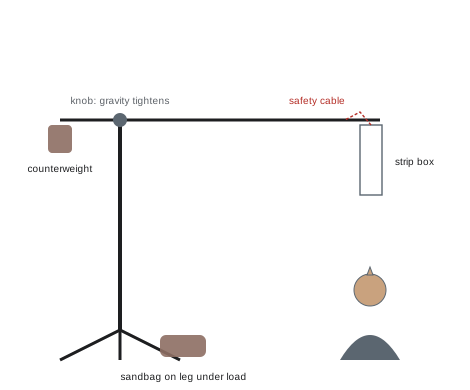
- Never placing lights or booms directly over a subject's head without a counterweight and a safety cable, and using C-stands with sandbags for booms.
- Lowering stands and removing heavy modifiers when moving them, and carrying stands with lights removed.
Rolling stands and wall- or ceiling-mounted rails reduce floor clutter in permanent studios, but still need regular inspection.
Cables and trip hazards
Power and sync cables crossing the floor are trip hazards, especially in a darkened studio with people moving around. Route cables along walls and behind sets rather than across walkways; tape them down with gaffer tape or cover them with cable protectors where they must cross; leave slack at the light so that a tug does not pull the stand over; and avoid creating tight loops that can catch feet. Battery-powered lights and radio triggers eliminate many cables. Keep the floor clear of bags, cases and modifiers, and maintain enough light to move safely between shots, using modeling lights or work lights.
Electrical safety and circuit capacity
Studio flashes, continuous lights, computers and chargers draw significant current. In Canada and the United States, household and many commercial circuits supply about 120 V and are typically protected by 15 or 20 amp breakers, so a single circuit can supply about 1,800 or 2,400 watts in total, and continuous loads should be kept to about 80 % of the rating. Continuous lights draw their rated power the whole time; strobes draw large surges while recycling, especially at full power, and several strobes recycling at once can trip breakers. Spread lights across different circuits where possible, find out which outlets share circuits, and avoid daisy-chaining power bars. Use heavy-duty extension cords rated for the load, fully uncoiled to prevent overheating, and inspect cords and plugs for damage.
Worked problem
Will the circuit cope?
A studio runs on a single 15 A, 120 V circuit. The photographer plans to use two 300 W LED continuous lights, a laptop (90 W), a monitor (60 W), and three strobes whose modeling lights draw 100 W each. Is the continuous load within the recommended 80 % limit, and what about strobe recycling?
Show solution
- Circuit capacity: 15 A × 120 V = 1,800 W; 80 % for continuous loads = 1,440 W.
- Continuous load: 600 + 90 + 60 + 300 = 1,050 W, within 1,440 W.
- Strobe recycling surges add short peaks that can be large; three strobes recycling at full power at once may trip the breaker.
- Turn modeling lights down or off when not needed, recycle at lower power, or move some lights to another circuit.
Answer: The continuous load of about 1,050 W is within the 1,440 W guideline, but strobe recycling surges could still trip the breaker, so reduce modeling lights or split circuits.
Certification marks
Electrical equipment used in a studio should carry recognized safety certification, especially inexpensive lights, chargers and batteries bought online, some of which are not certified and may present fire or shock hazards.
In the United States, workplace equipment should be listed by a Nationally Recognized Testing Laboratory (NRTL) recognized by OSHA, shown by marks such as UL, ETL or CSA with a US indicator. The National Electrical Code (NFPA 70), adopted by states and local jurisdictions, governs wiring and installations, and OSHA regulations apply to workplaces with employees.
Look for these marks on flashes, power packs, LED drivers, chargers and extension cords, and be cautious about uncertified products.
Flash capacitors and maintenance
Studio flashes store energy in high-voltage capacitors, often charged to several hundred volts, which can deliver a dangerous shock and can remain charged after the unit is switched off and unplugged. Never open a flash head or pack; repairs should be done by qualified technicians. Replace flash tubes and modeling lamps only according to the manufacturer's instructions, with the unit switched off, unplugged and allowed to discharge for the specified time. Inspect flash heads for cracked glass domes, loose parts and damaged cables. Keep liquids away from lights and power packs. Flash tubes and modeling lamps get hot; let them cool before handling.
Heat and fire
Continuous tungsten lights and older modeling lamps produce intense heat, enough to burn skin, melt modifiers and ignite paper, fabric and gels placed too close. LEDs run cooler but their heat sinks and fixtures still get hot. Use heat-resistant gels designed for lighting, keep modifiers rated for the light's heat output, leave clearance between lights and backgrounds, curtains and props, and never cover vents on lights or power supplies. Turn off modeling lights when not needed. Keep a fire extinguisher suitable for electrical fires in the studio, know where it is, and keep exits clear.
Batteries
Lithium-ion batteries power speedlights, battery strobes, LED panels, cameras and laptops. Damaged, overcharged or counterfeit batteries can overheat and catch fire. Use the manufacturer's chargers and genuine or reputable batteries; charge on non-flammable surfaces, not unattended overnight on soft furnishings; stop using batteries that are swollen, damaged or unusually hot; and dispose of them through battery recycling programs. Store spare batteries in protective cases so terminals cannot short-circuit. When traveling with lighting batteries, observe airline rules on watt-hour limits (PHOT-201).
Subject safety and wellbeing
Subjects are close to lights and equipment and may not know the risks. Keep stands and booms stable and away from where subjects move; warn subjects before firing flashes close to their eyes; and avoid repeated rapid flashes for people who are sensitive. Some people have photosensitive epilepsy, a condition in which flashing lights can trigger seizures; although single studio flashes rarely cause problems, ask about sensitivities, avoid rapid strobing, and stop if a subject feels unwell. Children need extra care: secure all stands, keep cables out of reach, keep hot lights away, and never leave children unattended near equipment. Keep the studio at a comfortable temperature, provide water and breaks, and respect privacy with a changing area for clothing changes.
The studio as a workplace
A professional studio is a workplace, and photographers who employ assistants or run businesses have responsibilities under occupational health and safety law: assessing hazards, providing safe equipment and training, reporting and recording incidents, and ensuring safe working hours. Insurance, including general liability insurance covering injuries to clients and visitors and equipment insurance, is essential for working photographers (PHOT-410). Clear communication helps: brief assistants on the setup, agree who moves lights and who fires the camera, call out before firing flashes or moving booms, and maintain a tidy, organized space. Good safety practice also builds client confidence.
| Hazard | Control |
|---|---|
| Falling stands and booms | Sandbags, correct extension, counterweights, safety cables |
| Trip hazards | Route and tape cables, battery lights, clear floors |
| Overloaded circuits | Calculate loads, split circuits, rated cords |
| Electric shock | Certified equipment, no opening flash units, inspection |
| Heat and fire | Clearances, heat-rated gels, extinguisher, LEDs |
| Battery fire | Genuine chargers, inspection, safe storage |
| Subject wellbeing | Ask about sensitivities, supervise children, comfort and privacy |
Rigging overhead lights
Overhead lights, such as hair lights, top lights for products and large overhead scrims, are among the most dangerous items in a studio, because a falling light or boom can strike someone below. Use booms rated for the load, with the stand's leg under the boom and a sandbag on that leg; balance the boom with a counterweight; position the knob so that gravity tightens it rather than loosens it, often described as "righty tighty" with the load on the right; and attach a safety cable from the light to the boom or stand. Ceiling rail systems in permanent studios carry lights on pantographs, which are safer than floor-standing booms but must be installed by qualified people and inspected regularly. Never stand directly under a light while adjusting it.
Working in rented and shared spaces
Rented studios, community spaces and client locations each have their own rules and hazards. Before shooting, ask about electrical capacity and which outlets share circuits, any restrictions on equipment, insurance requirements and emergency procedures. Inspect the space for hazards such as uneven floors, low ceilings, sprinkler heads near hot lights and smoke detectors that can be triggered by haze or heat. Leave the space as you found it, with backgrounds returned, floors clean and equipment removed. Many rental studios require proof of liability insurance before booking.
Haze, smoke and special effects
Some studio images use haze or smoke to make light beams visible or add atmosphere. Haze machines and smoke effects can trigger fire alarms, irritate eyes and lungs, and cause problems for people with asthma or respiratory conditions. Use water-based haze fluids designed for photography and film, ventilate the space, check that fire alarm systems will not be triggered or arrange with building management in advance, and inform subjects before using them. Other effects, such as water, fans, sparklers and fire, require careful risk assessment, appropriate permissions and safety equipment, and are often handled by specialists.
A pre-shoot safety checklist
A simple checklist before each session reduces risk: all stands sandbagged and knobs tight; booms counterweighted and secured with safety cables; cables routed and taped; circuit loads checked; lights and cords inspected; modeling lights turned down when not needed; hot lights away from flammable materials; fire extinguisher accessible; exits clear; subject briefed on the setup and asked about sensitivities; first aid kit available. Posting the checklist on the studio wall makes it a routine.
First aid and incidents
Keep a stocked first aid kit in the studio, including burn dressings for contact with hot lights, and know the location of the nearest medical facility. Record any incident, however minor, with the date, what happened and what was done, and review the cause so that it does not recur. If someone is injured on your premises or at your session, notify your insurer as required. Training in basic first aid is valuable for anyone who runs sessions with clients, children or assistants. Prompt, calm handling of minor incidents also reassures clients and preserves trust.
Safety is also a matter of culture: encourage everyone in the studio, from assistants to clients, to point out hazards they notice, and thank them for doing so. A studio where people feel comfortable raising concerns is a safer and more professional place to work.
Common mistakes
MistakeLeaving stands without sandbags.
InsteadSandbag every stand holding a light.
MistakeBooms over subjects without counterweight or safety cable.
InsteadCounterweight, sandbag and secure with a safety cable.
MistakeRunning everything from one circuit.
InsteadCalculate loads and spread lights across circuits.
MistakeOpening a flash head to fix it.
InsteadLeave repairs to qualified technicians.
MistakeCharging batteries unattended on soft surfaces.
InsteadCharge on non-flammable surfaces with genuine chargers.
Summary and key terms
- Sandbag stands, extend them correctly and secure booms with counterweights and safety cables.
- Route and tape cables to prevent trips.
- A 15 A, 120 V circuit supplies about 1,800 W; keep continuous loads under 80 %.
- Use certified equipment and never open flash units.
- Manage heat, fire risk and battery safety.
- Protect subjects, including children and people with photosensitivity.
- Treat the studio as a workplace with training, communication and insurance.
- Sandbag
- Weight that stabilizes a stand.
- C-stand
- Sturdy studio stand with arm.
- Boom
- Arm extending a light over a subject.
- Counterweight
- Weight balancing a boom.
- Safety cable
- Cable securing a light against falling.
- Circuit breaker
- Device protecting a circuit from overload.
- Capacitor
- Component storing flash energy at high voltage.
- Certification mark
- Mark showing tested electrical safety.
- Photosensitive epilepsy
- Seizures triggered by flashing lights.
- Gaffer tape
- Cloth tape for securing cables.
Practice problems
Work each problem on paper first, then reveal the answer to check.
Where should a sandbag go on a stand?
Show answer
On the leg under the direction of the load.
Which sections of a stand extend first?
Show answer
The thicker, lower sections.
What secures a boom over a subject?
Show answer
Counterweight, sandbag and safety cable.
Capacity of a 15 A, 120 V circuit?
Show answer
About 1,800 W.
Recommended continuous load on a 20 A, 120 V circuit?
Show answer
About 1,920 W (80 % of 2,400 W).
Why can strobes trip breakers?
Show answer
Recycling surges, especially several at once.
Why never open a flash head?
Show answer
High-voltage capacitors can remain charged.
Name two fire precautions.
Show answer
Heat-rated gels, clearances, extinguisher, vents clear.
What should you ask subjects about?
Show answer
Sensitivity to flashing lights.
Name two workplace responsibilities.
Show answer
Hazard assessment, training, incident records, insurance.
Lesson quiz · 5 questions
Score 60% or more to complete this lesson.
Create a free account to save your progress, take quizzes and earn a certificate.