
PHOT-210 · Lesson 5 of 12 · 25 min
Hard and soft light, size and distance
Two physical facts explain most of what happens in studio lighting. First, the apparent size of a light source, as seen from the subject, determines how hard or soft the light is. Second, light spreads out as it travels, so its intensity falls rapidly with distance, according to the inverse square law. Together, these determine the shape of shadows, the brightness of the subject relative to the background, the evenness of light across a group, and the look of skin and texture. This lesson explains apparent size, hard and soft light and their uses, feathering, the inverse square law and its practical consequences, controlling background brightness with distance, working with large and small sources, and specular highlights.
Apparent size
The hardness or softness of light depends not on the physical size of the light source alone but on its size relative to its distance from the subject, its apparent size or angular size as seen from the subject. The sun is enormous, but so far away that it appears tiny in the sky, about half a degree across, and therefore gives hard light with crisp shadows. A small speedlight 30 cm from a face appears relatively large and gives softer light than the same flash 3 m away. A 120 cm softbox at 1 m from the subject appears very large and gives very soft light; the same softbox at 5 m appears small and becomes noticeably harder. Clouds soften sunlight by turning the whole sky into a huge source; diffusion panels, softboxes and bounce surfaces do the same in the studio.
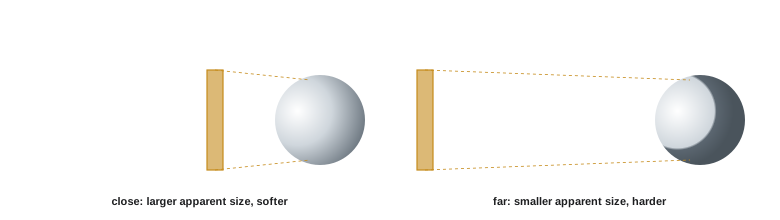
Hard light
Hard light, from small or distant sources such as bare flashes, reflectors with grids, Fresnel spotlights or direct sun, produces shadows with sharp edges, a narrow transition from light to shadow, bright specular highlights, and strong emphasis on texture. It suits dramatic, graphic and high-contrast portraits; film noir and classic Hollywood looks; fashion and editorial images with crisp shadows; and subjects where texture should be emphasized, such as weathered faces, fabrics, food crusts and architectural details. Hard light also reveals skin imperfections and requires precise placement, since small changes in position change shadows dramatically. Its shadows are a design element: their shape and position should be planned, for example the classic shadow of the nose in Rembrandt or butterfly lighting (Lesson 7).
Soft light
Soft light, from large sources close to the subject, such as big softboxes, umbrellas, octaboxes, scrims, bounce boards and windows, produces gradual transitions, soft shadow edges, broad, gentle highlights and smooth skin. It is forgiving: small changes in subject position change the look only slightly, and it flatters most faces by minimizing texture and blemishes. It suits beauty, commercial, family, corporate and product photography, and is the default for most studio portraits. Too much softness, especially with large fill, can look flat and dull; the shape of a face still needs shadow to look three-dimensional, so soft light is usually positioned to the side and combined with controlled fill rather than placed flat in front.
| Feature | Hard light | Soft light |
|---|---|---|
| Source | Small or distant | Large and close |
| Shadow edge | Sharp | Gradual |
| Texture | Emphasized | Minimized |
| Highlights | Small, bright | Broad, gentle |
| Placement | Critical | Forgiving |
| Typical uses | Drama, fashion, texture | Beauty, portraits, products |
Feathering
Light from a softbox or umbrella is not uniform across its beam: it is brightest along the central axis and softer and dimmer toward the edges. Feathering means turning the light so that the subject is lit by the edge of the beam rather than the center. This produces softer, more even light, can balance brightness across a subject, such as a group where people nearer the light would otherwise be brighter, and reduces spill onto the background. A common portrait technique aims the softbox slightly in front of the subject's face, so that the edge of the light falls on the face, giving a soft glow with gentle fall-off. Experiment by rotating the light while watching the modeling light and the subject's face.
The inverse square law
Light from a small source spreads over an area that grows with the square of the distance. At twice the distance, the same light covers four times the area, so its intensity on any surface is a quarter, two stops less. At three times the distance, it is a ninth. The relationship is:
In stops, moving a light from distance \(d_1\) to \(d_2\) changes exposure by:
Moving a light 1.4 times farther loses one stop; twice as far loses two stops. The law applies strictly to point sources; for large modifiers at close range, light falls off a little more slowly than predicted, but the law remains an excellent guide in practice.
Worked problem
Moving the key light
A softbox at 1 m from a subject gives f/11 at ISO 100. The photographer moves it to 2 m to cover more of the body. What will the meter read, and how can f/11 be restored?
Show solution
- Distance doubles, so intensity falls to a quarter: 2 stops less.
- f/11 minus 2 stops is f/5.6.
- To restore f/11, increase flash power by 2 stops (for example from 1/8 to 1/2), or raise ISO to 400.
- The light will also be slightly harder, because the softbox appears smaller from 2 m.
Answer: The meter reads about f/5.6; raise power by two stops to return to f/11, accepting slightly harder light.
Fall-off and subject-to-background distance
The inverse square law explains how lights affect backgrounds. Suppose a key light is 1 m from the subject and the background is 2 m behind the subject, 3 m from the light. The background receives a ninth of the light the subject receives, more than three stops less, so it appears much darker. If the light is moved to 3 m from the subject, with the background at 5 m from the light, the background receives (3 ÷ 5)² = 0.36 of the subject's light, about 1.5 stops less, so it appears brighter relative to the subject. This gives photographers a powerful control: a close light produces dark backgrounds and dramatic fall-off; a distant light produces more even illumination of subject and background. Moving the subject farther from the background also darkens the background.
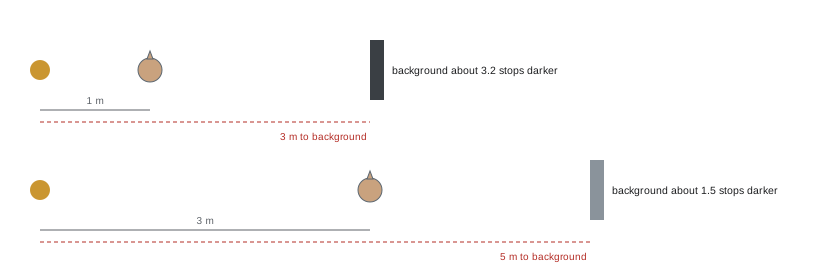
Evenness across a group or full-length subject
The same law determines how evenly light covers a group or a standing figure. A light close to a group lights the nearest person much more brightly than the farthest: at 1 m and 2 m, there is a two-stop difference. Moving the light farther away, for example to 4 m and 5 m, reduces the difference to about two-thirds of a stop. For groups and full-length portraits, place lights farther away, raise their power, and use large modifiers or feathering to keep illumination even, accepting slightly harder light. For a standing figure lit from the side, raise the light and angle it so that its distance to the face and feet is similar, or feather it so the brighter center of the beam falls lower on the body.
Large sources at close range
The softest portrait light comes from a large source very close to the subject, just outside the frame. Close sources also give the fastest fall-off across the face and background, which can create dramatic, sculpted portraits with dark backgrounds even when the light is soft, a look associated with classical painting. As the source moves closer, it also becomes brighter, so power must be reduced, which may require ND gels or lower-power lights to achieve wide apertures. Very close sources can create a noticeable brightness difference between the near and far side of a face; feathering and careful angling balance it.
Specular highlights and modifiers
Shiny surfaces reflect a mirror image of the light source. The size, shape and brightness of these specular highlights depend on the modifier: a small, bright source makes a small, intense highlight; a large softbox makes a large, softer one. On skin, small, intense highlights can look oily, while large sources produce a gentle sheen that flatters many skin types, particularly darker skin, where controlled highlights reveal form and texture beautifully. On products such as bottles, watches and cars, the shape of the source becomes part of the design, which is why strip boxes and large panels are used to create clean, elongated reflections (PHOT-211).
The relationship between softness and wraparound
Large sources do more than soften shadow edges. Because light from a large source arrives from many directions, it wraps around curved surfaces such as faces, cheeks and noses, lighting areas that a small source would leave in shadow. This wraparound reduces contrast and creates smooth, luminous gradients across the face. A source placed to the side and slightly behind the subject, called a wrap light or side-back key, can light the side and front of the face softly while leaving the near side darker, a look often used in fashion and beauty work. The wider the source relative to the face, the more it wraps.
Diffusion layers and hot spots
Softboxes and diffusers do not create perfectly even light. Many softboxes have a brighter area in the center, called a hot spot, where the flash tube is closest to the front diffuser; an inner baffle, a second layer of diffusion inside the box, spreads light more evenly. Adding more diffusion layers makes the light more even and slightly softer but costs light, typically a half to one stop per layer. Removing the inner baffle gives a punchier light with a brighter center, useful for more contrast. Testing your modifiers by photographing a white wall or a large gray card at close range reveals their evenness.
Size, distance and catchlights in practice
Because softness depends on apparent size, photographers sometimes choose between a smaller modifier close to the subject and a larger modifier farther away, both giving similar softness. The difference is in fall-off and catchlights: the close small modifier gives faster fall-off across the face and background and a smaller catchlight; the distant large modifier gives more even illumination and a larger, more distant catchlight. Choose based on whether you want dramatic fall-off or even coverage, and on how the catchlight will look in the eyes.
Practicing with simple objects
A useful exercise for understanding size and distance is to photograph a white egg or a ball on a dark surface with one softbox, at distances of 0.5 m, 1 m, 2 m and 4 m, keeping the same exposure by adjusting power. Compare the shadow edges, the width of the transition, the size of the specular highlight and the brightness of the surface below. The differences are obvious and memorable, and the same lessons apply to every face you light.
Inverse square and modeling lights
The inverse square law applies to modeling lights too, so their relative brightness across the set gives a rough visual impression of fall-off. Walking around the set while watching shadows and brightness change on the background and subject is a quick way to see the law in action before metering confirms it.
Small changes in distance have large effects close to a light: moving a softbox from 0.5 m to 0.7 m loses about one stop, while moving it from 4 m to 4.2 m changes exposure by only a seventh of a stop. Fine-tune close lights with care.
Common mistakes
MistakeAssuming a large modifier is always soft.
InsteadRemember softness depends on distance too.
MistakeLighting groups with a single close light.
InsteadMove lights farther away for even coverage.
MistakeMoving lights without adjusting power.
InsteadUse the inverse square law to recalculate exposure.
MistakePlacing soft light flat in front of the face.
InsteadPosition it to the side for shape.
MistakeIgnoring feathering.
InsteadUse the beam edge for softer, more even light.
Summary and key terms
- Apparent size relative to the subject determines hard or soft light.
- Hard light emphasizes texture and drama; soft light flatters and forgives.
- Feathering uses the softer edge of a beam.
- Intensity falls with the square of distance: double distance, two stops less.
- Close lights darken backgrounds; distant lights light subject and background more evenly.
- Distant lights give even coverage for groups and full-length portraits.
- Modifier size shapes specular highlights on skin and products.
- Apparent size
- Angular size of a source as seen from the subject.
- Hard light
- Light from a small source with sharp shadows.
- Soft light
- Light from a large source with gradual shadows.
- Feathering
- Lighting with the edge of a beam.
- Inverse square law
- Intensity falls with the square of distance.
- Fall-off
- Decrease in light across distance.
- Point source
- Very small light source.
- Transition
- Area between highlight and shadow.
- Specular highlight
- Reflection of the source on shiny surfaces.
- Spill
- Light falling where it is not wanted.
Practice problems
Work each problem on paper first, then reveal the answer to check.
Why is the sun a hard source?
Show answer
It appears very small from Earth.
What happens to a softbox moved farther away?
Show answer
It becomes harder and dimmer.
Name two uses for hard light.
Show answer
Drama, fashion, texture, film noir.
What is feathering?
Show answer
Lighting with the edge of the beam.
Stops lost at three times the distance?
Show answer
About 3.2 stops.
Distance increase for one stop loss?
Show answer
About 1.4 times.
Light at 2 m gives f/8; at 1 m?
Show answer
f/16.
How do you darken a background?
Show answer
Bring the light closer to the subject or move the subject from the background.
How do you light a group evenly?
Show answer
Move lights farther away and raise power.
Why do large sources flatter darker skin?
Show answer
They produce gentle, controlled highlights that reveal form.
Lesson quiz · 5 questions
Score 60% or more to complete this lesson.
Create a free account to save your progress, take quizzes and earn a certificate.