
PMP-120 · Lesson 1 of 12 · 30 min
The project manager as leader
Projects are delivered by people. Plans, schedules and budgets matter, but they only turn into results when a group of people agree on what they are trying to achieve, trust each other enough to share problems early and keep working when things get hard. This course is about that human side of project management: how a project manager leads, builds and develops a team. It is the first of two People courses in this series. This one focuses on the team you lead; PMP-121 turns outward to stakeholders, negotiation and communication planning.
PMP and PMBOK are marks of PMI. This course is an independent study aid written from public sources, and its practice questions are original. It does not reproduce PMI exam questions, and on its own it does not provide the 35 contact hours required for the PMP application (see PMP-101 for the rules on qualifying education).
Leadership and management
People often use the words leadership and management as if they meant the same thing. They overlap, but they are not identical. Management is about getting work done through systems: planning, organizing, budgeting, controlling and reporting. Leadership is about people choosing to follow: setting direction, aligning people around it and motivating them to achieve it. A project manager needs both. A brilliant motivator who cannot run a schedule loses control of the project; a careful planner who cannot inspire trust ends up with a perfect plan that nobody believes in.
| Management emphasis | Leadership emphasis |
|---|---|
| Plans and budgets | Direction and vision |
| Organizing and staffing | Aligning people around a shared goal |
| Controlling and problem solving | Motivating and inspiring |
| Relies on position and process | Relies on relationships and trust |
| Focuses on the short term and efficiency | Looks to the longer term and purpose |
| Asks how and when | Asks what and why |
On the PMP exam, the leadership side carries real weight. The People domain of the July 2026 exam content outline accounts for about 33 percent of the exam, and many questions in the other domains also test how a project manager behaves with people. Scenario questions rarely ask you to recite a definition. They describe a team problem and ask what you should do next, so you need to understand the reasoning behind good leadership choices.
What the exam outline expects
The July 2026 exam content outline (ECO) organizes the People domain into eight tasks. Four are mainly about the team, and four are mainly about stakeholders and communication. This course covers the team-facing tasks in depth and touches the others; PMP-121 covers the rest.
| People domain task (2026 ECO) | Main home in this series |
|---|---|
| Develop a common vision | PMP-120, lessons 1 and 4 |
| Manage conflicts | PMP-120, lesson 8 (team conflict); PMP-121 (stakeholder conflict and negotiation) |
| Lead the project team | PMP-120, lessons 2 to 7, 9 and 11 |
| Engage stakeholders | PMP-121 |
| Align stakeholder expectations | PMP-121; mentoring in PMP-120, lesson 7 |
| Manage stakeholder expectations | PMP-121 |
| Help ensure knowledge transfer | PMP-120, lesson 5 |
| Plan and manage communication | PMP-121; team communication norms in PMP-120, lessons 4 and 10 |
Look closely at the verbs in the "Lead the project team" task. Its enablers include establishing team-level expectations, empowering the team, solving problems, representing the voice of the team, supporting varied experiences and perspectives, choosing an appropriate leadership style, and establishing clear roles and responsibilities. Each of those ideas has a lesson in this course. A useful way to study is to ask, for each lesson, "what would I do on Monday morning if this were my team?"
Sources of power
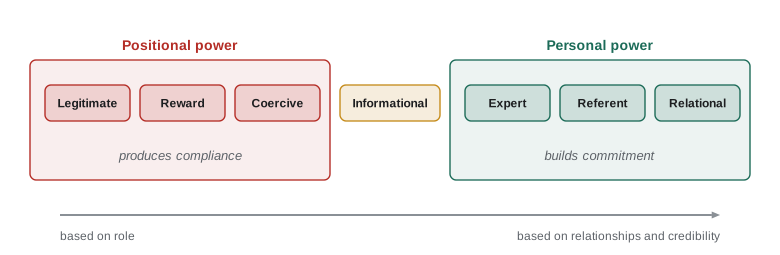
Leaders influence people, and influence rests on power. Power here does not mean domination; it means the capacity to affect what others do. French and Raven's classic model describes five bases of power, and project management texts often add a few more. Project managers frequently have limited formal authority, especially in functional and weak matrix organizations (see PMP-110, lesson 7), so they rely heavily on the personal forms of power.
| Type of power | Where it comes from | Project example | Typical effect |
|---|---|---|---|
| Legitimate (formal) | The position or role | The charter names you project manager | Compliance, as long as the role is respected |
| Reward | Ability to give things people value | Recommending someone for a bonus or a good assignment | Effort, if rewards are fair and valued |
| Coercive (punitive) | Ability to impose negative consequences | Escalating poor performance to a functional manager | Short-term compliance; resentment if overused |
| Expert | Knowledge and skill | You are the one person who understands the data migration | Respect and voluntary cooperation |
| Referent | Being liked, respected or identified with | People want to work with you because of your reputation | Commitment and loyalty |
| Informational | Control of or access to information | You know what the steering committee decided | Influence; can damage trust if hoarded |
| Relational (connection) | Networks and alliances | You can get time with the chief information officer | Access to resources and decisions |
A good rule for exam questions and for practice: personal power (expert, referent, relational) builds commitment; positional power (legitimate, reward, coercive) produces compliance. Commitment means people want to deliver; compliance means they do the minimum required. When a question asks for the best way to gain a team's cooperation, look for answers that build relationships, credibility and shared purpose before answers that rely on authority or threats. Coercive power is not forbidden, but it is usually the last resort, used for issues such as safety violations or ethical breaches.
Worked problem
Choosing a source of power
You are leading a project in a weak matrix organization. A senior database administrator, who reports to the infrastructure manager, keeps putting your tasks last. You cannot assign or discipline her. What power can you use, and how?
Show solution
- Recognize the limits: your legitimate power over her is small, and coercive power (complaining to her manager) would damage the relationship and may not work.
- Use referent and relational power: meet her privately, ask what pressures she is under and show that you understand them.
- Use expert and informational power: explain clearly why her tasks are on the critical path and what the sponsor has said about the deadline.
- Use reward power where you have it: offer recognition in project reports and a positive note to her manager when she delivers.
- Only if this fails, work with her functional manager to agree priorities, framed as solving a resourcing conflict rather than as a complaint.
Answer: Start with personal and informational power and a private conversation; escalate to the functional manager only to resolve a genuine priority conflict, not as punishment.
The Talent Triangle and power skills
PMI's Talent Triangle groups the skills project professionals need into three areas: Ways of Working (the methods and tools of project delivery, predictive, agile and hybrid), Power Skills (interpersonal skills such as collaborative leadership, communication, an innovative mindset, empathy and problem solving), and Business Acumen (understanding the organization, its strategy and its environment). PMP-110 introduced the triangle. This course lives mostly in the Power Skills corner. PMI chose the name "power skills" deliberately to replace "soft skills", because these skills are anything but soft in their effect on outcomes: research published by PMI and others repeatedly links failed projects to poor communication, unclear goals and weak sponsor and team relationships rather than to technical errors.
Power skills also count for certification maintenance. PMP holders earn professional development units (PDUs) in all three Talent Triangle areas, and at the time of writing at least eight of the 35 education PDUs in each three-year cycle must come from each area. A course like this one can contribute to the Power Skills area after you are certified, provided it meets PMI's PDU rules.
Leading with a shared vision
The first People task in the 2026 outline is to develop a common vision. A project vision is a short, memorable statement of what the project will achieve and why it matters. It is not the same as the scope statement, which lists deliverables, or the charter, which authorizes the project. The vision answers the question a team member asks on a bad day: "Why are we doing this?"
A strong vision is concise (one or two sentences), describes an outcome rather than an activity, is meaningful to the people who will use the result, and is specific enough to guide decisions. "Implement the new scheduling system" is an activity. "By next winter, patients in the region will book, change or cancel clinic appointments online in under two minutes, and clinic staff will spend half as much time on the phone" is a vision: it describes the change in people's lives and gives the team a way to test design choices.
Worked problem
Turning a scope into a vision
A charter says: "Replace the legacy warehouse management system with a cloud-based platform and integrate it with the enterprise resource planning (ERP) system." Write a project vision that a picker on the warehouse floor and the chief financial officer would both understand.
Show solution
- Identify who benefits: pickers, supervisors, customers and finance.
- Describe the outcome, not the system: fewer errors, faster orders and accurate stock figures.
- Make it measurable but short.
- Draft: "Every order picked right the first time and shipped the same day, with stock figures finance can trust in real time."
- Test it with a few people from each group and revise wording that does not resonate.
Answer: A vision states the outcome in human terms and can be tested against decisions; the technical scope stays in the scope statement.
The outline lists four enablers for this task: help ensure a shared vision with key stakeholders, promote it, keep it current and break down misunderstandings to find their root cause. In practice the project manager drafts the vision with the sponsor and key stakeholders, often in a kickoff workshop; displays it on the team board, the project site and status reports; revisits it when scope or strategy changes; and investigates when people describe the project in conflicting ways. In adaptive projects the product owner usually owns the product vision, and the project manager or team facilitator helps keep the team connected to it.
When two team members argue about a design, a quick test is to ask which option better serves the vision. When a stakeholder asks for a feature that does not fit, the vision provides a polite, objective reason to discuss it. When the team is tired, a reminder of the people who will benefit can restore energy. A vision that lives only in the charter does none of these things.
Leadership behaviors that matter on projects
Research and practice agree on a handful of leadership behaviors that make the biggest difference on project teams. They do not depend on personality; anyone can learn them.
- Set clear direction: a shared vision, clear objectives and priorities, and visible criteria for success.
- Build trust: be consistent, keep commitments, admit mistakes and share information openly.
- Create psychological safety: make it safe to raise problems, ask questions and disagree without fear of embarrassment or punishment (lesson 5 explores this).
- Empower people: give the team authority to decide how to do its work, within clear boundaries (lesson 4).
- Remove obstacles: treat impediments as your job to clear, not the team's problem to endure.
- Develop people: coach, mentor and give growth opportunities (lesson 7).
- Model the behavior you expect: punctuality, respect, honesty and the PMI Code of Ethics values of responsibility, respect, fairness and honesty.
In US workplaces, these behaviors also connect to legal duties. Federal laws enforced by the Equal Employment Opportunity Commission (EEOC), such as Title VII of the Civil Rights Act and the Americans with Disabilities Act, prohibit discrimination and harassment, and many states add their own requirements. Project managers who supervise people help their organizations meet those obligations.
How the exam tests leadership
PMP questions about people usually describe a situation and offer four plausible actions. Several patterns appear again and again, and recognizing them helps you choose the best answer rather than merely a possible one.
| Pattern | Usually better | Usually weaker |
|---|---|---|
| A team member has a problem | Talk privately, listen first, understand the cause | Reprimand in public; escalate immediately |
| The team disagrees | Facilitate collaboration toward a shared solution | Impose your own decision without discussion |
| Agile or self-organizing team | Support, coach and remove impediments | Assign tasks or dictate the solution |
| A rule or ethical line is broken | Address it directly and promptly, following policy | Ignore it to keep the peace |
| Information is uncertain | Gather facts, assess and analyze first | Act on assumptions |
| Authority is limited | Influence through relationships and shared goals | Wait for someone else to fix it |
Be careful with these patterns: they describe what is usually best, and a scenario can change the answer. If someone is in immediate danger, acting decisively is correct. If a decision is urgent and minor, the project manager may simply decide. The exam rewards judgment, not slogans.
Looking ahead
The rest of the course follows the life of a team. Lesson 2 compares leadership styles and examines servant leadership. Lessons 3 to 5 build and develop the team: acquiring people, agreeing a team charter and helping the team mature. Lessons 6 to 9 sustain it: motivation, coaching, conflict and emotional intelligence. Lessons 10 and 11 deal with distributed teams and performance problems, and lesson 12 brings everything together in a case about a project team in trouble.
Common mistakes
MistakeTreating leadership and management as the same thing.
InsteadManagement runs the systems; leadership aligns and motivates people. Project managers need both.
MistakeRelying on positional authority to get cooperation.
InsteadBuild expert, referent and relational power; they create commitment rather than compliance.
MistakeWriting a vision that is just a restatement of the scope.
InsteadDescribe the outcome for people in a sentence or two that can guide decisions.
MistakeUsing the vision once at kickoff and then forgetting it.
InsteadPromote it, keep it current and use it to resolve disagreements.
MistakeCalling interpersonal skills "soft" and leaving them to chance.
InsteadTreat power skills as learnable and as critical to outcomes as technical skills.
MistakeApplying exam patterns mechanically.
InsteadRead each scenario: urgency, safety and ethics can change the best answer.
Summary and key terms
- Management runs plans, budgets and controls; leadership sets direction and motivates people.
- The People domain is about a third of the July 2026 PMP exam and has eight tasks.
- Power bases include legitimate, reward, coercive, expert, referent, informational and relational.
- Personal power builds commitment; positional power produces compliance.
- The Talent Triangle's Power Skills area covers leadership, communication, empathy and problem solving.
- A project vision states the outcome in human terms and helps the team make decisions.
- Exam questions reward listening, collaboration, empowerment and prompt action on ethics and safety.
- Leadership
- Setting direction and aligning and motivating people to achieve it.
- Management
- Planning, organizing, controlling and reporting to get work done through systems.
- Legitimate power
- Influence that comes from a formal position or role.
- Referent power
- Influence that comes from being respected, liked or identified with.
- Expert power
- Influence that comes from knowledge and skill.
- Coercive power
- Influence that comes from the ability to impose negative consequences.
- Power skills
- PMI's term for interpersonal skills such as leadership, communication and empathy.
- Project vision
- A brief statement of the outcome a project will achieve and why it matters.
- Commitment
- Willing engagement in achieving a goal, beyond what is required.
- Compliance
- Doing what is required because of rules or authority, without personal investment.
Practice problems
Work each problem on paper first, then reveal the answer to check.
Give one activity that is mainly management and one that is mainly leadership.
Show answer
For example, building the cost baseline (management) and agreeing the project vision with the team (leadership).
Which two power bases are most likely to produce commitment?
Show answer
Expert and referent power.
A project manager reminds the team that the charter gives her authority to approve tasks. Which power is she using?
Show answer
Legitimate (formal) power.
What percentage of the July 2026 PMP exam is the People domain?
Show answer
About 33 percent.
Name the three areas of the PMI Talent Triangle.
Show answer
Ways of Working, Power Skills and Business Acumen.
Rewrite "Upgrade the payroll system" as a vision.
Show answer
For example: "Everyone is paid correctly and on time, and payroll staff spend their time helping people rather than fixing errors."
Why might coercive power be appropriate for a safety violation?
Show answer
Because immediate compliance is needed to prevent harm, and policy requires a firm response.
Name four enablers of the "Lead the project team" task.
Show answer
Any four of: establish team expectations, empower the team, solve problems, represent the voice of the team, support varied experiences, choose a leadership style, establish roles and responsibilities.
Two team members argue about a feature. How can the vision help?
Show answer
Ask which option better serves the agreed outcome; it gives an objective basis for the decision.
Which People tasks does PMP-121 mainly cover?
Show answer
Engaging, aligning and managing stakeholders, communication planning, and negotiation and stakeholder conflict.
Lesson quiz · 5 questions
Score 60% or more to complete this lesson.
Create a free account to save your progress, take quizzes and earn a certificate.