
PMP-120 · Lesson 5 of 12 · 31 min
Developing the team: stages, safety and knowledge transfer
Putting capable people together does not automatically produce a capable team. Teams develop: they learn how to work together, build trust, settle disagreements and gradually become more than the sum of their members. Project managers can speed this process or slow it. This lesson goes beyond the brief introduction in PMP-110 to look at how to diagnose a team's stage of development, what high-performing teams have in common, why psychological safety matters so much, how to plan training, and how to ensure knowledge is transferred within the team and beyond it.
Diagnosing the team's stage
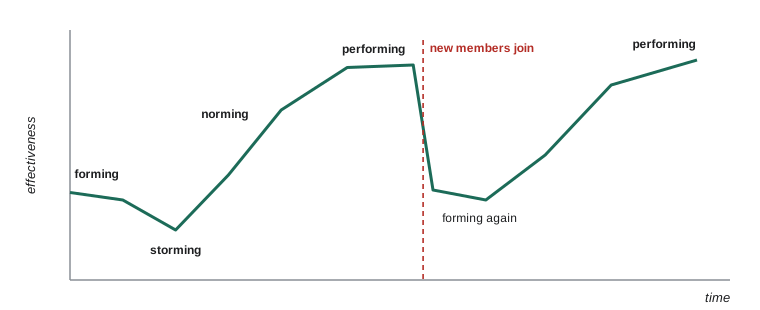
Bruce Tuckman's model, first published in 1965 and extended with a fifth stage in 1977, remains the best-known description of team development: forming, storming, norming, performing and adjourning. Its value for project managers lies less in memorizing the names than in recognizing the signals of each stage and responding appropriately. Teams do not always move neatly forward; a change in membership, leadership, scope or pressure can send a team back to an earlier stage.
| Stage | Typical signals | What the team needs | Project manager focus |
|---|---|---|---|
| Forming | Politeness, uncertainty, questions about purpose and roles, dependence on the leader | Clarity and orientation | Share the vision, clarify roles, start the team charter, build relationships |
| Storming | Disagreement about approach and priorities, challenges to the leader, frustration, cliques | Safe ways to resolve differences | Surface conflict, facilitate resolution, reinforce ground rules, coach |
| Norming | Agreed processes, growing trust, constructive feedback, shared language | Reinforcement and growing responsibility | Step back, delegate more, recognize progress, keep the charter current |
| Performing | High autonomy, rapid problem solving, members cover for each other, focus on results | Freedom and challenge | Remove impediments, protect the team, provide stretch goals and development |
| Adjourning | Attention to wrap-up, mixed feelings, concern about next roles | Closure and recognition | Recognize contributions, capture lessons, support transitions |
Worked problem
Tuckman stage diagnosis
Read each description and name the most likely stage. (a) In a retrospective, team members give each other blunt but respectful feedback and quickly agree changes to their workflow. (b) Two weeks after kickoff, developers and testers argue over whether testing should start before code is complete, and several members privately complain that the project manager is not making decisions. (c) A long-performing team receives three new members and a new product owner; meetings become quiet and members ask what the new priorities are. (d) A team that has worked well for six months now solves problems without the project manager and helps other teams.
Show solution
- (a) Agreed processes and constructive feedback indicate norming, moving toward performing.
- (b) Disagreement about approach and challenges to the leader indicate storming.
- (c) A large change in membership and leadership has sent the team back to forming: uncertainty and questions about purpose.
- (d) Autonomy and helping others indicate performing.
Answer: (a) Norming; (b) storming; (c) forming again after the change; (d) performing. Responses differ: clarity for forming, facilitation for storming, delegation for norming and protection and challenge for performing.
Other models complement Tuckman. The Drexler/Sibbet team performance model describes seven stages from orientation and trust building through goal clarification, commitment, implementation and high performance to renewal. Katzenbach and Smith distinguish working groups, pseudo-teams, potential teams, real teams and high-performance teams, arguing that a real team has a small number of people with complementary skills, a common purpose, performance goals and an approach for which they hold themselves mutually accountable. These models agree on the essentials: clear purpose, trust, agreed ways of working and mutual accountability.
What high-performing teams have in common
PMI material and team research converge on a set of characteristics that distinguish high-performing teams. They include open communication, shared understanding of goals, shared ownership of outcomes, trust, collaboration, adaptability, resilience, empowerment and recognition. Google's Project Aristotle study of its own teams, published in 2015, found that the most important factor was psychological safety, followed by dependability, structure and clarity, meaning (the work is personally important) and impact (the work matters).
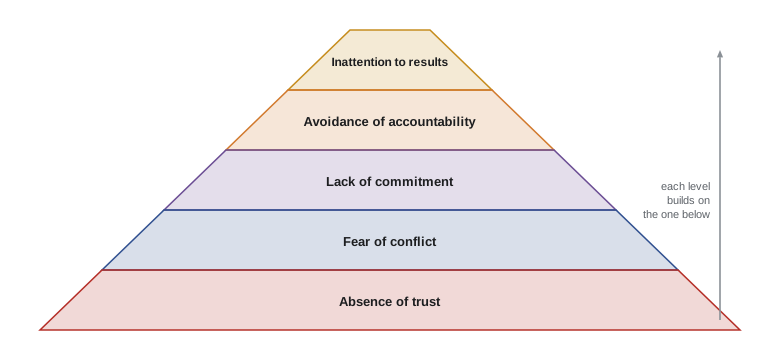
Patrick Lencioni's model of the five dysfunctions of a team offers the reverse view. It describes a pyramid of problems, each building on the one below: absence of trust, fear of conflict, lack of commitment, avoidance of accountability and inattention to results. A team that does not trust its members avoids honest debate, so its decisions are not really bought into, so people do not hold each other to account, so individual or departmental goals take precedence over team results. The model is popular because it gives leaders a sequence to work on: build trust first.
Psychological safety
Amy Edmondson defines psychological safety as a shared belief that the team is safe for interpersonal risk taking. In a psychologically safe team, people can ask questions, admit mistakes, raise concerns and offer half-formed ideas without fear of being embarrassed, rejected or punished. It is not the same as being nice, lowering standards or avoiding disagreement. Edmondson's research found that high-performing hospital teams reported more errors, not fewer, because they felt safe to report them; the errors were caught and learned from.
Psychological safety matters especially on projects, where uncertainty is high and early warning of problems is valuable. A team member who fears blame will hide the fact that a component is behind schedule until it is too late to recover. A team that is safe will raise it at the stand-up while there is still time to help.
| Low psychological safety | High psychological safety |
|---|---|
| Status reports are always green until suddenly red | Problems surface early, while there is time to act |
| People stay quiet in meetings, then complain afterward | People disagree openly in meetings and commit to decisions |
| Mistakes are hidden or blamed on others | Mistakes are reported and treated as learning |
| Only senior people propose ideas | Ideas come from everyone, including new members |
| Questions are seen as weakness | Questions are seen as contributions |
Project managers build psychological safety through specific behaviors. Frame the work as a learning problem: "This is new for all of us, and we will need everyone's eyes on it." Acknowledge your own fallibility: "I may be missing something; what do you see?" Model curiosity by asking lots of questions. Respond productively when people raise problems: thank them, focus on the issue rather than the person and act on it. Use blameless reviews that ask what in the system allowed a problem to occur, not who caused it. And deal firmly with behavior that undermines safety, such as ridicule or interruption.
Worked problem
Responding to bad news
At a stand-up, a junior developer says, "I think I broke the build last night. I pushed a change without running the integration tests." The team lead sighs loudly and says, "Again?" How should the project manager respond, during and after the meeting?
Show solution
- During the meeting: thank the developer for raising it promptly ("Thanks for flagging that straight away; it means we can fix it fast"), and focus on the fix: "Who can pair on this after stand-up?"
- After the meeting, privately with the team lead: describe the effect of the sigh and comment ("When people get that reaction, they stop reporting problems") and ask for help in making reporting safe.
- With the team, later: hold a short blameless review. Why could a change reach the build without integration tests? Perhaps the pipeline should run them automatically.
- Follow up: implement the safeguard and recognize the team for improving the process.
Answer: Reward the disclosure, fix the problem, coach the team lead privately and improve the system so the mistake is harder to repeat.
Training and development
Training is one of the most direct ways to develop a team. It can address gaps found in the skills matrix (lesson 3), prepare people for new tools or methods, meet compliance requirements and support individual career goals. Training can be formal (classroom, online courses, certifications) or informal (pairing, job shadowing, mentoring, lunch-and-learns, communities of practice). On projects, informal methods are often faster and more relevant, while formal training suits regulated or highly technical skills.
Plan training in the resource management plan, including who needs what, when, how it will be delivered and how much it will cost. Time training so it happens just before the skill is needed: too early and people forget; too late and they learn on the job under pressure. Remember that training costs are project costs if the skill is needed specifically for the project; general development may be funded by functional departments.
Worked problem
Planning just-in-time training
Your project will move to a new automated testing framework in month 4. Five testers need to learn it. Options: (A) a three-day vendor course for all five in month 1 at $1,800 per person; (B) a one-day course for two testers in month 3 at $900 per person, then those two coach the others through pairing in month 4. Which would you choose, and why?
Show solution
- Option A costs 5 × $1,800 = $9,000 and happens three months before use, so much will be forgotten.
- Option B costs 2 × $900 = $1,800 in fees plus the coaching time of two testers in month 4. The training is close to use and builds internal coaching capacity.
- Consider risk: if the framework is critical and complex, two trained people may not be enough. A middle path is three people trained in month 3.
- Consider development: coaching others also develops the two lead testers.
Answer: Option B (or a variation) is usually better: just-in-time, cheaper and it builds internal expertise, provided enough people are trained to cover the risk.
Knowledge transfer
The ECO task "help ensure knowledge transfer" has three enablers: identify knowledge critical to the project, gather knowledge and foster an environment for knowledge transfer. Knowledge is often described as explicit (it can be written down, such as procedures, designs and lessons learned) or tacit (it lives in people's heads and is hard to express, such as judgment, relationships and know-how). Explicit knowledge can be transferred through documents and repositories; tacit knowledge needs interaction, such as pairing, mentoring, storytelling and communities of practice.
| Technique | Best for | Example |
|---|---|---|
| Pairing and shadowing | Tacit skills and judgment | A junior analyst sits in on the senior analyst's requirements workshops |
| Documentation and wikis | Explicit procedures and decisions | An architecture decision record explains why the team chose a message queue |
| Lessons learned register | Experience from this and past projects | Recording that early security reviews avoided rework |
| Communities of practice | Sharing across projects | A monthly meeting of all test leads in the organization |
| Storytelling and demos | Context and culture | A sprint review where the team explains how it solved a hard problem |
| Handover sessions | Transitions | A departing engineer walks a successor through the system before leaving |
Knowledge transfer is not only an end-of-project activity. Lessons learned should be captured throughout the project, not just at closure when people have forgotten the details and are already moving on. Agile retrospectives make this routine. Knowledge transfer also flows outward: to operations teams who will support the product, to users who will adopt it and to future projects through the organization's process assets. PMP-131 covers the process side of knowledge management; here the focus is the environment. People share knowledge when they trust each other, when sharing is recognized and when they have time to do it.
Knowledge transfer can have legal dimensions. On US federal and state projects, records about decisions may be subject to records management requirements and freedom of information laws, so decision records should be accurate and stored in approved repositories. Where contractors leave a project, contract terms on data rights and documentation should be checked before they go.
Team-building activities
Team-building activities range from a coffee chat at kickoff to a day-long offsite. They help most in the forming and storming stages, when people are getting to know each other, and when they are tied to real work. A workshop where the team builds its charter is team building; so is a joint problem-solving session or a celebration after a milestone. Forced fun that ignores people's preferences or excludes some members, for example evening drinks that parents and non-drinkers cannot comfortably attend, can do more harm than good. Ask the team what it values and vary the activities.
Co-location is the traditional way to build team cohesion: placing members in the same physical space, sometimes in a dedicated team room (a "war room" or "obeya"). It supports informal communication and rapid problem solving. When co-location is not possible, lesson 10 discusses how to build the same connections virtually.
Common mistakes
MistakeAssuming a team progresses steadily through the Tuckman stages.
InsteadExpect regression when members, leaders or priorities change, and respond to the current stage.
MistakeEquating psychological safety with being nice or lowering standards.
InsteadPsychological safety enables candour and high standards by making it safe to raise problems.
MistakeReacting to bad news with blame.
InsteadThank people for raising problems, fix the issue and improve the system.
MistakeScheduling training long before the skill is needed.
InsteadPlan just-in-time training so skills are fresh when used.
MistakeCapturing lessons learned only at project closure.
InsteadCapture them throughout, for example in retrospectives.
MistakeRelying on documents to transfer tacit knowledge.
InsteadUse pairing, mentoring and storytelling for tacit knowledge.
Summary and key terms
- Tuckman's stages are forming, storming, norming, performing and adjourning; teams can regress.
- Each stage calls for a different project manager focus, from clarity to facilitation to delegation.
- High-performing teams share trust, clear goals, open communication, shared ownership and empowerment.
- Lencioni's five dysfunctions start with absence of trust and end with inattention to results.
- Psychological safety is the belief that it is safe to take interpersonal risks; it enables early problem reporting.
- Plan training just in time and use informal methods such as pairing where they fit.
- Knowledge transfer requires identifying critical knowledge and matching techniques to explicit or tacit knowledge.
- Tuckman ladder
- A model of team development: forming, storming, norming, performing and adjourning.
- Psychological safety
- A shared belief that the team is safe for interpersonal risk taking.
- High-performing team
- A team with trust, shared goals, open communication and mutual accountability that consistently delivers results.
- Blameless review
- A review that examines how the system allowed a problem, rather than who is at fault.
- Explicit knowledge
- Knowledge that can be written down and shared through documents.
- Tacit knowledge
- Knowledge based on experience and judgment that is hard to express in writing.
- Community of practice
- A group of people who share a profession or interest and learn from each other.
- Co-location
- Placing team members in the same physical location.
- Lessons learned register
- A project document that records knowledge gained during the project.
- Just-in-time training
- Training delivered shortly before the skill is needed.
Practice problems
Work each problem on paper first, then reveal the answer to check.
Name the five Tuckman stages in order.
Show answer
Forming, storming, norming, performing, adjourning.
A team argues about roles and challenges the leader. Stage?
Show answer
Storming.
What usually causes a performing team to regress?
Show answer
Significant changes, such as new members, a new leader or a major change in direction.
What is the base of Lencioni's pyramid?
Show answer
Absence of trust.
Define psychological safety in one sentence.
Show answer
A shared belief that the team is safe for interpersonal risk taking.
Give two leader behaviors that build psychological safety.
Show answer
For example, acknowledging your own fallibility and thanking people who raise problems.
Which knowledge type needs pairing or mentoring to transfer?
Show answer
Tacit knowledge.
Why should lessons learned be captured throughout the project?
Show answer
Details are fresher, and lessons can be applied while the project is still running.
Five people at $1,200 each versus two at $700 each: what is the fee difference?
Show answer
$6,000 − $1,400 = $4,600.
Name one risk of team-building activities.
Show answer
They can exclude or alienate people if they ignore preferences, for example evening drinking events.
Lesson quiz · 5 questions
Score 60% or more to complete this lesson.
Create a free account to save your progress, take quizzes and earn a certificate.