
PMP-120 · Lesson 2 of 12 · 28 min
Leadership styles and servant leadership
No single leadership style works for every team, every stage of a project or every crisis. A style that energizes an experienced agile team can leave a new graduate lost; a style that rescues a failing project in a week can exhaust a healthy team in a month. The ECO asks project managers to "determine an appropriate leadership style", which means knowing the main styles, recognizing the signals that call for each and being able to shift deliberately. This lesson surveys the styles PMP candidates meet most often and then looks closely at servant leadership, the style most associated with agile and hybrid delivery.
From traits to situations
Leadership theory has moved through several waves. Early trait theories asked what personal qualities leaders share, such as intelligence, confidence and integrity. They found some correlations but could not explain why the same person led well in one setting and poorly in another. Behavioral theories, such as the Ohio State and Michigan studies, looked instead at what leaders do and identified two broad dimensions: task-oriented behavior (organizing work, setting standards) and people-oriented behavior (supporting, building relationships). Contingency and situational theories then argued that the best mix depends on the situation: the people, the task and the context. Modern approaches, such as transformational and servant leadership, add an emphasis on purpose, values and developing others.
For project managers, the practical message is that style is a choice. You can read the situation and adjust. The main factors are the team's competence and experience with the task, its commitment and confidence, the urgency and risk of the situation, the organizational culture and the development approach (predictive, adaptive or hybrid).
A catalog of styles
| Style | What the leader does | Works well when | Risks |
|---|---|---|---|
| Directive (autocratic) | Decides and tells; close supervision | Emergencies, safety issues, very inexperienced teams | Low engagement; good ideas lost; dependence on the leader |
| Laissez-faire | Steps back and lets the team decide almost everything | Highly skilled, motivated, self-directed experts | Drift, confusion and unresolved conflict if the team is not ready |
| Democratic (participative) | Involves the team in decisions; seeks consensus or votes | Complex problems needing many perspectives; building buy-in | Slow decisions; may avoid hard choices |
| Transactional | Sets goals and exchanges rewards or corrections for performance | Routine work with clear standards; contract-based teams | Little innovation; motivation limited to rewards |
| Transformational | Inspires with vision, challenges thinking, attends to individuals | Change, innovation, uncertain environments | Can depend on the leader's charisma; may neglect detail |
| Charismatic | Energizes through personal presence and conviction | Rallying people through difficult change | Followers may follow the person rather than the goal |
| Servant | Puts the team's needs first; removes obstacles; develops people | Self-organizing and agile teams; knowledge work | Can be misread as passivity; needs organizational support |
| Interactional | Combines transactional, transformational and charismatic elements | Many project situations | Requires judgment about when to use which element |
| Situational | Adapts directing and supporting behavior to each person's readiness | Mixed-experience teams; changing tasks | Requires accurate diagnosis of readiness |
Two pairs are easily confused. Transactional leadership is an exchange: do this and you get that, with management by exception when things go wrong. Transformational leadership raises people's sights: it connects work to a larger purpose and develops individuals. Bass described four components of transformational leadership, often called the four I's: idealized influence (acting as a role model), inspirational motivation (a compelling vision), intellectual stimulation (encouraging people to question assumptions) and individualized consideration (attending to each person's needs). Most effective project managers use transactional tools, such as clear objectives and recognition for meeting them, inside a transformational frame.
Situational leadership
Hersey and Blanchard's situational leadership model, later developed by Blanchard as Situational Leadership II, is one of the most practical tools for project managers. It describes four styles produced by combining two kinds of leader behavior: directive behavior (telling people what, when and how) and supportive behavior (listening, encouraging and involving). The right combination depends on the follower's development level for a particular task, which combines competence (skill and knowledge) and commitment (motivation and confidence).
| Development level | Typical description | Matching style | Leader behavior |
|---|---|---|---|
| D1: low competence, high commitment | Enthusiastic beginner | S1 Directing | High direction, low support: clear instructions and close follow-up |
| D2: some competence, low commitment | Disillusioned learner | S2 Coaching | High direction, high support: explain decisions, encourage, answer questions |
| D3: moderate to high competence, variable commitment | Capable but cautious contributor | S3 Supporting | Low direction, high support: listen, involve, build confidence |
| D4: high competence, high commitment | Self-reliant achiever | S4 Delegating | Low direction, low support: hand over responsibility and stay available |
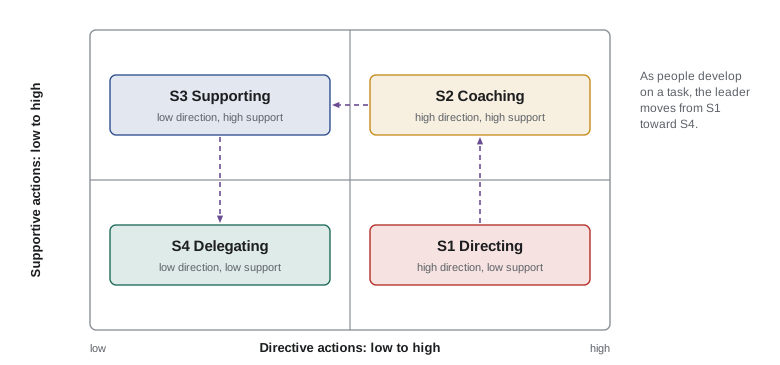
The key insight is that development level is task-specific. A senior developer may be D4 on coding and D1 on presenting to the board. Treating that person as a self-reliant achiever on the board presentation sets them up to fail; treating them as a beginner on code insults them. Effective project managers diagnose each person on each important task, agree the style openly, and move toward delegating as people grow.
Worked problem
Diagnosing development levels
Three people join your project. Amira, a new graduate, is excited to write her first test scripts but has never used the test tool. Ben, a capable analyst, has written requirements before but is anxious because his last project's requirements were heavily criticized. Chen is an experienced architect who has designed three similar systems. Which style suits each person for their main task?
Show solution
- Amira: low competence on this task, high commitment: D1. Use directing: show her the tool, give step-by-step guidance, check her first scripts closely.
- Ben: good competence but shaken confidence: D3. Use supporting: involve him in decisions, listen to his concerns, praise good work, provide little instruction.
- Chen: high competence and commitment: D4. Use delegating: agree outcomes and constraints, then let him decide how to design, and stay available.
- Plan to revisit: Amira may hit a D2 dip when the work gets harder, needing coaching rather than more instructions.
Answer: Amira S1 directing, Ben S3 supporting, Chen S4 delegating, with regular reassessment as each person develops.
Servant leadership
Robert Greenleaf introduced the term servant leadership in a 1970 essay. His test was whether those served grow as persons: do they become healthier, wiser, freer and more autonomous? In project management, servant leadership has become closely associated with agile teams, where the team facilitator (for example a Scrum Master) is described as a servant leader. PMI's Agile Practice Guide and the PMBOK Guide describe the servant leader as someone who focuses on understanding and addressing the needs and development of team members to enable the highest possible team performance.
Servant leadership is not doing whatever the team asks, and it is not passive. A servant leader still holds standards, protects the vision and makes hard calls. The difference is the direction of service: instead of the team serving the leader's plan, the leader serves the team's ability to deliver value. Practical behaviors include:
- Removing impediments: chasing approvals, resolving tool problems, getting access to people and data.
- Shielding the team: protecting it from constant interruptions and changes in priority that bypass agreed channels such as the product owner or change control.
- Facilitating rather than dictating: running meetings so that the team reaches its own decisions.
- Coaching and developing: helping people build skills and grow into more responsibility.
- Listening first: understanding problems from the team's perspective before proposing solutions.
- Encouraging self-organization: letting the team decide how to do its work and who does what.
- Building a culture of trust, safety and continuous improvement.
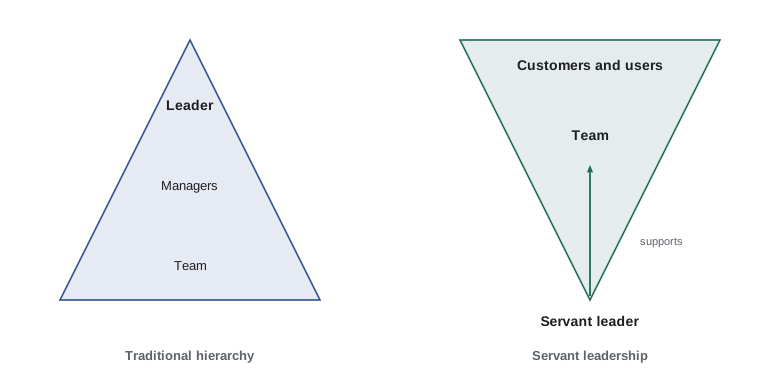
Larry Spears, drawing on Greenleaf's writing, listed ten characteristics of servant leaders: listening, empathy, healing, awareness, persuasion, conceptualization, foresight, stewardship, commitment to the growth of people, and building community. You do not need to memorize the list for the exam, but it captures the spirit: servant leaders persuade rather than coerce, think about the long term and take responsibility for the wellbeing of the group.
Worked problem
What would a servant leader do?
An agile team's daily stand-up reveals that the testers have been waiting three days for access to a test environment controlled by another department. The team has emailed twice. A senior manager has also started dropping by to ask individual developers for "quick favors". What should the servant leader do?
Show solution
- Treat the environment access as an impediment that is the leader's job to remove: contact the other department's manager directly, explain the impact and agree a date, escalating if needed.
- Protect the team's focus: speak privately with the senior manager, explain how unplanned requests disrupt the sprint, and redirect requests to the product owner for prioritization.
- Report back to the team so they know the impediment is being handled.
- Raise both issues at the retrospective so the team can suggest preventive measures, such as requesting environments earlier.
Answer: Remove the impediment personally and shield the team from bypassed priorities, while keeping the team informed and involved in prevention.
Choosing and blending styles
Experienced project managers blend styles rather than choosing one forever. They may be directive during a production outage, democratic in a design workshop, transactional when managing a fixed-price supplier and servant-oriented with a mature agile team, all in the same week. The skill lies in reading the signals and switching deliberately, and in explaining the switch: "Normally I'd want everyone's input, but the system is down and customers can't pay, so for the next hour I'm going to make the calls."
| Signal | Style that often fits |
|---|---|
| Immediate danger, crisis or very tight deadline with a clear solution | Directive, explained afterward |
| New or inexperienced team members on a task | Directing or coaching |
| Skilled team, complex problem, need for buy-in | Democratic or supporting |
| Self-organizing agile team | Servant leadership; delegating |
| Large organizational change, uncertain future | Transformational |
| Routine work with clear standards or a contract | Transactional, within a supportive relationship |
| Expert team that resents oversight | Delegating or laissez-faire with clear outcomes |
Development approach matters too. Predictive projects often place more decision authority with the project manager, and a blend of transactional and transformational leadership is common. Adaptive projects distribute decisions: the product owner decides what to build, the team decides how, and the team facilitator serves both. Hybrid projects require the project manager to shift between these modes, sometimes on different work streams at the same time (PMP-140 covers agile roles in detail).
Organizational culture also shapes what styles people expect. US workplaces generally reward individual initiative and fairly direct communication, but expectations differ across industries, between unionized and non-unionized environments, and across the cultural backgrounds of team members. In unionized settings, the collective bargaining agreement may also define how work is assigned and how performance concerns are handled.
Leadership on the exam
When a PMP question describes a self-organizing or agile team, answers in which the project manager assigns tasks or tells people how to do the work are almost always weaker than answers in which the project manager coaches, facilitates or removes impediments. When a question describes a crisis or safety threat, decisive direction is appropriate. When a question describes a team member who is new to a task, providing direction and training is appropriate; when it describes a capable but unsure person, support and encouragement fit better. Look for clues about competence, commitment, urgency and approach, and choose the style that fits.
Common mistakes
MistakeBelieving there is one best leadership style.
InsteadChoose the style that fits the people, the task, the urgency and the approach, and shift as these change.
MistakeTreating servant leadership as passive or as doing whatever the team wants.
InsteadServant leaders hold standards and protect the vision while serving the team's ability to deliver.
MistakeDiagnosing a person's development level once for all tasks.
InsteadDevelopment level is task-specific; reassess for each important task.
MistakeDelegating to an enthusiastic beginner because they seem keen.
InsteadHigh commitment without competence needs direction and training first.
MistakeAssigning tasks to members of a self-organizing team.
InsteadLet the team decide how to do its work; coach and remove impediments instead.
MistakeSwitching styles without explanation.
InsteadTell the team why you are being more directive or more hands-off in this situation.
Summary and key terms
- Leadership theory moved from traits to behaviors to situational and values-based approaches.
- Common styles include directive, laissez-faire, democratic, transactional, transformational, charismatic, servant, interactional and situational.
- Transformational leadership uses idealized influence, inspirational motivation, intellectual stimulation and individualized consideration.
- Situational leadership matches directing, coaching, supporting or delegating to each person's development level on a task.
- Servant leaders remove impediments, shield the team, facilitate, coach and encourage self-organization.
- Effective project managers blend styles deliberately and explain their choices.
- Transactional leadership
- Leading by setting goals and exchanging rewards or corrections for performance.
- Transformational leadership
- Leading by inspiring people with a vision and developing them to exceed expectations.
- Servant leadership
- Leading by putting the team's needs and growth first so it can perform at its best.
- Situational leadership
- Adapting directive and supportive behavior to each person's development level.
- Development level
- A person's combination of competence and commitment for a specific task.
- Laissez-faire
- A hands-off style in which the leader leaves most decisions to the team.
- Directive style
- A style in which the leader decides and gives instructions, with close supervision.
- Impediment
- An obstacle that slows or blocks the team's progress.
- Self-organizing team
- A team that decides for itself how to do its work and who does what.
- Interactional leadership
- A blend of transactional, transformational and charismatic leadership.
Practice problems
Work each problem on paper first, then reveal the answer to check.
Name the two dimensions of leader behavior in situational leadership.
Show answer
Directive behavior and supportive behavior.
Which style fits a skilled person who has lost confidence?
Show answer
Supporting (S3): low direction, high support.
What did Greenleaf propose as the test of servant leadership?
Show answer
Whether those served grow as persons and become healthier, wiser, freer and more autonomous.
Name the four I's of transformational leadership.
Show answer
Idealized influence, inspirational motivation, intellectual stimulation and individualized consideration.
A data center is on fire. Which style fits?
Show answer
Directive: make clear, fast decisions, then explain and debrief afterward.
Give two behaviors of a servant leader.
Show answer
For example, removing impediments and shielding the team from interruptions.
What is the main risk of laissez-faire leadership with a new team?
Show answer
Drift, confusion and unresolved conflict because the team is not ready to direct itself.
Why is transactional leadership often combined with transformational leadership?
Show answer
Clear goals and rewards provide structure, while vision and development provide motivation and growth.
In an agile team, who decides how the work is done?
Show answer
The team itself.
An enthusiastic intern has never used the scheduling tool. Which style fits?
Show answer
Directing (S1): clear instructions and close follow-up.
Lesson quiz · 5 questions
Score 60% or more to complete this lesson.
Create a free account to save your progress, take quizzes and earn a certificate.